
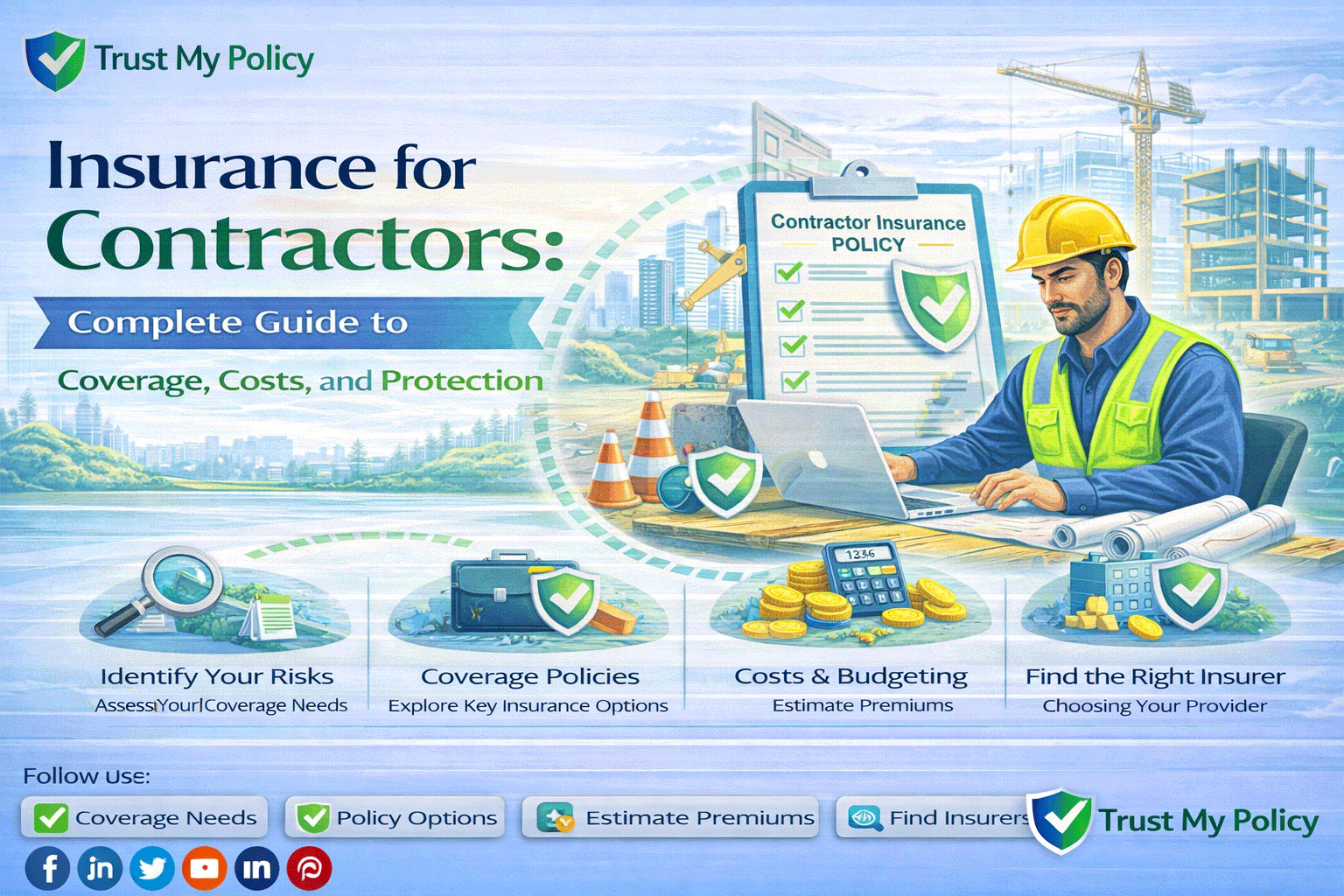
Contractors need general liability insurance with products-completed operations coverage, since many basic policies exclude problems that surface after a job is finished. Beyond that, most contractors also need tools and equipment coverage, workers’ compensation if they have employees or use subcontractors, commercial auto insurance for work vehicles, and often a surety bond required by clients or local permitting authorities.
Walter Higgins, 47, ran a small general contracting business in Denver for over a decade and assumed his standard general liability policy covered every aspect of his work, until a kitchen renovation he completed caused a water leak eight months later. He learned that his basic policy excluded products-completed operations coverage entirely, the exact gap that left him personally exposed for the repair costs.
Insurance for Contractors in 2026 needs to cover several distinct risks beyond basic liability: general liability with products-completed operations coverage for problems that surface after a job is done, tools and equipment coverage for theft or damage, workers’ compensation for any employees or subcontractors, commercial auto for work vehicles, and often a surety bond required by clients or permitting authorities. This guide breaks down exactly which coverage matters for your specific trade and project size.
This article covers the core coverage contractors need, what’s commonly excluded from generic policies, real scenarios with specific dollar figures, and a clear framework for building out a complete coverage stack. By the end, you’ll know exactly what gap nearly caught Walter off guard.
| Feature | Details |
| What it is | A combination of liability, equipment, workers’ comp, auto, and bonding coverage for contracting work |
| Who needs it | General contractors, specialty trades (electrical, plumbing, roofing), and subcontractors |
| Typical cost | $1,000–$5,000+/year depending on trade, revenue, and coverage limits |
| Key coverage gap | Products-completed operations coverage, often excluded from basic or generic liability policies |
| Key benefit | Protects against the most common and most financially severe contractor-specific risks |
| Key limitation | Generic small business policies frequently exclude specific trades entirely |
| Regulator | State insurance departments and state licensing boards (US); Financial Conduct Authority (UK) |
Think of contractor insurance like building a house with multiple distinct systems: plumbing, electrical, structural, and roofing each need their own dedicated protection, and missing just one system can compromise the whole project. Contractor insurance works the same way, requiring several distinct coverage types working together rather than one generic policy covering everything.
Contractors need general liability insurance specifically including products-completed operations coverage, which protects against problems that surface after a job is finished, a frequently excluded gap in basic policies. Tools and equipment coverage protects against theft or damage to the often expensive equipment contractors rely on daily. Workers’ compensation becomes necessary with any employees, and many states also require coverage for certain subcontractor relationships. Commercial auto insurance covers work vehicles, since personal auto policies typically exclude business use. Many contractors also need a surety bond, a distinct financial guarantee often required by clients or local permitting authorities. Anyone in a contracting trade needs to build out this full combination rather than assuming a single generic policy covers everything.
| Criteria | General Liability Alone | Full Contractor Coverage Stack |
| Coverage scope | Third-party injury and property damage only, possibly excluding completed work | Liability (with completed operations), tools, workers’ comp, auto, and bonding |
| Common gap | Products-completed operations often excluded by default | Specifically confirmed and included as part of the stack |
| Cost | $500–$1,500/year | $1,000–$5,000+/year depending on trade and team size |
| Pros | Lower cost, simpler to set up | Closes the most common and most financially severe contractor-specific gaps |
| Cons | Leaves significant exposure for completed work, tools, and vehicles | Higher combined cost, requires coordinating multiple policies |
We recommend the full contractor coverage stack for most readers, since the products-completed operations gap alone, as Walter’s experience shows, can result in significant uncovered repair costs.
Scenario 1: Walter, 47, general contractor in Denver. Walter’s basic general liability policy excluded products-completed operations coverage, leaving him personally exposed for a water leak repair eight months after a kitchen renovation. Verdict: this is one of the most commonly overlooked exclusions in contractor liability policies. Action: Walter switched to a policy specifically confirmed to include products-completed operations coverage for all his project types.
Scenario 2: An electrician in Manchester whose van and tools were stolen overnight. His basic general liability policy didn’t cover the stolen tools at all, since this required a separate tools and equipment policy. Verdict: tools and equipment require dedicated coverage, separate from general liability. Action: he added a tools and equipment policy covering his full inventory at replacement cost.
Scenario 3: A roofing contractor in Houston using two subcontractors on a large project. A subcontractor’s injury during the project raised a workers’ compensation question, since state rules on subcontractor coverage requirements varied by the specific work arrangement. Verdict: subcontractor coverage rules require careful attention, since they vary by state and arrangement. Action: the contractor confirmed his state’s specific requirements and adjusted his coverage and subcontractor agreements accordingly.
Scenario 4: A landscaping contractor in Leeds required to provide a performance bond before starting a large municipal project. The bond, a distinct financial guarantee from his general liability insurance, was required by the local authority before work could begin. Verdict: bonding requirements are common for larger or municipal contracting projects, separate from standard insurance. Action: the contractor secured the bond through a specialized surety provider ahead of the project start date.
| Pros | Cons |
| Products-completed operations coverage closes one of the most financially severe common gaps. | Coordinating multiple policy types requires more research and ongoing management. |
| Tools and equipment coverage protects against a genuinely common and costly theft risk. | Combined premiums are meaningfully higher than a single basic liability policy. |
| Commercial auto insurance avoids a denied claim from undisclosed business vehicle use. | Subcontractor-related coverage rules vary significantly by state, requiring careful attention. |
| Surety bonds satisfy client and permitting requirements separate from insurance. | Bonding requires a separate application and underwriting process from standard insurance. |
| A complete stack significantly reduces the risk of a costly, uncovered claim. | Generic small business policies often don’t address trade-specific needs at all. |
⚠️ WARNING: Never assume your general liability policy covers problems that arise after a project is completed. Products-completed operations coverage is a distinct, often excluded coverage part, and confirming it’s included is one of the single most important checks any contractor can make.
| Your Situation | Our Recommendation |
| You haven’t confirmed products-completed operations coverage is included | Yes — confirm this with your insurer immediately, regardless of how long you’ve held the policy |
| You own significant tools or equipment | Yes — add a dedicated tools and equipment policy at replacement cost |
| You have employees or use subcontractors | Yes — confirm your state’s specific workers’ compensation requirements for each arrangement |
| You use any vehicle regularly for contracting work | Yes — add commercial auto insurance, even if the vehicle is also used personally |
| You’re bidding on a larger or municipal project | Yes — research bonding requirements well before submitting your bid |
| You’re using a generic small business policy without trade-specific review | Yes — confirm your specific trade isn’t subject to an exclusion in the policy |
| You haven’t reviewed your coverage stack in over a year | Yes — review it now, especially if your project sizes or team have grown |
💡 TIP: The single golden rule for contractor insurance: confirm products-completed operations coverage is explicitly included in your policy, since this single gap is responsible for some of the most costly uncovered contractor claims.
| Scenario | Typical Annual Cost | Notes |
| General liability with products-completed operations, small contractor | $1,200–$3,000/year | Reflects appropriately complete coverage for most trades |
| Tools and equipment coverage, moderate inventory | $300–$800/year | Varies based on total replacement value of tools and equipment |
| Workers’ compensation, 3-employee contracting business | $2,000–$6,000/year | Varies significantly by specific trade risk classification |
| Commercial auto insurance, single work vehicle | $1,200–$2,500/year | Higher than personal auto due to business-use risk |
| Surety bond, mid-sized municipal project | 1%–3% of the bond amount annually | A financial guarantee, distinct from standard insurance premium |
| Full coverage stack, small general contracting business | $4,000–$10,000+/year | Includes liability, tools, workers’ comp, and auto combined |
| UK contractors’ public liability and tools insurance combined | £400–£1,200/year | UK equivalent combined coverage for similar trades |
The Hartford and Hiscox (US) — Offer contractor-specific liability and tools coverage with clear products-completed operations guidance. Cost range: competitive small business pricing. Best for: US contractors wanting trade-specific policy forms. Rating: AM Best A.
NEXT Insurance (US) — Provides fast, industry-tailored contractor policies through a streamlined online application. Cost range: competitive small business pricing. Best for: US contractors wanting a quick, trade-specific quote. Rating: backed by AM Best-rated carrier partners.
Simply Business (UK) — A UK comparison platform specializing in contractor and tradesperson insurance across many specific trades. Cost range: free to compare. Best for: UK contractors wanting industry-specific comparison quotes. Rating: FCA-regulated comparison service.
Surety bond providers (specialty US and UK carriers) — Offer the specific bonding products required for larger or municipal contracting projects. Cost range: 1%–3% of the bond amount annually. Best for: contractors bidding on bonded projects. Rating: varies by provider, check licensing.
Independent insurance brokers specializing in contractors — Brokers experienced specifically with contracting trades can confirm whether your policy includes products-completed operations and other trade-specific needs. Cost range: typically free for the consumer. Best for: any contractor wanting a thorough trade-specific review. Rating: varies by broker, check licensing.
We recommend The Hartford or Hiscox as best overall because both offer contractor-specific policy forms with clear products-completed operations coverage, the exact gap that catches many contractors off guard.
Contractors typically need general liability insurance with products-completed operations coverage, tools and equipment coverage, workers’ compensation, commercial auto insurance, and often a surety bond for larger projects.
This coverage protects against claims that arise after a job is finished, when a problem like a leak or structural issue surfaces later, a frequently excluded gap in basic liability policies.
Yes, typically. Tools and equipment usually require a dedicated policy, since general liability and standard property insurance often don’t adequately cover this specific exposure.
No, in most cases. Personal auto policies typically exclude regular business use, even for a vehicle also used personally, requiring a separate commercial auto policy.
A surety bond is a financial guarantee, distinct from traditional insurance, often required by clients or local permitting authorities for larger or municipal contracting projects.
This depends on your specific state’s rules and the nature of the subcontractor relationship, so it’s important to confirm your exact requirements rather than assuming subcontractors are automatically excluded.
A full coverage stack for a small general contracting business typically costs $4,000 to $10,000 or more annually, depending on trade, team size, and coverage limits.
This is most likely because your policy excludes products-completed operations coverage, a common gap that needs to be specifically confirmed and added if missing.
Yes, definitely. Bonding requirements should be confirmed well before submitting a bid, since the application and underwriting process for a surety bond takes time.
Yes, this is common. Generic policies often exclude specialized trades, making it important to confirm your specific trade isn’t subject to an exclusion before relying on the policy.
This article is for informational purposes only. Always consult a licensed insurance professional before making coverage decisions. Trust My Policy does not sell insurance products or represent any insurer.

Jagadeesh Gutha is the founder of TrustMyPolicy.com, an independent insurance information platform covering life, health, car, home, and business insurance for US and UK readers. He researches insurance products, policy structures, and consumer rights to help everyday people make informed coverage decisions without the jargon. All content on TrustMyPolicy is independently researched, fact-checked, and written to educate — not to sell.



Insurance Guides for UK, USA & Worldwide We are not an insurer or broker.

Reader Comments (0)