
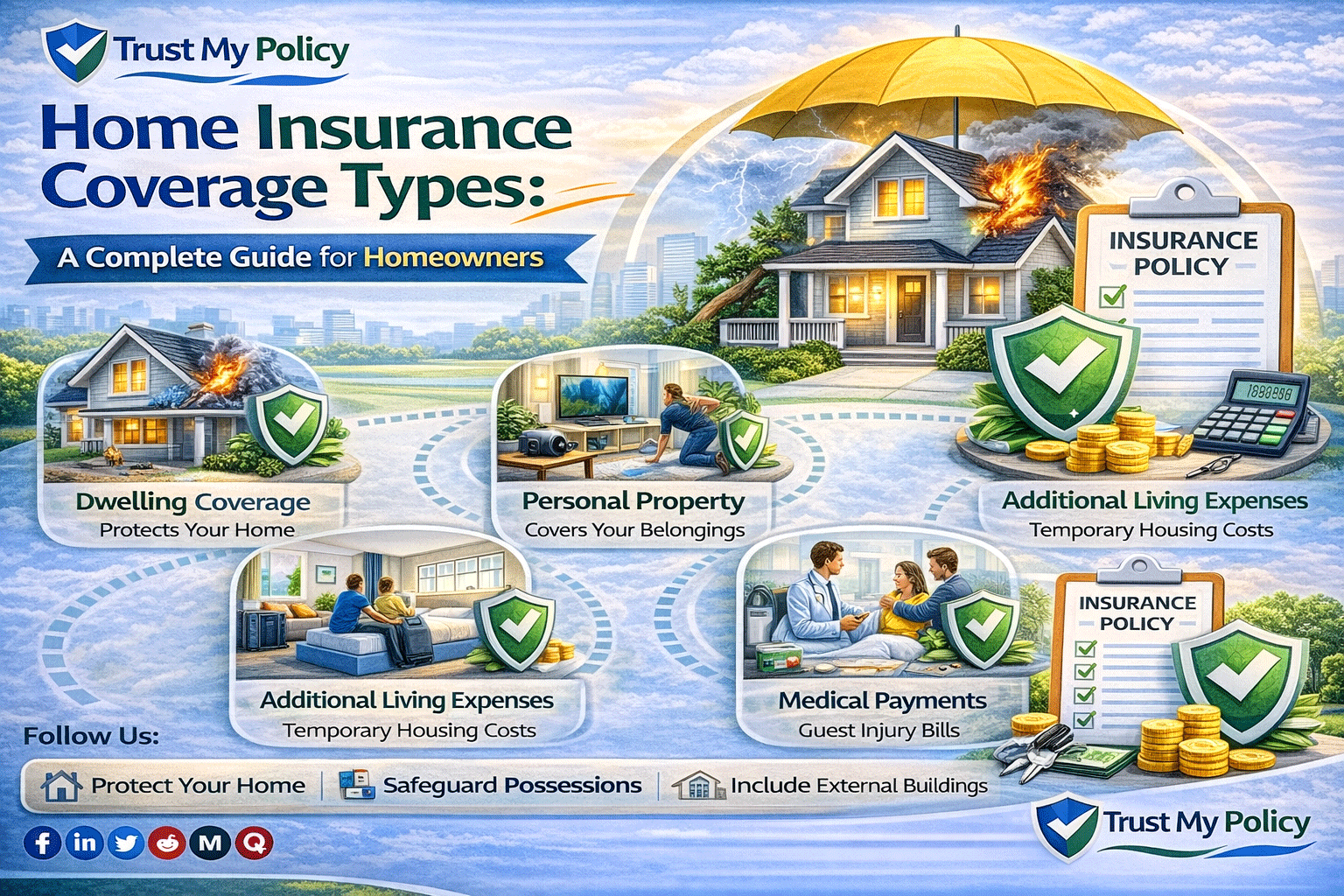
US home insurance is sold in standardized policy forms: HO-3 (the most common, covering single-family homes broadly), HO-4 (renters), HO-5 (comprehensive, broader than HO-3), HO-6 (condos), HO-7 (mobile/manufactured homes), and HO-8 (older homes with unique repair challenges, often valued at actual cash value rather than replacement cost). Most standard single-family homeowners hold an HO-3, while older or historic homes often require the more specialized HO-8 form.
Diane Ferraro, 61, inherited her grandmother’s 1920s farmhouse in rural Vermont and was confused when a standard insurer quoted her a dramatically different policy form than the one her neighbor in a newly built subdivision received. She’d never heard the term “HO-8” before, and didn’t realize her home’s age had placed her into an entirely different category of home insurance coverage type.
Home Insurance Coverage Types in 2026 refer to the specific standardized policy forms insurers use, commonly labeled HO-1 through HO-8 in the US, each covering a different combination of homeowner situations: standard single-family homes, condos, renters, mobile homes, and older homes with unique replacement cost challenges. Choosing or being placed into the wrong form can mean significant coverage gaps. This guide breaks down each policy form and which situation it’s actually designed for.
This article covers each major home insurance policy form, who each one is designed for, real scenarios showing the practical differences, and how to confirm you’re in the right one. By the end, you’ll understand exactly which letter-and-number combination applies to your specific home.
| Feature | Details |
| What it is | Standardized home insurance policy forms, each designed for a different homeowner situation |
| Who it affects | Every US homeowner, renter, condo owner, or mobile home owner |
| Most common form | HO-3, covering most standard single-family homes |
| Specialized forms | HO-4 (renters), HO-5 (comprehensive), HO-6 (condo), HO-7 (mobile home), HO-8 (older homes) |
| Key benefit | Matches coverage structure to the realistic needs of your specific home type |
| Key limitation | Older homes (HO-8) often use actual cash value rather than replacement cost |
| Regulator | State insurance departments (US); Financial Conduct Authority (UK, different policy naming conventions) |
Think of home insurance policy forms like different standardized contract templates a law firm keeps on hand, each pre-built for a specific common situation rather than drafted from scratch every time. A single-family home, a rented apartment, a condo, and a 100-year-old farmhouse each have meaningfully different risk profiles, so the insurance industry built distinct standardized forms for each rather than forcing every homeowner into one generic template.
US home insurance policy forms are numbered HO-1 through HO-8, though HO-1 and HO-2 are now rarely sold, having been largely replaced by broader forms. HO-3 is the most common, covering most standard single-family homes broadly for the dwelling while listing specific named perils for personal property. HO-5 offers even broader, open-peril coverage for both the dwelling and personal property. HO-4 is designed specifically for renters, who don’t need dwelling coverage at all. HO-6 is designed for condo owners, addressing the specific gap between personal coverage and a condo association’s master policy. HO-7 covers mobile or manufactured homes. HO-8 is designed for older or historic homes where replacement cost might significantly exceed market value, often using actual cash value instead. Anyone insuring a home needs to confirm which specific form applies to their situation.
| Criteria | HO-3 (Standard) | HO-5 (Comprehensive) | HO-8 (Older Homes) |
| Dwelling coverage | Open-peril (broad coverage unless specifically excluded) | Open-peril, same as HO-3 | Often actual cash value rather than full replacement cost |
| Personal property coverage | Named-peril only (covers specifically listed causes of loss) | Open-peril, broader than HO-3 | Often named-peril, similar to HO-3 |
| Best for | Most standard single-family homes | Higher-value homes wanting broader personal property protection | Older or historic homes with high replacement cost relative to market value |
| Pros | Most widely available and moderately priced | Most comprehensive personal property protection available | Provides a realistic, available option for hard-to-insure older homes |
| Cons | Personal property coverage has more specific gaps than HO-5 | Higher premium cost than HO-3 | Actual cash value can mean a lower payout than full replacement cost |
We recommend most standard single-family homeowners start with HO-3 coverage, upgrading to HO-5 if broader personal property protection matters to them, while owners of significantly older homes should specifically ask about HO-8 eligibility and its actual cash value implications.
Scenario 1: Diane, 61, owner of a 1920s farmhouse in rural Vermont. Diane’s insurer placed her into an HO-8 policy form, reflecting her home’s age and the gap between its replacement cost and market value. Verdict: older or historic homes often require this specialized form rather than the standard HO-3. Action: Diane confirmed her policy’s actual cash value terms and budgeted accordingly for any future claim.
Scenario 2: A renter in Manchester (UK equivalent: contents-only cover) who assumed she needed dwelling coverage. She learned the UK equivalent of an HO-4-style policy, contents-only insurance, was the appropriate and sufficient coverage for her rented flat. Verdict: renters need contents-focused coverage, not coverage designed for property owners. Action: she purchased a contents-only policy matched specifically to renting, rather than a full homeowners-style policy.
Scenario 3: A condo owner in Houston confused about why her personal policy didn’t cover the building’s exterior walls. Her HO-6 policy was specifically designed to cover her unit’s interior and personal property, while the condo association’s master policy covered the building’s exterior structure. Verdict: HO-6 policies are intentionally narrower than a full dwelling policy, designed to coordinate with a separate master policy. Action: she reviewed her condo association’s master policy to confirm exactly where her HO-6 coverage needed to begin.
Scenario 4: A homeowner in Dallas with a high-value modern home choosing between HO-3 and HO-5. She upgraded to HO-5 specifically for the broader, open-peril personal property coverage, given her home’s significant contents value. Verdict: higher-value homes often benefit from the broader protection HO-5 provides over the standard HO-3. Action: she confirmed the premium difference was worth the broader personal property protection for her specific situation.
| Pros | Cons |
| Standardized forms make it easier to compare coverage across different insurers. | Many homeowners don’t realize multiple forms exist beyond the standard HO-3. |
| HO-6 and HO-7 specifically address condo and mobile home coverage gaps. | HO-8 actual cash value coverage can mean a lower payout for older homes. |
| HO-5 provides meaningfully broader protection for higher-value homes. | Confirming you’re in the correct form requires asking your insurer directly. |
| HO-4 ensures renters aren’t paying for unnecessary dwelling coverage. | Switching forms as your housing situation changes requires proactive action. |
| The system provides a clear, recognized framework across the US insurance industry. | UK policy naming conventions differ, which can confuse comparisons across countries. |
⚠️ WARNING: Never assume your home insurance policy form provides the same coverage structure as a neighbor’s, even on a similar-looking home. Differences in age, value, and ownership structure can place genuinely different homes into entirely different policy forms with meaningfully different coverage terms.
| Your Situation | Our Recommendation |
| You own a standard, relatively modern single-family home | Yes — HO-3 is likely the appropriate, most widely available form |
| You have significant personal property value and want broader protection | Yes — ask specifically about upgrading to HO-5 |
| You rent your home | Yes — confirm you have an HO-4 (US) or contents-only (UK) policy, not a dwelling policy |
| You own a condo | Yes — confirm your HO-6 policy coordinates properly with your association’s master policy |
| You own a mobile or manufactured home | Yes — confirm you have the specific HO-7 form designed for this housing type |
| You own a significantly older or historic home | Yes — ask whether HO-8 applies and understand its actual cash value implications |
| You’re unsure which form your current policy uses | Yes — ask your insurer directly to confirm and explain your specific policy form |
💡 TIP: The single golden rule for home insurance coverage types: don’t assume your policy uses the standard HO-3 form just because that’s the most common — confirm directly with your insurer, especially if your home is older, a condo, or a mobile home.
| Scenario | Policy Form | Typical Annual Cost |
| Standard single-family home, moderate value | HO-3 | $1,200–$2,000/year |
| Higher-value home, broader personal property coverage | HO-5 | $1,800–$3,000/year |
| Rented apartment, contents-focused coverage | HO-4 | $150–$300/year |
| Condo, unit interior and personal property | HO-6 | $400–$800/year |
| Mobile or manufactured home | HO-7 | $700–$1,500/year |
| Older or historic home, actual cash value coverage | HO-8 | $1,000–$2,500/year |
| UK equivalent: standard buildings and contents (no direct HO-form equivalent) | N/A | £250–£450/year |
Your insurer’s policy documents — The most reliable source for confirming exactly which HO form applies to your specific policy. Cost range: free to review. Best for: confirming your exact policy form directly. Rating: not applicable, primary source document.
Independent insurance brokers — Brokers can confirm whether you’re in the correct form for your specific housing situation and recommend an upgrade if appropriate. Cost range: typically free for the consumer. Best for: any homeowner unsure which form applies to them. Rating: varies by broker, check state or FCA licensing.
Insurance Information Institute (US) — Publishes plain-language guidance explaining each HO policy form and its intended use. Cost range: free public resource. Best for: US consumers researching policy form differences. Rating: industry trade association resource.
NAIC consumer resources (US) — Offers consumer guidance on standardized home insurance policy forms across different states. Cost range: free public resource. Best for: US consumers comparing forms across different insurers. Rating: regulatory standards body.
Your condo association (for HO-6 coordination) — The source for your specific condo’s master policy terms, essential for understanding where your personal HO-6 coverage needs to begin. Cost range: free to request. Best for: condo owners confirming their specific coverage gap. Rating: not applicable, primary source document.
We recommend reviewing your own policy documents first as best overall, since confirming your specific HO form directly with your insurer is the only reliable way to know exactly what coverage structure applies to your home.
US home insurance is sold in standardized forms, commonly HO-3 (standard), HO-4 (renters), HO-5 (comprehensive), HO-6 (condo), HO-7 (mobile home), and HO-8 (older homes), each designed for a different homeowner situation.
HO-3 is the most common home insurance form, covering the dwelling broadly against most causes of loss while covering personal property only for specifically named perils.
HO-5 provides broader, open-peril coverage for personal property, while HO-3 covers personal property only for specifically named perils, making HO-5 more comprehensive but typically more expensive.
HO-8 is designed for older or historic homes where replacement cost would significantly exceed market value, often using actual cash value coverage instead of full replacement cost.
Yes. Renters typically use an HO-4 form in the US, which covers personal property and liability without dwelling coverage, since the renter doesn’t own the building itself.
HO-6 covers a condo owner’s unit interior and personal property, specifically designed to coordinate with the condo association’s separate master policy covering the building’s exterior structure.
This typically happens when a home’s age and construction make its replacement cost significantly higher than its market value, making actual cash value coverage a more practical option for the insurer.
No. The UK uses different terminology, typically referring to buildings insurance, contents insurance, or combined buildings and contents policies, without the same HO-numbered form system.
Check your policy documents directly or ask your insurer, since the specific form isn’t always obvious from general marketing material describing your coverage.
It’s worth considering if you have significant personal property value and want broader, open-peril protection, though this typically comes with a higher premium cost.
This guide reflects the latest 2026 insurance data.
This article is for informational purposes only. Always consult a licensed insurance professional before making coverage decisions. Trust My Policy does not sell insurance products or represent any insurer.

Jagadeesh Gutha is the founder of TrustMyPolicy.com, an independent insurance information platform covering life, health, car, home, and business insurance for US and UK readers. He researches insurance products, policy structures, and consumer rights to help everyday people make informed coverage decisions without the jargon. All content on TrustMyPolicy is independently researched, fact-checked, and written to educate — not to sell.

[…] insurance is built from six distinct coverage parts. Dwelling coverage protects your home’s physical structure. Other structures coverage protects detached items like […]
[…] insurance deductibles come in two fundamentally different structures. A standard flat deductible applies a fixed dollar amount, like $1,000, to most claims, similar to auto or general property […]
[…] Replacement cost value pays the full cost to rebuild your home or replace your belongings with new items of similar kind and quality, without subtracting for depreciation. Actual cash value pays replacement cost minus depreciation, accounting for the age and condition of the damaged item at the time of loss. Most modern homeowners policies pay replacement cost for the dwelling structure itself, but many still default to actual cash value for personal belongings unless you’ve specifically added a replacement cost endorsement for contents. […]




Insurance Guides for UK, USA & Worldwide We are not an insurer or broker.
Reader Comments (4)
[…] policy that bundles dwelling coverage for your home’s physical structure, personal property coverage for your belongings, liability coverage if someone is injured on your property or you’re […]