

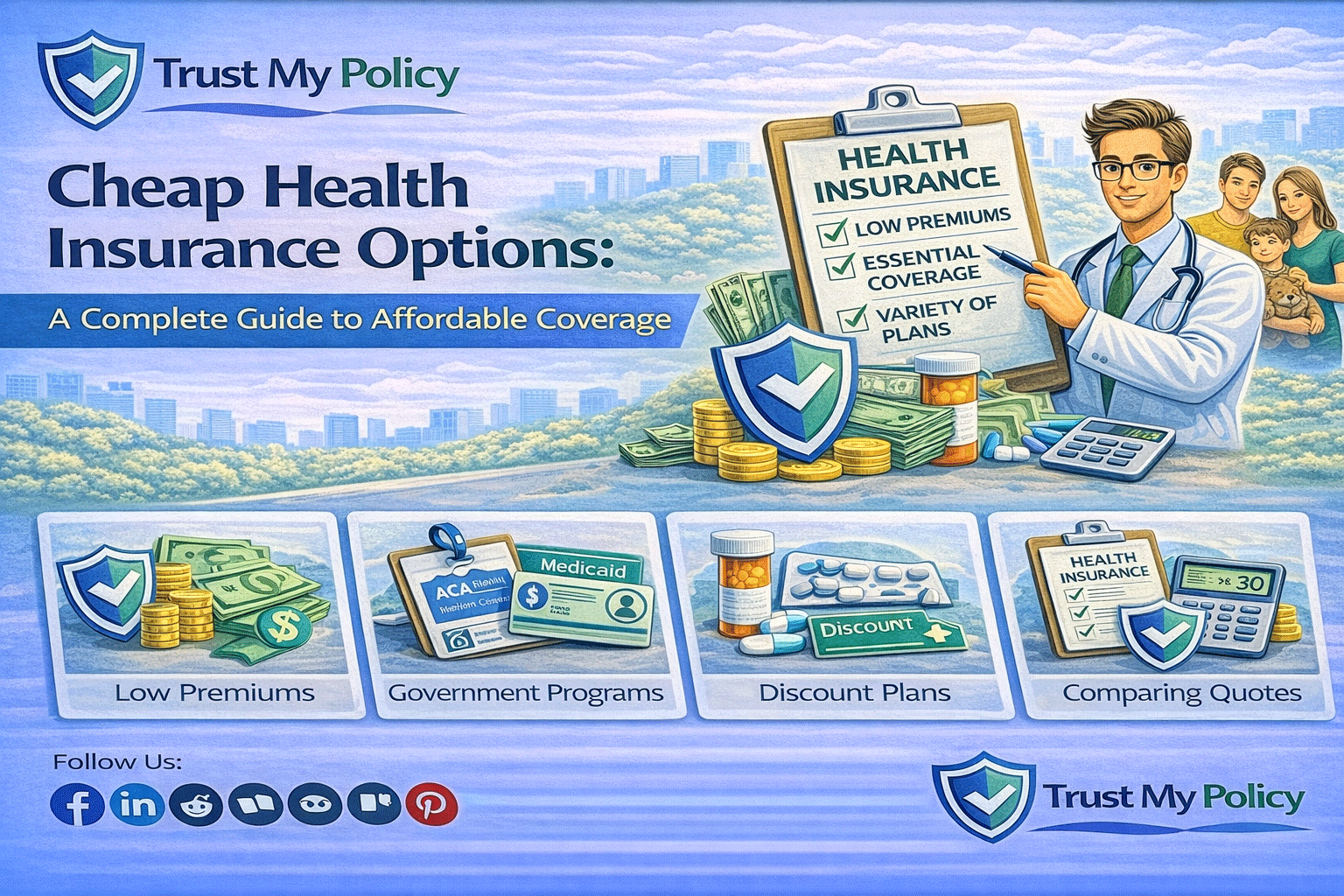
The cheapest health insurance options in 2026 are Medicaid for qualifying low-income Americans (often $0 premium), subsidised ACA marketplace plans for those earning under roughly $60,000 (often $0–$150/month after credits), and Catastrophic plans for those under 30. In the UK, NHS coverage is free to all residents; private medical insurance adds fast specialist access from roughly £30/month.
Table of Contents
ToggleCheap Health Insurance Options
Priya Sharma, 27, quit her corporate job to go freelance in Nashville and panicked when she saw individual health plan prices, assuming every option would cost $600 or more a month. After checking HealthCare.gov, she found a Silver plan with a premium tax credit for $147 a month — less than she’d been paying as her share of her employer’s plan.
Cheap Health Insurance Options in 2026 depend heavily on your income, household size, and employment status, but most people have more genuinely affordable routes than they realise: subsidised marketplace plans, Medicaid for qualifying income levels, short-term plans for bridge gaps, and NHS-based coverage in the UK with optional low-cost private supplements. This guide maps every option in one place with real costs, so you can identify the cheapest route that still provides adequate protection.
This article covers every low-cost health insurance route available in the US and UK in 2026, what each one genuinely covers, real costs at different income levels, and a clear decision framework. By the end, you’ll know exactly which option fits your situation.
Quick Summary Table
| Feature | Details |
| Cheapest US option | Medicaid: $0 premium for qualifying income levels |
| Next cheapest US option | Subsidised ACA marketplace plan: $0–$240/month depending on income |
| UK baseline | NHS coverage: £0 direct cost to all UK residents |
| UK low-cost add-on | Private medical insurance from £30/month |
| Key benefit | Multiple genuinely affordable routes exist that most people don’t fully explore |
| Key limitation | Cheapest options (short-term, Catastrophic) often have significant coverage gaps |
| Regulator | CMS and state departments (US); NHS England and FCA (UK) |
What Are the Real Cheap Health Insurance Options?
Think of cheap health insurance like budget travel — there are genuinely affordable options, but each comes with specific trade-offs on comfort, flexibility, or coverage. The key is matching the trade-offs to your actual situation rather than assuming the cheapest option is automatically the right one.
Cheap health insurance options in 2026 range from $0 Medicaid for qualifying low-income Americans, through subsidised marketplace plans covering most services at $0–$240 a month after premium tax credits, to short-term plans filling brief gaps at $80–$200 a month with limited benefits. In the UK, the NHS provides free baseline coverage to all residents, with private medical insurance available from around £30 a month for those wanting faster specialist access. Every option has a different coverage scope, which matters enormously if you actually need to use it.
How to Identify Your Cheapest Adequate Option — 5 Steps
- Check your Medicaid eligibility first if you’re in the US. Income thresholds vary by state, but qualifying adults in expansion states can access full coverage at $0 premium.
- Check your ACA marketplace subsidy eligibility. Even incomes up to $60,000+ for an individual can qualify for a partial premium tax credit, significantly reducing marketplace plan costs.
- Compare the total cost, not just the premium. A Bronze plan with a $0 premium after subsidy might cost more overall than a Silver plan if you need regular medical care, once deductibles are factored in.
- Consider short-term plans only for genuine bridge gaps. These are cheaper but don’t cover pre-existing conditions, so they suit only specific, time-limited situations.
- In the UK, rely on NHS as your baseline. Adding a private medical supplement only makes financial sense if NHS wait times for non-urgent care genuinely affect you.
Comparison: US Cheap Health Insurance Options
| Option | Typical Monthly Cost | Coverage Scope | Best For |
| Medicaid | $0 | Comprehensive | Low-income qualifying Americans |
| Subsidised Silver (ACA) | $0–$240 | Comprehensive | Most working Americans under ~$60,000 income |
| Subsidised Bronze (ACA) | $0–$100 | Comprehensive but high deductible | Healthy individuals expecting minimal care |
| Catastrophic plan | $180–$260 | Limited until high deductible met | Under-30s wanting only catastrophic protection |
| Short-term plan | $80–$200 | Very limited, no pre-existing coverage | Bridge gaps of under 3 months only |
| CHIP (children only) | $0–$50 | Comprehensive for children | Families with qualifying children |
We recommend a subsidised ACA Silver plan for most readers, since it offers the best balance of genuine comprehensive coverage and affordable net cost after premium tax credits.
4 Real-Life Scenarios
Scenario 1: Priya, 27, freelancer in Nashville earning $38,000. Priya’s marketplace Silver plan cost $147 a month after her premium tax credit, far less than she’d assumed before checking. Verdict: most freelancers significantly overestimate their true marketplace cost before applying. Action: Priya updates her income estimate on HealthCare.gov every quarter to avoid a reconciliation surprise at tax time.
Scenario 2: A family of three in Texas earning $42,000. They qualified for Medicaid in Texas (a non-expansion state) for their child through CHIP, while the parents enrolled in a subsidised ACA plan at $220/month combined. Verdict: splitting coverage between Medicaid/CHIP for children and marketplace plans for adults is a legitimate, often optimal strategy. Action: they review eligibility annually as their income changes.
Scenario 3: A 24-year-old in Edinburgh relying on the NHS. She pays no direct premium for full baseline healthcare, using A&E and GP services freely, and has no private supplement. Verdict: for most UK residents, the NHS provides genuinely comprehensive free baseline coverage that’s hard to improve on at any price. Action: she’s researching a low-cost private supplement specifically to reduce wait times for elective physiotherapy.
Scenario 4: A contractor in Ohio between contracts for six weeks. He bought a short-term plan at $130/month for the gap, fully aware it excluded his pre-existing knee condition. Verdict: short-term plans suit specific, time-limited bridge gaps for otherwise healthy individuals. Action: he enrolled in a marketplace plan as soon as his next contract ended and he had a qualifying life event.
Pros & Cons of Cheap Health Insurance Options
| Pros | Cons |
| Multiple genuinely affordable routes exist beyond just one type of plan. | Cheapest plans (short-term, Catastrophic) carry significant coverage gaps. |
| Medicaid provides $0 comprehensive coverage for qualifying individuals. | Medicaid eligibility varies by state, leaving some low-income Americans in coverage gaps. |
| ACA premium tax credits significantly reduce marketplace plan costs for most income levels. | Short-term plans don’t cover pre-existing conditions at all. |
| UK NHS provides free baseline coverage to all residents by default. | NHS wait times for non-urgent specialist care can be long without a private supplement. |
| CHIP provides low or no cost coverage specifically for qualifying children. | Catastrophic plans only cover essential benefits and have very high deductibles. |
5 Common Mistakes People Make
- Assuming they earn too much for any subsidy without checking. This happens because people guess based on round-number income estimates. What to do instead: run your actual projected income through HealthCare.gov before assuming you’re ineligible.
- Choosing a short-term plan as a long-term solution. This happens because the low premium is compelling without fully considering the coverage gaps. What to do instead: use short-term plans only for genuine, time-limited bridge gaps, never as ongoing primary coverage.
- Choosing the cheapest Bronze plan without checking the deductible impact. This happens because the lowest premium looks like the obvious savings. What to do instead: estimate your total annual cost including expected out-of-pocket spending before choosing a plan tier.
- UK residents buying private medical insurance assuming it replaces the NHS. This happens because private insurance sounds more comprehensive. What to do instead: keep NHS registration active and use private supplements only for what the NHS doesn’t provide quickly enough.
- Not checking CHIP eligibility for children separately. This happens because parents assume the whole family must be on the same plan. What to do instead: check whether your children qualify for CHIP even if you’re on a marketplace or employer plan yourself.
⚠️ WARNING: Never let a coverage gap continue while shopping for the cheapest option. A single emergency room visit without any coverage can cost $5,000–$30,000 or more, making even a modest short-term plan a better financial outcome than no coverage at all.
Decision Table: Which Cheap Option Is Right for You?
| Your Situation | Our Recommendation |
| You qualify for Medicaid in your state | Yes — enrol immediately, it’s the cheapest genuinely comprehensive option |
| You’re self-employed earning under $60,000 | Yes — check your ACA marketplace subsidy before assuming any option is unaffordable |
| You’re under 30 and in excellent health | Yes — compare a Catastrophic plan against a subsidised Bronze plan first |
| You’re between jobs for less than 3 months | Yes — a short-term plan may bridge the gap, but confirm it covers any existing conditions |
| You’re a UK resident with no urgent care needs | No — the NHS provides adequate free baseline coverage without a private supplement |
| You have a pre-existing condition and no coverage | Yes — go straight to a marketplace plan, since only ACA plans guarantee coverage |
| You have qualifying children without coverage | Yes — check CHIP eligibility before assuming they need marketplace coverage |
💡 TIP: The single golden rule for cheap health insurance: always check your actual Medicaid and ACA subsidy eligibility before buying any private plan, since most people’s true marketplace cost is significantly lower than their first guess.
Cost Table: What Cheap Health Insurance Actually Costs
| Scenario | Monthly Cost | Notes |
| Medicaid, qualifying income | $0 | Varies by state; not all states expanded Medicaid |
| ACA Silver plan, income ~$30,000 | $0–$80/month | Strong subsidy tier for most counties |
| ACA Silver plan, income ~$50,000 | $80–$200/month | Partial subsidy still applies at this income level |
| ACA Bronze plan, subsidised | $0–$60/month | Lowest premium but highest deductible |
| Catastrophic plan, under 30 | $180–$260/month | Very high deductible before any benefits apply |
| Short-term plan, healthy adult | $80–$200/month | No pre-existing condition coverage |
| UK NHS (baseline) | £0 | Free to all UK residents |
| UK private medical supplement | £30–£80/month individual | Speeds up non-urgent specialist access |
Best Providers for Low-Cost Health Insurance
Molina Healthcare (US) — Specialises in Medicaid and ACA marketplace plans for lower-income individuals. Cost range: competitive subsidised pricing. Best for: US individuals near the lower end of the income-subsidy range. Rating: AM Best A-.
Centene/Ambetter (US) — A major ACA marketplace insurer in many states, often competitive on subsidised Bronze and Silver plans. Cost range: competitive marketplace pricing. Best for: US individuals and families wanting affordable subsidised marketplace options. Rating: AM Best A-.
Oscar Health (US) — A digital-first ACA marketplace insurer available in select metro areas, known for transparent pricing tools. Cost range: competitive marketplace pricing. Best for: younger US policyholders in available metro areas. Rating: AM Best A-.
Bupa (UK) — Offers affordable entry-level private medical supplements alongside NHS baseline coverage. Cost range: from £30/month individual. Best for: UK individuals wanting minimal-cost private access. Rating: Defaqto 5 Star.
AXA Health (UK) — Provides flexible, modular private medical plans that allow UK residents to add only the specific benefits they need. Cost range: competitive UK private supplement pricing. Best for: UK individuals wanting a customisable, lower-cost private supplement. Rating: Defaqto 5 Star.
We recommend checking Medicaid eligibility or your ACA marketplace subsidy through HealthCare.gov first, since these government routes are almost always cheaper than any private option at equivalent coverage levels.
Frequently Asked Questions
What are the cheapest health insurance options in 2026?
Medicaid ($0 for qualifying individuals), subsidised ACA marketplace plans ($0–$240/month), and for the UK, NHS coverage (£0) with optional private supplements from £30/month.
How do I know if I qualify for Medicaid?
Eligibility depends on your income and household size, and varies by state. Check your eligibility directly at HealthCare.gov or your state Medicaid agency’s website.
Are short-term health insurance plans a good idea?
Only for genuine, time-limited bridge gaps of under three months, since short-term plans don’t cover pre-existing conditions and aren’t adequate as ongoing primary coverage.
What is a Catastrophic health plan?
A Catastrophic plan is available to people under 30 or those with specific exemptions, offering very low premiums with a very high deductible before most benefits apply.
Can I get a subsidy if I’m self-employed?
Yes, potentially. Self-employed individuals are eligible for ACA premium tax credits based on projected annual income, often significantly reducing marketplace plan costs.
Is the NHS completely free in the UK?
NHS baseline coverage is free for all UK residents, funded through taxation, though some specific services like prescriptions carry a flat charge.
Should UK residents get private health insurance?
Only if NHS wait times for non-urgent specialist care are a genuine concern; the NHS provides adequate free baseline coverage for most health needs.
Can children get cheaper coverage than parents?
In the US, yes — children may qualify for CHIP at a lower cost than a marketplace plan, even when parents are on different coverage.
What happens if I miss the ACA open enrollment window?
You’ll need to wait for the next open enrollment period unless you have a qualifying life event, such as losing a job or having a child, that triggers a special enrollment period.
Is a Bronze plan always cheaper than a Silver plan?
The Bronze premium is lower, but the deductible is much higher, so the total annual cost can actually be higher than a Silver plan if you have any regular medical needs.
Key Takeaways
- Check Medicaid eligibility before assuming you must buy private coverage.
- Run your actual income through HealthCare.gov before assuming subsidised plans are unaffordable.
- Compare total annual cost, not just premium, before choosing between Bronze and Silver plans.
- Use short-term plans only for genuine bridge gaps, never as permanent coverage.
- Keep NHS registration active in the UK and add private coverage only for specific unmet needs.
- Check CHIP eligibility for qualifying children separately from your own coverage.
- Never let a gap in coverage continue while searching for the perfect cheap option.
This article is for informational purposes only. Always consult a licensed insurance professional before making coverage decisions. Trust My Policy does not sell insurance products or represent any insurer.


Reader Comments (2)
[…] and specialist visits, with the exact cost-sharing depending on your chosen metal tier. Bronze plans have the lowest premiums but highest deductibles; Silver plans are the only tier eligible for […]