

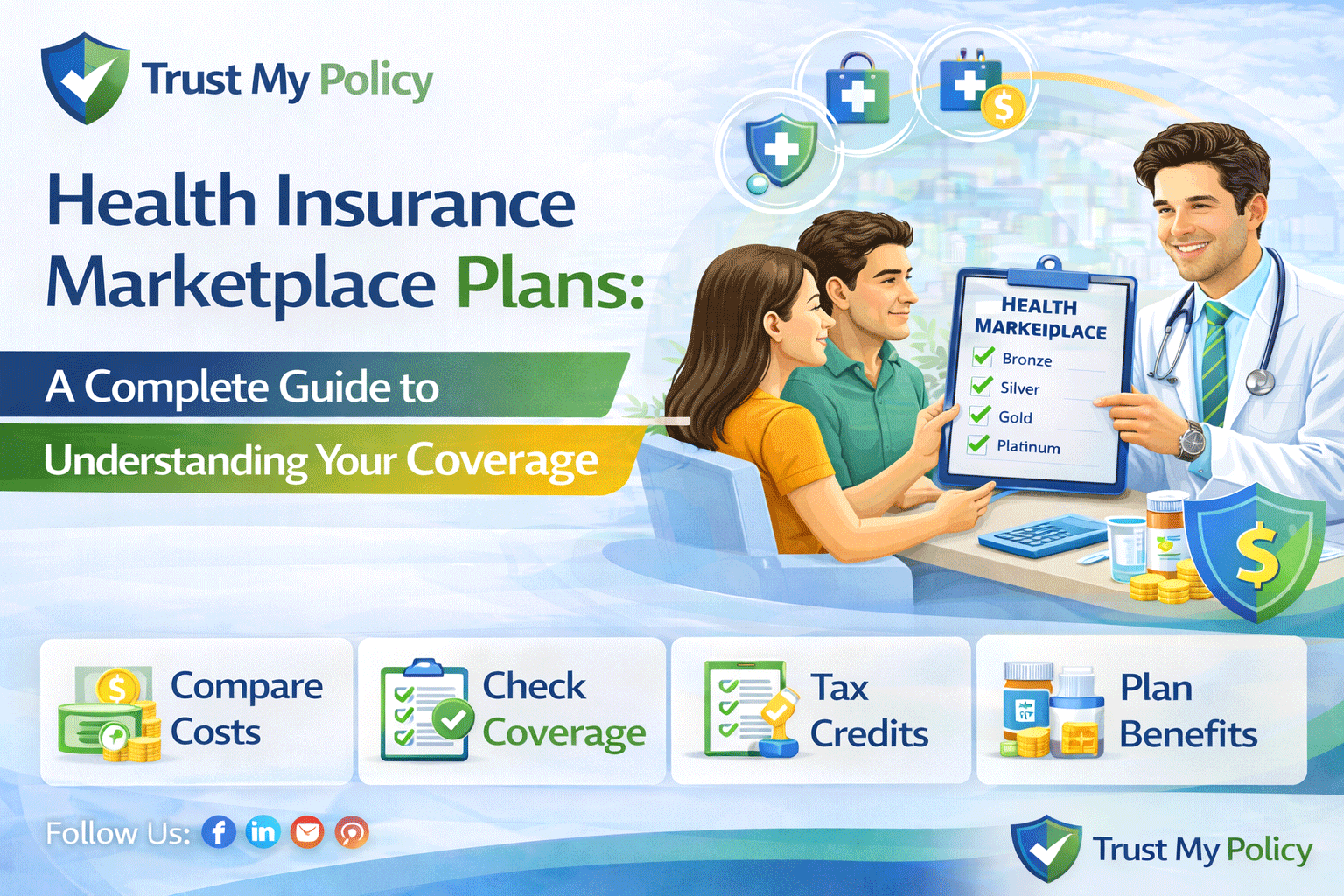
US health insurance marketplace plans are sold through HealthCare.gov or state exchanges in four metal tiers: Bronze (lowest premium, highest out-of-pocket), Silver (mid-range, with extra cost-sharing reductions for lower incomes), Gold, and Platinum (highest premium, lowest out-of-pocket). Most households earning under roughly $60,000–$120,000 (depending on size) qualify for a premium tax credit. In the UK, comparable individual private health insurance is purchased directly from insurers or through brokers, typically costing £30–£100 a month.
Table of Contents
ToggleHealth Insurance Marketplace Plans
Darren Walsh, 33, left his corporate job to freelance in Chicago and spent three weeks assuming he couldn’t afford health coverage. When a friend finally walked him through HealthCare.gov, Darren discovered he qualified for a premium tax credit that brought his Silver plan down to $187 a month — less than he’d been paying for his gym membership.
Health Insurance Marketplace Plans in 2026 are individual and family health insurance policies sold through the federal HealthCare.gov marketplace (or a state-based exchange in 17 states), organised into four metal tiers — Bronze, Silver, Gold, and Platinum — and typically subsidised for households earning under roughly 400% of the federal poverty level. In the UK, marketplace-equivalent purchasing happens through direct insurer or broker comparison since there is no government exchange, but private medical insurance follows a similar tiered structure. This guide breaks down exactly how to navigate both systems.
This article covers how the US marketplace tiers and subsidies work, what each metal tier actually means for your out-of-pocket costs, real scenarios with specific premium figures, and how to choose the right tier for your situation. By the end, you’ll know exactly which plan fits your income and expected healthcare use.
Quick Summary Table
| Feature | Details |
| What it is | Government-facilitated individual and family health insurance plans organised by metal tier |
| Who uses it | Individuals and families without employer-sponsored or government health coverage |
| US metal tiers | Bronze, Silver, Gold, Platinum — from lowest to highest premium and coverage |
| Subsidy eligibility | Premium tax credits available for incomes up to roughly 400% of the federal poverty level |
| UK equivalent | Direct purchase private medical insurance through insurers or brokers |
| Key benefit | Guaranteed-issue coverage with subsidy eligibility regardless of health history |
| Regulator | CMS and state insurance departments (US); Financial Conduct Authority (UK) |
What Are Health Insurance Marketplace Plans, Really?
Think of the marketplace like a supermarket with four aisles labelled Bronze, Silver, Gold, and Platinum, where Bronze costs the least at the checkout every month but charges you more when you actually pick items off the shelf. Platinum costs the most monthly but charges you very little when you use it. The subsidy is like a store discount card — it reduces your checkout price based on your income, making the mid-tier Silver aisle often the best value for most shoppers.
Health insurance marketplace plans are individual or family policies sold through a structured government-facilitated exchange, organised into metal tiers based on the split between what you pay monthly versus what you pay when you actually use care. The marketplace is the primary mechanism through which Americans without employer-sponsored or government-provided coverage (Medicare/Medicaid) access health insurance, with premium tax credits significantly reducing costs for eligible households. In the UK, the equivalent purchasing route is directly comparing private medical insurance policies through insurers or comparison platforms, since there is no government exchange.
How Marketplace Plans Actually Work — 5 Steps
- You check your subsidy eligibility before comparing plans. Your premium tax credit is calculated based on your projected household income and size; checking this first tells you your real cost rather than the sticker price.
- You choose a metal tier based on your expected healthcare use. Lower tiers cost less monthly but more when you use care; higher tiers cost more monthly but less when you use care.
- Silver plans unlock cost-sharing reductions (CSRs) at lower incomes. CSRs reduce your deductible, copays, and out-of-pocket maximum on Silver plans for households earning under roughly 250% of the federal poverty level — this is a separate benefit from the premium tax credit.
- You enrol during open enrollment or a qualifying life event. Open enrollment for 2026 plans ran through January 15th; special enrollment periods apply after events like job loss or having a child.
- You update your income estimate if your earnings change during the year. This ensures your subsidy stays accurate and avoids an unexpected repayment at tax time.
Comparison: The Four US Marketplace Metal Tiers
| Criteria | Bronze | Silver | Gold | Platinum |
| Monthly premium | Lowest | Moderate | Higher | Highest |
| Deductible | Highest (~$7,000–$9,000) | Moderate (~$3,000–$5,000) | Lower (~$1,000–$2,500) | Very low (~$0–$500) |
| Insurer pays on average | 60% of covered costs | 70% | 80% | 90% |
| Best for | Healthy, low-use individuals | Most people, especially those eligible for CSRs | Those with moderate-high healthcare use | Those with very high healthcare use |
| CSR eligibility | No | Yes, if income qualifies | No | No |
We recommend Silver plans for most readers who qualify for cost-sharing reductions, since the combination of premium tax credit and reduced deductible frequently makes Silver the lowest total-cost option even compared to Bronze.
4 Real-Life Scenarios
Scenario 1: Darren, 33, freelancer in Chicago. Darren’s $187/month subsidised Silver plan covered him fully for a year, with a $2,800 deductible and no surprise bills. Verdict: checking subsidy eligibility before assuming coverage is unaffordable is the single most valuable step most uninsured people skip. Action: Darren now updates his income estimate every quarter to keep his subsidy accurate.
Scenario 2: A single mother of two in Texas earning $32,000. Her income qualified her for both a premium tax credit and cost-sharing reductions on a Silver plan, lowering her deductible from the standard Silver tier to approximately $900. Verdict: CSRs on Silver plans can transform a moderate-tier plan into near-Gold-level coverage for lower-income households. Action: she confirmed her CSR eligibility specifically on HealthCare.gov rather than through a broker, ensuring access to the CSR benefit.
Scenario 3: A healthy 26-year-old in Austin earning $55,000. His income placed him near the edge of subsidy eligibility. He compared a Bronze plan at $180/month (no subsidy) against a Silver plan at $310/month and chose Bronze, estimating his likely annual healthcare use was low enough that the deductible gap wouldn’t be reached. Verdict: Bronze plans are genuinely cost-effective for healthy, low-use individuals above the CSR threshold. Action: he kept a $7,000 savings buffer specifically to cover the worst-case Bronze deductible if needed.
Scenario 4: A UK consultant comparing private medical insurance plans. Without a government exchange, she used Compare the Market to compare three insurers directly by premium, excess, and specialist access scope, choosing a mid-tier plan with a £200 excess for £68 a month. Verdict: UK private medical insurance comparison functions similarly to the US marketplace but without a formal tier structure or government subsidy. Action: she set a renewal reminder to recompare quotes each year rather than auto-renewing.
Pros & Cons of Marketplace Plans
| Pros | Cons |
| Guaranteed-issue coverage regardless of health history under ACA rules. | Open enrollment windows restrict when you can apply without a qualifying life event. |
| Premium tax credits can dramatically reduce monthly premiums for eligible households. | Plan networks are often narrower (HMO/EPO) than employer-sponsored coverage. |
| Cost-sharing reductions on Silver plans provide near-Gold coverage at Silver premiums. | Subsidy reconciliation at tax time can create unexpected bills if income was underestimated. |
| Standardised metal tiers make plan comparison more structured and transparent. | Out-of-pocket maximums can still be very high on Bronze and some Silver plans. |
| Both in-person navigators and online tools are free resources for enrollment support. | The US marketplace is federal-only in most states, limiting state-specific plan innovation. |
5 Common Mistakes People Make
- Comparing plans by premium alone rather than total expected cost. This happens because the monthly number is the most visible figure. What to do instead: estimate your likely annual healthcare use and compare total cost (premium plus expected out-of-pocket) across tiers.
- Not checking CSR eligibility before selecting a metal tier. This happens because CSRs are a separate benefit from the premium tax credit and are only accessible on Silver plans. What to do instead: confirm CSR eligibility on HealthCare.gov specifically, since choosing a Bronze plan at a CSR-eligible income means forfeiting this benefit.
- Underestimating income on the subsidy application. This happens because variable or freelance income is hard to project. What to do instead: estimate conservatively and update throughout the year, since a large underestimate results in a subsidy repayment at tax time.
- Missing open enrollment without a qualifying life event. This happens because there’s no HR department sending reminders. What to do instead: set a calendar reminder for October or November to begin comparing plans before the December enrollment deadline.
- Auto-renewing without re-shopping each year. This happens because the renewal process runs automatically if no action is taken. What to do instead: actively review your plan and subsidy estimate each open enrollment, since both available plans and your income may have changed.
⚠️ WARNING: Never purchase an off-exchange health plan without first confirming your subsidy eligibility on HealthCare.gov. Off-exchange plans never qualify for premium tax credits, meaning a household that qualifies for a subsidy will pay significantly more by going off-exchange unnecessarily.
Decision Table: Which Marketplace Tier Is Right for You?
| Your Situation | Our Recommendation |
| Your income qualifies for cost-sharing reductions | Yes — choose Silver; CSRs are only available on Silver plans |
| You’re healthy with very low expected medical use above the CSR threshold | Yes — consider Bronze, but keep a savings buffer for the high deductible |
| You have a chronic condition with high, predictable medical use | Yes — consider Gold or Platinum; the lower out-of-pocket usually justifies the higher premium |
| You haven’t checked your subsidy eligibility yet | Yes — do this first on HealthCare.gov before comparing any plans |
| You’re considering an off-exchange plan | No — confirm your subsidy eligibility first; most people eligible for a subsidy should stay on-exchange |
| You auto-renewed last year without reviewing | Yes — actively recompare your options this open enrollment |
| You’re unsure whether a life event qualifies for special enrollment | Yes — check HealthCare.gov directly, since many common events qualify |
💡 TIP: The single golden rule for marketplace plans: always confirm your subsidy and CSR eligibility on HealthCare.gov before choosing a metal tier, since this information determines which tier actually costs you the least in total.
Cost Table: What Marketplace Plans Actually Cost
| Scenario | Monthly Premium | Notes |
| Income ~$28,000, subsidised Silver, individual | $0–$50/month | Often qualifies for both premium tax credit and CSRs |
| Income ~$45,000, subsidised Silver, individual | $120–$200/month | Strong subsidy tier, CSR may still apply |
| Income ~$70,000, subsidised Silver, individual | $180–$280/month | Partial subsidy, no CSR at this income level |
| Income ~$95,000, unsubsidised Bronze, individual | $300–$420/month | Near or above subsidy threshold |
| Income ~$32,000, subsidised Silver, family of four | $0–$150/month | Likely qualifies for both premium credit and strong CSRs |
| UK private medical insurance, individual | £30–£100/month | No government subsidy; varies by age, health, and insurer |
| Off-exchange Silver equivalent, unsubsidised | $400–$600/month | Never qualifies for a subsidy regardless of income |
Best Providers for Marketplace Plans
Blue Cross Blue Shield (US) — Available in nearly every state’s marketplace with broad network access. Cost range: competitive marketplace pricing. Best for: individuals wanting wide network availability across most states. Rating: AM Best A.
Kaiser Permanente (US) — An integrated insurer offering marketplace plans in its service areas with consistently strong quality ratings. Cost range: competitive in available regions. Best for: individuals in Kaiser’s service areas wanting integrated care. Rating: AM Best A.
Oscar Health (US) — A digitally focused marketplace insurer available in select metro areas, popular with younger enrollees. Cost range: competitive in available markets. Best for: tech-savvy individuals in Austin, Dallas, Houston, and other Oscar markets. Rating: AM Best A-.
Bupa (UK) — A leading UK private medical insurer offering individual and family plans with strong specialist access. Cost range: competitive UK private medical pricing. Best for: UK individuals wanting comprehensive private medical coverage. Rating: Defaqto 5 Star.
AXA Health (UK) — Offers flexible UK private medical plans with strong digital tools and specialist network access. Cost range: competitive UK pricing. Best for: UK individuals comparing private medical plan options. Rating: Defaqto 5 Star.
We recommend checking Blue Cross Blue Shield as the first US comparison since it’s the most broadly available marketplace insurer nationally, and Bupa for UK individuals as the most comprehensively rated private medical option.
Frequently Asked Questions
What are health insurance marketplace plans?
Marketplace plans are individual and family health insurance policies sold through HealthCare.gov or a state exchange, organised into four metal tiers and often subsidised through premium tax credits.
How do the four metal tiers differ?
Bronze has the lowest premium and highest out-of-pocket costs; Silver is mid-range and unlocks cost-sharing reductions at lower incomes; Gold and Platinum have higher premiums but lower out-of-pocket costs when care is used.
What is a premium tax credit?
A premium tax credit is a federal subsidy that reduces your monthly marketplace premium based on your household income and size, available to households earning up to roughly 400% of the federal poverty level.
What are cost-sharing reductions?
Cost-sharing reductions are an additional subsidy available on Silver plans for households earning under roughly 250% of the federal poverty level, lowering deductibles, copays, and out-of-pocket maximums beyond what the standard Silver tier provides.
When can I enrol in a marketplace plan?
During the annual open enrollment period, which typically runs from November 1st to December 15th for January 1st coverage, or during a special enrollment period triggered by a qualifying life event.
Can I buy a marketplace plan at any time of year?
Only if you experience a qualifying life event such as losing job-based coverage, having a child, getting married, or moving to a new coverage area.
What happens if my income changes after I enrol?
Update your income estimate on HealthCare.gov as soon as possible, since a significant underestimate can result in a subsidy repayment at tax time, while an overestimate can be corrected to increase your credit.
Should I choose Bronze if I’m healthy?
Only if you have savings to cover the high deductible and are not eligible for cost-sharing reductions. If you qualify for CSRs, Silver is almost always the better total-value choice.
Does the UK have a health insurance marketplace?
No. The UK has the NHS for baseline care and a private market for supplemental coverage, but no government-operated purchasing exchange with subsidies equivalent to the US marketplace.
What is a navigator and how do they help?
A navigator is a free, federally funded resource who can help you understand your options, check subsidy eligibility, and enrol in a marketplace plan, available through local community organisations.
Key Takeaways
- Check your subsidy and CSR eligibility on HealthCare.gov before comparing any plan tiers.
- Choose Silver if you qualify for cost-sharing reductions — this is the only tier where CSRs apply.
- Compare total annual cost (premium plus expected out-of-pocket), not just the monthly premium.
- Never buy off-exchange if you qualify for a subsidy, since off-exchange plans never receive premium tax credits.
- Update your income estimate throughout the year to keep your subsidy accurate.
- Set a calendar reminder for open enrollment so you don’t miss the window.
- Re-shop your plan every open enrollment rather than auto-renewing.
This article is for informational purposes only. Always consult a licensed insurance professional before making coverage decisions. Trust My Policy does not sell insurance products or represent any insurer.




Reader Comments (5)
[…] Insurance for Freelancers in Texas in 2026 means choosing between a subsidized HealthCare.gov marketplace plan, an off-exchange private plan, or a short-term policy, since Texas has no state-run exchange […]