

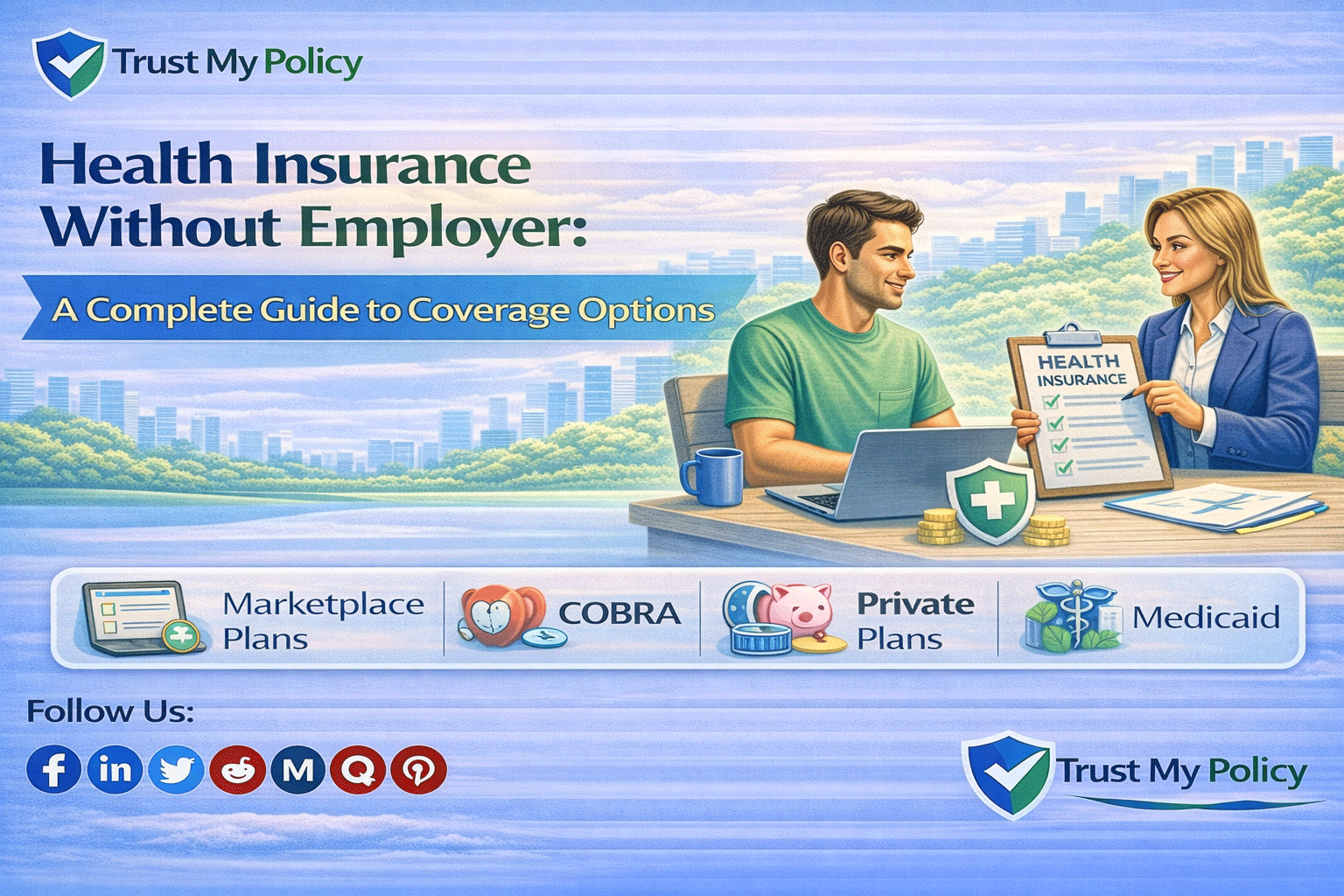
Without employer coverage, your main options in the US are a subsidised marketplace plan through HealthCare.gov (most cost-effective for incomes between 100%–400% of the federal poverty level), Medicaid (free or near-free for lower-income individuals in expansion states), or COBRA (continuing your former employer’s plan at full premium cost). In the UK, NHS coverage continues regardless of employment status, and private medical insurance is an optional supplement.
Table of Contents
ToggleHealth Insurance Without Employer
Keisha Morrison, 34, left her corporate job to start her own consulting practice in Atlanta and assumed COBRA was her only real option for maintaining health coverage. She paid $890 a month for four months before a friend mentioned she might qualify for a marketplace subsidy — which turned out to cut her monthly cost to $210 for similar coverage.
Health Insurance Without Employer in 2026 means choosing from three primary options depending on your income and situation: a subsidised marketplace plan through HealthCare.gov, which most people earning under around $58,000 individually qualify for; Medicaid, available to lower-income adults in states that expanded it; or COBRA, which continues your former employer’s coverage at full cost for up to 18 months. This guide breaks down exactly how each works, what it costs, and which one fits your specific situation.
This article covers all three major pathways, how to apply during a qualifying life event, real scenarios with specific costs, and how the UK’s NHS functions as baseline coverage for those without private employer plans. By the end, you’ll know exactly what to do on your first day without employer coverage.
Quick Summary Table
| Feature | Details |
| What it is | Coverage options available to those without an employer-sponsored health plan |
| Main US options | Marketplace plan (subsidised), Medicaid, COBRA |
| Qualifying event trigger | Losing employer coverage triggers a 60-day special enrollment period on the marketplace |
| Typical marketplace cost | $0–$350/month subsidised individual; $400–$700/month unsubsidised |
| COBRA cost | Usually $400–$700/month individual (full premium, no employer subsidy) |
| UK baseline | NHS coverage continues regardless of employment status |
| Regulator | CMS and state insurance departments (US); Financial Conduct Authority (UK) |
What Are Your Real Options Without Employer Coverage?
Think of losing your employer health plan like losing your company car — there are several ways to replace it, ranging from very affordable to expensive, and the right choice depends entirely on how far you’re driving (your expected medical use) and how much you can afford upfront (your budget for premiums vs. deductibles).
Health insurance without an employer falls into three main pathways in the US: the HealthCare.gov marketplace, which offers subsidised plans to eligible individuals and is typically the most cost-effective option for most working adults; Medicaid, which provides free or very low-cost coverage to lower-income individuals in states that expanded eligibility under the ACA; and COBRA, which allows you to continue your previous employer’s exact plan but at the full premium cost including the portion your employer was previously subsidising. In the UK, the NHS provides baseline healthcare to all residents regardless of employment status, making the loss of an employer health plan less immediately urgent.
How to Secure Coverage Without an Employer — 5 Steps
- Confirm your qualifying life event triggers a special enrollment period. Losing employer coverage gives you 60 days to enroll in a marketplace plan; don’t wait until the annual open enrollment window.
- Estimate your annual income to check marketplace subsidy eligibility. Most individuals earning between 100% and 400% of the federal poverty level qualify for a premium tax credit.
- Compare marketplace plans against Medicaid eligibility. If your income is low enough for Medicaid in your state, this is almost always the most cost-effective option.
- Compare your marketplace options against COBRA cost. COBRA is worth considering only if you’re near the end of a large deductible year or have very specific in-progress care that depends on provider continuity.
- Enroll before the 60-day special enrollment deadline to avoid a gap in coverage. A single missed deadline can mean waiting months for your next enrollment opportunity.
Comparison: Marketplace Plan vs. COBRA vs. Medicaid
| Criteria | Marketplace Plan | COBRA | Medicaid |
| Typical monthly cost | $0–$350 subsidised; $400–$700 unsubsidised | $400–$700 (full premium, no employer share) | $0–$50 (income-dependent) |
| Eligibility | Anyone without employer or government coverage | Anyone who recently lost employer coverage | Income-based, varies by state |
| Coverage quality | Comparable to employer plans | Exactly your former employer’s plan | Comprehensive, covers most essential needs |
| Best for | Most working adults without employer coverage | Short gaps or active care needing provider continuity | Lower-income individuals qualifying in expansion states |
| Pros | Often significantly subsidised; guaranteed issue | Exact same plan and network continues | Lowest cost for eligible individuals |
| Cons | Networks may differ from employer plan | Full premium is typically very expensive | Not available in all states; eligibility varies |
We recommend checking marketplace subsidy eligibility first for most readers, since most people earning under approximately $58,000 individually qualify for a premium tax credit that makes marketplace coverage significantly more affordable than COBRA.
4 Real-Life Scenarios
Scenario 1: Keisha, 34, consultant in Atlanta. Keisha’s four months of COBRA at $890 a month could have been replaced with a $210 subsidised marketplace plan from day one. Verdict: COBRA is almost never the most cost-effective option for most income levels. Action: Keisha now recommends every person leaving employer coverage immediately check their marketplace subsidy before paying COBRA’s first premium.
Scenario 2: A 28-year-old in Texas leaving a job to return to school. His income dropped significantly, making him eligible for Medicaid in Texas (a non-expansion state) — but Texas has not expanded Medicaid, creating a coverage gap for some low-income adults. Verdict: Medicaid eligibility varies significantly by state, particularly in non-expansion states. Action: he enrolled in a marketplace plan with a partial subsidy instead.
Scenario 3: A 45-year-old in Ohio leaving a job in November with an active cancer treatment plan. Switching from her employer plan to any new marketplace plan mid-treatment would interrupt her established in-network care team. Verdict: COBRA is specifically valuable when active, ongoing treatment depends on an exact provider network. Action: she chose COBRA for three months to complete her treatment cycle, then switched to a marketplace plan.
Scenario 4: A UK employee made redundant in Leeds. Unlike in the US, losing her job didn’t affect her access to NHS care in any way. Verdict: UK residents retain full NHS coverage regardless of employment status. Action: she focused her planning on income protection rather than health coverage, since NHS access was unaffected.
Pros & Cons of Each Option
| Pros | Cons |
| Marketplace subsidies can cut premiums dramatically for most income levels. | Marketplace plan networks may differ from your former employer plan’s network. |
| COBRA preserves exact provider and network continuity. | COBRA’s full premium is usually significantly more expensive than a subsidised alternative. |
| Medicaid provides near-zero cost coverage for eligible individuals. | Medicaid is unavailable or narrower in non-expansion states. |
| The 60-day special enrollment window gives meaningful time to compare options. | Missing the 60-day enrollment window means waiting for the next open enrollment period. |
| UK residents retain NHS access regardless of employment status. | UK employer private health plans typically lapse on the last day of employment. |
5 Common Mistakes People Make
- Automatically enrolling in COBRA without checking marketplace subsidy eligibility. This happens because COBRA paperwork arrives immediately and feels like the easy default. What to do instead: check your specific marketplace subsidy amount before paying COBRA’s first premium.
- Missing the 60-day special enrollment window while deliberating. This happens because people want to make the “perfect” decision without realising the clock is running. What to do instead: enroll in a temporary plan immediately if needed, since you can switch during the next open enrollment.
- Assuming Medicaid isn’t available at their income level without checking. This happens because eligibility thresholds are not widely understood. What to do instead: check your specific state’s Medicaid eligibility directly on Medicaid.gov before assuming you don’t qualify.
- Going without coverage during a gap because a decision feels too complex. This happens because the options feel overwhelming during an already stressful transition. What to do instead: a marketplace plan or COBRA, even if imperfect, is far better than no coverage at all.
- Not asking their employer about COBRA timing and cost before their last day. This happens because people assume this information will arrive automatically in time to act. What to do instead: ask HR for your exact COBRA cost and the start-of-coverage date before leaving.
⚠️ WARNING: Never go without health coverage between jobs, even for what feels like a short gap. A single emergency room visit or hospitalisation without coverage can result in tens of thousands of dollars in medical bills that a marketplace or COBRA plan would have largely covered.
Decision Table: Which Option Is Right for You?
| Your Situation | Our Recommendation |
| You earn under ~$58,000 individually | Yes — check marketplace subsidy eligibility first |
| You have low income in a Medicaid expansion state | Yes — check Medicaid eligibility directly on Medicaid.gov |
| You’re mid-treatment with a specific in-network care team | Yes — consider COBRA for continuity, then switch when treatment allows |
| You’re tempted to go without coverage for a short gap | No — apply for a marketplace plan immediately |
| You missed the 60-day special enrollment window | Yes — apply for a marketplace short-term plan or check for other qualifying events |
| You’re in the UK and lost your employer private health plan | No immediate coverage gap — NHS access is unaffected |
| You’re unsure whether COBRA or marketplace costs less | Yes — compare your actual COBRA premium against your subsidised marketplace quote directly |
💡 TIP: The single golden rule when losing employer coverage: check your marketplace subsidy eligibility before paying your first COBRA premium, since most people are surprised by how affordable a subsidised marketplace plan actually is.
Cost Table: What Each Option Actually Costs
| Scenario | Monthly Cost | Notes |
| Marketplace plan, income $35,000 individually, subsidised | $50–$150/month | Strong subsidy tier for most states |
| Marketplace plan, income $55,000 individually, partial subsidy | $200–$350/month | Still meaningfully cheaper than most COBRA premiums |
| Marketplace plan, income $80,000, unsubsidised | $400–$700/month | Comparable to COBRA at this income level |
| COBRA, typical employer plan | $400–$700/month | Includes both employer and employee share of premium |
| Medicaid, expansion state, eligible individual | $0–$50/month | Near-zero cost for eligible income levels |
| Short-term health plan (bridge coverage) | $100–$250/month | Limited benefits, not ACA-compliant, not recommended long-term |
| UK NHS access without employment | £0 direct cost | Funded through taxation; continues regardless of employment status |
Resources for Enrolling Without Employer Coverage
HealthCare.gov (US) — The federal marketplace for individual health insurance, including subsidy calculator and plan comparison tools. Cost range: free to use. Best for: US adults without employer or government coverage. Rating: federal government marketplace.
Medicaid.gov (US) — The official source for checking Medicaid eligibility by state and income level. Cost range: free to use. Best for: lower-income US adults checking state-specific eligibility. Rating: federal government resource.
Your former employer’s HR department (COBRA details) — The most direct source for your exact COBRA premium, coverage dates, and enrollment deadline. Cost range: free to contact. Best for: anyone needing specific COBRA cost and timing details. Rating: not applicable, direct plan source.
Policygenius (US) — A comparison platform showing real marketplace plan quotes across multiple insurers. Cost range: free to compare. Best for: US adults wanting a guided marketplace plan comparison. Rating: independent comparison service.
NHS.uk (UK) — Confirms that UK residents retain full NHS coverage regardless of employment status and explains how to access care. Cost range: free public resource. Best for: UK residents confirming their coverage status after leaving employment. Rating: government health service.
We recommend HealthCare.gov as best overall first step for US readers, since it immediately shows your subsidy eligibility and plan options in one place — and most people are surprised by how much they qualify for.
Frequently Asked Questions
What are my health insurance options without an employer?
In the US, your main options are a subsidised marketplace plan through HealthCare.gov, Medicaid if you qualify based on income, or COBRA to continue your former employer’s plan at full cost.
Is COBRA always my best option when I leave a job?
No. COBRA is usually significantly more expensive than a subsidised marketplace plan for most income levels, since you pay the full premium including the portion your employer was previously covering.
How long do I have to enroll in a marketplace plan after losing employer coverage?
You have 60 days from the date you lose employer coverage to enroll in a marketplace plan under a special enrollment period.
What is Medicaid and do I qualify?
Medicaid is a government-funded health programme for lower-income individuals. Eligibility depends on your income and your state’s specific rules, particularly whether your state expanded Medicaid under the ACA.
Can I go without health insurance between jobs?
You can, but it’s strongly inadvisable. A single uninsured medical emergency can result in tens of thousands of dollars in bills that a marketplace or COBRA plan would have largely covered.
How is health insurance different in the UK without an employer plan?
UK residents retain full NHS access regardless of employment status, so losing an employer private health plan doesn’t create a healthcare coverage gap the way it would in the US.
What is a special enrollment period?
A special enrollment period is a limited window, typically 60 days, triggered by a qualifying life event like losing employer coverage, during which you can enroll in a marketplace plan outside the standard annual open enrollment.
How do I check my marketplace subsidy eligibility?
Enter your household income and size on HealthCare.gov, which will calculate your specific premium tax credit eligibility in real time before you commit to a plan.
Can I switch from COBRA to a marketplace plan at any time?
Yes, voluntarily dropping COBRA is a qualifying life event that triggers a special enrollment period for a marketplace plan, so you’re not locked into COBRA for its full duration.
Is COBRA ever worth choosing over a marketplace plan?
COBRA is worth considering specifically when active, ongoing treatment depends on an exact provider network that a new marketplace plan doesn’t include, and when the treatment can be completed within COBRA’s 18-month window.
Key Takeaways
- Check your marketplace subsidy eligibility before paying your first COBRA premium.
- Enroll within the 60-day special enrollment window to avoid a coverage gap.
- Check Medicaid eligibility on Medicaid.gov if your income has dropped significantly.
- Never go without coverage between jobs, even briefly.
- COBRA is worth considering mainly when active treatment depends on exact provider continuity.
- UK residents retain NHS access regardless of employment status.
- Use HealthCare.gov to compare your subsidised marketplace options directly against your COBRA cost.
This article is for informational purposes only. Always consult a licensed insurance professional before making coverage decisions. Trust My Policy does not sell insurance products or represent any insurer.



Reader Comments (2)
[…] for a plan and when coverage actually begins. For US employer plans, the ACA caps this at 90 days. Marketplace plans have no waiting period after enrollment — coverage starts on the plan’s effective date. […]