
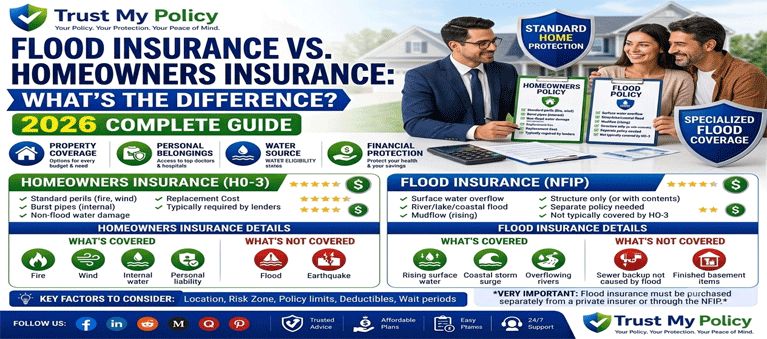
Homeowners insurance and flood insurance cover water damage from opposite directions. Homeowners insurance covers water that starts inside your home or falls from above — a burst pipe, a failed water heater, rain pouring in through a storm-damaged roof. Flood insurance covers water that comes from outside and rises up — overflowing rivers, storm surge, or heavy rain runoff pooling and entering at ground level. A standard homeowners policy excludes flood damage entirely, no matter the cause, which means even hurricane-related flooding requires a separate flood policy.
In the US, flood insurance is available through the National Flood Insurance Program (NFIP), run by FEMA, or through a growing number of private flood insurers. In the UK, flood cover isn’t a separate policy at all — it’s built into standard home insurance, backed behind the scenes by a government-industry scheme called Flood Re. Other countries handle it differently again, so where you live changes this conversation more than almost any other line of home insurance.
This is genuinely the whole concept, and it trips up more homeowners than almost any other insurance distinction. Insurers don’t ask “was there water damage?” — they ask “where did the water come from?”
Covered by homeowners insurance (generally): – A pipe bursts inside a wall – A water heater or appliance fails and leaks – Wind tears off part of your roof and rain gets in through the opening
Covered only by flood insurance: – A nearby river or lake overflows into your home – Storm surge from a hurricane pushes seawater into your property – Heavy rain runoff pools on the ground and seeps in at floor level – Mudflow
The distinction sounds simple, but it produces genuinely confusing edge cases. If wind rips your roof off and rain pours straight in, that’s usually a homeowners claim. If that same storm also causes a storm surge that floods your street and water enters through your front door, that part of the damage is a flood claim — even though it’s the same storm, the same day, the same house.
A standard homeowners policy is built to cover sudden, accidental damage from an internal or above-ground source. Typical covered water-damage scenarios:
What every standard homeowners policy excludes, without exception: flood damage from an external, rising water source — regardless of whether that flooding was caused by a hurricane, prolonged rain, snowmelt, or a nearby river overflowing. This exclusion exists industry-wide, not just with one or two insurers, because flooding tends to affect entire neighborhoods or regions simultaneously, which makes it a fundamentally different — and far more catastrophic — kind of risk to underwrite than a single house fire or burst pipe.
Flood insurance is a separate policy, purpose-built to cover damage from rising or external water. It generally covers:
What flood insurance typically excludes: – Damage from moisture, mildew, or mold that could have been prevented – Currency, precious metals, and some high-value items (often capped or excluded) – Temporary housing costs — unlike homeowners insurance, most flood policies don’t cover additional living expenses if you’re displaced
In the United States, flood insurance is sold two ways:
The National Flood Insurance Program (NFIP), managed by FEMA and sold through participating private insurers under its “Write Your Own” program:
Private flood insurance, sold by private carriers (including through the surplus-lines market in some states):
Flood insurance is mandatory in the US if you have a federally backed mortgage on a property in a high-risk flood zone (as mapped by FEMA), and optional — but often still worthwhile — everywhere else. It’s worth noting that a large share of flood damage in the US occurs outside officially designated high-risk zones, which is one reason many advisors recommend considering flood coverage even for homes not required to carry it.
The UK takes a structurally different approach. There’s no separate consumer-facing “flood insurance policy” to shop for — flood cover is built into standard buildings and contents insurance. What makes flood-prone UK homes insurable at an affordable price is a government-and-industry reinsurance scheme called Flood Re.
Here’s how it works, in plain terms:
Flood Re has some notable eligibility limits: it generally excludes homes built after 2009 (to discourage building on flood-prone land) and excludes commercial properties. It’s currently scheduled to run until 2039, with reforms announced in mid-2026 aimed at better targeting support toward lower-value homes rather than the most expensive properties. Because policy details like this evolve, anyone relying on Flood Re specifics for a purchase decision should check current terms directly with Flood Re or their insurer.
Flood insurance structures vary considerably by country, and it’s genuinely one of the least standardized areas of property insurance globally:
Because of this variation, readers outside the US or UK should treat this article’s mechanics as illustrative of how the two most-documented systems work, and check with a local insurer or regulator for how flood risk is actually underwritten where they live.
A few things worth weighing:
Flood insurance premiums vary enormously by location and risk level. Contributing factors generally include:
Because these factors vary so much by property, there’s no single “typical” premium that applies broadly — getting a quote for your specific address is the only reliable way to know your actual cost.
A homeowner in a US coastal state survives a hurricane with an intact roof, only to discover storm surge flooded the ground floor — and their homeowners policy specifically excludes that damage, leaving them reliant on the separate flood policy they’d fortunately already purchased.
A UK homeowner in a flood-prone area buys ordinary home insurance without ever seeing the term “flood insurance” on their paperwork, unaware that Flood Re is quietly making that policy affordable and available in the first place.
A US homeowner outside an official high-risk flood zone experiences flooding after an unusually heavy rain event and learns, after the fact, that their mortgage didn’t require flood coverage — but their home flooded anyway, since zone maps reflect statistical risk, not a guarantee.
(These are illustrative scenarios, not personalized recommendations.)
Does homeowners insurance cover flood damage from a hurricane? Generally, no. Wind damage from a hurricane is typically covered under homeowners insurance, but flooding and storm surge from that same hurricane require a separate flood insurance policy.
Is flood insurance required by law? In the US, it’s required if you have a federally backed mortgage on a property in a FEMA-designated high-risk flood zone. Outside that, it’s optional but often still worth considering. In the UK, there’s no separate flood policy requirement, since flood cover is generally built into standard home insurance via the Flood Re scheme.
What’s the difference between NFIP and private flood insurance? NFIP is a federally backed program with capped coverage limits ($250,000 building / $100,000 contents) and a standard 30-day waiting period. Private flood insurance often offers higher limits and shorter waiting periods, but individual insurers can choose not to renew a policy.
How long is the flood insurance waiting period? NFIP policies typically carry a 30-day waiting period before coverage begins. Private flood insurers often offer shorter waiting periods, sometimes with no wait at all, depending on the insurer and circumstances.
Can I get flood insurance if I’m not in a high-risk flood zone? Yes. Flood insurance is generally available regardless of zone designation, and a meaningful share of flood claims come from homes outside officially designated high-risk areas.
What is Flood Re, and do I need to buy it separately? Flood Re is a UK government-and-industry reinsurance scheme, not a consumer product. You don’t buy it directly — it works behind the scenes to help insurers offer affordable flood cover within your ordinary home insurance policy.
Does flood insurance cover temporary housing if I’m displaced? Usually not. Unlike homeowners insurance, most flood policies don’t include additional living expenses coverage, which is worth factoring in if you’re weighing how much protection you actually have.

Jagadeesh Gutha is the founder of TrustMyPolicy.com, an independent insurance information platform covering life, health, car, home, and business insurance for US and UK readers. He researches insurance products, policy structures, and consumer rights to help everyday people make informed coverage decisions without the jargon. All content on TrustMyPolicy is independently researched, fact-checked, and written to educate — not to sell.




Insurance Guides for UK, USA & Worldwide We are not an insurer or broker.

Reader Comments (0)