
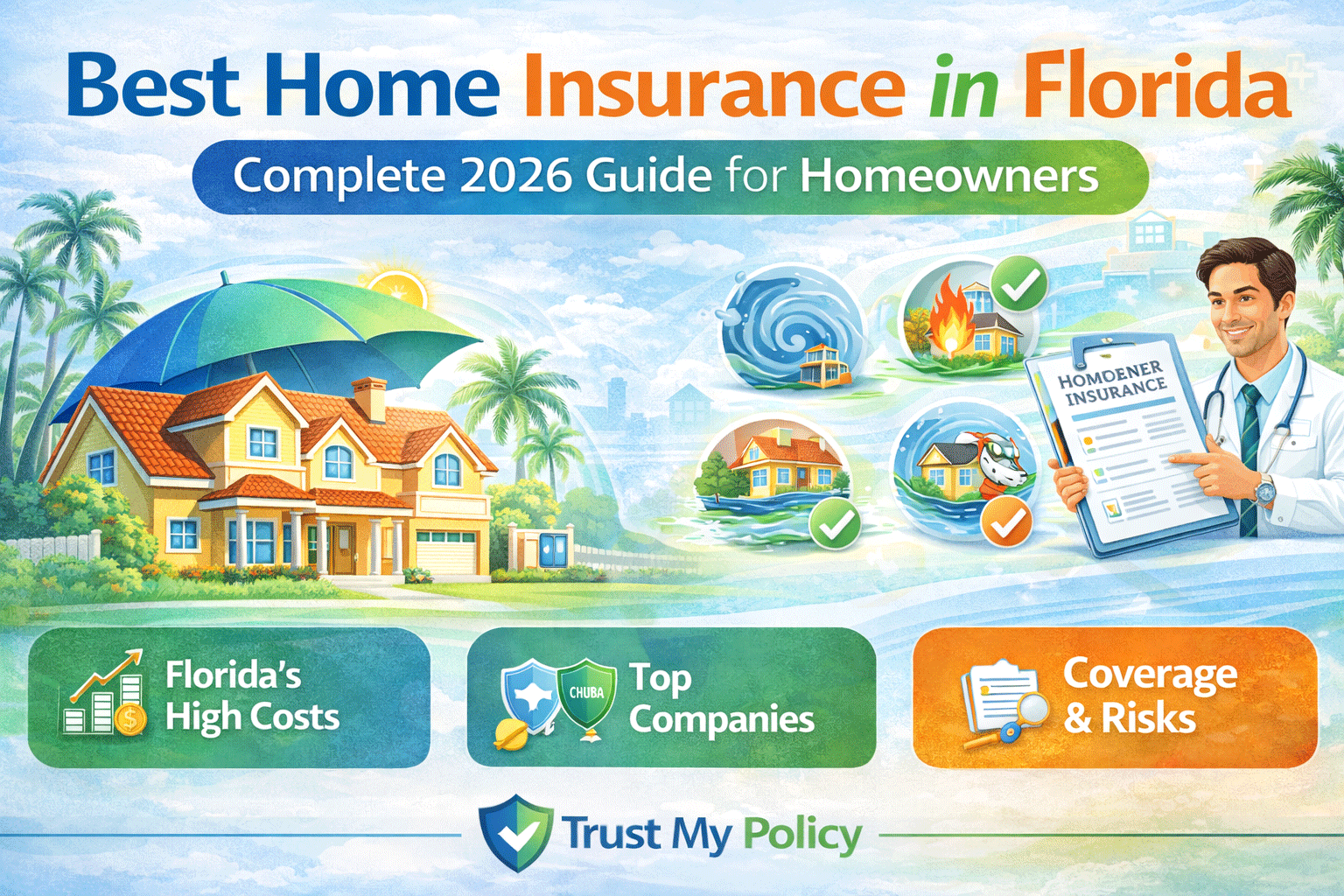
Best home insurance in Florida in 2026 is State Farm for overall value ($3,195/year average per NerdWallet 2026), Security First for the lowest available rate ($798/year for $350,000 dwelling coverage per ValuePenguin 2026), and Chubb for high-value homes above $500,000. The statewide average is $3,390/year (NerdWallet 2026), compared to the US national average of $2,424/year (Bankrate 2026). Florida’s market is stabilising in 2026 — rates fell in 2025 and Citizens Property Insurance is cutting rates 8.7% this spring. Hurricane deductibles of 2-5% of your dwelling value are standard and apply separately from your standard deductible.
Lisa, a 48-year-old teacher from Orlando, opened her home insurance renewal in March 2026 and stared at a number she could barely believe: $8,200 per year — up from $4,800 just three years earlier. She had made zero claims. Her roof was only 7 years old. Three back-to-back hurricane seasons, a wave of insurer exits, and years of litigation abuse had pushed Florida premiums into the stratosphere. Her neighbour had already cancelled coverage entirely — joining the 19.4% of Florida homeowners who are currently uninsured, according to ValuePenguin 2026 data. Lisa needed better coverage at a realistic price without gambling her $420,000 home on never filing a claim.
best home insurance in Florida in 2026 is harder to find than in any other state — but it does exist. According to NerdWallet 2026, State Farm averages $3,195 per year in Florida, compared to the state average of $3,390 per year, making it the strongest value major insurer in the state. Security First averages just $798 per year for $350,000 of dwelling coverage (ValuePenguin 2026) — the cheapest available. Most importantly, Citizens Property Insurance is cutting statewide rates by 8.7% in spring 2026, per FLOIR data, and Florida is the only US state where average home insurance premiums actually went down in 2025.
In this guide you will see the top 5 home insurers in Florida with 2026 rate data, what Florida home insurance covers and what it excludes, hurricane deductible rules most buyers overlook, average premiums by city, four real-life buyer scenarios, five proven strategies to cut your premium, and what to do if the standard market will not cover your property.
| Feature | Details |
| State average annual premium | $3,390/year — NerdWallet 2026 | $7,136/year — insurance.com (higher coverage level) |
| US national average (comparison) | $2,424/year — Bankrate 2026 (Florida pays 40-194% more depending on methodology) |
| Cheapest insurer 2026 | Security First — $798/year for $350,000 dwelling (ValuePenguin 2026) |
| Best value major insurer | State Farm — $3,195/year average (NerdWallet 2026) |
| Citizens rate change spring 2026 | Reducing 8.7% statewide (FLOIR) |
| Hurricane deductible | 2-5% of dwelling value — a separate deductible applying to named storm damage only |
| Flood coverage included? | No — flood requires a separate NFIP or private flood policy |
| Uninsured Florida homeowners | 19.4% — sixth highest uninsured rate nationally (ValuePenguin 2026) |
| Regulated by | Florida Office of Insurance Regulation (FLOIR) |
Florida has the second-highest home insurance rates in the US, behind only Louisiana. The causes are specific, structural, and — importantly — beginning to reverse in 2026.
Hurricane risk is the primary driver. Florida is the most hurricane-prone state in the country. In 2024 alone, Florida residents filed nearly 458,000 hurricane claims, according to Insurify 2026. Hurricane Ian in 2022 caused an estimated $113 billion in total damage — one of the costliest natural disasters in US history. Every Florida home insurance policy is priced with the assumption that a direct hurricane strike is a realistic near-term possibility.
Litigation abuse drove a secondary crisis. Florida historically accounted for 71% of all US homeowner insurance lawsuits despite representing only 9% of all claims, according to FLOIR data. This litigation crisis drove 12 insurers out of Florida between 2021 and 2024. Florida’s legislature passed sweeping litigation reform laws in 2023 — eliminating assignment of benefits abuse and one-way attorney fee awards that had caused insurer losses to spiral far beyond actual claim costs.
Roof age compounds every other factor. Florida insurers charge significantly more for roofs over 15 years old, and many refuse to write new policies on roofs older than 20 years without a current inspection certificate. A new roof can reduce Florida home insurance premiums by $500-$2,000 per year and dramatically expands the range of insurers willing to cover the property.
The positive shift in 2026: Florida is the only US state where average home insurance rates declined in 2025 — approximately 1% statewide per ValuePenguin 2026. Major carriers including State Farm have filed for double-digit rate decreases. Citizens Property Insurance is implementing an 8.7% statewide rate cut in spring 2026 (FLOIR). The reform-driven stabilisation is real, though rates remain well above the national average.
For guidance on filing a Florida home insurance claim after storm damage [INTERNAL LINK: why insurance claims get rejected and how to appeal — complete 2026 guide]
Standard Florida homeowners policies exclude: flood damage (requires a separate NFIP or private flood insurance policy), earthquake damage, normal wear and tear, mould unless caused by a covered sudden event, sinkhole damage (available as an optional endorsement under Florida law), and home-based business equipment above personal property limits.
Flood coverage is the most critical exclusion. Storm surge from a hurricane is classified as flooding — not wind damage — and is therefore excluded from standard home insurance. If your property is in or near a FEMA Special Flood Hazard Area, your mortgage lender almost certainly requires separate flood insurance as a loan condition. NFIP flood policies average $700-$2,800 per year in Florida depending on flood zone designation.
Average annual premium: $3,195/year (NerdWallet 2026). Why recommended: State Farm is the cheapest major insurer in Florida in 2026 with the lowest complaint ratio among large carriers according to the NAIC 2025 National Complaint Index. It writes policies statewide including most coastal areas where other carriers decline coverage. Auto-home bundle discounts of 10-15% are widely available. Best for: Most Florida homeowners wanting reliable coverage at a competitive price with local agent support. Rating: A++ AM Best; 4.2/5 JD Power 2025. Note: State Farm has filed for double-digit rate decreases in Florida — check your specific ZIP code for the current rate.
Average annual premium: $798/year for $350,000 dwelling coverage (ValuePenguin 2026). Why recommended: Security First is a Florida-specialist insurer offering the lowest statewide average rates for standard residential properties. It has coverage options for Florida-specific risks including hurricane protection for screened porches and lanais — features most national carriers handle poorly. Availability: Florida only — Security First does not operate in other states. Best for: Budget-focused Florida homeowners with newer homes in lower coastal-risk areas. Rating: A- AM Best; review current Trustpilot and Google reviews at your ZIP code, as service quality varies regionally.
Average annual premium: $682/year (The Zebra 2026) — among the lowest for newer builds. Why recommended: Travelers offers the most competitive rates for newly constructed homes built after Florida’s 2002 building code updates, which significantly strengthened hurricane-resistance requirements. Homes built post-2002 qualify for meaningful premium reductions versus pre-2002 construction. Multi-policy discounts available. People’s Trust Insurance — a Florida-specialist carrier — is even cheaper for new builds at $524/year (The Zebra 2026). Best for: Homeowners with construction dated 2002 or later. Rating: A++ AM Best; 3.8/5 JD Power 2025.
Why recommended: Chubb is rated the top overall Florida home insurer for high-value homes by NerdWallet 2026. Key advantages include extended replacement cost coverage that pays above policy limits if rebuild costs exceed the coverage amount — critical in Florida’s post-hurricane contractor market where demand spikes drive up costs. Chubb also offers a cash settlement option, allowing policyholders to take a lump sum payment instead of rebuilding. Risk consulting service: Chubb sends inspectors to identify and help mitigate risks before they become claims. Best for: Homes valued above $500,000, particularly in coastal areas with high rebuild cost risk. Typical premium: $4,000-$8,000 per year depending on location, age, and construction. Rating: AA Moody’s; 4.5/5 NerdWallet.
Average premium: Implementing an 8.7% statewide rate reduction in spring 2026 (FLOIR). Why relevant: Citizens is Florida’s state-backed insurer of last resort — a not-for-profit entity created by the Florida legislature to insure homeowners who cannot obtain coverage in the standard private market. It currently holds more Florida policies than any private carrier, though the state is actively depopulating Citizens by moving policies to private insurers. Best for: Homeowners in high-risk coastal areas declined by private market insurers. Eligibility: You must demonstrate that private coverage is either unavailable or is priced more than 15% above Citizens’ rate to qualify. Important limitation: Citizens coverage is generally less comprehensive than private market options — review dwelling limits, contents limits, and loss-of-use coverage carefully before accepting a Citizens policy.
We recommend State Farm for most Florida homeowners as the best combination of premium, coverage breadth, claims reliability, and statewide availability in 2026. Budget-focused buyers with newer construction in lower-risk areas should compare Security First and Travelers before committing to any insurer.
| City | Average Annual Premium | Key Risk Factors | Notes |
| Miami | $8,345/year (NerdWallet 2026) | Coastal, hurricane, high litigation history | Highest-cost major city in Florida |
| Tampa | $4,800-$6,200/year (estimated) | Gulf Coast exposure, post-2024 storm losses | Improving as litigation reforms take effect |
| Orlando | $3,200-$4,800/year (estimated) | Central Florida, lower coastal hurricane exposure | Better rates than coastal cities |
| Jacksonville | $2,800-$3,800/year (estimated) | Northeast Florida, lower hurricane frequency | Among more affordable major cities |
| Tallahassee | $2,640/year (NerdWallet 2026) | Inland, lower storm surge risk | Lowest major-city rate in Florida |
| Naples | $2,801/year (InsuredBetter 2026) | Coastal southwest Florida | Highest per-city rate in InsuredBetter dataset |
| Melbourne | $1,683/year (InsuredBetter 2026) | East central coast | Lowest per-city rate in InsuredBetter dataset |
| $500k dwelling — statewide average | $3,723/year (ValuePenguin 2026) | Varies widely by ZIP code | Security First lowest at $1,039/year for same coverage |
Scenario 1: Lisa, 48, Teacher — Orlando (Standard Mid-Range Home)
Lisa owns a $420,000 home built in 2008 with a 7-year-old roof. Her renewal came in at $8,200/year from her existing insurer. She requested quotes from three providers: State Farm $3,600/year, Security First $2,100/year, Travelers $2,800/year. She chose State Farm for its A++ AM Best rating and local agent presence — both matter for post-hurricane claim support. She also bundled auto insurance for a 12% multi-policy discount, reducing her effective home premium to $3,168/year. Annual saving versus auto-renewing: $5,032. Verdict: Shopping at renewal instead of auto-renewing saved Lisa over $5,000 per year. This is the single most impactful action any Florida homeowner can take.
Scenario 2: Marcus, 62, Retired — Miami Beach (High-Risk Coastal Property)
Marcus owns a $650,000 oceanfront condo in Miami Beach. Three private insurers declined to cover it — the coastal location put it outside their underwriting appetite. He was placed with Citizens Property Insurance at $11,200/year. He obtained a wind mitigation inspection ($150) which confirmed new impact-resistant windows and a 2019 roof, qualifying him for mitigation discounts that reduced the Citizens premium to $8,400/year. He also purchased a separate NFIP flood policy at $2,800/year for a combined total of $11,200. Verdict: High-risk coastal properties frequently have no viable standard market option. Wind mitigation upgrades are the most effective premium reduction tool available in this situation.
Scenario 3: Priya, 34, First-Time Buyer — Jacksonville (New Construction)
Priya bought a newly built $310,000 home in Jacksonville in 2026. Post-2002 new construction qualifies for Florida’s lowest rates. People’s Trust quoted $524/year. Travelers quoted $682/year. State Farm quoted $1,100/year. She chose People’s Trust at $524/year after verifying their A- AM Best rating. Her 2% hurricane deductible on $310,000 dwelling value = $6,200 — she confirmed she had that amount in accessible savings before closing. Verdict: New construction in lower-risk inland areas can achieve rates well below the state average. Always confirm your hurricane deductible amount equals accessible cash savings.
Scenario 4: The Ahmed Family — Tampa (Post-Hurricane Non-Renewal)
The Ahmeds owned a $380,000 home built in 1998 in Tampa. After suffering Hurricane Helene damage in 2024, their insurer non-renewed the policy. They had 60 days to secure replacement coverage. Their roof was now 16 years old — most standard carriers declined or required roof replacement as a condition of quoting. They replaced the roof ($18,000 investment) which qualified them for standard market coverage. State Farm offered $4,200/year post-replacement. Without the new roof, Citizens was their only option at $6,800/year. The roof replacement saves $2,600/year in premium — break-even point: 6.9 years. Verdict: A new roof in Florida is one of the most financially sound home investments available. It dramatically expands insurer choice and reduces premiums by $1,500-$3,000/year.
| Pros | Cons |
| Market stabilising — Florida is the only US state where average rates declined in 2025 (ValuePenguin 2026) | Second-highest rates in the US — average $3,390-$7,136/year depending on coverage level |
| Citizens reducing rates 8.7% statewide spring 2026 (FLOIR) — last resort is becoming more affordable | 19.4% of Florida homeowners currently uninsured — highest financial exposure risk of any major state |
| Wind mitigation credits reduce premiums $500-$3,000/year for qualifying upgrades | Hurricane deductible is 2-5% of dwelling value — $8,000-$20,000 OOP on a $400,000 home before insurer pays |
| New construction post-2002 qualifies for lowest state rates and broadest insurer choice | Flood damage is excluded from standard policies — a separate NFIP or private flood policy is required |
| Multiple insurer options in most areas — competition returning after 2023 litigation reforms | Roofs over 15 years old face higher premiums; roofs over 20 years old are often uninsurable in standard market |
Strategy 1: Replace an Ageing Roof
Why it works: Florida insurers treat roof age as a primary risk indicator. A new roof signals lower vulnerability to hurricane damage. Cost: $8,000-$20,000 depending on home size and material. Annual premium saving: $500-$3,000. Break-even: typically 4-7 years. Beyond the premium saving, a new roof dramatically expands the number of insurers willing to cover your home — especially critical after a non-renewal.
Strategy 2: Get a Wind Mitigation Inspection
Why it works: Florida law requires insurers to apply premium discounts when your home has certified wind mitigation features — impact-resistant windows, hurricane shutters, reinforced roof deck attachments. A wind mitigation inspection documents these features formally. Cost: $150 for the inspection. Annual premium saving: $200-$1,500 depending on features confirmed. The inspection fee is typically recouped within 4-6 weeks of the discount being applied.
Strategy 3: Raise Your Standard Deductible
Why it works: Increasing your standard (non-hurricane) deductible from $1,000 to $2,500 typically reduces your annual premium by 5-15%. Note that this is entirely separate from your hurricane deductible, which is fixed by the insurer as a percentage of dwelling value. Only raise the standard deductible if you have the higher amount in accessible savings.
Strategy 4: Bundle Home and Auto Insurance
Why it works: Most major Florida insurers — State Farm, Travelers, Allstate — offer 10-15% multi-policy discounts when you hold both home and auto insurance with the same carrier. Annual saving: $300-$800 on combined premiums. Lisa saved an effective $432/year on her home premium alone by bundling with State Farm.
Strategy 5: Shop at Every Annual Renewal
Why it works: Florida’s insurance market changes faster than any other state. An insurer that was cheapest 18 months ago may now be 40% more expensive than a competitor. Getting 3-5 quotes at every renewal — including Florida specialists like Security First, People’s Trust, and Florida Peninsula that do not appear on national comparison sites — is the highest-value 30 minutes any Florida homeowner can invest annually.
⚠️ WARNING: Cancelling Your Home Insurance to Save Money
What happens: 19.4% of Florida homeowners are currently uninsured (ValuePenguin 2026). A single hurricane can generate $50,000-$400,000 in structural damage with zero insurance recovery. Uninsured homeowners with a mortgage also face lender action — most Florida mortgage agreements require continuous home insurance, and lenders can purchase force-placed insurance at 3-5 times the market rate and add it to your outstanding loan balance. What to do instead: If your premium is genuinely unaffordable, contact Citizens Property Insurance (citizensfla.com) before cancelling any policy. Citizens is legally required to provide coverage to eligible Florida homeowners. Also request a wind mitigation inspection immediately — the $150 cost and resulting discount can make a significant difference within weeks.
| Your Situation | Our Recommendation |
| Standard market insurer available within 15% of Citizens rate | ✅ Choose standard market — typically broader coverage, stronger financial backing, more flexible policy terms |
| All private insurers have declined your application | ✅ Citizens is your legal right — apply directly at citizensfla.com |
| Your roof is over 20 years old | ✅ Replace the roof first, then get fresh standard market quotes — Citizens as fallback if timing is critical |
| You own a high-value home over $500,000 | ✅ Chubb or a private high-value specialist — Citizens limits may be insufficient for the full replacement cost |
| You are in inland central Florida — Orlando, Gainesville, Tallahassee area | ✅ Standard market — lower hurricane risk means competitive private rates are widely available |
| You are in a high-risk coastal zone — Miami-Dade, waterfront Tampa Bay, Keys | ✅ Get 5-6 quotes from Florida specialists before defaulting to Citizens; Security First and People’s Trust serve coastal areas |
| You received a non-renewal notice | ✅ Act within 60 days — contact an independent Florida broker immediately to find replacement coverage |
| Your premium increased more than 30% at renewal | ✅ Shop immediately — do not auto-renew; the 2026 market has competitive alternatives in most Florida ZIP codes |
💡 Tip: Get a wind mitigation inspection before your next renewal. The $150 fee typically generates $400-$1,500 in annual premium savings — recouped within weeks. Contact a Florida-licensed inspector through your insurer, an independent inspector directory, or search for NACHI-certified inspectors in your area.
| Profile / Scenario | Cheapest Insurer | Annual Premium | Notes |
| New construction, $300k dwelling, inland Florida | People’s Trust | $524/year (The Zebra 2026) | Post-2002 build qualifies for lowest tier rates |
| New construction, $300k, Travelers | Travelers | $682/year (The Zebra 2026) | Strong for newer builds, competitive multi-policy |
| State average, $350k dwelling | Security First | $798/year (ValuePenguin 2026) | Florida specialist — not available in other states |
| State Farm average, all dwelling values | State Farm | $3,195/year (NerdWallet 2026) | Best major insurer value statewide |
| State average all insurers, standard coverage | Various | $3,390/year (NerdWallet 2026) | Compare against national average of $2,424/year |
| $500k dwelling, statewide average | Security First | $1,039-$3,723/year (ValuePenguin 2026) | Wide range — location and roof age are key drivers |
| Miami — highest-cost major city | State Farm or Citizens | $8,345/year average (NerdWallet 2026) | Coastal exposure; litigation history drives rates |
| High-value home $600k+ | Chubb | $4,000-$8,000/year | Extended replacement cost; cash settlement option |
Florida home insurance is expensive due to three compounding factors: hurricane risk (Florida is the most hurricane-prone US state — 458,000 hurricane claims filed in 2024 per Insurify 2026), historical litigation abuse (Florida accounted for 71% of US homeowner lawsuits despite 9% of claims per FLOIR data), and high post-storm construction costs. On rates going down: yes, in many cases. Florida is the only US state where average home insurance rates declined in 2025 (approximately 1%, per ValuePenguin 2026). Citizens is cutting rates 8.7% statewide in spring 2026. State Farm and others have filed for further reductions. Rates are stabilising — but they remain well above the US national average.
A hurricane deductible is a separate deductible that applies specifically to damage caused by a named hurricane. Unlike standard deductibles — which are flat dollar amounts such as $1,000 or $2,500 — a hurricane deductible is calculated as a percentage of your insured dwelling value. Florida law requires insurers to offer hurricane deductible options of 2%, 5%, and 10% of dwelling coverage. On a home insured for $400,000 with a 2% hurricane deductible, you pay $8,000 out of pocket before your insurer covers any hurricane damage. The hurricane deductible applies only to named tropical storms and hurricanes; other windstorm damage such as tornadoes uses the standard deductible.
No. Standard Florida homeowners insurance explicitly excludes flood damage — including storm surge from a hurricane, which is classified as flooding rather than wind damage. Flood coverage requires a separate policy through the National Flood Insurance Program (NFIP) or a private flood insurer. NFIP policies average $700-$2,800 per year in Florida depending on your FEMA flood zone designation. If your home is in a FEMA Special Flood Hazard Area, your mortgage lender almost certainly requires flood insurance as a condition of your loan.
Citizens Property Insurance Corporation is Florida’s state-backed insurer of last resort — a non-profit entity created by the Florida legislature to cover homeowners who cannot obtain insurance in the standard private market. Citizens is implementing an 8.7% statewide rate reduction in spring 2026 per FLOIR. To be eligible, you must demonstrate that private market coverage is either unavailable to you or is priced more than 15% above Citizens’ rate. If a private insurer offers you a policy within 15% of Citizens’ rate, you are required to take the private policy. Apply directly at citizensfla.com or through a Florida-licensed insurance agent.
Roof age is one of the most influential rating factors in Florida. Insurers charge progressively higher premiums for roofs over 10 years old, significantly more for roofs over 15 years, and many refuse to write new policies at all on homes with roofs older than 20 years without an inspection certificate showing the roof is in adequate condition. A new roof — particularly one with impact-resistant shingles qualifying for a Florida Fortified designation — can reduce annual premiums by $500-$3,000 and is often the deciding factor in whether a standard market insurer will cover your property at all.
A wind mitigation inspection is a professional assessment of your home’s structural resistance to wind damage. An inspector evaluates your roof type and age, roof deck attachment method, roof-to-wall connections, roof covering material, and openings protection such as impact windows or hurricane shutters. Florida law requires insurers to apply premium discounts to homes with certified wind mitigation features. The inspection costs approximately $150, takes 45-90 minutes, and typically generates annual premium savings of $200-$1,500 depending on which features are present. The discount is applied immediately when you submit the completed wind mitigation report to your insurer.
An independent insurance broker is strongly recommended in Florida. The state has numerous specialist regional carriers — Security First, People’s Trust, Florida Peninsula, Tower Hill, Kin — that offer significantly lower rates than national carriers in many ZIP codes but are not quoted on national comparison websites and are not accessible through direct-to-consumer channels. An independent broker with Florida market experience can access 15-25 carriers simultaneously and match your specific home’s age, location, construction, and roof type to the insurer most likely to offer the lowest rate. Broker commissions are paid by the insurer — there is no additional cost to you as the policyholder.
If your Florida home insurer becomes insolvent, the Florida Insurance Guaranty Association (FIGA) steps in to pay covered claims up to $300,000 per claim. FIGA coverage provides continuity while you find a new insurer and ensures claims filed against the insolvent company are honoured. Between 2021 and 2024, multiple Florida home insurers became insolvent — selecting an insurer with a current A or higher AM Best financial strength rating significantly reduces this risk. Citizens Property Insurance, as a state-backed entity, carries no insolvency risk.
It is increasingly difficult but not impossible. Most major national carriers will decline to write a new policy on a home with a roof older than 20 years. Florida specialist insurers — Security First, People’s Trust, Florida Peninsula — often have more flexible roof age underwriting and may quote on roofs up to 20-25 years with a current roof inspection certificate showing the roof is in serviceable condition. Citizens Property Insurance will also cover older roofs in most cases, though at higher premiums than a comparable new roof would generate. If your roof is approaching 20 years, obtaining quotes and scheduling a replacement proactively rather than reactively after a non-renewal gives you far more options.
Force-placed insurance — also called lender-placed insurance — is coverage your mortgage lender purchases on your behalf if your home insurance lapses or is cancelled. The lender does this to protect their financial interest in the property. Force-placed insurance typically costs 3-5 times more than standard market coverage, covers only the lender’s interest (not your personal property or liability), and is charged directly to your mortgage account — increasing your monthly payment. To avoid it: never allow your home insurance to lapse. If your premium is unaffordable, contact Citizens or an independent broker before cancelling. A standard Citizens policy at any rate is significantly cheaper than force-placed insurance.
Most Florida homeowners benefit from both. Standard home insurance covers hurricane wind damage, fire, theft, liability, and most structural perils — but explicitly excludes flooding, including hurricane storm surge. A separate NFIP or private flood policy covers flood damage from storm surge, heavy rainfall, and rising water. If you are in a FEMA-designated flood zone, your lender requires flood insurance. Even if you are not in a designated flood zone, private flood insurance is worth considering in Florida — approximately 25% of flood claims nationwide come from properties outside designated flood zones according to FEMA data.
This article is for informational purposes only. Always consult a licensed Florida insurance professional before making coverage decisions. Trust My Policy does not sell insurance products or represent any insurer.

Jagadeesh Gutha is the founder of TrustMyPolicy.com, an independent insurance information platform covering life, health, car, home, and business insurance for US and UK readers. He researches insurance products, policy structures, and consumer rights to help everyday people make informed coverage decisions without the jargon. All content on TrustMyPolicy is independently researched, fact-checked, and written to educate — not to sell.




Insurance Guides for UK, USA & Worldwide We are not an insurer or broker.

Reader Comments (0)