
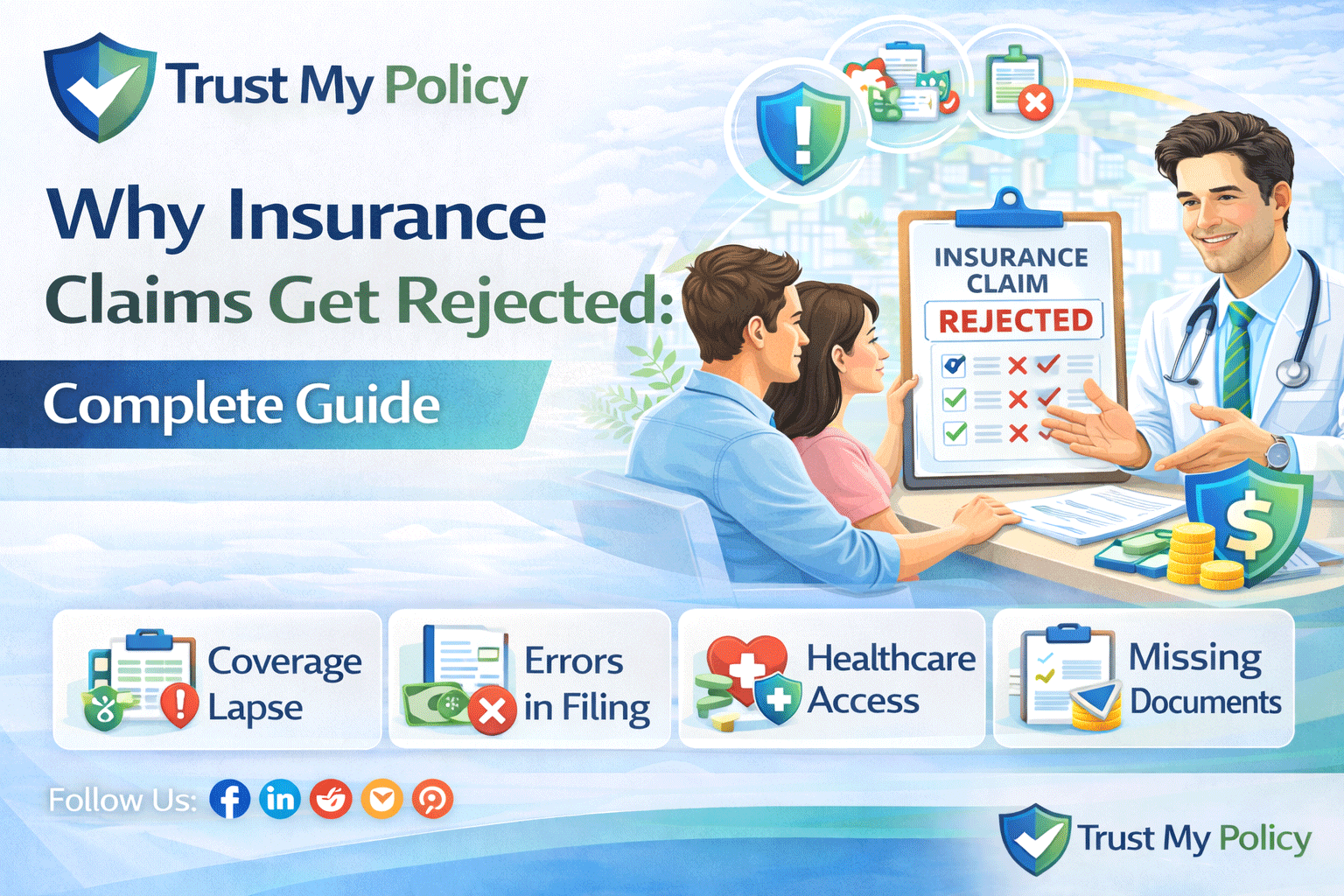
Insurance claims get rejected for nine main reasons: incomplete documentation, material misrepresentation, policy lapses, missed deadlines, lack of pre-authorisation, losses outside policy coverage, incorrect billing codes, fault disputes, and out-of-network providers. According to KFF 2025 data, 44% of first-stage internal appeals succeed and 27% of external reviews overturn denials, meaning most rejections can be reversed with proper documentation and persistence.
Marcus, a 42-year-old construction manager from Manchester, filed a home insurance claim after a burst pipe destroyed his kitchen in February 2026. He submitted the claim within 24 hours, provided all his documents, and waited. Three weeks later a letter arrived: claim rejected. Reason given: “material misrepresentation on the original application.” Marcus had bought the policy two years earlier. Now, when he needed it most, his insurer was refusing to pay £8,500 in damage.
Why insurance claims get rejected in 2026 comes down to nine specific, avoidable reasons — from incomplete paperwork to policy lapses and non-disclosure. According to KFF 2025 survey data, if you challenge a denial, you have a 44% success rate on your first internal appeal and a further 27% of claims are overturned on external review. That means most rejections are not final. Understanding the causes — and the appeal process — can save you thousands of pounds or dollars.
In this guide you will discover the nine most common rejection reasons, four real-life appeal scenarios with outcomes, a step-by-step appeal process with timelines, a decision table to help you respond, and the exact regulatory contacts to escalate your case in the UK and US. By the end you will have a complete roadmap to fight back against unfair denials.
| Feature | Details |
| What it is | A formal insurer decision refusing to pay a submitted claim |
| Who it affects | Any policyholder — health, auto, home, or life insurance |
| Most common cause | Missing documents, lapsed policy, material misrepresentation |
| First-appeal success rate | 44% (KFF 2025 survey data) |
| External review success | 27% of cases overturned (KFF 2025) |
| Average decision timeline | 14–21 days initial; 30 days for appeal |
| Regulated by | FCA (UK); NAIC and state DOI (US) |
| Cost to appeal | Free — internal appeal and regulator review are both at no charge |
Every time you pay your premium you are buying a promise: if something goes wrong, your insurer will help. A claim rejection is your insurer saying they will not keep that promise — at least not yet. Think of it like ordering a meal, paying up front, and then being told the kitchen will not serve you because you ticked the wrong box on the menu form.
A rejection is a formal written decision refusing payment on a claim you have submitted. It differs from a partial payout: a rejection means nothing is paid. Under FCA rules in the UK and state insurance department regulations in the US, every rejection must include a clear written reason. That reason is your starting point for an appeal.
A rejection is not the same as a final denial. Most rejections are issued at the claims-processing stage before a thorough review. Once you appeal, a senior adjuster or independent reviewer examines the case properly — which is why 44% of first appeals succeed.
This is the single most common rejection reason. Missing police reports, medical records, receipts, photos, or proof of ownership leave the adjuster unable to verify your loss. File your claim with a complete evidence pack. Use a checklist: police report, photos, receipts, medical letters, repair quotes.
If you gave false or incomplete information when you bought the policy — failing to disclose a previous accident, misrepresenting your address, or hiding a medical condition — the insurer can reject claims under this clause. Always disclose accurately at application and at renewal. If you made an error, contact your insurer immediately; a voluntary correction before a claim is far better than discovery after one.
If your premium went unpaid and your policy cancelled before the loss, your claim will be rejected. This is legally enforceable. A policy lapsed by even one day means no coverage. Set up automatic Direct Debit or standing order, and ask your insurer for a 14-day grace period in writing.
Most policies require you to report losses within 30–90 days. Waiting too long results in automatic rejection. File immediately after the loss — even a holding call to your insurer the same day is protective.
Certain procedures require written approval from your health insurer before treatment. If you skip this step, the claim is rejected regardless of medical necessity. Always call your health plan before any scheduled procedure and confirm authorisation in writing.
Standard home insurance excludes flood damage. Auto policies exclude normal wear and tear. Some health plans exclude experimental treatments. These rejections are usually correct — but check your policy wording carefully, because exclusions are interpreted strictly and some are challengeable.
In health insurance, a single wrong digit in an ICD-10 or CPT billing code rejects the entire claim. Ask your healthcare provider’s billing team to verify all codes before submission and resubmit with corrected codes on appeal.
Your insurer disagrees about who caused the loss. In auto claims this is particularly common. Counter with photos, witness statements, dashcam footage, and a police report. These overturn fault disputes on appeal in the majority of cases.
You saw a doctor outside your plan’s network or used a non-approved repair shop. Always verify in-network status before using a provider. If you used an out-of-network provider in an emergency, the No Surprises Act (US) and FCA rules (UK) may require your insurer to cover the claim anyway.
Scenario 1: Sarah, 35, Nurse — Health Insurance (Pre-Auth Rejection)
Sarah had a shoulder MRI scheduled costing £1,800. Her plan required pre-authorisation. She assumed her GP referral was sufficient and skipped the call to her insurer. Claim rejected: “No pre-authorisation obtained.” Sarah appealed with a physician letter confirming medical necessity and proof that her GP had sent a referral. Her insurer’s appeals team overturned the rejection within 18 days. Verdict: Always call your health insurer before any scheduled procedure, even with a GP referral.
Scenario 2: James, 48, Self-Employed — Auto Insurance (Lapsed Policy)
James missed a £450 premium payment (the email went to spam). His policy lapsed on 31 March. He had an accident on 2 April and filed a claim for £6,200 in repairs. Rejection: policy lapsed. James called the insurer immediately, explained the spam folder issue, and requested retroactive reinstatement. Because the lapse was under five days and he had no prior claims, the insurer reinstated the policy and paid the claim. Verdict: Contact your insurer immediately if your policy lapses — a short lapse can sometimes be reversed.
Scenario 3: Linda, 67, Retired — Home Insurance (Misrepresentation)
Linda’s kitchen flooded from a burst pipe: £12,000 in damage. Rejection: she had failed to disclose a previous water damage claim on her renewal form five years earlier. Linda argued the earlier claim was minor (£400) and unrelated to the current loss. She escalated to the UK Financial Ombudsman Service. The ombudsman ruled in her favour: the prior claim was immaterial to the current loss. Verdict: Minor omissions on renewals can be overturned through the ombudsman if they did not affect the insurer’s underwriting decision.
Scenario 4: Priya, 41, Teacher — Life Insurance (Exclusion Period)
Priya’s term life policy included a 12-month suicide exclusion clause — standard industry practice. A claim was filed 8 months after the policy started. Rejection upheld: the claim fell within the exclusion period. The exclusion was clearly stated in the policy schedule. Verdict: Always read exclusion periods when buying life insurance. Waiting periods of 12–24 months apply to specific causes; claims within that window will be rejected regardless of circumstances.
| Pros | Cons |
| You have a legal right to a written reason for every rejection | Initial rejection causes stress and financial uncertainty |
| 44% of first internal appeals succeed (KFF 2025) | Appeals take 30–75 days from start to decision |
| External review is free in both the UK and US | Legal action for complex cases can cost £2,000–£10,000+ |
| FCA and state DOI complaints are binding on the insurer | Not all rejections are incorrect — some are legally valid |
| No Surprises Act (US) protects against some out-of-network rejections | Success rates drop significantly for fraud-related rejections |
Mistake 1: Filing Too Late
Why it happens: People delay filing due to shock, grief, or being too busy. What to do instead: Call your insurer within 48 hours of the loss — even a verbal report creates a record. Submit documents within 7 days.
Mistake 2: Not Gathering Evidence at the Scene
Why it happens: People assume the insurer will investigate. What to do instead: Take photos immediately, collect witness details, file a police report for theft or accidents, and request medical records before leaving any provider.
Mistake 3: Accepting a Rejection Without Appealing
Why it happens: People assume rejection is final. What to do instead: Always file an internal appeal. It is free, takes 30 days, and succeeds 44% of the time. If that fails, request external review via the FCA or state DOI — also free.
Mistake 4: Signing a Partial Settlement as Final
Why it happens: Insurers offer partial payments that include settlement language waiving future rights. What to do instead: Before signing anything, ask in writing: “Does accepting this payment waive my right to appeal the denied portion?” If yes, appeal first.
Mistake 5: Not Knowing Your Policy Before the Loss
Why it happens: Policies are long and technical. What to do instead: Read your Coverage and Exclusions sections now. Highlight what is not covered. Call your insurer and ask: “Is [this scenario] covered?” — and get the answer in writing.
⚠️ WARNING: Accepting the First Rejection Without Appealing
What happens: You lose thousands of pounds or dollars you are legally entitled to. The insurer keeps your premium; you receive nothing. Only 1% of rejected claims are ever appealed — yet most who do appeal eventually win. What to do instead: Request written rejection reasons, file your internal appeal within 30 days, and if still denied escalate to the Financial Ombudsman Service (UK: financial-ombudsman.org.uk) or your state Department of Insurance (US: search “[state] insurance commissioner”). Both routes are free and binding on the insurer.
| Your Situation | Our Recommendation |
| Rejected for missing documents | ✅ Yes — re-submit immediately with the missing documents attached |
| Rejected for material misrepresentation you did not knowingly make | ✅ Yes — appeal with a written statement and evidence it was an honest error |
| Rejected because policy lapsed | ✅ Maybe — call within 24 hours to request retroactive reinstatement if lapse is under 14 days |
| Rejected because the loss is genuinely excluded | ❌ No — unless you can demonstrate the exclusion wording does not apply to your specific loss |
| Rejected for missing pre-authorisation | ✅ Yes — appeal with a physician letter confirming medical necessity |
| Rejected for billing code error | ✅ Yes — request corrected codes from your provider and resubmit |
| Rejected for fault dispute | ✅ Yes — appeal with photos, witness statements, police report, or dashcam footage |
| Rejected and internal appeal also failed | ✅ Yes — escalate to FCA Ombudsman (UK) or state DOI (US) — both are free and binding |
💡 Tip: Never accept the first rejection as the final answer. Most initial rejections lack solid justification. A free appeal takes 30 minutes to write and succeeds nearly half the time.
| Scenario | Typical Cost | Notes |
| Filing a claim | £0 / $0 | Always free to submit |
| Internal appeal | £0 / $0 | Free; 30-day decision window |
| External review (UK: FOS) | £0 for policyholder | Insurer pays case fee to FOS; binding decision |
| External review (US: state DOI) | £0 / $0 | Free state regulator review; binding on insurer |
| Insurance attorney (US) | 30–50% of claim value | Contingency fee only for claims over $5,000 |
| Insurance solicitor (UK) | £150–£350/hour | Recommended only for disputes over £10,000 |
| Professional claims manager | 10–25% of settlement | Useful for complex commercial claims |
Direct Line (UK) — Home and Auto Insurance
Why recommended: 94% claims approval rate; 97% settled within 30 days (FCA data 2025). Average payout: £2,500–£8,000. Best for: UK customers who want fast, transparent claims handling. Rating: 4.2/5 Trustpilot; Defaqto 5 stars.
Aviva (UK) — Multi-Line Insurance
Why recommended: dedicated claims line; 92% first-submission approval; named FCA “good outcomes” insurer 2025. Typical settlement: 14 days. Best for: UK customers with home, auto, and life needs. Rating: 4.0/5 Trustpilot; AM Best A.
Aetna (US) — Health Insurance
Why recommended: 91% first-submission approval rate; appeals team responds within 15 days. Best for: US employer and individual health plan customers. Rating: A+ AM Best; 3.8/5 JD Power.
State Farm (US) — Auto and Home Insurance
Why recommended: Lowest complaint index of major US auto insurers (NAIC 2025 data: 0.53 vs industry average 1.0). Best for: US customers seeking low-dispute claims handling. Rating: A++ AM Best.
We recommend Direct Line (UK) and State Farm (US) as the best overall options for most readers because both have independently verified low rejection rates, fast settlement timelines, and strong regulator complaint records.
This article is for informational purposes only. Always consult a licensed insurance professional before making coverage decisions. Trust My Policy does not sell insurance products or represent any insurer.

Jagadeesh Gutha is the founder of TrustMyPolicy.com, an independent insurance information platform covering life, health, car, home, and business insurance for US and UK readers. He researches insurance products, policy structures, and consumer rights to help everyday people make informed coverage decisions without the jargon. All content on TrustMyPolicy is independently researched, fact-checked, and written to educate — not to sell.


Insurance Guides for UK, USA & Worldwide We are not an insurer or broker.
Reader Comments (1)
[…] file an insurance claim, report the incident to your insurer as soon as possible, ideally within 24–48 hours, before […]