
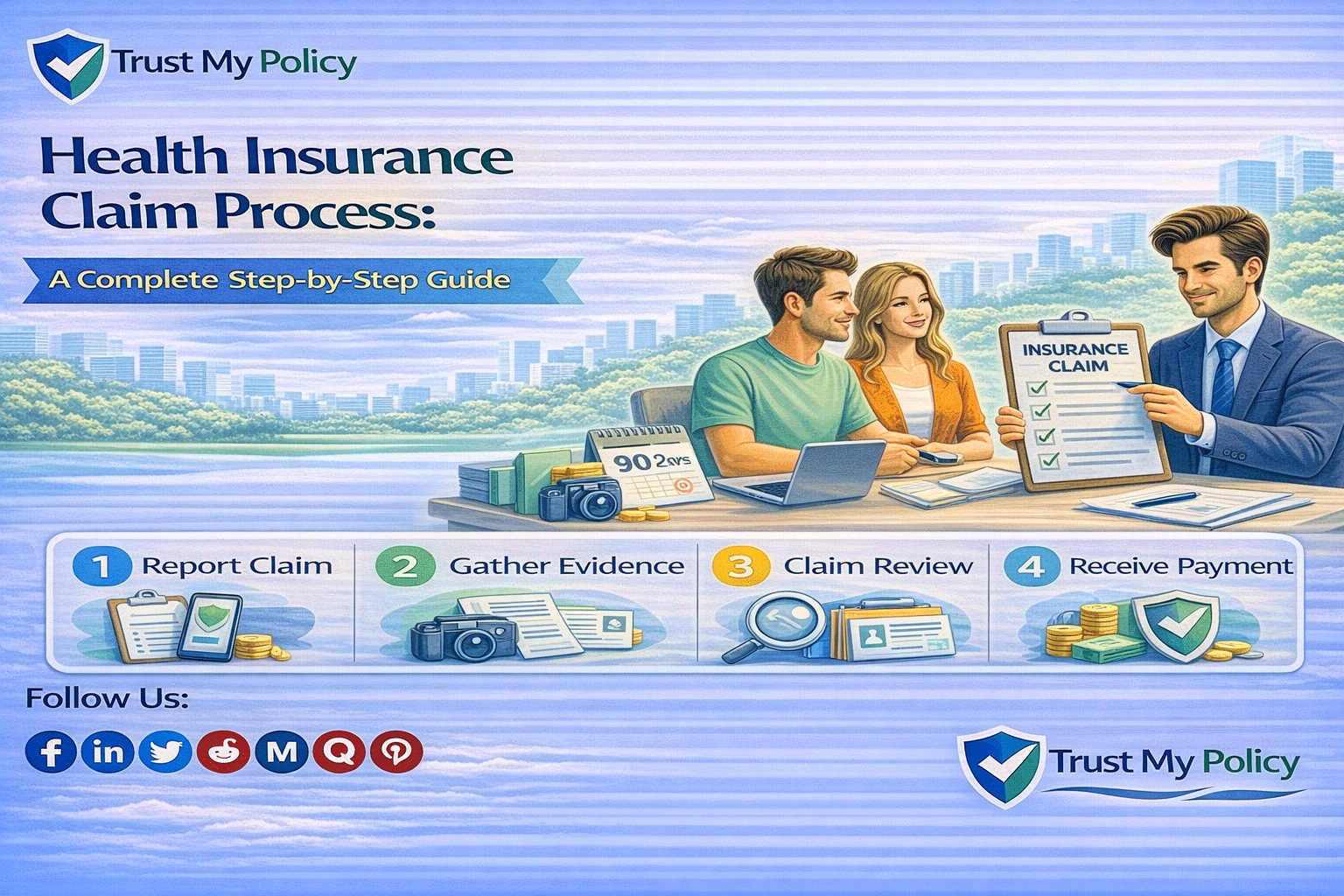
In the US, most in-network health insurance claims are filed by your healthcare provider directly with your insurer, with you receiving an Explanation of Benefits (EOB) summarising the outcome — not a bill. Out-of-network or overseas claims may require you to pay upfront and file for reimbursement. In the UK, NHS treatment requires no claim at all; private medical insurance typically requires a GP referral and pre-authorisation, after which the insurer bills the provider directly.
Karen Obi, 44, received an Explanation of Benefits (EOB) from her US health insurer two weeks after a specialist visit and assumed it was a bill. It wasn’t — it was simply her insurer’s summary of how the claim was processed. She paid it anyway and spent six weeks untangling the overpayment.
The Health Insurance Claim Process in 2026 typically happens largely behind the scenes for US in-network care, with providers billing insurers directly and patients receiving an EOB afterward, not a bill. For out-of-network or self-pay situations, the claimant may need to file directly. In the UK, NHS care involves no patient billing at all, while private medical insurance claims require a referral code, pre-authorisation for many treatments, and a separate billing process through the provider. This guide breaks down exactly how claims move from consultation to payment in both countries.
This article covers how the US and UK health insurance claim processes differ, how to read an Explanation of Benefits, real scenarios showing what can go wrong and how to fix it, and what your rights are if a health claim is denied. By the end, you’ll never mistake an EOB for a bill again.
| Feature | Details |
| What it is | The process by which a health insurance payment is requested, reviewed, and settled |
| US in-network process | Provider bills insurer directly; patient receives an EOB, not an immediate bill |
| US out-of-network process | Patient may pay upfront then submit a reimbursement claim |
| UK NHS process | No patient claim required; funded through taxation |
| UK private medical insurance | Requires GP referral, pre-authorisation for many treatments, insurer pays provider directly |
| Key benefit | Understanding the process prevents common errors like paying an EOB as a bill |
| Regulator | CMS and state insurance departments (US); Financial Conduct Authority (UK) |
Think of the health insurance claim process like a backstage operation at a restaurant — most diners simply order food and receive it. The kitchen’s complex supply chain, billing, and inventory management happen entirely without their involvement. Most US in-network health claims work similarly: the billing happens between provider and insurer, and you receive a summary only after it’s done.
The health insurance claim process is the sequence through which a healthcare provider requests payment from an insurer for services rendered, the insurer reviews and adjudicates the claim, and a settlement is reached. For US in-network care, most of this happens without any action required from the patient. For out-of-network care or international healthcare, the patient often initiates the claim themselves. In the UK, NHS care involves no claim process for the patient, while private medical insurance involves a pre-authorisation step before care is delivered. Understanding which process applies to your specific situation prevents the kind of confusion Karen experienced.
| Criteria | US In-Network | US Out-of-Network | UK Private Medical Insurance |
| Who files the claim | Provider files directly | Sometimes the patient files for reimbursement | Provider files after insurer pre-authorises treatment |
| Patient upfront payment | Usually just a copay at time of service | Often full cost upfront, then reimbursement | Usually just the policy excess |
| Pre-authorisation required | Sometimes for specific procedures | Sometimes for specific procedures | Often required, especially for specialist referrals |
| Key document received | Explanation of Benefits (EOB) | Reimbursement confirmation | Authorisation letter and provider invoice |
| Pros | Minimal patient effort, billing handled by provider | Access to any provider | Fast specialist access with insurer handling payment |
| Cons | EOB confuses many patients as a bill | More paperwork and upfront cash required | Gaps between referral, authorisation, and care can add time |
We recommend always using in-network providers for most US readers, since the claim process is far simpler and your out-of-pocket cost is typically lower.
Scenario 1: Karen, 44, US health plan member who paid her EOB. Karen paid her EOB as if it were a bill and spent six weeks recovering the overpayment. Verdict: an EOB is a summary document, not a bill — wait for a separate provider invoice before paying anything. Action: Karen now writes “EOB — not a bill” on each EOB as soon as it arrives to avoid the same mistake.
Scenario 2: A US traveller who received emergency care abroad. He paid the foreign hospital upfront and submitted a reimbursement claim to his insurer on return, including translated receipts and a claims form. Verdict: out-of-network and international claims require the patient to initiate the claim, with full documentation. Action: he now carries a travel health insurance card alongside his main plan’s member ID.
Scenario 3: A UK private medical insurance member in Manchester referred for a knee consultation. Her GP provided a referral letter, her insurer issued a pre-authorisation code, and she gave this to the private hospital, which billed the insurer directly. Verdict: UK private medical insurance typically requires a pre-authorisation code before the claim is processed. Action: she now confirms pre-authorisation before every private appointment to avoid unexpected out-of-pocket costs.
Scenario 4: A US employee whose in-network claim was initially processed incorrectly. The provider had used the wrong billing code, causing the insurer to apply the claim to the wrong benefit category. Verdict: billing code errors are a common cause of unexpected patient cost — always compare your EOB against your actual services received. Action: the employee contacted both her insurer and the provider’s billing department, and the corrected claim was reprocessed within two weeks.
| Pros | Cons |
| US in-network claims require minimal patient action, handled between provider and insurer. | EOBs are widely misread as bills, causing unnecessary and erroneous payments. |
| UK private medical insurance handles payment directly with the provider. | Pre-authorisation requirements can add delays between referral and actual care. |
| Standardised billing codes reduce some claim processing ambiguity. | Billing code errors are a frequent, avoidable cause of incorrect patient costs. |
| Patients have the right to appeal denied health claims at no cost. | Out-of-network claims require significantly more patient effort and upfront cash. |
| Electronic claim submission speeds the US adjudication process. | Out-of-network reimbursement timelines can take weeks to months. |
⚠️ WARNING: Never pay a health bill without first confirming your insurer has processed the claim and your EOB reflects the correct patient responsibility. Paying before the insurer has processed the claim means you may overpay, and recovering an overpayment is far more difficult than simply waiting for the correct amount.
| Your Situation | Our Recommendation |
| You received an EOB from your insurer | Yes — read it carefully but wait for a provider invoice before paying |
| A service on your EOB doesn’t match what you received | Yes — contact your provider’s billing department and your insurer to request a correction |
| You received care out-of-network and paid upfront | Yes — submit a reimbursement claim with all receipts and required forms promptly |
| You need a specialist procedure that may require pre-authorisation | Yes — confirm with your insurer before the appointment, not after |
| Your health claim was denied | Yes — file an internal appeal immediately with supporting documentation |
| You’re unsure of the difference between your EOB and your bill | Yes — contact your insurer’s member services line for a plain-language explanation |
| You’re on UK private medical insurance and need a specialist | Yes — get a GP referral first, then confirm pre-authorisation before booking |
💡 TIP: The single golden rule for the health insurance claim process: an Explanation of Benefits is never a bill — always wait for a separate provider invoice that confirms your actual patient responsibility after the claim has been processed.
| Scenario | Claim Path | Patient Cost |
| US in-network GP visit, $30 copay plan | Provider files directly, copay at service | $30 copay, no additional bill if deductible met |
| US in-network specialist visit, $2,000 deductible not yet met | Provider files directly, deductible applied | Full allowed amount until deductible is met |
| US out-of-network hospital visit | Patient pays upfront, files reimbursement | Full cost upfront; reimbursed at out-of-network rate (often 50%–70%) |
| UK NHS treatment | No claim required | £0 direct cost to patient |
| UK private medical insurance specialist visit | Pre-authorisation + provider bills insurer | Typically just the policy excess (e.g., £100–£250) |
| EOB paid in error by patient | N/A — no claim path change | Overpayment must be recovered from provider or insurer; can take weeks |
| Denied claim appealed successfully | Internal appeal | Original claim paid at the plan’s standard rate |
Your insurer’s member services line — The fastest way to clarify whether an EOB is correct, confirm pre-authorisation requirements, or understand a denied claim reason. Cost range: free. Best for: any immediate claim question. Rating: not applicable, primary service channel.
Your provider’s billing department — Can correct billing code errors and resubmit a claim on your behalf. Cost range: free. Best for: resolving discrepancies between your EOB and actual services received. Rating: not applicable, primary billing contact.
CMS.gov (US) — Publishes consumer guides on understanding EOBs and your rights under Medicare and marketplace plans. Cost range: free. Best for: US consumers wanting official guidance on the claim process. Rating: federal government resource.
Financial Ombudsman Service (UK) — Can review unresolved private medical insurance claim disputes after the insurer’s internal process is exhausted. Cost range: free for consumers. Best for: UK policyholders with an unresolved claim dispute. Rating: independent statutory ombudsman.
State insurance departments (US) — Can assist if a health claim is unreasonably delayed or improperly denied after internal appeal. Cost range: free to file a complaint. Best for: US policyholders facing an unresolved denial. Rating: government regulatory body.
We recommend starting with your insurer’s member services line as best overall first step, since most EOB questions, billing discrepancies, and pre-authorisation requirements can be resolved in a single phone call.
For in-network care, your provider submits the claim directly to your insurer, which adjudicates it and sends you an EOB. You then receive a separate bill from the provider for your share.
An EOB is a document your insurer sends after processing a health claim, summarising what was billed, what the insurer paid, and what you owe. It is not a bill.
For out-of-network or overseas care, download a claim form from your insurer, attach all provider invoices and receipts, and submit according to your plan’s instructions.
Pre-authorisation is your insurer’s advance approval for a specific procedure or specialist referral, confirming it’s covered before care is delivered. Without it, the claim may be denied.
In-network US claims typically process within 7–30 days. Out-of-network reimbursement can take 4–8 weeks depending on the complexity and completeness of submitted documentation.
File an internal appeal immediately with your insurer, including any additional documentation that addresses the denial reason. Many health claim denials are reversed at this stage.
NHS treatment requires no patient claim; it’s funded through taxation, and patients are not billed for covered NHS services.
You obtain a GP referral, your insurer issues a pre-authorisation code, you receive treatment, and the provider bills the insurer directly. You typically only pay your policy excess.
Yes. Incorrect billing codes can cause claims to be applied to the wrong benefit category or denied entirely. Always compare your EOB against your actual services and dispute any discrepancy.
An EOB is your insurer’s summary of how it processed a claim. A medical bill is the separate document from your provider showing what you actually owe after the insurer’s payment.
This article is for informational purposes only. Always consult a licensed insurance professional before making coverage decisions. Trust My Policy does not sell insurance products or represent any insurer.

Jagadeesh Gutha is the founder of TrustMyPolicy.com, an independent insurance information platform covering life, health, car, home, and business insurance for US and UK readers. He researches insurance products, policy structures, and consumer rights to help everyday people make informed coverage decisions without the jargon. All content on TrustMyPolicy is independently researched, fact-checked, and written to educate — not to sell.



Insurance Guides for UK, USA & Worldwide We are not an insurer or broker.
Reader Comments (1)
[…] act of deception to obtain an insurance payout or reduce a premium unfairly, including exaggerating claims, staging accidents, or misrepresenting information on an application. It costs US insurers […]