
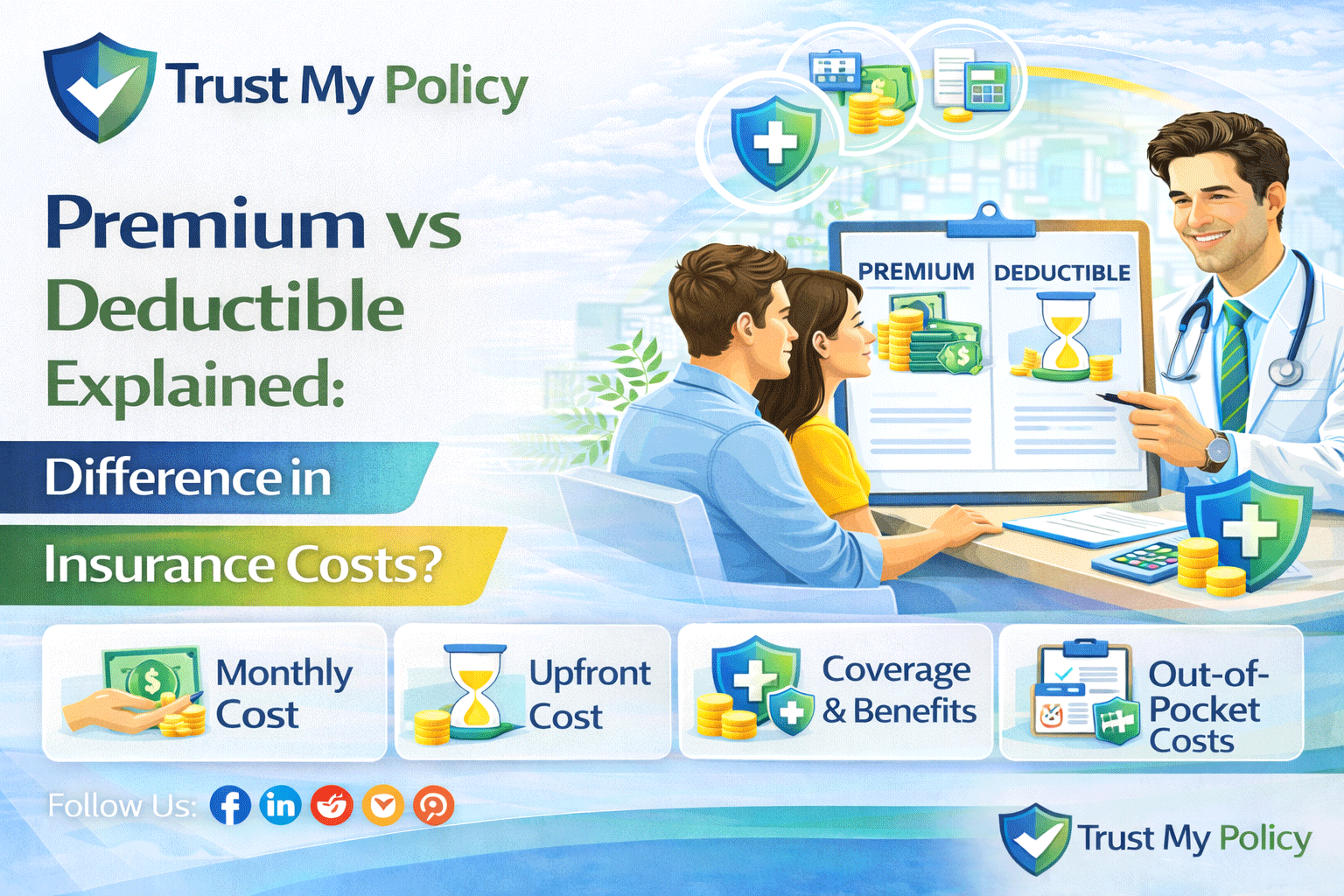
A premium is the fixed payment — monthly or annual — you make to keep your insurance policy active, regardless of whether you make a claim. A deductible is the amount you pay out of pocket before your insurer starts covering costs on a claim. They have an inverse relationship: higher deductible usually means lower premium. In 2026, the average individual health deductible for an HDHP is $1,700 minimum (HealthPartners 2026). For most people, choosing based on premium alone is a costly mistake.
Ranjit, a 38-year-old IT consultant from Texas, spent 20 minutes comparing two health plans during open enrollment. Plan A cost $180 per month. Plan B cost $260 per month. He picked Plan A — obviously the cheaper option. Eight months later, Ranjit had knee surgery. The total hospital bill was $22,000. Under Plan A, his deductible was $4,500. Under Plan B, it would have been $1,200. Ranjit paid $3,300 more out of pocket than he needed to — because he compared monthly premiums instead of total annual cost.
Premium vs deductible in 2026 represents the two most important numbers in any insurance policy: the premium is the fixed monthly or annual amount you pay to keep your policy active whether you use it or not, while the deductible is the amount you pay out of pocket before your insurer starts covering costs. These two figures move in opposite directions — lower your premium and your deductible almost always rises, and vice versa. According to HealthPartners 2026 data, plans with deductibles over $1,700 for individuals and $3,400 for families are classified as high-deductible health plans (HDHPs) in 2026.
This guide explains exactly how premiums and deductibles work across health, auto, and home insurance, how to calculate your true annual cost under each plan type, when a high-deductible plan saves money and when it costs more, and the break-even formula that most comparison sites do not include. By the end you will know precisely how to choose the right premium-deductible balance for your situation.
| Feature | Premium | Deductible |
| Definition | Fixed payment to keep policy active | Amount you pay before insurer covers claims |
| When paid | Every month or year, regardless of claims | Only when you make a claim |
| Cost type | Certain — paid no matter what | Conditional — only if a loss occurs |
| Relationship | Higher deductible = lower premium | Higher premium = lower deductible |
| 2026 HDHP threshold (health) | N/A | $1,700 individual / $3,400 family (HealthPartners 2026) |
| 2026 Medicare Part B | $202.90/month (CMS 2026) | $283/year (CMS 2026) |
| Regulated by | CMS, state DOI, FCA (UK) | CMS, state DOI, FCA (UK) |
| Best strategy | Low premium if healthy, low-usage | Low deductible if high-usage, chronic conditions |
Think of your insurance like a gym membership with an injury fund. Your premium is your monthly gym fee — you pay it whether you go or not. Your deductible is the minimum you must personally spend if you get injured before the gym’s injury fund kicks in. You pay the fee no matter what. You only touch the injury fund if something goes wrong.
A premium is the cost of maintaining your insurance coverage. You pay it monthly, quarterly, or annually. Miss a payment and your policy lapses — your coverage disappears. The premium is not a savings account; it does not roll over or accumulate toward future claims.
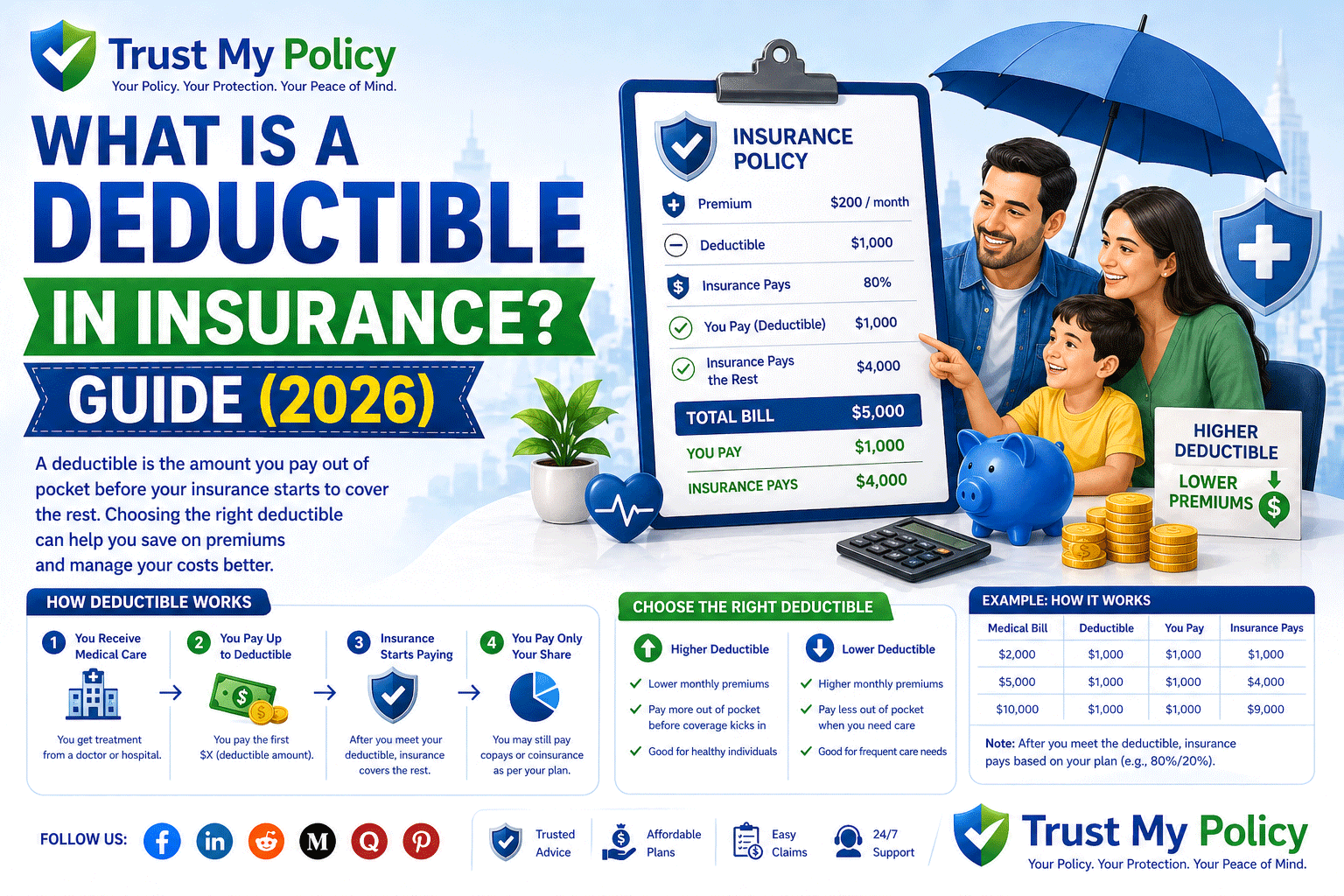
A deductible is the financial threshold you must cross before your insurer starts paying. If your car insurance deductible is $500 and you have a $3,000 accident, you pay the first $500; your insurer pays $2,500. If your deductible is $1,500 and you have a $1,200 repair bill, you pay the full $1,200 — your insurer pays nothing because you did not reach the deductible.
Every type of insurance has both. Health insurance has annual deductibles ($0–$7,000+). Auto insurance has per-claim deductibles ($250–$2,000). Home insurance has per-claim deductibles ($500–$5,000). Life insurance has premiums but no deductible — the death benefit is paid in full. For more on how these costs fit together, see our guide [INTERNAL LINK: how health insurance costs work — premium, deductible, copay, and coinsurance explained].
| Criteria | High Premium / Low Deductible | Low Premium / High Deductible |
| Monthly cost | $200–$350+ / month | $80–$160 / month |
| Deductible amount | $250–$1,000 | $1,500–$7,000+ |
| Best for | Frequent users, chronic conditions, families | Healthy individuals, low usage, HSA-eligible |
| Risk level | Low — predictable costs | High — large OOP if claim occurs |
| Total annual cost if no claims | Higher (premiums paid all year) | Lower (only premium paid, no claims) |
| Total annual cost if claim occurs | Lower (low deductible = insurer pays more) | Higher (high deductible = you pay more before insurer steps in) |
| HSA eligibility | No (most low-deductible plans are not HDHP-eligible) | Yes — HDHPs qualify for tax-advantaged HSA contributions |
| Winner when healthy | Neither — but low premium saves premium dollars | Wins on premium savings alone |
| Winner when sick | Wins — insurer covers costs sooner | Loses — you pay large deductible first |
We recommend a low-premium / high-deductible plan only if you are genuinely healthy, have fewer than 4 medical visits per year, have no chronic conditions, and have $3,000–$7,000 in savings to cover the deductible if needed. For everyone else, a lower deductible plan is almost always cheaper in total annual cost.
This is the calculation most insurance comparison sites skip entirely. Before choosing between a high-deductible and low-deductible plan, calculate your personal break-even point:
Break-even years = Deductible difference ÷ Annual premium difference
Example: Plan A costs $150/month ($1,800/year) with a $3,000 deductible. Plan B costs $250/month ($3,000/year) with a $500 deductible. Premium difference = $1,200/year. Deductible difference = $2,500. Break-even = $2,500 ÷ $1,200 = 2.1 years.
This means: if you make even one significant claim within 2.1 years, Plan B (higher premium, lower deductible) saves you money. If you go claim-free for more than 2.1 years, Plan A saves you money. For anyone with a chronic condition or a family, 2.1 claim-free years is unlikely — making Plan B the better financial choice.
Apply this formula before every insurance renewal. It takes 5 minutes and often reveals the “cheaper” plan is actually more expensive. For a detailed walkthrough of all health insurance costs, see our full guide [INTERNAL LINK: complete guide to health insurance costs in 2026].
Scenario 1: Ranjit, 38, IT Consultant — Wrong Plan Choice (Health Insurance)
Ranjit chose Plan A ($180/month, $4,500 deductible) over Plan B ($260/month, $1,200 deductible). He had knee surgery costing $22,000. Under Plan A he paid $4,500 deductible. Under Plan B he would have paid $1,200. Extra cost: $3,300. The premium saving of $80/month = $960/year. Break-even = $3,300 ÷ $960 = 3.4 years. Ranjit would have needed to be claim-free for 3.4 years for Plan A to break even. One surgery in year one made Plan B far cheaper. Verdict: Run the break-even formula before choosing. Ranjit should have chosen Plan B.
Scenario 2: Priya, 27, Yoga Instructor — Right High-Deductible Choice (Health Insurance)
Priya is healthy, visits her GP once per year (free preventive care), takes no medications. She chose an HDHP with $95/month premium and $2,500 deductible. She contributed $200/month to an HSA (tax-free savings). In 2026 she had zero claims. Annual premium cost: $1,140. If she had chosen a low-deductible plan at $230/month, she would have paid $2,760/year. Her HDHP saved her $1,620 while building $2,400 in HSA savings. Verdict: HDHPs work brilliantly for genuinely healthy, low-usage individuals who fund an HSA.
Scenario 3: David, 55, Teacher — Auto Insurance Deductible Choice
David chose auto insurance with a $1,500 deductible and $88/month premium. His neighbour chose a $500 deductible at $112/month. David saves $288/year in premium. Deductible difference = $1,000. Break-even = $1,000 ÷ $288 = 3.5 years. David had a fender-bender 18 months in costing $2,200. He paid $1,500; his insurer paid $700. His neighbour would have paid $500 and had $1,700 covered. David’s higher deductible cost him $1,000 extra on that single claim. Verdict: If your driving record shows one accident every 3 years or less, choose a lower auto deductible.
Scenario 4: The Ahmed Family — Home Insurance Deductible
The Ahmeds chose a $2,500 home insurance deductible saving $340/year in premium over a $500 deductible plan. Their home was flooded 4 years in, causing $18,000 in damage. Under the $2,500 deductible they paid $2,500 out of pocket. Under the $500 deductible they would have paid $500. Extra cost: $2,000. Premium savings over 4 years: $1,360. Net: they paid $640 more by choosing the higher deductible. Verdict: For home insurance, the lower deductible wins if a claim occurs within 6 years — use the break-even formula at renewal every year.
| Pros of High Premium / Low Deductible | Cons | Pros of Low Premium / High Deductible | Cons |
| Insurer covers costs sooner — lower OOP risk | Higher guaranteed monthly spend | Lower guaranteed monthly cost | High OOP exposure if you make a claim |
| Predictable total cost even if claims occur | Premium cost is wasted if no claims | HDHP plans qualify for tax-free HSA accounts | Must have savings to cover deductible if needed |
| Better for families with unpredictable health needs | Less incentive to avoid small unnecessary claims | Good if healthy and claim-free most years | Any claim becomes expensive before deductible is met |
| Lower stress — less financial shock when claim occurs | Premium paid even if claim never happens | Premium savings can be invested or saved in HSA | Discourage necessary care due to high upfront cost |
| Some employers subsidise high-premium plans more | May encourage over-use of coverage for minor issues | Ideal for young, healthy single individuals | Families with children face unpredictable deductible exposure |
Mistake 1: Choosing Based on Monthly Premium Alone
Why it happens: The monthly premium is the most visible number on the comparison page. What to do instead: Calculate total annual cost for both a claim-free year AND a year with one significant claim. Use the break-even formula before deciding.
Mistake 2: Choosing a High-Deductible Plan Without Savings to Cover It
Why it happens: The low premium looks affordable. The deductible seems abstract until it is due. What to do instead: Before choosing a high-deductible plan, confirm you have the full deductible amount in accessible savings. If you do not have $3,000–$7,000 liquid, a high-deductible plan is a financial risk.
Mistake 3: Not Using an HSA with a High-Deductible Plan
Why it happens: Many people do not know HSAs exist or how powerful they are. What to do instead: If you choose an HDHP, open an HSA immediately. In 2026, you can contribute up to $4,300 (individual) or $8,550 (family) tax-free per year (IRS 2026 limits). This money covers your deductible tax-free, reducing the real cost of your HDHP.
Mistake 4: Forgetting That Deductibles Reset Each Year
Why it happens: Policyholders assume deductible payments from late in the year carry forward. They do not. What to do instead: If you hit your deductible late in the year (October–December), schedule any elective care before December 31. Your deductible resets on January 1.
Mistake 5: Comparing Plans Across Different Deductible Structures
Why it happens: Health, auto, and home deductibles work differently. Health deductibles are annual. Auto and home deductibles apply per claim. What to do instead: Apply the break-even formula separately for each insurance type. Do not assume a strategy that works for health insurance applies to auto or home.
⚠️ WARNING: Choosing a High-Deductible Plan Without Emergency Savings
What happens: You choose a $250/month HDHP to save $100/month over a standard plan. Then you have an emergency appendectomy costing $35,000. Your $6,500 deductible is due within 30 days. Without savings, you face debt, delayed care decisions, or medical credit at 24% APR. What to do instead: Never choose a deductible higher than your liquid savings. If you have $1,500 in savings, do not choose a $3,000 deductible plan — even if the premium looks attractive. The monthly premium saving is never worth financial crisis risk.
| Your Situation | Our Recommendation |
| You have a chronic condition or see a doctor 4+ times per year | ✅ Choose lower deductible — higher premium is worth the reduced OOP cost |
| You are healthy, under 35, fewer than 4 GP visits per year | ✅ Consider higher deductible / lower premium — but only if you have savings |
| You have less than $2,000 in accessible savings | ✅ Choose lower deductible — you cannot afford a large deductible if a claim hits |
| You want to use a Health Savings Account (HSA) | ✅ Choose HDHP — only HDHPs qualify for tax-free HSA contributions (2026 limit: $4,300) |
| You are covering a family with children | ✅ Choose lower deductible — children create unpredictable medical usage |
| You are planning elective surgery this year | ✅ Choose lower deductible plan before surgery — deductible saving outweighs premium |
| Your employer subsidises both plan options equally | ✅ Use the break-even formula — model your specific expected usage |
| You are approaching deductible in November/December | ✅ Schedule outstanding care before year end — deductible resets 1 January |
💡 Tip: The golden rule — your deductible should never exceed what you can pay within 30 days from savings. If you cannot comfortably cover the deductible without debt, it is too high, regardless of how attractive the premium looks.
| Insurance Type / Scenario | Typical Monthly Premium | Typical Deductible | Notes |
| Health — Low deductible plan (individual) | $230–$320/month | $500–$1,000/year | Higher premium; insurer covers costs sooner |
| Health — HDHP individual (2026) | $90–$160/month | $1,700–$7,000/year | HDHP threshold: $1,700 individual (HealthPartners 2026) |
| Health — Medicare Part B (2026) | $202.90/month | $283/year | CMS official 2026 figures |
| Auto — Low deductible ($500) | $112–$160/month | $500 per claim | Higher premium; insurer covers more per accident |
| Auto — High deductible ($1,500) | $80–$110/month | $1,500 per claim | Lower premium; significant OOP per accident |
| Home — Low deductible ($500) | $120–$180/month | $500 per claim | Best for high-risk areas (flood, storm zones) |
| Home — High deductible ($2,500) | $80–$120/month | $2,500 per claim | Saves $300–$400/year in premium |
| Life term — No deductible | $15–$60/month | No deductible | Full death benefit paid; no deductible applies |
Kaiser Permanente (US) — Health Insurance
Why recommended: Offers the widest range of deductible options ($0–$6,000) with the lowest OOP costs in the JD Power 2025 Commercial Health Insurance Study. Average individual premium: $180–$280/month. Best for: CA, CO, GA, HI, MD, OR, VA, WA residents who want flexible deductible control. Rating: A AM Best; 4.2/5 JD Power 2025.
GEICO (US) — Auto Insurance
Why recommended: Cheapest liability-only at $41/month (NerdWallet Feb 2026); strong deductible flexibility ($250–$2,000). Best for: US drivers wanting to fine-tune the premium-deductible trade-off. Rating: A++ AM Best; 4.1/5 JD Power.
Aviva (UK) — Home and Auto Insurance
Why recommended: Flexible excess (UK term for deductible) options; FCA-compliant fair value products; 92% claims approval rate. Typical UK home excess: £100–£500. Best for: UK homeowners wanting low-excess options with reliable claims. Rating: 4.0/5 Trustpilot; AM Best A.
Direct Line (UK) — Multi-Line
Why recommended: Transparent excess structure; no-claims discount of up to 65%; excess options from £50. Best for: UK customers who want low excess and consistent premium reduction for claim-free years. Rating: 4.2/5 Trustpilot; Defaqto 5 stars.
We recommend Kaiser Permanente (US) and Aviva (UK) as the best overall for most readers because both offer genuine deductible/excess flexibility, strong claims approval rates, and independently verified fair-value pricing.
A premium is the fixed amount you pay to keep your insurance policy active — monthly, quarterly, or annually — whether or not you ever make a claim. A deductible is the amount you pay out of your own pocket before your insurer starts covering costs on a claim. Premiums are certain; deductibles are conditional. They move in opposite directions: higher deductible typically means lower premium, and vice versa.
It depends on your expected healthcare or claim usage. If you are healthy, rarely visit a doctor, and have savings to cover a large deductible, a higher deductible and lower premium saves money overall. If you have a chronic condition, a family, or limited savings, a lower deductible (higher premium) is almost always cheaper in total annual cost. Use the break-even formula: Deductible difference divided by Annual premium difference = Break-even years.
Break-even years = Deductible difference divided by Annual premium difference. Example: Plan A costs $1,800/year in premium with a $3,000 deductible. Plan B costs $3,000/year in premium with a $500 deductible. Premium difference = $1,200. Deductible difference = $2,500. Break-even = 2.1 years. If you make one claim within 2.1 years, Plan B saves you money. If you stay claim-free for more than 2.1 years, Plan A saves you money.
No. Premium payments are the cost of keeping your policy active. They do not count toward your deductible. Your deductible is only met through actual claim payments — when you pay for medical services, car repairs, or home damage out of pocket. Premium and deductible are entirely separate costs that serve different purposes.
According to HealthPartners 2026 data, a health plan is classified as a High-Deductible Health Plan (HDHP) in 2026 if the deductible is at least $1,700 for an individual or $3,400 for a family. HDHPs must also have out-of-pocket maximums no greater than $8,550 (individual) or $17,100 (family) in 2026. HDHP status matters because only HDHP policyholders can open a tax-free Health Savings Account (HSA).
You cannot negotiate a deductible with your insurer in the way you might negotiate a purchase price. However, you can choose from the deductible options your insurer offers at renewal. Most auto and home insurers offer deductible choices from $250 to $2,000+. Most health plans offer 2–5 deductible tiers. You can also adjust your deductible mid-policy with some insurers for a premium adjustment — call your insurer and ask what options are available.
For health insurance, many hospitals and providers offer payment plans for the deductible amount owed. Some states have medical debt protections. For auto insurance, if you cannot pay the deductible, your insurer may not release the claim payment — repair shops often require the deductible before releasing your repaired vehicle. For home insurance, your mortgage lender may require the claim to be paid before releasing repair funds. Always have your deductible amount in savings before choosing a plan.
Yes, for health insurance. Your deductible resets on January 1 each year (or on your plan anniversary date). Any deductible payments from December do not carry forward to January. For auto and home insurance, the deductible applies per claim — there is no annual reset because each claim is assessed independently.
In UK insurance, the term “excess” is used instead of “deductible.” They are the same concept: the amount you pay towards a claim before the insurer covers the remainder. UK excess options typically range from £100 to £500 for home and auto policies. Some UK policies have a “compulsory excess” (set by the insurer) and a “voluntary excess” (chosen by you to reduce your premium). The voluntary excess is equivalent to choosing a higher deductible in US insurance.
A zero-deductible plan means your insurer covers costs from the very first pound or dollar of a claim. These plans exist but carry the highest premiums. They are best suited for people with very high expected annual claim costs — for example, someone managing a serious chronic condition expecting multiple hospitalisations. For most people, even a modest $500–$1,000 deductible saves significant premium costs. Calculate your personal break-even point before choosing a zero-deductible plan.
This guide reflects the latest 2026 insurance data and regulatory information.
This article is for informational purposes only. Always consult a licensed insurance professional before making coverage decisions. Trust My Policy does not sell insurance products or represent any insurer.

Jagadeesh Gutha is the founder of TrustMyPolicy.com, an independent insurance information platform covering life, health, car, home, and business insurance for US and UK readers. He researches insurance products, policy structures, and consumer rights to help everyday people make informed coverage decisions without the jargon. All content on TrustMyPolicy is independently researched, fact-checked, and written to educate — not to sell.



Insurance Guides for UK, USA & Worldwide We are not an insurer or broker.


Reader Comments (0)