

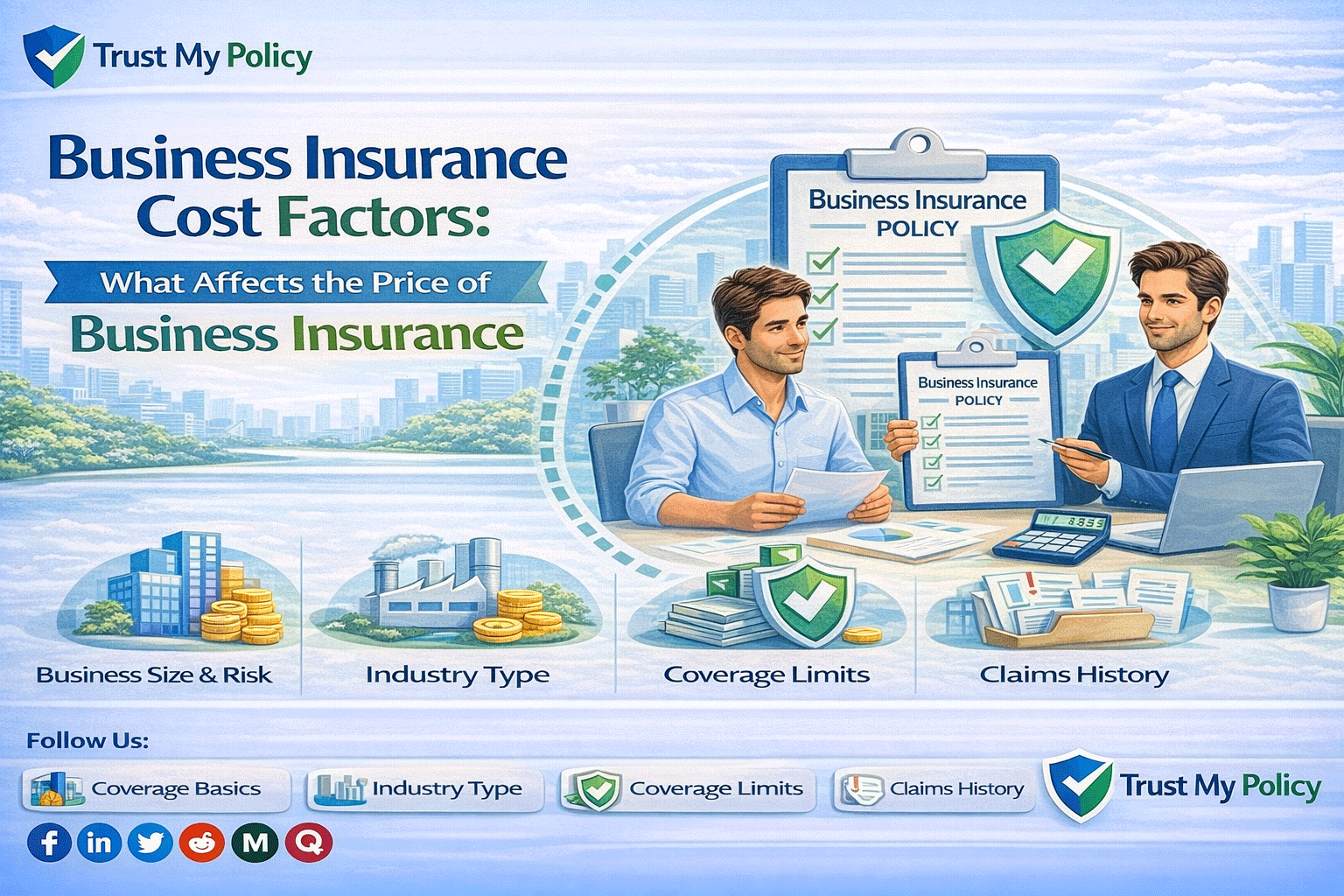
Business insurance costs are driven primarily by your industry classification code, which reflects the inherent risk of your specific trade, along with payroll size, annual revenue, claims history, business location, and chosen coverage limits. A landscaping business with a higher-risk classification code can pay nearly double what an accounting firm with similar headcount pays for workers’ compensation, purely due to industry risk classification.
Table of Contents
ToggleBusiness Insurance Cost Factors: Complete 2026 Guide
Phillip Granger, 50, runs a small landscaping company in Charlotte and was confused when his workers’ compensation premium nearly doubled compared to his friend’s accounting firm with a similar number of employees. His broker explained that his industry classification code, not just his headcount, was driving the bulk of that difference.
Business Insurance Cost Factors in 2026 go well beyond simply “how many employees you have.” The biggest drivers are your industry classification code, payroll size, annual revenue, claims history, location, and the specific coverage limits you choose. This guide breaks down exactly how each factor moves your premium, with real numbers showing the difference between a low-risk and high-risk classification.
This article covers the specific factors that determine business insurance cost, how classification codes work, real scenarios with dollar figures, and what you can actually influence. By the end, you’ll understand exactly why two seemingly similar businesses can pay very different premiums.
Quick Summary Table
| Feature | Details |
| What it is | The specific factors insurers use to calculate a business’s premium |
| Who it affects | Every business purchasing commercial insurance |
| Core cost factors | Industry classification code, payroll, revenue, claims history, location, coverage limits |
| Typical impact of classification code | Can vary premium by 2-3x or more between low- and high-risk industries |
| Key benefit | Understanding these factors helps identify what you can realistically influence |
| Key limitation | Industry classification code is largely fixed and not something you can change |
| Regulator | State insurance departments (US); Financial Conduct Authority (UK) |
What Actually Determines Business Insurance Cost?
Think of business insurance pricing like a restaurant inspection score that varies dramatically by type of kitchen. A salad bar and a deep-fryer-heavy kitchen face fundamentally different fire risks, even if they’re the exact same size and serve a similar number of customers. Your business’s specific classification code works the same way, reflecting the inherent risk of your trade regardless of how careful you personally are.
Business insurance cost is driven by a specific combination of factors: your industry classification code, which reflects the statistical risk associated with your specific trade; your payroll size, which directly drives workers’ compensation pricing; your annual revenue, which often drives general liability pricing; your claims history; your business location; and the specific coverage limits and deductibles you choose. Anyone comparing quotes or trying to understand a renewal increase needs to know which of these factors is actually moving the number.
How Each Cost Factor Actually Works — 5 Steps
- Your industry classification code sets your baseline risk tier. In the US, this often follows NCCI classification codes for workers’ compensation, while general liability uses similar industry-based rating classifications.
- Your payroll size multiplies against your workers’ compensation rate. Workers’ compensation premiums are typically calculated per $100 of payroll, multiplied by your specific classification code’s rate.
- Your annual revenue often drives general liability pricing. Many general liability policies are rated partly on gross revenue, since higher revenue often correlates with greater exposure.
- Your claims history adjusts your premium through an experience modifier. A business with a worse-than-average claims history for its classification pays more; a better-than-average history can lower the premium.
- Your location and chosen coverage limits finalize the calculation. Regional risk factors and your specific liability limits or deductibles complete the final premium calculation.
Comparison: Low-Risk vs. High-Risk Industry Classification
| Criteria | Low-Risk Classification (e.g., Office-Based Consulting) | High-Risk Classification (e.g., Landscaping, Construction) |
| Workers’ compensation rate per $100 payroll | $0.30–$0.80 | $3.00–$15.00+ |
| General liability cost | Lower, reflecting minimal physical risk | Higher, reflecting greater physical injury and property damage exposure |
| Claims frequency | Generally lower | Generally higher |
| Pros | Lower overall insurance cost for similar revenue and headcount | None specifically; reflects genuinely higher inherent risk |
| Cons | None specifically | Premiums can be 2-3x or more higher purely due to classification |
We recommend confirming your specific classification code is accurate for most readers, since misclassification, in either direction, can meaningfully affect what you pay.
4 Real-Life Scenarios
Scenario 1: Phillip, 50, landscaping company owner in Charlotte. Phillip’s workers’ compensation premium nearly doubled compared to a similarly sized accounting firm, driven almost entirely by his higher-risk industry classification code. Verdict: classification code, not headcount alone, is often the single largest cost driver. Action: Phillip confirmed his code was accurate and explored safety programs that could improve his experience modifier over time.
Scenario 2: A small bakery in Leeds with rapidly growing revenue. As the bakery’s annual revenue grew, its general liability premium increased proportionally at renewal, reflecting the revenue-based rating component of the policy. Verdict: revenue growth directly affects liability pricing for many businesses. Action: the bakery’s owner now budgets for an insurance cost increase alongside any significant revenue growth.
Scenario 3: A construction company in Houston with a worse-than-average claims history for its classification. Its experience modifier pushed the workers’ compensation premium above the standard rate for similar businesses in its classification. Verdict: claims history directly adjusts cost beyond the base classification rate. Action: the company implemented a formal safety program aimed at improving its experience modifier at the next review period.
Scenario 4: Two similar consulting firms in different US states. Despite nearly identical revenue and headcount, the firm in a higher-cost-of-living state paid noticeably more for the same coverage limits. Verdict: location is a real, independent cost factor beyond industry and claims history. Action: both firms compared multiple insurers to ensure they were getting competitive pricing within their respective states.
Pros & Cons of How Business Insurance Cost Factors Work
| Pros | Cons |
| Understanding these factors helps you identify what’s actually driving your premium. | Industry classification code is largely fixed and not something you can easily change. |
| A strong claims history can meaningfully lower your premium through your experience modifier. | A poor claims history compounds cost increases for multiple years before improving. |
| Confirming an accurate classification code can correct overpriced misclassifications. | Revenue growth can mean your insurance costs increase even without any change in risk behavior. |
| Comparing quotes across insurers can reveal meaningfully different pricing for the same risk factors. | Location-based cost differences aren’t something most businesses can easily change. |
| Safety programs can directly and measurably improve your long-term cost trajectory. | Understanding the full rating formula takes more effort than comparing a single premium number. |
5 Common Mistakes Business Owners Make
- Assuming headcount alone determines workers’ compensation cost. This happens because headcount feels like the most intuitive cost driver. What to do instead: understand that your specific classification code often matters more than headcount alone.
- Not confirming their industry classification code is accurate. This happens because this code is often assigned automatically without much explanation. What to do instead: ask your insurer to confirm your specific classification code matches your actual primary business activity.
- Not budgeting for insurance cost increases alongside revenue growth. This happens because revenue growth feels like an unrelated success metric. What to do instead: anticipate a proportional general liability cost increase as your revenue grows, especially for revenue-rated policies.
- Ignoring the impact of claims history on future premiums. This happens because a single claim can feel like an isolated event rather than a multi-year cost factor. What to do instead: understand that your experience modifier reflects claims history over a multi-year window, compounding the cost impact.
- Not comparing quotes across multiple insurers for the same risk factors. This happens because business owners assume all insurers price the same risk factors identically. What to do instead: get at least two or three comparison quotes, since pricing can vary meaningfully between insurers even for identical risk profiles.
⚠️ WARNING: Never assume your business’s industry classification code is automatically correct. A misclassified code, even an honest administrative error, can result in significantly overpaying for years without you realizing it.
Decision Table: What Should You Check About Your Costs?
| Your Situation | Our Recommendation |
| You’ve never confirmed your industry classification code’s accuracy | Yes — ask your insurer to verify it matches your actual primary business activity |
| Your revenue has grown significantly since your last renewal | Yes — expect a proportional cost increase on revenue-rated policies like general liability |
| You’ve had a recent workplace injury claim | Yes — ask how this will affect your experience modifier over the coming renewal periods |
| You haven’t compared quotes from other insurers recently | Yes — get at least two or three comparison quotes for your specific risk factors |
| Your business operates in a higher-risk industry classification | Yes — consider implementing a formal safety program to improve your long-term cost trajectory |
| You’re comparing your costs to a similarly sized business in a different industry | Yes — recognize that classification code differences can fully explain a large cost gap |
| You’re unsure how location specifically affects your premium | Yes — ask your insurer or broker how your specific location factors into your pricing |
💡 TIP: The single golden rule for business insurance costs: confirm your specific industry classification code is accurate before assuming a high premium reflects poor pricing, since this single factor often explains the largest cost differences between businesses.
Cost Table: How Specific Factors Change Real Premiums
| Scenario | Cost Factor | Effect on Premium |
| Office-based consulting firm, workers’ compensation | Low-risk classification code | $0.30–$0.80 per $100 of payroll |
| Landscaping or construction firm, workers’ compensation | High-risk classification code | $3.00–$15.00+ per $100 of payroll |
| General liability, revenue-rated policy, 20% revenue growth | Revenue increase | Often a proportional premium increase at renewal |
| Worse-than-average claims history for classification | Experience modifier above 1.0 | Can increase premium by 10%–50%+ above the base rate |
| Better-than-average claims history for classification | Experience modifier below 1.0 | Can decrease premium by 10%–25% below the base rate |
| Higher coverage limits ($2M vs. $1M general liability) | Coverage limit choice | Typically increases premium by 15%–30% |
| Business located in a higher-cost-of-living region | Location factor | Can increase premium by 10%–20% compared to lower-cost regions |
Resources for Understanding Your Business Insurance Costs
NCCI (National Council on Compensation Insurance, US) — Maintains the classification code system used for workers’ compensation rating in most US states. Cost range: free to research classification codes. Best for: US business owners verifying their workers’ compensation classification. Rating: industry rating and data organization.
Independent insurance brokers — Brokers can confirm whether your classification code is accurate and compare quotes across multiple insurers for your specific risk profile. Cost range: typically free for the consumer. Best for: any business owner wanting a thorough cost factor review. Rating: varies by broker, check state or FCA licensing.
The Hartford and Hiscox (US) — Offer transparent rating guidance and classification code lookups for small business insurance. Cost range: competitive small business pricing. Best for: US businesses wanting clearly explained cost factors. Rating: AM Best A.
Simply Business (UK) — A UK comparison platform allowing businesses to compare cost factors across multiple insurers and industries. Cost range: free to compare. Best for: UK businesses comparing pricing across providers. Rating: FCA-regulated comparison service.
Your state insurance department (US) — Can confirm whether your specific rate or classification has been properly filed and applied. Cost range: free to contact. Best for: US business owners questioning a specific classification or rate. Rating: government regulatory body.
We recommend an independent broker as best overall because they can directly verify your classification code accuracy and compare your specific risk factors across multiple insurers at once.
Frequently Asked Questions
What factors determine business insurance cost?
The main factors are your industry classification code, payroll size, annual revenue, claims history, business location, and the specific coverage limits and deductibles you choose.
What is an industry classification code?
An industry classification code categorizes your business by its specific trade or activity, reflecting the statistical risk associated with that classification, and is a major driver of your insurance premium.
Why does my workers’ compensation cost more than a similar-sized business in a different industry?
This is most likely due to a different, higher-risk industry classification code, which can drive workers’ compensation rates several times higher even for businesses with similar headcount.
Does revenue growth affect my business insurance cost?
Yes, for many policies, particularly general liability, which is often rated partly on gross revenue, meaning your premium can rise proportionally as your revenue grows.
What is an experience modifier?
An experience modifier adjusts your premium based on your business’s claims history relative to others in the same classification, increasing cost for worse-than-average history and decreasing it for better-than-average history.
Can I change my industry classification code if I think it’s wrong?
Yes, you can request your insurer review and correct your classification code if it doesn’t accurately reflect your business’s actual primary activity.
Does my business’s location affect insurance cost?
Yes, location is an independent cost factor, with regional risk differences and cost-of-living variations both influencing your final premium.
How can I lower my business insurance costs?
Confirm your classification code is accurate, implement safety programs to improve your claims history over time, compare quotes across multiple insurers, and choose coverage limits matched to your actual risk.
Why did my premium increase even though I haven’t filed a claim?
This could reflect revenue growth, a classification code adjustment, broader industry-wide pricing trends, or changes in your experience modifier from a multi-year claims history window.
Should I compare quotes from multiple insurers for my business?
Yes, definitely. Pricing can vary meaningfully between insurers even for businesses with identical risk factors, making comparison shopping worthwhile.
Key Takeaways
- Confirm your industry classification code accurately reflects your actual business activity.
- Expect general liability costs to rise proportionally with significant revenue growth.
- Understand that claims history affects your premium through a multi-year experience modifier.
- Implement safety programs if you’re in a higher-risk classification to improve long-term costs.
- Compare quotes across multiple insurers, since pricing varies even for identical risk factors.
- Recognize that location is an independent cost factor beyond industry and claims history.
- Review your coverage limits and deductibles periodically to ensure they still match your actual risk.
This article is for informational purposes only. Always consult a licensed insurance professional before making coverage decisions. Trust My Policy does not sell insurance products or represent any insurer.




Reader Comments (0)