
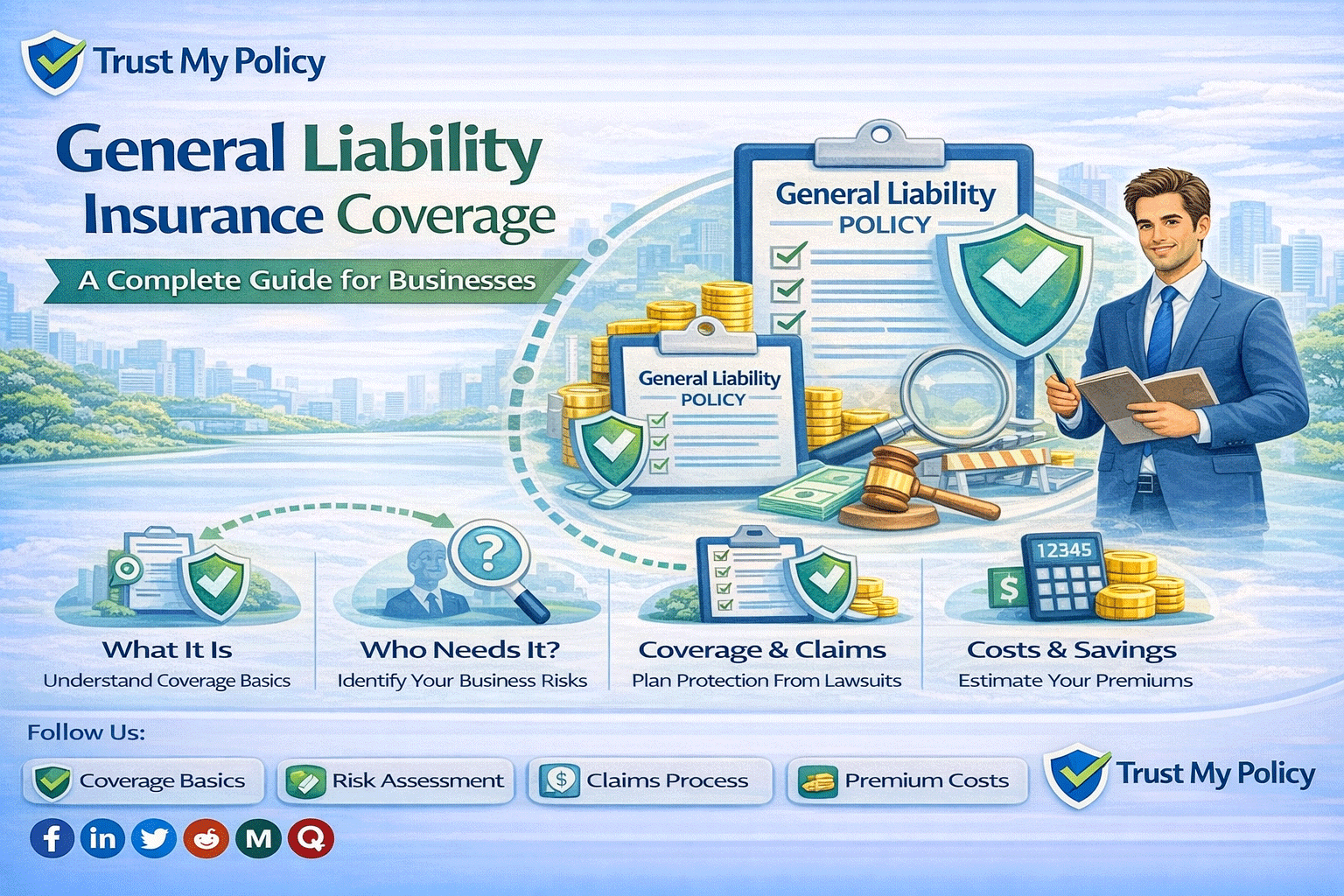
General liability insurance coverage consists of three core parts: bodily injury and property damage liability (covering third-party injuries or property damage at your business), personal and advertising injury liability (covering claims like defamation or copyright infringement in your marketing), and products-completed operations liability (covering claims arising after a product or service is delivered). Common exclusions include professional errors, employee injuries, and intentional acts.
Bianca Solis, 35, ran a small home staging business in Dallas and assumed her general liability policy would cover absolutely any claim against her business. When a stager accidentally scratched a $30,000 antique table while moving furniture for a client, she learned that property damage to items in her care, custody, or control fell into a more nuanced coverage area than she’d expected, requiring a closer read of her policy’s specific terms.
General Liability Insurance Coverage in 2026 is built from three core coverage parts: bodily injury and property damage liability, personal and advertising injury liability, and products-completed operations liability. Each part responds to a different category of third-party claim, and understanding exactly which part covers what is the difference between a smooth claim and an unpleasant surprise. This guide breaks down each coverage part in plain language, with real examples of what’s included and excluded.
This article covers the three core coverage parts in detail, common exclusions that catch business owners off guard, real scenarios showing each part in action, and what this means for reviewing your own policy. By the end, you’ll know exactly what your general liability policy does and doesn’t cover.
| Feature | Details |
| What it is | A liability policy covering third-party injury, property damage, and certain reputational claims |
| Who needs it | Nearly any business with customers, a physical location, or marketing activity |
| Core coverage parts | Bodily injury/property damage, personal/advertising injury, products-completed operations |
| Typical cost | $40–$120/month for most small businesses |
| Key benefit | Covers the most common type of third-party claim a business faces |
| Key limitation | Excludes professional errors, employee injuries, and intentional or contractual liability |
| Regulator | State insurance departments (US); Financial Conduct Authority (UK) |
Think of general liability coverage like a three-panel security system protecting different entry points of the same building. One panel watches for physical injuries and property damage on your premises or from your operations. A second panel watches for reputational and advertising-related claims. A third watches for problems that surface only after you’ve already delivered your product or service. Each panel responds to a different kind of intrusion.
General liability insurance is built from three distinct coverage parts. Bodily injury and property damage liability covers claims when someone is physically hurt or their property is damaged because of your business operations. Personal and advertising injury liability covers non-physical claims like libel, slander, or copyright infringement arising from your marketing or business conduct. Products-completed operations liability covers claims that arise after you’ve finished a job or delivered a product, when something goes wrong later. Anyone holding a general liability policy needs to understand which of these three parts actually applies to a specific claim.
| Criteria | Bodily Injury/Property Damage | Personal/Advertising Injury | Products-Completed Operations |
| Triggers on | Physical injury or property damage | Non-physical reputational or advertising claims | Problems arising after a job is completed or product delivered |
| Common example | A customer slips and falls in your store | A competitor claims your ad copy defamed them | A contractor’s completed renovation causes a leak months later |
| Best protects | Businesses with physical premises or operations | Any business doing marketing or advertising | Contractors, manufacturers, and product-based businesses |
| Pros | Covers the most statistically common type of claim | Closes a reputational gap many businesses overlook | Extends protection beyond the moment of service delivery |
| Cons | Doesn’t cover claims arising after project completion | Doesn’t cover physical injury or property damage | Doesn’t cover claims during active, ongoing operations |
We recommend confirming all three coverage parts are included in your specific policy for most readers, since some basic or limited policies may exclude one of these parts, particularly products-completed operations.
Scenario 1: Bianca, 35, home stager in Dallas. Bianca’s accidental damage to a client’s antique table fell under property damage liability, though she learned that damage to property in her “care, custody, or control” carries specific nuances worth confirming directly with her insurer. Verdict: property damage liability can have specific carve-outs for items you’re actively handling. Action: Bianca added a specific care, custody, and control endorsement after this experience.
Scenario 2: A marketing agency in Manchester sued for an alleged copyright violation in a client’s ad campaign. This claim fell under personal and advertising injury liability, a distinct coverage part from any physical injury claim. Verdict: advertising-related claims require this specific coverage part, separate from bodily injury or property damage. Action: the agency confirmed this coverage part was explicitly included in their policy renewal.
Scenario 3: A contractor in Phoenix whose completed kitchen renovation caused a water leak eight months after the job finished. This delayed-onset claim was covered under products-completed operations liability, not the general bodily injury part of the policy. Verdict: completed work claims require this specific, often overlooked coverage part. Action: the contractor specifically confirmed this coverage applied to all past completed projects, not just current ones.
Scenario 4: A retail store in Leeds where a customer slipped on a wet floor. This straightforward incident was covered under the bodily injury and property damage liability part, the most commonly used component of general liability coverage. Verdict: this remains the most frequent type of general liability claim across most industries. Action: the store added clearer wet floor signage as a loss-prevention measure following the claim.
| Pros | Cons |
| Covers the most statistically common type of third-party business claim. | Excludes professional service errors, requiring separate professional liability coverage. |
| Personal and advertising injury liability closes a reputational gap many businesses overlook. | Excludes employee injuries, which require workers’ compensation instead. |
| Products-completed operations extends protection well beyond the moment of service delivery. | Excludes intentional acts and most contractual liability assumed in a separate agreement. |
| Legal defense costs are typically covered in addition to the liability payout. | Basic or limited policies may not include all three coverage parts by default. |
| Relatively affordable given the breadth of common claims it addresses. | Care, custody, and control of client property can carry specific policy nuances. |
⚠️ WARNING: Never assume general liability insurance covers a professional service error, an employee injury, or damage from a completed job without confirming the specific coverage part that applies. These are three of the most commonly misunderstood gaps in general liability policies.
| Your Situation | Our Recommendation |
| You haven’t confirmed all three coverage parts are included | Yes — ask your insurer directly which parts your specific policy includes |
| Your work involves handling client property regularly | Yes — ask about a care, custody, and control endorsement |
| You’re a contractor or product-based business | Yes — confirm products-completed operations coverage is included |
| Your business does any advertising or marketing | Yes — confirm personal and advertising injury liability is included |
| You assumed general liability covers professional errors | No — confirm this directly, since it typically requires separate professional liability coverage |
| You have employees and assumed general liability covers their injuries | No — workers’ compensation is required separately for this |
| You’re unsure whether legal defense costs reduce your liability limit | Yes — confirm this specific policy structure with your insurer |
💡 TIP: The single golden rule for general liability coverage: confirm all three coverage parts — bodily injury/property damage, personal/advertising injury, and products-completed operations — are explicitly included in your specific policy, not just assumed.
| Scenario | Cost | Notes |
| Low-risk consulting business, $1M/$2M limits | $300–$600/year | Among the lowest-cost general liability profiles |
| Retail store, $1M/$2M limits | $600–$1,200/year | Reflects higher foot traffic and physical premises risk |
| Contractor with products-completed operations coverage | $1,000–$3,000/year | Reflects elevated risk of delayed-onset claims |
| Home staging or property-handling business with C&C endorsement | $700–$1,500/year | Reflects specific care, custody, and control exposure |
| Marketing agency with advertising injury coverage | $500–$1,000/year | Reflects reputational and advertising-related claim exposure |
| Business owner’s policy (BOP) bundling general liability and property | $800–$2,000/year | Often more cost-effective than separate policies |
| UK public liability insurance, small business | £150–£500/year | UK equivalent of US general liability coverage |
Independent insurance brokers — Brokers can review your specific policy and confirm whether all three coverage parts and relevant endorsements are included. Cost range: typically free for the consumer. Best for: any business owner wanting a thorough policy review. Rating: varies by broker, check state or FCA licensing.
The Hartford and Hiscox (US) — Offer general liability policies with clear coverage part breakdowns and industry-specific endorsements. Cost range: competitive small business pricing. Best for: US businesses wanting clearly explained coverage parts. Rating: AM Best A.
Simply Business (UK) — A UK comparison platform specializing in public liability insurance across many industries. Cost range: free to compare. Best for: UK businesses comparing public liability coverage options. Rating: FCA-regulated comparison service.
Your insurer’s policy documents — The most reliable source for confirming exactly which coverage parts and exclusions apply to your specific policy. Cost range: free to review. Best for: confirming your exact coverage terms directly. Rating: not applicable, primary source document.
Insurance Information Institute (US) and Association of British Insurers (UK) — Industry bodies publishing plain-language guidance on liability coverage structures. Cost range: free public resources available. Best for: readers wanting deeper educational context. Rating: industry trade associations.
We recommend an independent broker as best overall because they can confirm exactly which of the three coverage parts and which specific endorsements your policy includes, the precise gap that caught Bianca off guard.
General liability insurance covers three core areas: bodily injury and property damage to third parties, personal and advertising injury claims like defamation, and products-completed operations claims arising after a job or product delivery.
General liability insurance typically excludes professional service errors, employee injuries, intentional acts, and most liability assumed under a separate contract.
Products-completed operations coverage protects against claims arising after you’ve finished a job or delivered a product, when a problem surfaces later rather than during the immediate transaction.
It depends on the specific policy terms; damage to property in your care, custody, or control sometimes requires a specific endorsement beyond standard property damage liability.
This coverage part protects against non-physical claims like libel, slander, or copyright infringement arising from your business’s advertising or general conduct.
Yes, typically, and in many policies these costs are paid in addition to your liability limit rather than reducing it, though this varies by specific policy.
No. Employee injuries require workers’ compensation insurance, which is a separate, often legally required policy distinct from general liability.
No. General liability covers third-party physical injury and property damage, while professional liability covers claims related to errors or omissions in professional services.
Most small businesses pay $300–$1,200 a year for general liability coverage, though costs vary significantly based on industry, revenue, and specific coverage parts included.
Yes, definitely. Some basic or limited policies may not include all three parts by default, so confirming this directly with your insurer is worth the effort.
This article is for informational purposes only. Always consult a licensed insurance professional before making coverage decisions. Trust My Policy does not sell insurance products or represent any insurer.

Jagadeesh Gutha is the founder of TrustMyPolicy.com, an independent insurance information platform covering life, health, car, home, and business insurance for US and UK readers. He researches insurance products, policy structures, and consumer rights to help everyday people make informed coverage decisions without the jargon. All content on TrustMyPolicy is independently researched, fact-checked, and written to educate — not to sell.

[…] types, each designed to respond to a different category of third-party claim against your business. General liability addresses physical injury or property damage claims; professional liability addresses claims about […]
[…] for online businesses generally needs to cover three specific areas beyond standard liability: product liability, which covers claims related to harm or damage caused by a physical product you […]
[…] need general liability insurance specifically including products-completed operations coverage, which protects against problems that […]
[…] stack that needs deliberate review at predictable company-size milestones. Solo founders need general liability and, where relevant, professional liability coverage. The moment you hire your first employee, […]
[…] insurance coverage types fall into several categories. Foundational coverage includes general liability, commercial property, and business owner’s policies, which bundle the two. Employee-related […]



Insurance Guides for UK, USA & Worldwide We are not an insurer or broker.
Reader Comments (6)
[…] business insurance is a category, not a single product, encompassing general liability insurance for third-party injury or property damage claims, commercial property insurance for your physical […]