
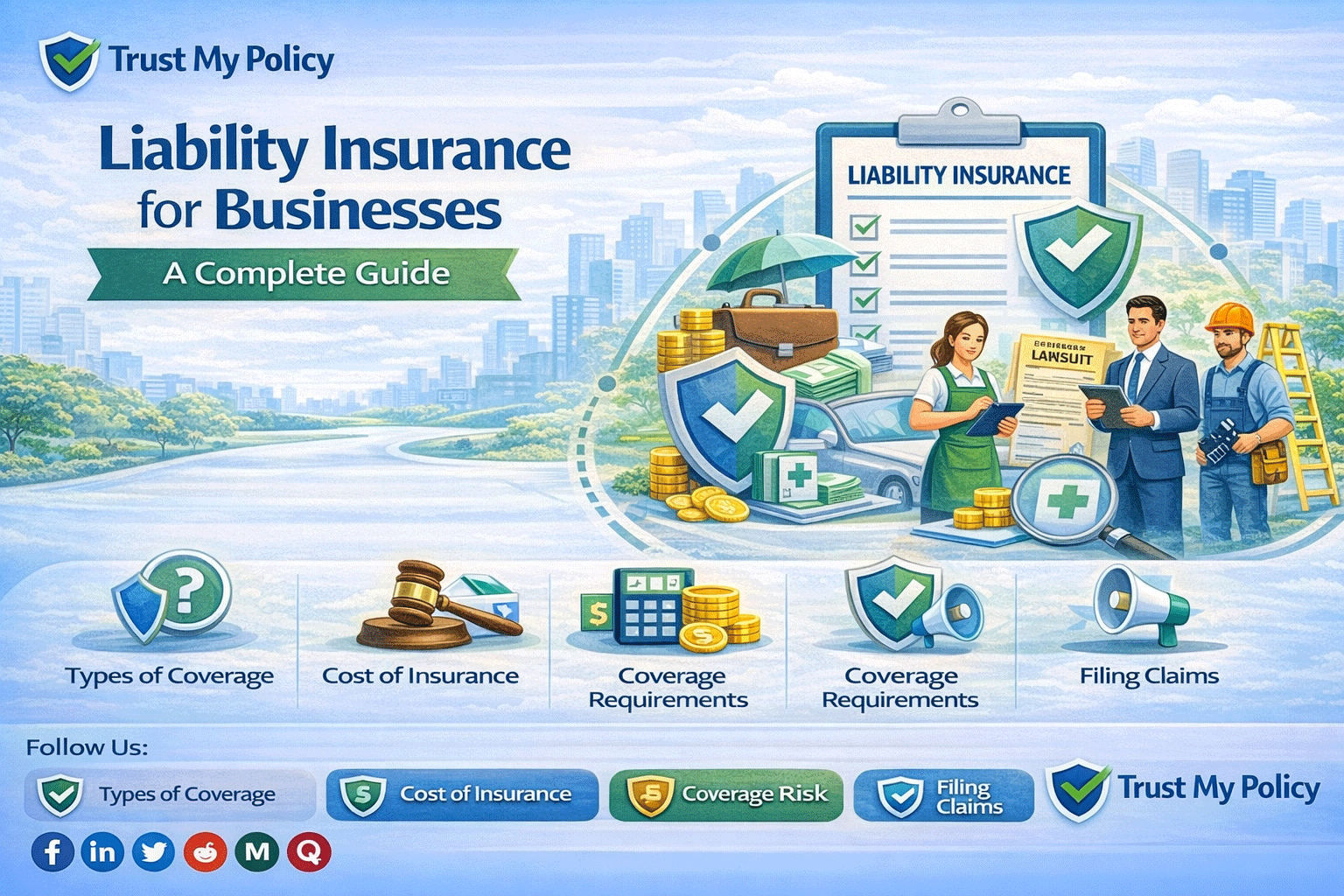
Liability insurance for businesses covers a family of related but distinct policy types: general liability for third-party injury or property damage, professional liability for service-related errors, product liability for defective goods, employer’s liability for workplace injuries, cyber liability for data breaches, and directors and officers insurance for leadership-related claims. Most businesses need general liability at minimum, with the others layered on based on specific industry and operational risk.
Yusuf Demir, 36, ran a small marketing agency in Chicago and assumed his single liability policy covered every possible claim against his business. When a client sued over an allegedly botched ad campaign, he discovered his general liability policy specifically excluded that exact type of claim, leaving a $40,000 legal bill with no coverage behind it.
Liability Insurance for Businesses in 2026 actually covers a family of distinct policy types, not one universal product: general liability for third-party injury and property damage, professional liability for service-related errors, product liability for defective goods, employer’s liability for workplace injury claims, cyber liability for data breaches, and directors and officers (D&O) insurance for leadership decisions. This guide breaks down each type, who needs it, and how Yusuf’s exact gap could have been avoided.
This article covers every major business liability insurance type, who specifically needs each one, real scenarios showing the differences, and a clear framework for building a complete liability program. By the end, you’ll know exactly which liability gaps your business might still have.
| Feature | Details |
| What it is | A family of distinct policy types, each covering a different category of business liability risk |
| Who needs it | Any business with customers, employees, a service offering, or physical products |
| Core types | General liability, professional liability, product liability, employer’s liability, cyber liability, D&O |
| Typical combined cost | $500–$5,000+/year depending on which types and how many your business needs |
| Key benefit | Each type closes a gap the others don’t cover, building a genuinely complete protection program |
| Key limitation | Businesses often assume one policy covers everything, leaving real gaps unaddressed |
| Regulator | State insurance departments (US); Financial Conduct Authority (UK) |
Think of business liability insurance like a set of locks on different doors of the same building. General liability locks the front door against the most common visitors’ claims. Professional liability locks a side door against claims about the quality of your actual work. Each lock protects against a genuinely different kind of intrusion, and missing even one leaves that specific door wide open.
Business liability insurance is an umbrella term covering several distinct policy types, each designed to respond to a different category of third-party claim against your business. General liability addresses physical injury or property damage claims; professional liability addresses claims about the quality or accuracy of your professional services; product liability addresses claims from defective goods; employer’s liability addresses workplace injury claims beyond standard workers’ compensation; cyber liability addresses data breach and privacy claims; and D&O insurance addresses claims related to corporate leadership decisions. Anyone running a business needs to identify which specific combination genuinely applies to their operations.
| Criteria | General Liability | Professional Liability | Product Liability | Cyber Liability |
| Covers | Bodily injury, property damage to third parties | Errors, omissions, or negligence in professional services | Injury or damage caused by a defective product | Data breaches and privacy-related claims |
| Who needs it | Nearly every business | Service-based and advisory businesses | Manufacturers, distributors, retailers | Any business handling customer or employee data |
| Typical cost | $40–$120/month | $50–$200/month | $50–$300/month, varies by product risk | $50–$300/month, varies by data sensitivity |
| Common exclusion gap | Excludes professional service errors | Excludes physical injury/property damage claims | Excludes service-related errors | Excludes physical injury or property damage |
We recommend most businesses treat general liability as the starting foundation and add the other types based specifically on whether they provide services, sell products, employ staff, or handle customer data.
Scenario 1: Yusuf, 36, marketing agency owner in Chicago. Yusuf’s general liability policy excluded the client’s claim about a botched ad campaign, since that’s a professional service error, not a physical injury or property damage claim. Verdict: general liability and professional liability cover genuinely different categories of claims. Action: Yusuf added a professional liability policy immediately after settling the dispute out of pocket.
Scenario 2: A small furniture manufacturer in Leeds. A defective chair design led to a customer injury claim, fully covered under the company’s product liability policy, separate from its general liability coverage. Verdict: product liability specifically addresses defect-related claims that general liability wouldn’t cover. Action: the manufacturer reviewed its product liability limits after a recent expansion into new markets.
Scenario 3: A healthcare technology startup in Boston handling patient data. A data breach affecting thousands of users triggered significant costs, fully covered under the company’s cyber liability policy. Verdict: cyber liability addressed a risk neither general nor professional liability would have covered. Action: the company increased its cyber liability limits as its user base grew.
Scenario 4: A venture-backed startup board facing a shareholder lawsuit over a strategic decision. The company’s directors and officers insurance covered the legal defense costs for its leadership team. Verdict: D&O insurance specifically protects leadership decisions, a category distinct from all the other liability types. Action: the board confirmed its D&O coverage limits were adequate before its next funding round closed.
| Pros | Cons |
| Each policy type closes a specific, well-defined gap the others don’t cover. | Businesses often mistakenly assume one policy covers all liability risks. |
| A layered approach lets you match coverage precisely to your actual operations. | Comparing and coordinating multiple policy types takes more effort than a single quote. |
| Many types can be bundled affordably with the same insurer. | Premiums increase as you add more specific coverage types. |
| Clear separation between policy types makes claims easier to direct correctly. | Identifying every relevant type for your specific business requires real research. |
| Reduces the risk of an uncovered claim like Yusuf’s costly out-of-pocket settlement. | Some industries require specialized forms beyond even these standard types. |
⚠️ WARNING: Never assume a single liability policy, regardless of its name, covers every type of claim your business might face. As Yusuf’s experience shows, general liability specifically excludes professional service errors, a gap that can cost tens of thousands of dollars if discovered only after a dispute arises.
| Your Situation | Our Recommendation |
| You run any business with customers or premises | Yes — get general liability insurance as your baseline |
| You provide professional services, advice, or expertise | Yes — add professional liability insurance |
| You manufacture, distribute, or sell physical products | Yes — add product liability insurance |
| You have employees | Yes — confirm your workers’ compensation and employer’s liability coverage |
| You handle any customer or employee data | Yes — add cyber liability insurance regardless of your industry |
| You have outside investors or a board | Yes — secure directors and officers (D&O) insurance |
| You assumed one policy covers all of the above | No — verify each specific gap directly with your insurer or broker |
💡 TIP: The single golden rule for business liability insurance: identify each distinct category of risk your business actually faces, then confirm you have a specific policy addressing each one, rather than assuming a single policy covers them all.
| Scenario | Typical Annual Cost | Notes |
| General liability, low-risk consulting business | $400–$800/year | Among the lowest-cost liability profiles |
| Professional liability, freelance consultant or agency | $600–$2,000/year | Varies by claims history and specific service type |
| Product liability, small furniture or goods manufacturer | $1,000–$3,500/year | Varies significantly by product type and risk |
| Employer’s liability / extended workers’ comp coverage | $1,500–$4,000/year | Varies by industry risk classification and payroll |
| Cyber liability, small business handling customer data | $1,000–$3,000/year | Varies by data sensitivity and volume |
| D&O insurance, seed-stage startup | $2,000–$5,000/year | Often a hard requirement from institutional investors |
| Combined general + professional liability bundle | $1,000–$2,800/year | Common bundling option for many service-based businesses |
Hiscox (US and UK) — Offers professional liability, general liability, and cyber coverage tailored to small and mid-sized businesses in both countries. Cost range: competitive small business pricing. Best for: service-based businesses wanting multiple liability types from one insurer. Rating: AM Best A.
The Hartford (US) — Offers a broad range of business liability types, including product liability and employer’s liability coverage. Cost range: competitive US pricing. Best for: US businesses wanting a single insurer for multiple liability needs. Rating: AM Best A.
Simply Business (UK) — A UK comparison platform covering public liability, professional indemnity, and product liability across many trades. Cost range: free to compare. Best for: UK businesses comparing multiple liability types at once. Rating: FCA-regulated comparison service.
Chubb — A major global insurer with strong product liability, cyber, and D&O offerings for growth-stage businesses. Cost range: competitive for larger or higher-risk businesses. Best for: businesses with more complex, layered liability needs. Rating: AM Best A++.
Independent insurance brokers — Brokers can assess your specific operations and identify every liability type genuinely relevant to your business. Cost range: typically free for the consumer. Best for: any business unsure which combination of liability types it actually needs. Rating: varies by broker, check licensing.
We recommend an independent broker as best overall because they can review your full operations and flag any liability gap before it becomes an expensive lesson, the way Yusuf’s missing professional liability coverage did.
Liability insurance for businesses is an umbrella term covering several distinct policy types, including general liability, professional liability, product liability, employer’s liability, cyber liability, and directors and officers insurance.
Most businesses need at least general liability, with additional types like professional liability, product liability, or cyber liability layered on based on your specific industry and operations.
General liability covers third-party physical injury or property damage claims, while professional liability covers claims that your professional services or advice were deficient, negligent, or caused a financial loss.
No. Claims related to a defective product require a separate product liability policy, since general liability typically excludes this specific category.
Yes, increasingly, if they handle any customer or employee data, regardless of industry, since data breach costs can be significant even for non-tech businesses.
Directors and officers insurance covers claims related to corporate leadership decisions, and is typically required by institutional investors once a business takes on outside funding and a board.
Often yes, many insurers offer bundled packages covering several liability types, though some specialized coverage, like product liability for certain industries, may require a separate specialist policy.
Combined costs typically range from $500 to $5,000 or more per year, depending on how many liability types your specific business needs and your industry risk level.
You remain exposed to any claim outside general liability’s specific scope, such as professional errors, product defects, data breaches, or leadership-related claims.
Review your specific operations, including whether you provide services, sell products, employ staff, handle data, or have outside investors, and match each risk to its corresponding liability type.
This article is for informational purposes only. Always consult a licensed insurance professional before making coverage decisions. Trust My Policy does not sell insurance products or represent any insurer.

Jagadeesh Gutha is the founder of TrustMyPolicy.com, an independent insurance information platform covering life, health, car, home, and business insurance for US and UK readers. He researches insurance products, policy structures, and consumer rights to help everyday people make informed coverage decisions without the jargon. All content on TrustMyPolicy is independently researched, fact-checked, and written to educate — not to sell.




Insurance Guides for UK, USA & Worldwide We are not an insurer or broker.
Reader Comments (1)
[…] Liability Insurance Coverage in 2026 is built from three core coverage parts: bodily injury and property damage […]