
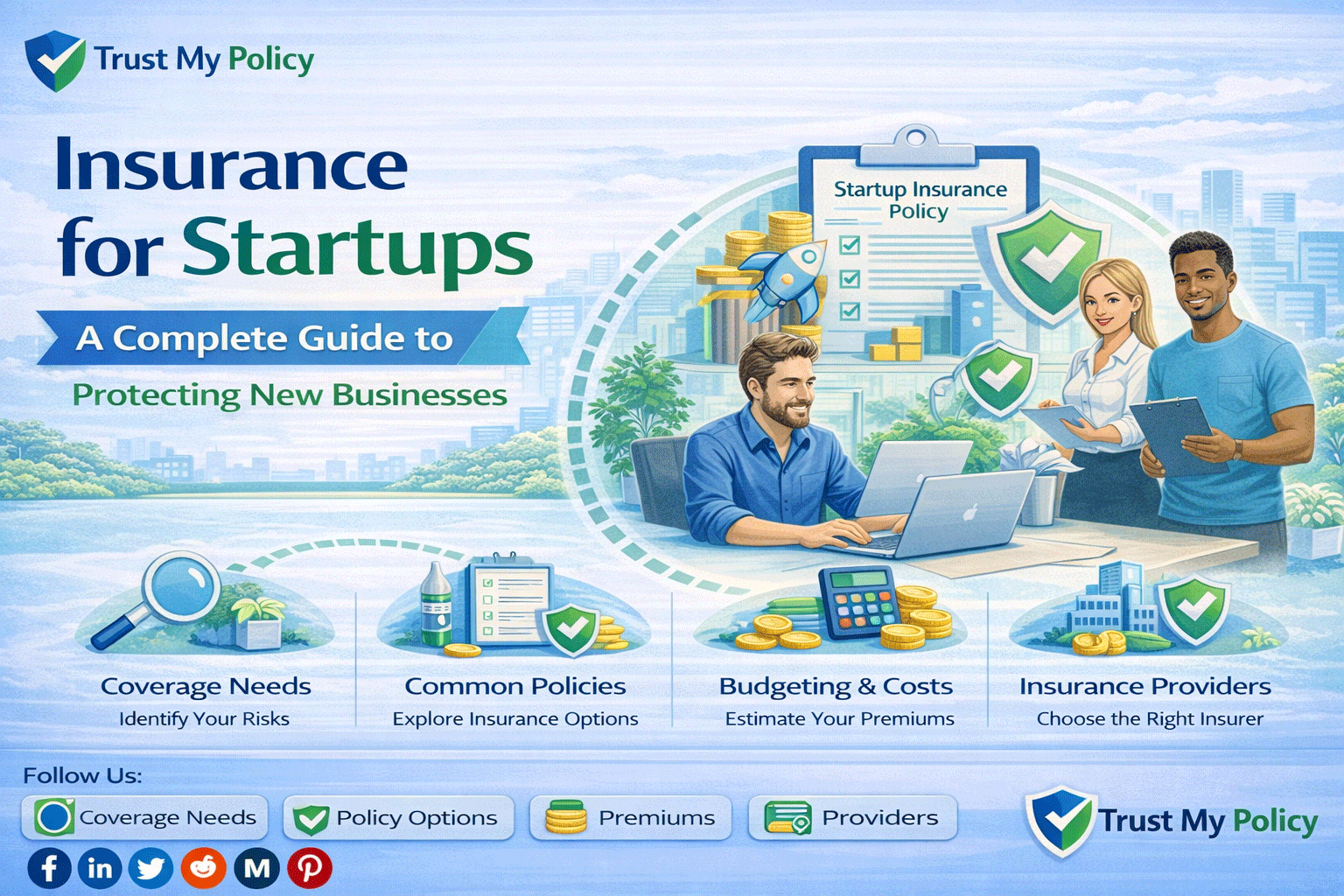
Startups need five core policies: general liability for basic third-party claims, directors and officers (D&O) insurance once outside investors are involved, cyber liability if your product touches any user data, professional liability if you provide a service or software, and property or renters insurance for your workspace. Many of these become urgent the moment a client, investor, or landlord specifically requests proof of coverage.
Two co-founders in Austin spent their first six months building their app with zero insurance in place, reasoning they had “nothing to protect yet” since they had no office, no employees, and no revenue. Their first paying enterprise client’s procurement team disagreed, requesting a certificate of insurance before signing a $40,000 contract, something the founders had never even considered needing.
Insurance for Startups in 2026 boils down to five must-haves most founders discover too late: general liability for basic third-party claims, directors and officers (D&O) insurance once investors are involved, cyber liability for any product touching user data, professional liability if you’re providing a service or software product, and renters or business property insurance for your workspace. This guide gives you the condensed, practical checklist to handle before a client, investor, or landlord asks for proof you don’t have.
This article covers the five must-have policies in plain language, when each one becomes urgent, real scenarios showing the stakes, and a simple checklist to work through before your next milestone. By the end, you’ll know exactly what to have ready before someone asks.
| Feature | Details |
| What it is | A condensed checklist of the core insurance policies most startups need |
| Who needs it | Any founder, from pre-revenue to post-funding |
| The five must-haves | General liability, D&O, cyber liability, professional liability, property/renters |
| Typical combined early-stage cost | $100–$300/month before any D&O is added |
| Key benefit | Satisfies the most common client, investor, and landlord requirements upfront |
| Key limitation | Many founders only discover a requirement after it’s urgently demanded |
| Regulator | State insurance departments (US); Financial Conduct Authority (UK) |
Picture insurance requirements like a series of unexpected ID checks as you move through different doors. The co-working space wants proof of general liability before handing you a key. The enterprise client’s procurement team wants a certificate of insurance before signing a contract. The investor’s lawyer wants D&O insurance bound before wiring funds. Each door has its own specific requirement, and showing up without it stalls you right at the threshold.
Insurance for startups means anticipating these five specific checkpoints: general liability insurance, which most landlords, co-working spaces, and enterprise clients expect as baseline proof of legitimacy; D&O insurance, which institutional investors frequently require before closing a round; cyber liability, essential the moment your product touches user data; professional liability, necessary if you’re delivering a service or software product that could be blamed for an error; and property or renters insurance for whatever physical space you operate from. Anticipating these five before they’re demanded avoids exactly the scramble those two Austin co-founders faced.
| Criteria | General Liability | D&O Insurance | Cyber Liability |
| Common trigger | Signing a lease or co-working agreement, or a client’s procurement request | Closing a funding round with institutional investors | Launching a product that collects or stores any user data |
| Who typically requires it | Landlords, co-working spaces, enterprise clients | Venture investors, sometimes as a term sheet condition | Often self-initiated, sometimes required by enterprise clients’ security reviews |
| Pros | Satisfies the most universally requested early-stage proof of coverage | Protects founders’ personal assets from corporate decision claims | Covers a genuinely significant and growing startup risk |
| Cons | Doesn’t cover data breaches or professional errors | Can take time to underwrite for first-time founders | Requires understanding your specific data exposure to price correctly |
We recommend working through all five must-haves before you’re specifically asked for proof, since each requirement tends to arrive with a tight deadline attached, whether it’s a lease signing, a contract close, or a funding round.
Scenario 1: The Austin co-founders. Their first enterprise client’s procurement team requested a certificate of insurance they didn’t have, nearly delaying a $40,000 contract close. Verdict: enterprise clients commonly require proof of general liability before signing, even from very early-stage startups. Action: they secured a basic general liability policy within a week and kept a digital certificate ready for future client requests.
Scenario 2: A two-person fintech startup in London closing a seed round. Their lead investor required D&O insurance be bound before funds would transfer, a requirement neither founder had researched in advance. Verdict: D&O insurance is frequently a hard, non-negotiable closing requirement for institutional funding. Action: they now recommend every founder research D&O coverage before starting fundraising conversations.
Scenario 3: A solo founder building a productivity app in Denver collecting user account data. A potential enterprise customer’s security review specifically asked about cyber liability coverage before considering a contract. Verdict: even early-stage products handling user data face real cyber liability expectations from larger customers. Action: the founder secured a basic cyber liability policy specifically to pass future security reviews.
Scenario 4: A two-person SaaS startup working from a co-working space in Manchester. The co-working space required proof of general liability insurance before issuing access badges, a requirement neither founder anticipated. Verdict: even basic workspace access can be gated behind an insurance requirement. Action: they secured coverage before their scheduled move-in date to avoid any delay.
| Pros | Cons |
| Avoids scrambling under a tight deadline when a requirement suddenly arises. | Requires proactive research before any specific requirement makes it urgent. |
| General liability and property coverage are relatively affordable for early-stage startups. | D&O and cyber liability costs scale up meaningfully as funding and data exposure grow. |
| Having a ready certificate of insurance can speed up enterprise client contracts. | Coordinating multiple policy types as the company grows takes ongoing attention. |
| Proactive D&O research avoids delaying a funding round close. | Many founders simply don’t know these requirements exist until they’re demanded. |
| Cyber liability coverage can help pass enterprise customer security reviews. | Comparing startup-specific insurers takes more research than a generic small business quote. |
⚠️ WARNING: Never assume you can skip insurance because your startup is too early-stage to need it. Landlords, enterprise clients, and investors routinely require proof of specific coverage regardless of your funding stage, often with very little notice before a deadline.
| Your Situation | Our Recommendation |
| You’re about to sign a lease or co-working agreement | Yes — get general liability insurance first |
| You’re pursuing your first enterprise client | Yes — have a certificate of insurance ready before contract negotiations begin |
| You’re about to start fundraising conversations | Yes — research D&O insurance now, before a term sheet makes it urgent |
| Your product collects or stores any user data | Yes — add cyber liability coverage |
| You provide a service or software product | Yes — add professional liability insurance |
| You assumed your pre-revenue stage means no insurance is needed yet | No — landlords and clients often require proof regardless of revenue |
| You haven’t reviewed your coverage since your last major milestone | Yes — review your full coverage stack at each funding round or new client tier |
💡 TIP: The single golden rule for startup insurance: have your five must-haves in place before someone specifically asks for proof, since these requirements almost always arrive with a tight deadline attached.
| Scenario | Cost | Notes |
| General liability insurance, early-stage startup | $30–$60/month | Often required by landlords, co-working spaces, and enterprise clients |
| Property/renters insurance for workspace and equipment | $20–$50/month | Covers laptops and basic office equipment |
| Professional liability insurance, early-stage | $40–$100/month | Covers service or software-related errors |
| Cyber liability insurance, early-stage tech product | $125–$400/month | Varies by amount and sensitivity of user data |
| D&O insurance, seed-stage | $165–$415/month | Often a hard requirement before a funding round closes |
| Combined five-policy bundle, early pre-funding stage | $100–$300/month | Excludes D&O until fundraising begins |
| Combined bundle, post-seed funding stage | $400–$1,000+/month | Includes D&O once outside investors are involved |
Vouch — A startup-focused insurance provider offering D&O, cyber liability, and general liability bundles designed specifically for founders. Cost range: competitive startup-specific pricing. Best for: US startups wanting all five must-haves in one streamlined application. Rating: backed by major reinsurance partners.
Embroker — Offers bundled startup insurance packages combining D&O, cyber, and general liability in a single application. Cost range: competitive startup pricing. Best for: founders wanting a fast, combined application process. Rating: AM Best-rated carrier partners.
Hiscox (US and UK) — Offers small business and professional liability coverage well suited to early-stage startups in both countries. Cost range: competitive small business pricing. Best for: startups in either the US or UK needing flexible coverage. Rating: AM Best A.
Next Insurance (US) — Provides fast, online small business policies, including general liability and property coverage, well suited to very early-stage startups. Cost range: competitive small business pricing. Best for: founders wanting a quick first policy before a lease or client deadline. Rating: backed by AM Best-rated carrier partners.
Independent insurance brokers specializing in startups — Brokers experienced with venture-backed companies can anticipate what your next milestone will require. Cost range: typically free for the consumer. Best for: any founder wanting proactive guidance ahead of a lease, client, or funding round. Rating: varies by broker, check licensing.
We recommend Vouch or Embroker as best overall for most US startups because both are purpose-built to cover the exact five must-haves founders typically need, in one streamlined application.
Startups generally need five core policies: general liability, D&O insurance once investors are involved, cyber liability if handling user data, professional liability for service or software risk, and property or renters insurance for their workspace.
Yes, often sooner than founders expect, since landlords, co-working spaces, and even early enterprise clients commonly require proof of general liability insurance regardless of revenue stage.
Ideally before starting fundraising conversations, since many institutional investors require proof of D&O coverage as a condition of closing a funding round.
A certificate of insurance is a document proving your specific coverage is active, often requested by enterprise clients’ procurement teams before signing a contract.
No. General liability typically excludes data breaches, which require a separate cyber liability policy.
Most early-stage startups can secure general liability, property, professional liability, and cyber coverage combined for roughly $100–$300 a month before adding D&O insurance.
Yes, commonly. Many co-working spaces require proof of general liability insurance before issuing access, similar to a standard commercial lease requirement.
It can delay or jeopardize your funding round closing, since many investors treat D&O insurance as a non-negotiable condition before funds transfer.
If your product collects or stores any user data, yes, since even early-stage products can face security reviews or breaches that general liability won’t cover.
At every major milestone, including signing a lease, landing a first enterprise client, and closing each funding round, since requirements typically expand at each stage.
This article is for informational purposes only. Always consult a licensed insurance professional before making coverage decisions. Trust My Policy does not sell insurance products or represent any insurer.

Jagadeesh Gutha is the founder of TrustMyPolicy.com, an independent insurance information platform covering life, health, car, home, and business insurance for US and UK readers. He researches insurance products, policy structures, and consumer rights to help everyday people make informed coverage decisions without the jargon. All content on TrustMyPolicy is independently researched, fact-checked, and written to educate — not to sell.



Insurance Guides for UK, USA & Worldwide We are not an insurer or broker.


Reader Comments (0)