
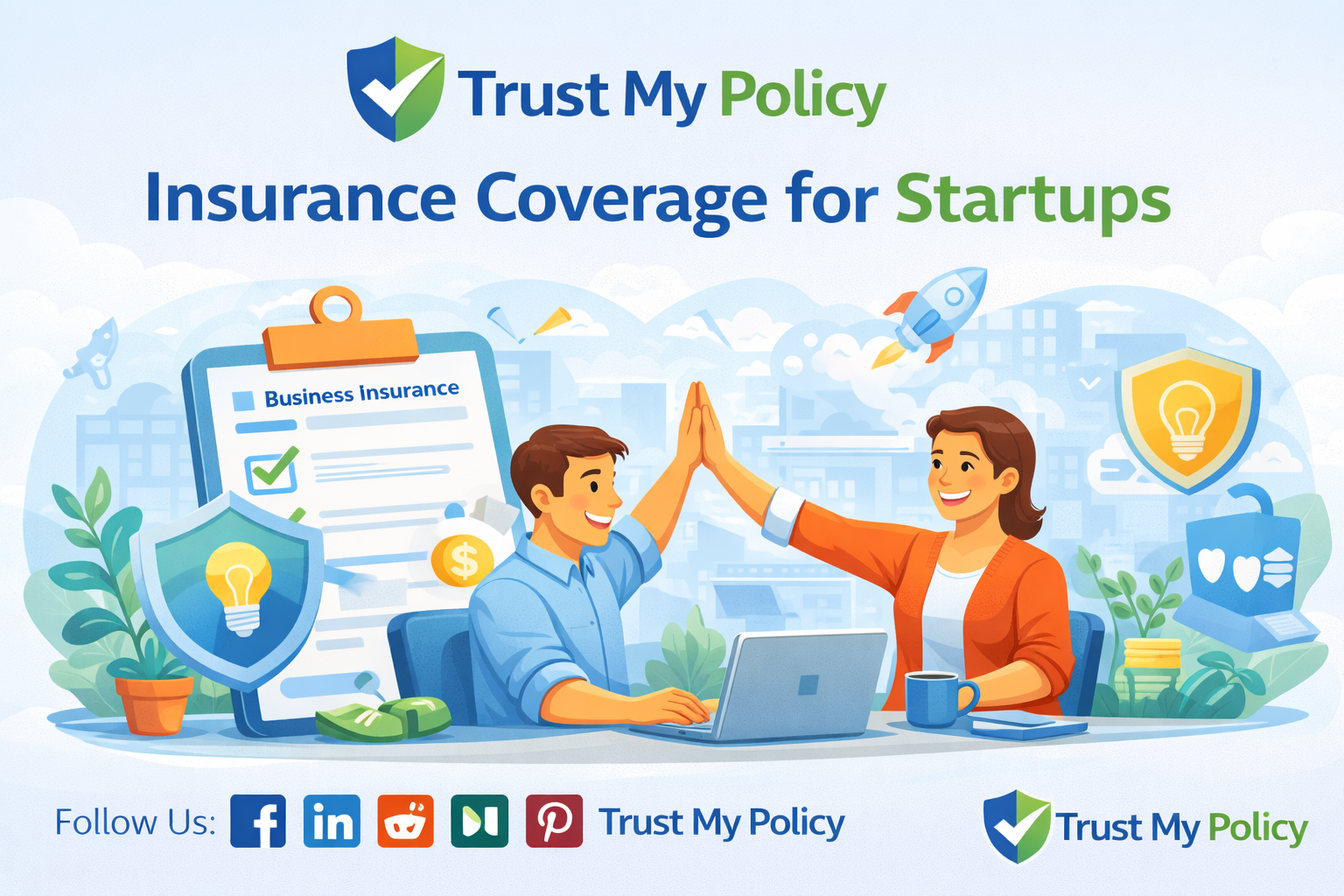
Startups need general liability insurance from day one, directors and officers (D&O) insurance as soon as they take outside investment or add a board, cyber liability and technology errors and omissions coverage for any product handling user data, and key person insurance once the business depends heavily on specific founders. D&O insurance is frequently a hard requirement in venture term sheets, not just a recommendation.
Nadia Khoury, 31, co-founded a fintech startup in San Francisco and closed a $2 million seed round, only for her lead investor’s term sheet to require a specific insurance policy be in place before the money would actually transfer. She’d never heard of directors and officers insurance before that exact moment, and scrambling to bind a policy in 48 hours nearly delayed her entire funding close.
Insurance Coverage for Startups in 2026 needs to evolve with each funding stage: general liability and renters insurance for a pre-seed home office, directors and officers (D&O) insurance once you take outside investment, cyber liability and technology errors and omissions for any product handling user data, and key person insurance once the business depends heavily on one or two founders. This guide breaks down exactly which coverage matters at each stage and why investors often require it.
This article covers the specific coverage types startups need at each funding stage, what investors typically require, real scenarios showing the stakes, and a clear framework for building out your coverage as you grow. By the end, you’ll know exactly what to have in place before your next round closes.
| Feature | Details |
| What it is | A staged set of coverage types that expand as a startup raises capital and grows |
| Who needs it | Founders, especially once outside investors, a board, or user data are involved |
| Typical early-stage cost | $50–$150/month for general liability and a basic tech E&O policy |
| Typical D&O cost | $2,000–$10,000/year depending on funding stage and industry |
| Key benefit | Protects founders’ personal assets and satisfies common investor requirements |
| Key limitation | Many founders only discover a coverage requirement during a funding close, under time pressure |
| Regulator | State insurance departments (US); Financial Conduct Authority (UK) |
Think of startup insurance like building out a house in phases as your family grows. A studio apartment (pre-seed) needs basic protection. Once you add roommates with financial stakes in the place (investors and a board), you need a different kind of coverage entirely. Once you’re storing other people’s valuables (user data), you need yet another layer.
Startup insurance needs to scale deliberately with each funding stage, since the risks a two-person pre-seed team faces are genuinely different from those of a Series A company with a board, investors, and thousands of users. General liability and basic property coverage form the earliest foundation, directors and officers insurance becomes essential once outside capital and a board are involved, and cyber liability or technology errors and omissions coverage becomes critical the moment user data is part of the product. Anyone building a startup needs to anticipate these stages rather than discovering them under the time pressure of a funding close.
| Criteria | Pre-Funding (Bootstrapped) Coverage | Post-Funding (Investor-Backed) Coverage |
| Core coverage | General liability, basic property | D&O, cyber liability, tech E&O, employment practices liability |
| Typical trigger | Forming the company, signing a lease or co-working agreement | Closing a funding round, particularly with institutional investors |
| Cost | $50–$150/month combined | $300–$1,500+/month combined, scaling with team size and funding |
| Pros | Affordable, covers the most basic early risks | Satisfies investor requirements and covers genuinely larger risks |
| Cons | Doesn’t address investor- or data-related risks at all | Meaningfully higher cost as the company scales |
We recommend founders proactively research D&O insurance before starting fundraising conversations, since waiting until term sheet negotiations begin often creates unnecessary time pressure.
Scenario 1: Nadia, 31, fintech founder in San Francisco. Nadia’s $2 million seed round nearly stalled when her lead investor required D&O insurance be bound within 48 hours before funds would transfer. Verdict: D&O insurance is frequently a hard, non-negotiable requirement in venture funding, not a suggestion. Action: Nadia now recommends every founder research D&O coverage before starting any fundraising conversations.
Scenario 2: A two-person pre-seed startup working from a London co-working space. Their co-working agreement required proof of general liability insurance before they could even sign the lease. Verdict: even pre-seed startups face concrete, immediate coverage requirements. Action: they secured a basic general liability policy within a week of forming the company.
Scenario 3: A Series A health-tech startup handling sensitive patient data in Boston. A data breach affecting 12,000 users triggered significant notification and remediation costs, fully covered under their cyber liability policy. Verdict: cyber liability coverage became essential the moment the product began handling sensitive user data. Action: the company increased its cyber liability limits at its next renewal given its growing user base.
Scenario 4: A startup whose technical co-founder, the sole holder of critical product knowledge, was seriously injured in an accident. Key person insurance provided a payout that helped the company manage a difficult transition period without that founder’s daily involvement. Verdict: key person insurance can provide a genuine financial buffer during an unexpected leadership gap. Action: the company used the proceeds to fund a structured technical knowledge transfer to the rest of the engineering team.
| Pros | Cons |
| Scaling coverage with funding stage avoids overpaying too early. | Many founders discover a coverage requirement only under fundraising time pressure. |
| D&O insurance protects founders’ personal assets from corporate decision-related claims. | D&O policies can take time to underwrite, especially for first-time founders. |
| Cyber liability coverage addresses a genuinely significant and growing startup risk. | Comparing cyber liability policies requires understanding your specific data exposure. |
| Key person insurance provides a real financial buffer during a leadership crisis. | Many founders underestimate this risk until it’s too late to easily obtain coverage. |
| Proactive planning avoids scrambling during an actual funding close. | Coordinating multiple policy types as the company grows takes ongoing attention. |
⚠️ WARNING: Never assume your investors will simply waive a D&O insurance requirement because your company is small or early-stage. Many institutional investors treat this as a non-negotiable condition of closing, and scrambling to bind a policy at the last minute can delay or jeopardize your funding round.
| Your Situation | Our Recommendation |
| You’re pre-seed, bootstrapped, with no outside investors yet | Yes — get general liability and basic property coverage now |
| You’re about to start fundraising conversations | Yes — research D&O insurance before you begin, not after a term sheet arrives |
| Your product handles any user data | Yes — add cyber liability and technology errors and omissions coverage |
| Your team has grown beyond a handful of employees | Yes — add employment practices liability insurance |
| Your company depends heavily on one or two specific founders | Yes — consider key person insurance |
| You assumed your general liability policy covers a data breach | No — confirm this directly, since it typically doesn’t |
| You haven’t reviewed your coverage since your last funding round | Yes — review your full coverage stack at each funding milestone |
💡 TIP: The single golden rule for startup insurance: research D&O coverage before you start fundraising, not after a term sheet makes it an urgent, time-pressured requirement.
| Scenario | Cost | Notes |
| Pre-seed general liability insurance | $30–$60/month | Often required by co-working space or lease agreements |
| Pre-seed basic property/equipment coverage | $20–$50/month | Covers laptops and basic office equipment |
| Seed-stage D&O insurance | $2,000–$5,000/year | Often a hard requirement before a funding round closes |
| Series A D&O insurance | $5,000–$15,000+/year | Scales with funding amount, board size, and industry risk |
| Cyber liability insurance (early-stage tech product) | $1,500–$5,000/year | Varies significantly by amount and sensitivity of user data |
| Employment practices liability insurance | $1,000–$3,000/year | Typically added once headcount grows beyond a small founding team |
| Key person insurance, healthy founder, $1,000,000 coverage | $40–$80/month | Cost varies by founder age, health, and coverage amount |
Vouch — A startup-focused insurance provider offering D&O, cyber liability, and tech E&O bundles designed specifically for venture-backed companies. Cost range: competitive startup-specific pricing. Best for: US startups wanting coverage tailored to investor requirements. Rating: backed by major reinsurance partners.
Embroker — Offers bundled startup insurance packages covering D&O, cyber, and general liability in one streamlined application. Cost range: competitive startup pricing. Best for: founders wanting a fast, combined application process. Rating: AM Best-rated carrier partners.
Hiscox (US and UK) — Offers small business and professional liability coverage well suited to early-stage startups in both countries. Cost range: competitive small business pricing. Best for: startups in either the US or UK needing flexible coverage. Rating: AM Best A.
Chubb — A major global insurer with strong D&O and cyber liability offerings for growth-stage and later startups. Cost range: competitive for Series A and beyond. Best for: growth-stage startups with more complex risk profiles. Rating: AM Best A++.
Independent insurance brokers specializing in startups — Brokers experienced specifically with venture-backed companies can anticipate what your next funding round will require. Cost range: typically free for the consumer. Best for: any founder wanting proactive guidance ahead of fundraising. Rating: varies by broker, check licensing.
We recommend Vouch or Embroker as best overall for most US startups because both are purpose-built for the exact coverage combination venture investors typically require.
Startups generally need general liability insurance from the earliest stage, directors and officers insurance once outside investors and a board are involved, and cyber liability or technology errors and omissions coverage for any product handling user data.
It’s often a hard requirement from institutional investors as a condition of closing a funding round, even though it’s not legally mandated, making it effectively non-negotiable in many fundraising processes.
Ideally before starting fundraising conversations, since many investors require proof of coverage before funds transfer, and scrambling to bind a policy under time pressure can delay a round.
No. General liability insurance typically excludes data breaches and cyber-related claims, which require a separate cyber liability policy.
Key person insurance provides a payout to the company if a critical founder or executive dies or becomes seriously incapacitated, helping fund the transition during a leadership gap.
Seed-stage D&O insurance typically costs $2,000–$5,000 a year, though this can vary based on funding amount, industry, and the specific insurer.
Yes, typically general liability and basic property coverage, especially if signing a lease or co-working agreement, which often require proof of coverage as a condition of the agreement.
Technology errors and omissions (tech E&O) insurance covers claims related to product failures, software errors, or service delivery issues specific to technology companies.
Generally once headcount grows beyond a small founding team, since the risk of employment-related claims, like wrongful termination, increases meaningfully with more employees.
At every funding round, since coverage needs typically expand significantly with each new round of investment, board additions, or major product changes.
This article is for informational purposes only. Always consult a licensed insurance professional before making coverage decisions. Trust My Policy does not sell insurance products or represent any insurer.

Jagadeesh Gutha is the founder of TrustMyPolicy.com, an independent insurance information platform covering life, health, car, home, and business insurance for US and UK readers. He researches insurance products, policy structures, and consumer rights to help everyday people make informed coverage decisions without the jargon. All content on TrustMyPolicy is independently researched, fact-checked, and written to educate — not to sell.




Insurance Guides for UK, USA & Worldwide We are not an insurer or broker.
Reader Comments (1)
[…] for Startups in 2026 boils down to five must-haves most founders discover too late: general liability for basic third-party claims, directors and […]