

An insurance premium is the amount you pay, usually monthly or annually, to keep a policy active. It’s calculated based on your personal risk factors — like age, location, and claims history — combined with broader claims trends across your risk pool and the insurer’s costs. A clean-record driver might pay $80 a month while a higher-risk driver pays $200 for similar coverage.
Devon Walsh, 30, opened his auto renewal notice in Phoenix and saw his premium had jumped from $89 to $124 a month with zero claims filed. Confused, he called his insurer and learned his rate had risen due to a combination of inflation in repair costs and a recent move to a higher-traffic ZIP code, not anything he’d personally done.
Insurance Premium Explained simply: your premium is the amount you pay, usually monthly or annually, to keep an insurance policy active. It’s calculated using your personal risk factors, the cost of claims across your wider risk pool, and the insurer’s operating costs and profit margin. This guide breaks down exactly what goes into that number and what you can actually do to lower it.
This article covers exactly how premiums are calculated, what factors move the number up or down, real scenarios with specific dollar amounts, and a clear framework for lowering your own. By the end, you’ll understand exactly what you’re paying for.
| Feature | Details |
| What it is | The recurring payment required to keep an insurance policy active |
| Who it applies to | Anyone holding an auto, home, health, or life insurance policy |
| Typical range | $80–$300/month for auto and home combined in the US; £30–£100/month UK life or health |
| What sets the amount | Personal risk factors, pool-wide claims trends, and insurer operating costs |
| Key benefit | Predictable, budgetable cost in exchange for protection against a large loss |
| Key limitation | Premiums can rise even without a personal claim, reflecting broader trends |
| Regulator | State insurance departments (US); Financial Conduct Authority (UK) |
Think of your premium like a subscription fee for protection, similar to a gym membership. You pay a set amount whether or not you use the facility that month, because the value is in having access whenever you need it, not in extracting your money’s worth from every single visit.
An insurance premium is the amount you pay, usually on a monthly or annual basis, to keep your policy active and your coverage in force. It’s calculated using actuarial data about your personal risk factors, combined with broader claims trends across your risk pool, plus the insurer’s administrative costs and profit margin. Anyone budgeting for insurance, or wondering why their rate changed, needs to understand what actually goes into this number.
| Criteria | Factors That Raise Your Premium | Factors That Lower Your Premium |
| Personal history | Recent claims, traffic violations, lapses in coverage | Clean claims history, continuous coverage, safe driving record |
| Demographics | Younger age (auto), older age (life), higher-risk occupation | Middle-age stability (auto), younger age (life), lower-risk occupation |
| Location | High-crime, high-traffic, or high-weather-risk areas | Lower-risk neighborhoods and regions |
| Policy choices | Lower deductible, higher coverage limits | Higher deductible, bundling multiple policies |
| Pros of understanding this | Helps you anticipate and budget for changes | Helps you actively lower your own premium over time |
We recommend reviewing your specific risk factors at every renewal for most readers, since understanding what’s driving your premium is the first step toward lowering it.
Scenario 1: Devon, 30, driver in Phoenix. Devon’s premium rose from $89 to $124 a month due to rising repair costs and a move to a higher-traffic ZIP code, despite having zero claims. Verdict: pool-wide trends and location changes can raise your premium independently of your own driving. Action: Devon compared quotes from three other insurers and found a $98/month alternative with similar coverage.
Scenario 2: Sarah, 45, homeowner in Leeds with a clean claims history. Sarah’s premium stayed flat for years until a regional flood-claims spike pushed her renewal up by £180 annually. Verdict: broader regional claims trends directly affect individual premiums. Action: Sarah asked her insurer about flood-resistant home upgrades that could offset part of the increase.
Scenario 3: A 32-year-old applying for term life insurance as a non-smoker with excellent health. He qualified for a preferred rate class, paying significantly less than a smoker of the same age would for identical coverage. Verdict: health classification has an outsized effect on life insurance premium pricing. Action: he locked in a 20-year level term policy to keep this favorable rate fixed for two decades.
Scenario 4: A small business owner in Texas who bundled auto, home, and business liability insurance with one insurer. Bundling reduced his combined premium by roughly 12% compared to three separate policies. Verdict: bundling is one of the most reliable ways to lower a combined premium. Action: he now reviews his bundled discount annually to confirm it still beats separate policy pricing.
| Pros | Cons |
| Premiums provide a predictable, budgetable cost for ongoing protection. | Premiums can rise due to pool-wide trends, not just personal behavior. |
| Understanding your risk factors helps you take action to lower your rate. | Some factors, like regional claims spikes, are outside your personal control. |
| Bundling multiple policies often reduces your combined premium meaningfully. | Comparing premiums across insurers takes more effort than accepting a renewal. |
| Maintaining continuous coverage typically helps keep your rate stable. | A lapse in coverage, even briefly, can raise your premium at the next application. |
| Healthy lifestyle and safe driving habits can directly lower your premium over time. | Premium increases aren’t always explained clearly on a renewal notice. |
⚠️ WARNING: Never let your coverage lapse to save money temporarily. Even a brief gap in coverage can raise your future premiums significantly when you reapply, since insurers view lapses as a risk signal.
| Your Situation | Our Recommendation |
| Your premium rose with no personal claims on record | Yes — ask your insurer for a specific explanation of what changed |
| You haven’t compared quotes from other insurers in years | Yes — get at least two or three comparison quotes before your next renewal |
| You have multiple policies with different insurers | Yes — ask about bundling discounts with a single insurer |
| You’re considering letting coverage lapse to save money temporarily | No — this typically raises your future premiums more than it saves now |
| You’ve improved your health, driving record, or home safety recently | Yes — ask your insurer whether this qualifies you for a lower premium |
| You’re choosing between two quotes with a large price gap | Yes — compare coverage limits and exclusions before assuming the cheaper option is better |
| You’re unsure what specific factors are driving your current premium | Yes — request a full risk factor breakdown from your insurer |
💡 TIP: The single golden rule for managing your premium: always ask what specific factor changed before accepting an increase, and always compare at least two other quotes before renewing automatically.
| Scenario | Typical Monthly Premium | Notes |
| Clean-record driver, age 35, full coverage | $80–$110 | Among the lowest standard auto risk classifications |
| Same driver after one at-fault accident | $130–$180 | Reflects an elevated claims probability |
| Healthy non-smoker, age 32, $500,000 term life | $25–$40 | Preferred health classification keeps pricing low |
| Smoker, age 32, $500,000 term life | $60–$100 | Smoking status significantly raises life insurance pricing |
| Bundled auto and home insurance, single insurer | 10%–15% combined discount | Common savings range for bundling multiple policies |
| Homeowner after a regional flood-claims spike | Increase of $150–$400/year | Reflects broader pool-level claims trends |
| UK car insurance after a lapse in coverage | 10%–25% premium increase at reapplication | Reflects the insurer’s added risk perception |
Independent insurance brokers — Brokers can compare how different insurers price your specific risk profile and identify bundling opportunities. Cost range: typically free for the consumer. Best for: anyone wanting a side-by-side premium comparison. Rating: varies by broker, check state or FCA licensing.
Policygenius (US) — A comparison platform showing real quotes across multiple insurers for life and home insurance. Cost range: free to compare. Best for: US shoppers wanting transparent premium comparisons. Rating: independent comparison service.
Compare the Market (UK) — A leading UK comparison site for home, auto, and life insurance quotes from multiple providers. Cost range: free to compare. Best for: UK shoppers wanting fast multi-carrier quotes. Rating: FCA-regulated comparison service.
Your state insurance department (US) — Can explain how rate factors are regulated and whether a specific increase seems consistent with state rules. Cost range: free to contact. Best for: US policyholders questioning a renewal increase. Rating: government regulatory body.
NAIC consumer resources (US) — Publishes plain-language guidance on how premiums are calculated across different insurance types. Cost range: free public resource. Best for: US consumers researching premium factors. Rating: regulatory standards body.
We recommend starting with an independent broker as best overall because comparing real quotes side by side is the fastest way to confirm whether your current premium is competitive.
An insurance premium is the amount you pay, usually monthly or annually, to keep your insurance policy active and your coverage in force.
Your premium is calculated using your personal risk factors, broader claims trends across your risk pool, and the insurer’s operating costs and profit margin.
Premium increases often reflect broader pool-wide trends, like rising repair costs or regional claims spikes, rather than anything specific to your individual history.
Yes, often through bundling multiple policies, improving your risk classification, increasing your deductible, or simply shopping quotes from other insurers.
Yes. Premiums vary meaningfully between insurers for the same coverage, so comparing at least two or three quotes annually can reveal real savings.
Yes, in many cases. Location is a significant risk factor for auto, home, and sometimes health insurance, so moving can raise or lower your premium.
Smoking is strongly linked to higher mortality risk in actuarial data, which significantly raises the premium for the same coverage amount compared to a non-smoker.
A lapse in coverage is typically viewed as a risk signal by insurers, which can raise your premium when you reapply, even if your personal risk hasn’t otherwise changed.
Usually, though not always. It’s still worth comparing the bundled price against separate policies from different insurers to confirm it’s genuinely the better deal.
Review your premium at every renewal, and request a specific explanation any time it changes meaningfully without a clear personal reason.
This guide reflects the latest 2026 insurance data.
This article is for informational purposes only. Always consult a licensed insurance professional before making coverage decisions. Trust My Policy does not sell insurance products or represent any insurer.

Jagadeesh Gutha is the founder of TrustMyPolicy.com, an independent insurance information platform covering life, health, car, home, and business insurance for US and UK readers. He researches insurance products, policy structures, and consumer rights to help everyday people make informed coverage decisions without the jargon. All content on TrustMyPolicy is independently researched, fact-checked, and written to educate — not to sell.


[…] myths are widely repeated but inaccurate beliefs about how premiums are priced, how claims are handled, or how much coverage someone actually needs. Anyone shopping for auto, […]
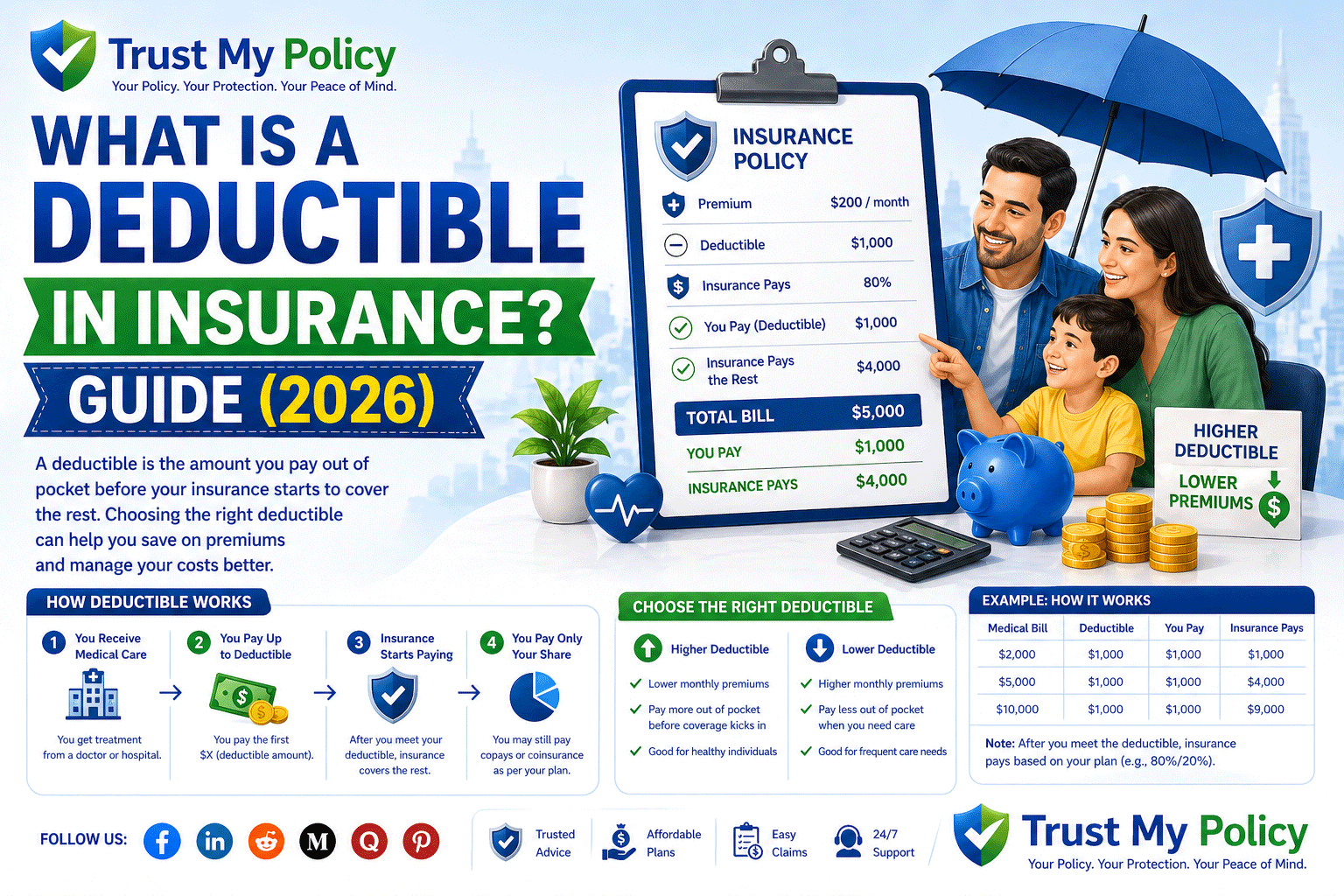
[…] to $2,000 for home and auto insurance. Choosing a higher deductible typically lowers your monthly premium by 10–20%, while a lower deductible raises […]
[…] with the declarations page, which summarizes your coverage. This page lists your premium, deductible, coverage limits, and policy period at a […]
[…] pooling in insurance means combining premiums from a large group of people so that the rare, costly claims of a few can be paid from everyone’s […]
[…] insurance grace period is the window of time after a missed premium payment, typically 10–31 days depending on the policy and state, during which your coverage remains […]
[…] The full pricing pipeline from base rate calculation to your final quoted premium […]
[…] insurance cost is driven by a specific combination of factors: your industry classification code, which reflects […]
[…] insurance premium increases come from two distinct categories: personal factors specific to your home and history, […]



Insurance Guides for UK, USA & Worldwide We are not an insurer or broker.
Reader Comments (9)
[…] Premium price becomes the primary comparison point. This happens because price is the single number every quote displays prominently. […]