

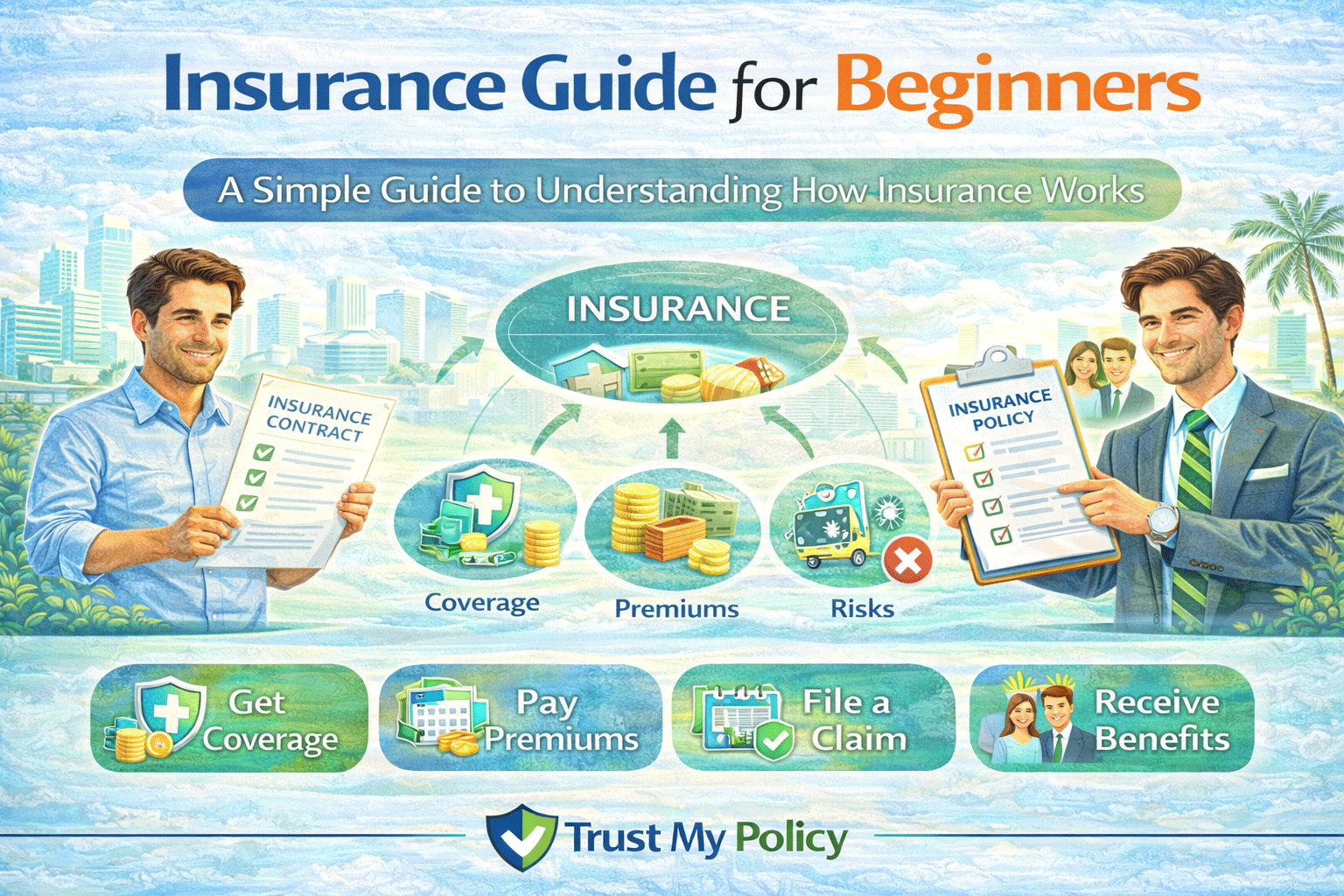
For beginners, the core insurance types are health, auto (if you drive), renters or homeowners, life (if you have dependents), and disability insurance. Most young adults should prioritize health and auto first, since both are often legally required or carry the highest financial risk if skipped, typically costing $50–$300 a month combined depending on location and coverage.
Olivia Tran, 23, moved into her first apartment in Seattle and signed up for renters insurance, auto insurance, and a phone plan add-on all in the same week, without really understanding any of them. Six months later, a stolen laptop claim taught her the hard way that her renters policy had a $500 deductible and a $1,500 electronics sub-limit she’d never read.
Insurance Guide for Beginners in 2026 starts with five core categories most adults eventually need: health, auto, renters or home, life, and disability insurance. Each protects against a different kind of financial loss, and most beginners only need three or four of them at once. This guide walks through what each type actually covers, what it costs, and which ones to prioritize first.
This article covers the core insurance types every beginner should know, how to read a policy before signing, real first-time buyer scenarios, and a simple decision framework. By the end, you’ll know exactly where to start.
Table of Contents
ToggleQuick Summary Table
| Feature | Details |
| What it is | The basic categories of personal insurance most adults eventually need |
| Who needs it | Anyone with a car, a rented or owned home, dependents, or an income to protect |
| Typical starter cost | $50–$300/month combined for health, auto, and renters insurance |
| Coverage available | Health, auto, renters/home, life, and disability as the five core categories |
| Key benefit | Protects against the financial losses most likely to derail a beginner’s finances |
| Key limitation | Skipping coverage to save money short-term can backfire badly after one bad event |
| Regulator | State insurance departments (US); Financial Conduct Authority (UK) |
What Is Insurance, in Plain Terms?
Most beginners picture insurance like a subscription service — you pay monthly, and you expect to “use” what you pay for, the way you’d stream a show. Insurance works more like a fire extinguisher hanging on the wall. You hope you never need it, but its entire value comes from being there the one time something goes wrong.
Insurance is a financial product where you pay a regular premium to a company that agrees to cover specific losses, like a car accident, theft, or illness, up to defined policy limits. You need this guide if you’re buying your first policy of any kind, just moved out on your own, started driving, or recently took on new financial responsibilities like a mortgage or a child.
How to Start Building Your Coverage — 5 Steps
- Identify your biggest financial risks first. Driving, renting or owning a home, and having dependents are the three most common triggers for needing coverage immediately.
- Prioritize legally required or contractually required coverage. Auto liability insurance is legally required in nearly every US state and UK driving situation; mortgage lenders also require home insurance.
- Add health insurance if you don’t already have it through an employer. A single hospital visit without coverage can cost more than years of premiums combined.
- Layer in life and disability insurance once you have dependents or debts. These protect your income and your family’s financial stability, not just physical property.
- Read your policy’s deductible, limits, and exclusions before relying on it. Many beginners only discover these details after filing their first claim.
Comparison: The 5 Core Insurance Types for Beginners
| Criteria | Health | Auto | Renters/Home | Life | Disability |
| Who needs it | Nearly everyone | Anyone who drives | Anyone renting or owning | Anyone with dependents or debt | Anyone relying on their income |
| Typical monthly cost | $50–$450 (varies hugely by plan/subsidy) | $80–$200 | $15–$40 (renters) / $80–$150 (home) | $15–$50 (term life) | $20–$60 |
| Legally required | Often via individual mandate or employer | Yes, liability in nearly all US states | No, but often lender-required for homes | No | No |
| Pros | Covers high-cost medical events | Covers accidents and liability | Covers theft, fire, and liability at home | Replaces income for dependents if you die | Replaces income if you can’t work |
| Cons | Can be complex to compare plans | Doesn’t cover your own car under liability-only | Renters often skip it, underestimating risk | Often delayed until “later” by beginners | Frequently overlooked entirely |
We recommend starting with health and auto insurance for most beginners because both protect against the highest-probability, highest-cost risks young adults actually face.
4 Real-Life Scenarios
Scenario 1: Olivia, 23, first apartment in Seattle. Olivia’s stolen laptop claim was reduced because her renters policy had a $1,500 electronics sub-limit she never read. Verdict: this is one of the most common first-time renter mistakes. Action: Olivia added a scheduled personal property rider to cover her electronics at full value going forward.
Scenario 2: Tyler, 25, new driver in Texas with only state-minimum liability. After an at-fault accident, his own $9,000 in vehicle damage wasn’t covered because liability-only doesn’t cover your own car. Verdict: Tyler misunderstood what “minimum coverage” actually protects. Action: Tyler upgraded to full coverage with collision and comprehensive after the accident.
Scenario 3: Priya, 29, freelancer in London without disability cover. A six-week injury left Priya unable to work with no income replacement at all. Verdict: disability insurance is one of the most skipped, most regretted gaps for self-employed beginners. Action: Priya now carries income protection insurance covering 60% of her average earnings.
Scenario 4: Marcus, 31, new father in Ohio without life insurance. Marcus realized his family had no financial safety net if something happened to him. Verdict: this is one of the most common “I’ll get to it later” gaps that beginners regret. Action: Marcus bought a $500,000, 20-year term policy for around $30 a month.
Pros & Cons of Building Coverage as a Beginner
| Pros | Cons |
| Protects against the financial risks most likely to hit you early in adulthood. | Comparing plans across five categories can feel overwhelming at first. |
| Many policies are inexpensive when you’re young and healthy. | It’s easy to underinsure by choosing the cheapest option without reading limits. |
| Bundling auto and renters/home often unlocks meaningful discounts. | Skipping coverage to save money short-term carries real financial risk. |
| Building coverage early often locks in lower rates than waiting. | Beginners often don’t know which add-ons (like scheduled property) they need. |
| Most core policies are straightforward to compare using free tools. | Life and disability insurance are frequently delayed far longer than they should be. |
5 Common Mistakes Beginners Make
- Confusing “legally required” with “fully protected.” This happens because minimum liability coverage satisfies the law but not your own financial protection. What to do instead: consider full coverage if you couldn’t afford to replace your car out of pocket.
- Not reading sub-limits on renters or home policies. This happens because policy documents are long and easy to skim. What to do instead: check specific category limits for electronics, jewelry, and other valuables before relying on a standard policy.
- Delaying life and disability insurance. This happens because these feel optional compared to auto or health coverage. What to do instead: get quotes as soon as you have any dependent or rely on your own income, since rates rise with age.
- Choosing the cheapest plan without comparing deductibles. This happens because the lowest premium looks like the obvious win. What to do instead: compare total potential out-of-pocket cost, not premium price alone.
- Not bundling policies with one insurer when it makes sense. This happens because beginners often buy each policy separately as the need arises. What to do instead: ask every new insurer whether bundling with an existing policy unlocks a discount.
⚠️ WARNING: Never assume state-minimum auto liability coverage protects your own vehicle. Liability-only insurance pays for damage you cause to others, not repairs to your own car.
Decision Table: Where Should You Start?
| Your Situation | Our Recommendation |
| You just started driving | Yes — get auto liability insurance immediately, it’s legally required |
| You just moved into a rental | Yes — get renters insurance, it’s inexpensive and covers theft and fire |
| You don’t have health coverage through work | Yes — compare marketplace or private health plans right away |
| You have a dependent or any debt in your name | Yes — get term life insurance while you’re young and healthy |
| You’re self-employed or freelance | Yes — prioritize disability/income protection insurance |
| You’re a single adult with no dependents or debt | No — life insurance can likely wait until your situation changes |
| You already have all five core policies | No — focus on reviewing limits and deductibles instead of buying more |
💡 TIP: The single golden rule for beginners: get coverage while you’re young and healthy, since nearly every policy type gets more expensive the longer you wait.
Cost Table: What Beginners Typically Pay
| Scenario | Typical Monthly Cost | Notes |
| US renters insurance, basic coverage | $15–$25 | One of the cheapest, most overlooked policies |
| UK contents insurance, basic coverage | £10–£20 | Similar value proposition to US renters insurance |
| US auto liability-only, young driver | $80–$150 | Legally required in nearly all states |
| US auto full coverage, young driver | $150–$250 | Covers your own vehicle, not just others |
| US subsidized ACA health plan, lower income | $0–$150 | Subsidy eligibility varies significantly by income |
| US unsubsidized health plan | $350–$550 | Applies above marketplace subsidy thresholds |
| Term life insurance, healthy 25-year-old, $250,000 | $12–$20 | One of the cheapest policies relative to payout |
| Disability/income protection insurance | $20–$60 | Often the most skipped policy among beginners |
Where Beginners Should Start Comparing Plans
HealthCare.gov / your state marketplace (US) — The federal or state-run marketplace where most Americans without employer coverage compare subsidized health plans. Cost range: $0–$550/month depending on income. Best for: anyone without employer-sponsored health coverage. Rating: federal/state government resource.
NerdWallet — A free US comparison and education platform covering auto, renters, life, and health insurance basics in beginner-friendly language. Cost range: free to use. Best for: US beginners comparing multiple policy types at once. Rating: independent comparison service.
Compare the Market (UK) — A leading UK platform for comparing home, auto, and life insurance quotes from multiple providers. Cost range: free to use. Best for: UK beginners wanting fast multi-carrier comparisons. Rating: FCA-regulated comparison service.
Policygenius — A US platform specializing in term life and disability insurance comparisons with beginner-friendly explanations. Cost range: free to compare. Best for: beginners tackling life or disability insurance for the first time. Rating: independent comparison service.
Lemonade — A digital-first US and UK insurer offering renters and home coverage with a simple, beginner-friendly app experience. Cost range: competitive, especially for renters. Best for: first-time renters wanting a fast digital signup. Rating: AM Best A-.
We recommend starting with your country’s marketplace (HealthCare.gov in the US, or a comparison site in the UK) as best overall because health coverage carries the highest financial risk if skipped entirely.
Frequently Asked Questions
What insurance do I actually need as a beginner?
Most beginners need health insurance, auto insurance if they drive, and renters or home insurance, with life and disability insurance added once they have dependents or rely on their own income.
How much does beginner insurance typically cost?
Combined health, auto, and renters insurance for a young adult typically ranges from $50 to $300 a month depending on income, location, and subsidy eligibility.
When should I get life insurance for the first time?
Get it as soon as you have a dependent, a partner relying on your income, or significant debt, since premiums rise with age and health changes.
Can I skip renters insurance if I don’t own much?
It’s not recommended, since renters insurance is inexpensive and also covers liability if someone is injured in your rented home, not just your personal belongings.
Is it worth bundling multiple policies with one insurer?
Often yes. Many insurers offer meaningful discounts for bundling auto with renters or home insurance, so it’s worth asking before buying separate policies.
Do I need disability insurance if I have a regular job?
Many employers offer some disability coverage, but it’s worth checking the replacement percentage and duration, since employer coverage is sometimes limited.
Why is auto liability insurance legally required but full coverage isn’t?
Liability coverage protects other people from damage you cause, which is why most US states and UK driving laws require it; full coverage protecting your own car is optional unless required by a lender.
How do I compare health insurance plans as a beginner?
Compare your expected premium, deductible, and out-of-pocket maximum together, not just the monthly premium, since a cheaper plan can cost more overall if you need care.
Is it too late to get insurance if I already had an incident?
It’s never too late to get appropriate coverage, though a recent claim or incident may affect your premium or eligibility for certain policies.
Can I change insurance policies if I find a better deal later?
Yes, in most cases you can switch insurers at renewal or even mid-term, though some policies may apply a small cancellation fee.
Key Takeaways
- Start with health and auto insurance, since both protect against the highest-probability financial risks.
- Add renters or home insurance immediately after moving, regardless of how few belongings you own.
- Get term life insurance as soon as you have a dependent or significant debt.
- Don’t overlook disability or income protection insurance, especially if self-employed.
- Read deductibles and sub-limits before assuming a policy fully protects you.
- Compare at least three quotes for any policy type before committing.
- Ask every new insurer about bundling discounts before buying separate policies.
This guide reflects the latest 2026 insurance data.
This article is for informational purposes only. Always consult a licensed insurance professional before making coverage decisions. Trust My Policy does not sell insurance products or represent any insurer.

Reader Comments (0)