
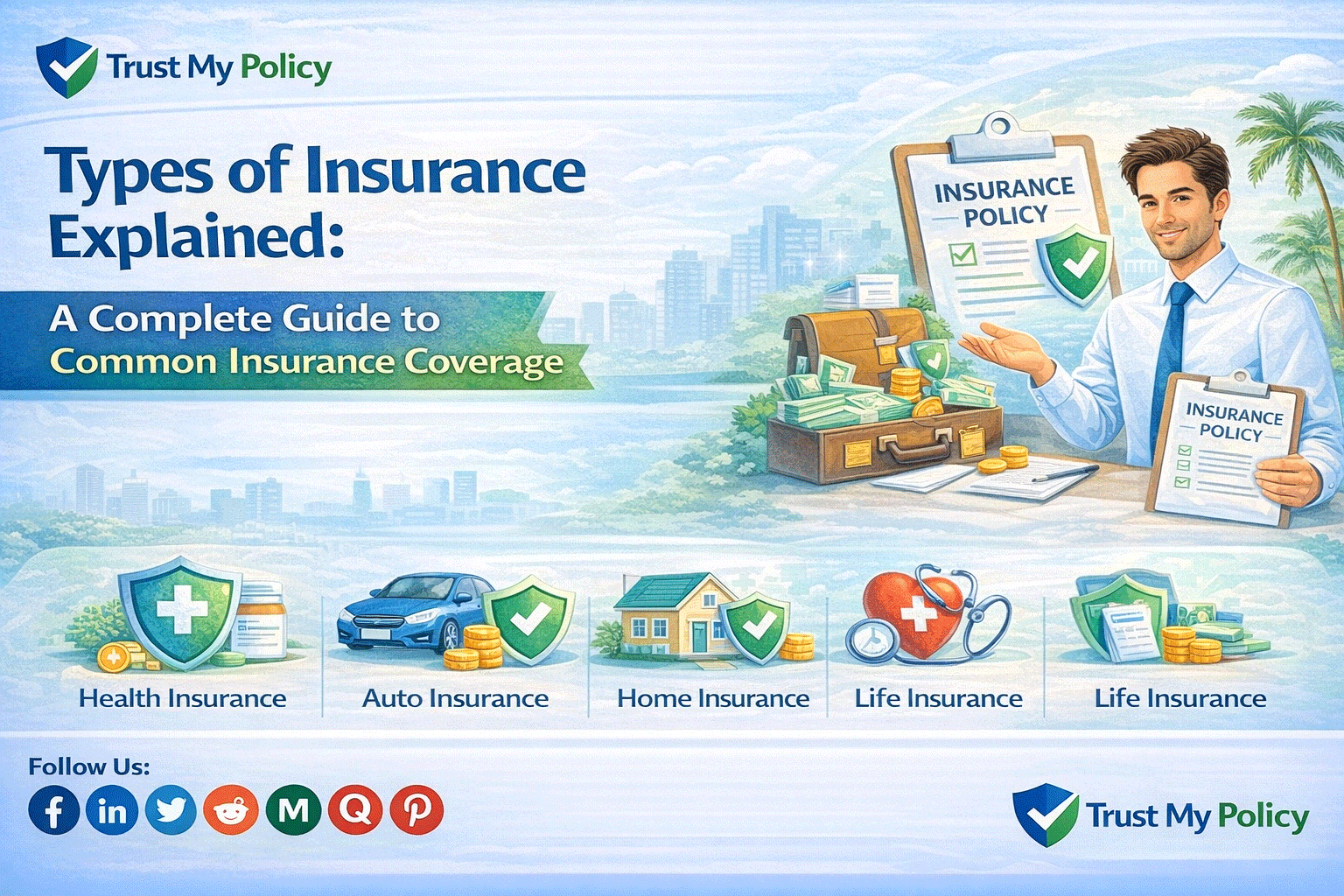
The major types of insurance are health insurance (medical costs), auto insurance (vehicle damage and liability), home or renters insurance (property and belongings), life insurance (income replacement for dependents), disability insurance (income protection if you can’t work), and liability insurance (lawsuit protection). Most people need several of these together, since each covers a distinct risk.
Hassan Malik, 30, started a small landscaping business in Manchester and assumed one general “business insurance” policy would cover everything from his van to a client’s injury. His broker quickly explained he actually needed several distinct types of coverage working together, not one all-purpose policy.
Types of Insurance in 2026 fall into a handful of core categories: health, auto, home or renters, life, disability, and liability insurance, each designed to protect against a specific kind of risk. Most people and businesses need a combination of several types, not just one. This guide breaks down every major category, what it actually covers, and roughly what it costs.
This article covers each major type of insurance, who specifically needs it, real scenarios showing how they work together, and a clear cost comparison. By the end, you’ll know exactly which types apply to your life or business.
| Feature | Details |
| What it is | Distinct categories of coverage, each protecting against a specific type of financial risk |
| Who needs multiple types | Nearly everyone — homeowners, drivers, parents, freelancers, and business owners |
| Typical combined cost | $300–$700/month for core US coverage combined; £100–£250/month UK equivalent |
| Coverage available | Health, auto, property, life, disability, and liability, among others |
| Key benefit | Each type addresses a risk the others don’t, so combining them closes coverage gaps |
| Key limitation | Assuming one policy covers everything often leaves serious gaps |
| Regulator | State insurance departments (US); Financial Conduct Authority (UK) |
Think of insurance types like specialized tools in a toolbox rather than one all-purpose multi-tool. A wrench doesn’t replace a screwdriver, and home insurance doesn’t replace life insurance — each is built for a specific job, and most people need several of them working together.
The core types of insurance include health insurance for medical costs, auto insurance for vehicle damage and liability, home or renters insurance for property and belongings, life insurance for replacing income after death, disability insurance for replacing income during a serious illness or injury, and liability insurance for protecting against lawsuits. Anyone managing a household, a family, or a business needs to know which of these apply specifically to their situation.
| Criteria | Health Insurance | Auto Insurance | Home/Renters Insurance | Life Insurance | Disability Insurance |
| What it covers | Medical costs and treatment | Vehicle damage and liability | Property, belongings, liability | Income replacement after death | Income replacement during disability |
| Who needs it | Everyone without employer/government coverage | Anyone who drives | Anyone renting or owning property | Anyone with dependents or debt | Anyone relying on their own income |
| Typical monthly cost | $150–$700 (US); £0–£100 (UK) | $40–$200 | $15–$200 | $25–$100 | $20–$80 |
| Pros | Covers often-catastrophic medical costs | Often legally required, protects against lawsuits | Affordable relative to potential loss | Protects dependents from financial hardship | Covers a risk often overlooked by other policies |
| Cons | Can be expensive without a subsidy | Doesn’t cover your own vehicle without add-ons | Doesn’t cover the structure if you’re a renter | No payout unless you pass away during the term | Often underpurchased relative to its real value |
We recommend most readers treat these as complementary, not interchangeable, since each type closes a gap the others don’t address.
Scenario 1: Hassan, 30, landscaping business owner in Manchester. Hassan assumed one general “business insurance” policy covered everything, until his broker explained he needed separate vehicle, liability, and equipment coverage. Verdict: business risk almost always requires multiple distinct types working together. Action: Hassan now carries commercial auto, general liability, and equipment coverage as three separate policies.
Scenario 2: Sarah, 34, mother of two in Phoenix. Sarah had health and auto insurance but no life or disability coverage, leaving a real gap if she became seriously ill and unable to work. Verdict: health insurance alone doesn’t replace lost income during a long-term disability. Action: Sarah added a disability insurance policy covering 60% of her income after a six-month elimination period.
Scenario 3: A renter in Leeds who only had auto insurance, assuming it was “enough” coverage overall. A burst pipe destroyed £2,800 of his belongings with no insurance in place to cover it, since auto insurance has nothing to do with rented property. Verdict: each insurance type only covers its specific category of risk. Action: he added a renters (contents) policy for £9 a month the following week.
Scenario 4: A freelance consultant in Austin with health insurance but no liability coverage. A client claimed his advice caused a financial loss and threatened legal action, a risk his health insurance had no bearing on at all. Verdict: professional liability insurance covers a completely different risk category than health coverage. Action: he added a professional liability (errors and omissions) policy to close this specific gap.
| Pros | Cons |
| Each type closes a specific gap the others don’t address. | Managing several policies takes more organization than one all-purpose plan. |
| Combining types creates comprehensive protection across major life risks. | Combined premiums across multiple types add up to a meaningful monthly cost. |
| Reduces the risk of a catastrophic, uninsured gap in any single area. | Overlapping coverage between policies can occasionally mean paying for redundancy. |
| Allows you to prioritize spending on your highest-exposure risks first. | Comparing multiple policy types across insurers takes more time than a single quote. |
| Supports both personal and business risk management simultaneously. | Some types, like disability insurance, are easy to overlook entirely. |
⚠️ WARNING: Never assume a single “umbrella” policy name means you’re covered for every type of risk. Even broad-sounding policies, like general business insurance, typically combine several specific coverage types rather than covering everything automatically.
| Your Situation | Our Recommendation |
| You drive a car, financed or owned | Yes — auto insurance, specifically liability coverage at minimum |
| You rent or own your home | Yes — renters or homeowners insurance depending on your situation |
| Someone depends on your income | Yes — life insurance, ideally term life for cost efficiency |
| You rely on your own income to cover expenses | Yes — disability insurance to protect against a long-term illness or injury |
| You’re without employer or government health coverage | Yes — individual health insurance |
| You run a business with any client or public-facing risk | Yes — commercial general liability insurance at minimum |
| You assume your personal policies cover your business activities | No — confirm with a broker, since this is rarely the case |
💡 TIP: The single golden rule for choosing types of insurance: match each specific risk in your life — driving, owning property, earning income, supporting dependents — to its own dedicated policy type, rather than assuming one policy covers them all.
| Scenario | Typical Monthly Cost | Notes |
| Individual health insurance (US, unsubsidized) | $400–$700 | Varies significantly by age, plan tier, and subsidy eligibility |
| UK private medical insurance (supplemental) | £30–£100 | Supplements, doesn’t replace, NHS access |
| Auto liability insurance | $40–$90 | Legally required in nearly all US states and the UK |
| Full coverage auto insurance | $100–$200 | Adds collision and comprehensive protection |
| Renters insurance | $12–$25 | Among the most affordable core policy types |
| Homeowners insurance | $100–$200 | Varies by home value and location risk |
| Term life insurance, healthy 35-year-old | $25–$45 | Low cost relative to the coverage amount provided |
| Disability insurance | $20–$80 | Often underpurchased relative to its real protective value |
State Farm (US) — Offers auto, home, and life insurance under one provider with broad agent availability. Cost range: competitive, varies by state. Best for: US households wanting multiple bundled policy types. Rating: AM Best A++.
Aviva (UK) — A major UK insurer offering home, life, auto, and private medical insurance across multiple categories. Cost range: competitive UK pricing. Best for: UK households wanting one insurer across several policy types. Rating: Defaqto 5 Star.
Progressive (US) — Strong auto and home insurance options with flexible coverage tiers. Cost range: competitive US pricing. Best for: US drivers and homeowners comparing coverage levels. Rating: AM Best A+.
Bupa (UK) — A leading UK private medical insurance provider, often paired with other UK insurers for full coverage. Cost range: competitive UK private medical pricing. Best for: UK individuals wanting faster specialist access. Rating: Defaqto 5 Star.
Policygenius (US) — A comparison platform spanning life, home, and disability insurance from multiple carriers. Cost range: free to compare. Best for: US shoppers wanting to compare several types at once. Rating: independent comparison service.
We recommend starting with an independent broker or a multi-line provider like State Farm or Aviva as best overall, since reviewing several types together helps ensure no major risk category is left uncovered.
The main types are health insurance, auto insurance, home or renters insurance, life insurance, disability insurance, and liability insurance, each covering a distinct category of risk.
Yes, in most cases. Each type covers a specific risk, so combining several — like auto, home, health, and life insurance — closes gaps that a single policy wouldn’t address.
Life insurance pays a benefit to your dependents after your death, while disability insurance replaces a portion of your income if you become unable to work due to illness or injury.
No. Liability insurance is a broader category that can apply to auto, home, or business risk, while auto insurance specifically covers vehicle-related liability and damage.
Yes. Businesses typically need commercial-specific types like general liability, commercial auto, and professional liability insurance, separate from personal policies.
Disability insurance is frequently overlooked, despite a long-term disability often being just as financially damaging as death without a payout to offset lost income.
Often yes, many insurers offer multiple types of coverage, sometimes with bundling discounts, though it’s still worth comparing whether a specialist insurer offers better terms for a specific type.
No. Health insurance covers medical treatment costs, while disability insurance covers lost income during a period when you can’t work due to illness or injury.
List your major assets, dependents, and income sources, then match each one to the insurance type specifically designed to protect against that risk.
Yes. A new home, business, child, or job should prompt a review of which insurance types you currently have and whether any new gaps have appeared.
This guide reflects the latest 2026 insurance data.
This article is for informational purposes only. Always consult a licensed insurance professional before making coverage decisions. Trust My Policy does not sell insurance products or represent any insurer.

Jagadeesh Gutha is the founder of TrustMyPolicy.com, an independent insurance information platform covering life, health, car, home, and business insurance for US and UK readers. He researches insurance products, policy structures, and consumer rights to help everyday people make informed coverage decisions without the jargon. All content on TrustMyPolicy is independently researched, fact-checked, and written to educate — not to sell.
[…] core benefits of insurance are financial protection against large, unpredictable losses, predictable monthly budgeting, legal […]



Insurance Guides for UK, USA & Worldwide We are not an insurer or broker.
Reader Comments (2)
[…] Insurance is a financial product where you pay a regular premium to a company that agrees to cover specific losses, like a car accident, theft, or illness, up to defined policy limits. You need this guide if you’re buying your first policy of any kind, just moved out on your own, started driving, or recently took on new financial responsibilities like a mortgage or a child. […]