
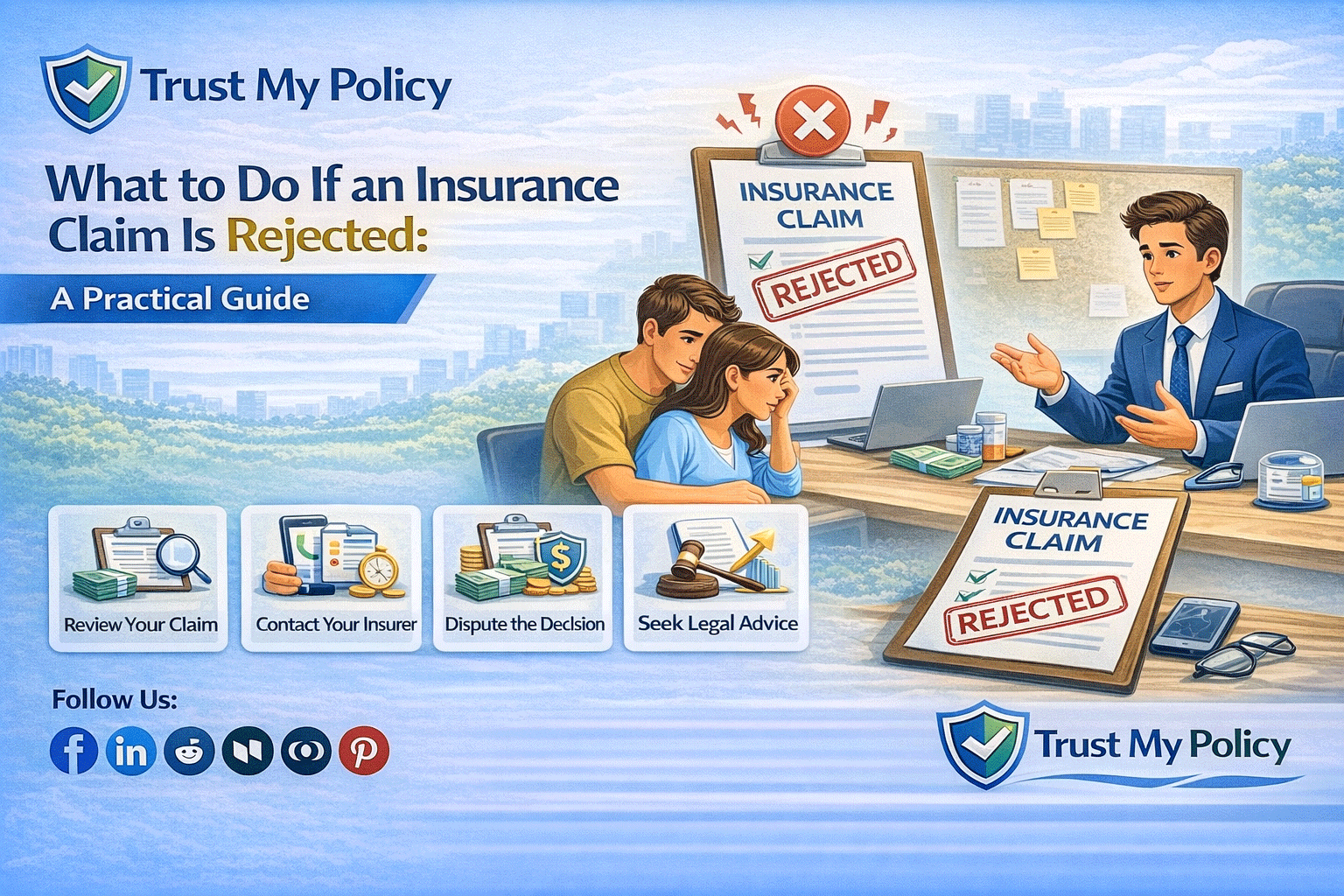
If your insurance claim is rejected, request the specific written reason for the denial, check your policy to confirm whether the exclusion genuinely applies, then file a formal internal appeal with additional supporting evidence. If the internal appeal fails, escalate to an independent external review. In the US, you can also file a free complaint with your state insurance department; in the UK, escalate to the Financial Ombudsman Service after exhausting your insurer’s internal process.
Sandra Osei, 43, received a denial letter on her $9,200 water damage claim in Bristol and assumed it was final. A colleague pointed out she had the right to a formal internal appeal, then an independent external review if that failed. Sandra appealed, submitted additional contractor evidence, and had the claim approved in full six weeks later.
What to Do If an Insurance Claim Is Rejected in 2026 follows a clear, staged path: request the specific written reason for the denial, review your policy to confirm whether the rejection is justified, file a formal internal appeal with supporting evidence, escalate to an independent external review if the internal appeal fails, and if necessary, file a complaint with your state insurance department (US) or the Financial Ombudsman Service (UK). This guide walks through every step in order, so you know exactly where to start the moment a rejection letter arrives.
This article covers the full appeal pathway, how to strengthen your case at each stage, real scenarios with specific outcomes, and the free regulatory tools available if your insurer won’t budge. By the end, you’ll know exactly how Sandra got her claim approved — and how to do the same.
| Feature | Details |
| What it is | A staged appeal process for challenging an insurer’s rejection of a claim |
| Who it applies to | Anyone who has received a formal denial on any type of insurance claim |
| Core appeal stages | Request written reason, internal appeal, external review, regulator complaint |
| Key benefit | Many rejections are reversed on appeal, especially those citing vague or administrative reasons |
| Key limitation | Fewer than 1% of denied claims in the US are ever appealed, per KFF 2024 data |
| Regulator | State insurance departments (US); Financial Ombudsman Service (UK) |
Think of a rejection letter like a parking fine, not an unappealable court verdict. Most people pay the fine because appealing feels complicated, even though a meaningful proportion of appeals succeed. Insurance claim rejections work the same way: the rejection is the insurer’s first answer, not necessarily its final one, and the formal appeal process exists specifically because first answers aren’t always correct.
When an insurance claim is rejected, the insurer has issued a written decision stating it won’t pay some or all of your claim. This decision can be challenged through a formal staged process: understanding the specific reason, reviewing your policy to verify whether the rejection is valid, filing an internal appeal with additional evidence, escalating to an independent external review, and if needed, filing a regulatory complaint. Anyone who receives a denial letter without immediately pursuing this pathway is almost certainly leaving a meaningful chance of reversal on the table.
| Criteria | Internal Appeal | External Review / Ombudsman |
| Who reviews it | The insurer’s own internal review team | An independent third party or statutory ombudsman |
| Cost | Free | Free for consumers |
| Typical timeline | Weeks | Weeks to a few months |
| Pros | Fastest first step, often sufficient for documentation-based denials | Genuinely independent, can override the insurer’s decision |
| Cons | Insurer upheld approximately 66% of internal health appeals in 2024, per KFF | Takes longer than an internal appeal |
We recommend filing the internal appeal first for most readers, since it’s free, fast, and sufficient to resolve many rejections, while keeping the external pathway ready if needed.
Scenario 1: Sandra, 43, homeowner in Bristol. Sandra’s $9,200 water damage denial was reversed after she filed an internal appeal with additional contractor documentation the insurer hadn’t initially reviewed. Verdict: internal appeals with supplementary evidence are one of the most effective tools for reversing documentation-based denials. Action: Sandra now keeps all claim-related documentation specifically in case an appeal is needed.
Scenario 2: Marcus, 36, health insurance claimant in Houston. Marcus’s claim was denied for “lack of prior authorization,” a requirement he’d never been clearly told about. His internal appeal was denied, but an independent external review found the prior authorization requirement hadn’t been adequately communicated to him and overturned the denial. Verdict: independent external review can override an insurer’s internal decision. Action: Marcus now confirms prior authorization requirements in writing before any non-emergency procedure.
Scenario 3: A small business owner in Manchester whose liability claim was denied citing a policy exclusion she disputed. After her internal appeal was denied, the Financial Ombudsman Service reviewed her case and found the exclusion had been applied more broadly than the policy wording justified, resulting in a partial payout. Verdict: the FOS can find in your favour even after a full internal denial. Action: she now keeps a detailed written record of all claim and appeal communications.
Scenario 4: A driver in California whose total loss settlement offer was disputed rather than a full denial. He filed a complaint with the California Department of Insurance after his insurer failed to respond to two written appeals within a reasonable timeframe. Verdict: state regulators can intervene when an insurer is unreasonably slow or unresponsive, not just in cases of outright denial. Action: his complaint prompted the insurer to respond within two weeks.
| Pros | Cons |
| Many denials, especially administrative ones, are reversed on internal appeal. | Fewer than 1% of denied US health claims are ever appealed, per KFF 2024 data. |
| External review and ombudsman services are free for consumers. | The process takes time and effort during an already stressful situation. |
| Regulatory complaints can prompt insurer action without costly legal proceedings. | Insurers uphold a majority of internal appeals, making external escalation sometimes necessary. |
| Written documentation throughout the appeal creates a strong record for escalation. | Some legitimate denials based on clear policy exclusions are unlikely to be overturned. |
| A successful appeal can result in full payment of a previously denied claim. | Not all claimants know the full staged appeal pathway exists. |
⚠️ WARNING: Never assume you must accept a rejection simply because the insurer stated a reason confidently. Vague reasons like “other” or administrative errors like missing prior authorization are among the most commonly reversed denial categories, and filing an appeal costs nothing.
| Your Situation | Our Recommendation |
| You just received a rejection letter | Yes — request the specific written denial reason immediately |
| The denial cites a vague or administrative reason | Yes — file an internal appeal with additional supporting evidence |
| The denial cites a clear, specific policy exclusion | Yes — verify whether the exclusion genuinely applies to your exact circumstances |
| Your internal appeal was denied | Yes — escalate to an independent external review or the Financial Ombudsman Service |
| Your insurer is unreasonably slow or unresponsive | Yes — file a complaint with your state insurance department or the FCA |
| You’re considering hiring an attorney immediately | No — exhaust free regulatory options first in most cases |
| You’re unsure whether to appeal a small rejected claim | Yes — if the claim involves a fixable documentation gap, an appeal costs nothing to try |
💡 TIP: The single golden rule when a claim is rejected: always request the specific written reason before deciding whether to appeal, since the right response depends entirely on what reason was actually cited.
| Scenario | Cost to Appeal | Potential Outcome |
| Internal appeal, documentation-based denial | $0 | Full claim approved if additional evidence resolves the gap |
| Internal appeal, vague “other” denial reason | $0 | Frequently reversed when a specific basis is requested and challenged |
| External review after failed internal appeal (US) | $0 | Independent reviewer can overturn the insurer’s decision |
| Financial Ombudsman Service complaint (UK) | $0 | FOS can award compensation and direct the insurer to pay |
| State insurance department complaint (US) | $0 | Can prompt insurer action without litigation |
| Hiring a public adjuster for a property claim | 5%–15% of claim payout | Often results in a higher settlement even after the fee |
| Hiring an attorney for bad faith insurance practices | 25%–40% contingency fee | Only worthwhile for large, clearly bad-faith denials |
Your state insurance department (US) — Provides a free complaint process that can prompt insurer action and investigation. Cost range: free. Best for: US policyholders facing unresolved rejections or delays. Rating: government regulatory body.
Financial Ombudsman Service (UK) — An independent statutory body that reviews unresolved insurance complaints and can direct insurers to pay. Cost range: free for consumers. Best for: UK policyholders who’ve exhausted their insurer’s internal process. Rating: independent statutory ombudsman.
NAIC consumer resources (US) — Publishes plain-language guidance on appeal rights across different insurance types and states. Cost range: free public resource. Best for: US consumers researching their specific appeal rights. Rating: regulatory standards body.
Independent insurance brokers — Many brokers will assist existing clients with appeal navigation at no extra charge. Cost range: usually free for existing policyholders. Best for: anyone wanting guidance on where to start with a specific rejection. Rating: varies by broker, check licensing.
Public adjusters (US, for property claims) — Can independently assess damage and advocate for a fair settlement on disputed property claims. Cost range: 5%–15% of the claim payout. Best for: large or complex property damage disputes. Rating: state-licensed, not insurer-affiliated.
We recommend starting with a free state insurance department complaint (US) or the Financial Ombudsman Service (UK) as best overall, since both are free, independent, and specifically designed to resolve exactly this type of dispute.
Request the specific written denial reason, review your policy against it, file a formal internal appeal with additional supporting evidence, then escalate to an independent external review or ombudsman if needed.
Yes. Most insurers are required to offer a formal internal appeals process, and independent external review or ombudsman services are available after that.
Success rates vary by denial reason, but documentation-based and administrative denials are among the most commonly reversed, particularly at the external review stage.
Yes. Both internal appeals and external review or ombudsman services are free for consumers in both the US and UK.
An independent external review is an assessment of your denied claim by a third party not affiliated with your insurer, which can overturn the insurer’s internal decision.
The Financial Ombudsman Service is an independent UK statutory body that reviews unresolved insurance complaints and can direct insurers to pay or provide compensation.
Generally not immediately. Exhaust free regulatory options first, since many rejections are resolved at the internal appeal or regulator complaint stage without legal fees.
File a complaint with your state insurance department (US) or the Financial Conduct Authority (UK), since unexplained delays in responding to a formal appeal can themselves be grounds for regulatory intervention.
Vague “other” reasons, administrative errors like missing prior authorization, and documentation gaps are among the most commonly reversed denial categories.
Internal appeals typically take weeks; external reviews and ombudsman investigations can take a few weeks to a few months, depending on complexity.
This article is for informational purposes only. Always consult a licensed insurance professional before making coverage decisions. Trust My Policy does not sell insurance products or represent any insurer.

Jagadeesh Gutha is the founder of TrustMyPolicy.com, an independent insurance information platform covering life, health, car, home, and business insurance for US and UK readers. He researches insurance products, policy structures, and consumer rights to help everyday people make informed coverage decisions without the jargon. All content on TrustMyPolicy is independently researched, fact-checked, and written to educate — not to sell.


Insurance Guides for UK, USA & Worldwide We are not an insurer or broker.
Reader Comments (0)