
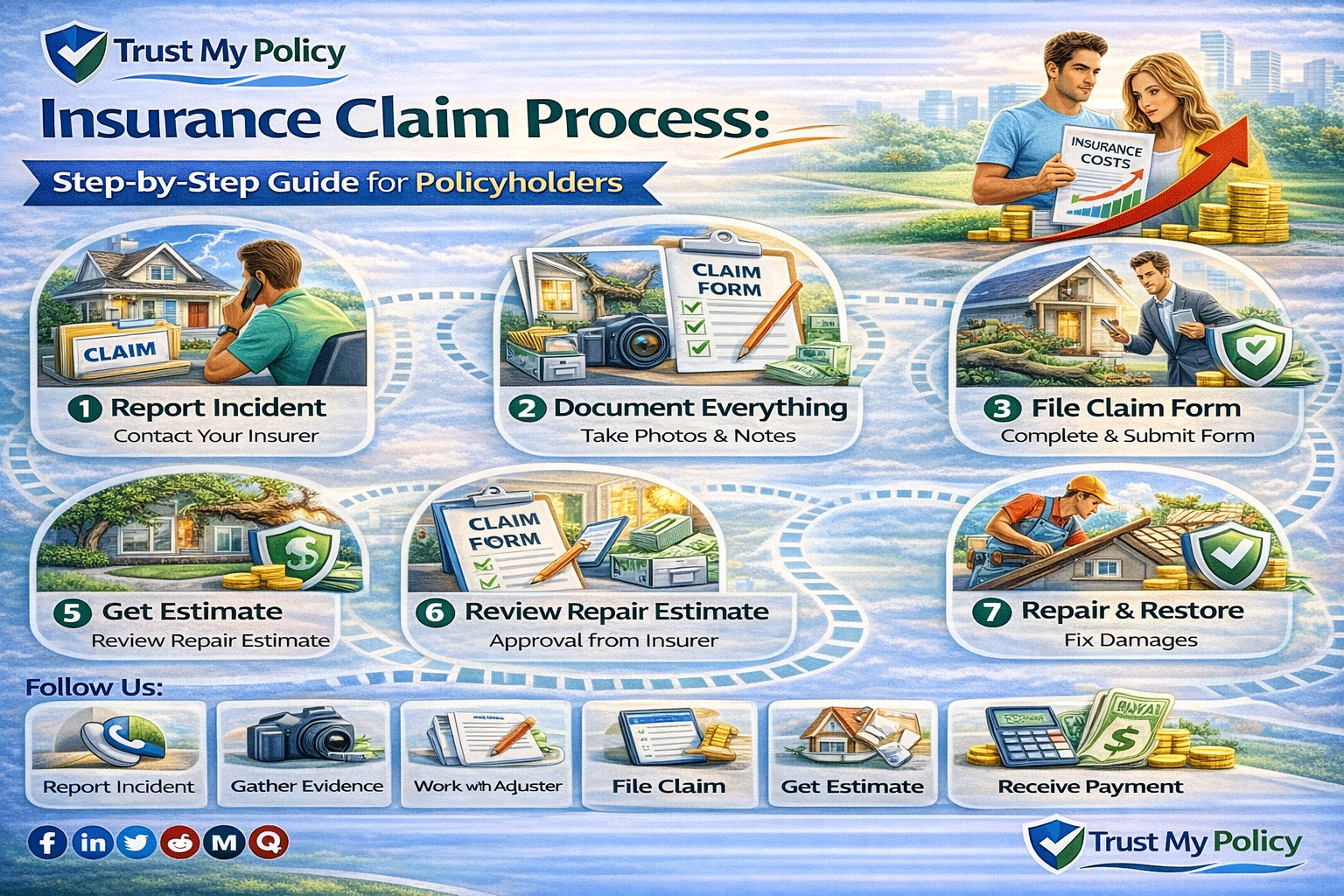
The insurance claim process typically involves five stages: reporting the incident to your insurer, providing documentation while the insurer investigates, receiving a coverage decision, negotiating or appraising the settlement amount if needed, and final payment. Straightforward claims can move through all five stages within days to a few weeks, while complex or disputed claims can take several months.
Felicity Bowman, 38, filed her first-ever insurance claim after a kitchen fire in Birmingham and had no idea what to expect next. She assumed a single phone call would resolve everything within days, only to learn her claim would actually move through several distinct stages, each with its own timeline and requirements, before any payment arrived.
The Insurance Claim Process in 2026 generally moves through five stages regardless of policy type: reporting the incident, documentation and investigation, the insurer’s coverage decision, negotiation or appraisal of the amount owed, and final settlement and payment. Understanding this full lifecycle, not just the first step, helps set realistic expectations and avoid unnecessary delays at each stage.
This article covers each stage of the claim lifecycle in detail, how timelines vary by claim complexity, real scenarios showing the process in action, and how to keep your claim moving at every stage. By the end, you’ll understand the full journey your claim takes from report to payout.
| Feature | Details |
| What it is | The full sequence of stages a claim moves through from report to payout |
| Who it applies to | Anyone filing an auto, home, health, or life insurance claim |
| Typical stages | Reporting, documentation/investigation, coverage decision, settlement negotiation, payment |
| Typical timeline | Days to a few weeks for simple claims; months for complex or disputed claims |
| Key benefit | Understanding each stage helps you anticipate delays and respond appropriately |
| Key limitation | Complex claims involving disputes or large amounts can extend significantly beyond initial expectations |
| Regulator | State insurance departments (US); Financial Conduct Authority (UK) |
Think of the claims process like a court case rather than a single verdict delivered instantly. There’s an initial filing, a discovery and evidence-gathering period, a decision, sometimes negotiation over the specifics, and finally a resolution. Each stage has its own purpose, and skipping ahead mentally to “the check arriving” without understanding the stages in between leads to frustration when things don’t move as fast as expected.
The insurance claim process is the full sequence an insurer follows from the moment you report a loss to the moment you receive payment. This includes reporting the incident, providing documentation while the insurer investigates the claim’s validity and value, receiving a formal coverage decision, sometimes negotiating or appraising the exact settlement amount, and finally receiving payment. Anyone filing any type of insurance claim benefits from understanding this full lifecycle rather than just the first step.
| Criteria | Simple Claims (e.g., minor auto damage) | Complex Claims (e.g., major property loss, disputed liability) |
| Typical timeline | Days to two weeks | Several weeks to several months |
| Documentation required | Photos, basic repair estimate | Extensive photos, contractor estimates, possibly an independent appraisal |
| Negotiation likelihood | Low, often a straightforward payout | Higher, especially for large or disputed claims |
| Pros | Fast resolution, minimal back-and-forth | More thorough review supports a fair outcome on larger claims |
| Cons | None specific | Can feel slow and frustrating without active follow-up |
We recommend understanding which category your specific claim falls into for most readers, since this sets realistic expectations for how long the full process will likely take.
Scenario 1: Felicity, 38, homeowner in Birmingham after a kitchen fire. Felicity’s claim moved through all five stages over six weeks, including a documentation phase requiring contractor estimates and a brief negotiation over the final repair scope. Verdict: even straightforward-seeming claims involve multiple distinct stages, not a single resolution call. Action: Felicity now understands to expect a multi-stage process for any future claim of similar size.
Scenario 2: Marcus, 27, driver in Houston after a minor parking lot collision. His claim moved quickly through all five stages within eight days, since the damage was clear-cut and required no negotiation. Verdict: simple, low-dispute claims can move through the full process quickly. Action: Marcus kept copies of all communication in writing, even though the process was fast and smooth.
Scenario 3: A family in Manchester whose flood damage claim involved a lengthy investigation stage. Their insurer required an independent loss adjuster assessment before reaching a coverage decision, extending the investigation stage to nearly a month. Verdict: investigation stages for larger or more complex losses can take meaningfully longer than simple claims. Action: the family followed up weekly in writing to keep the claim moving during this stage.
Scenario 4: A small business owner in Dallas with a disputed liability claim amount. After receiving a coverage decision, the business entered a formal negotiation stage over the exact settlement amount, eventually requiring an independent appraisal to resolve the disagreement. Verdict: disputed settlement amounts can require formal negotiation or appraisal before final payment. Action: the business owner hired a public adjuster to support the negotiation given the claim’s size.
| Pros | Cons |
| A structured, stage-based process ensures consistent evaluation across claims. | Complex claims involving disputes can take months rather than weeks. |
| Most insurers provide dedicated claims tracking, making each stage visible. | Documentation requirements can feel burdensome during an already stressful time. |
| Negotiation and appraisal stages exist specifically to resolve disputed amounts fairly. | Not every claimant knows these stages exist, leading to frustration over “slow” claims. |
| Written communication throughout the process builds a record useful for any dispute. | Investigation stages for larger losses can meaningfully extend the overall timeline. |
| Understanding the full lifecycle helps you anticipate and prepare for each stage. | Insurers don’t always proactively explain which stage a claim is currently in. |
⚠️ WARNING: Never assume a claim that’s taking longer than expected has stalled improperly without checking. Complex claims genuinely require more time at the investigation and negotiation stages, but persistent unexplained delays with no communication should be escalated to your state insurance department or the Financial Ombudsman Service.
| Your Situation | Our Recommendation |
| You just experienced a covered loss | Yes — report it immediately and ask what documentation will be needed |
| Your claim has been in the investigation stage for several weeks | Yes — follow up in writing and ask for a specific timeline |
| You received a coverage decision you believe is incorrect | Yes — request the specific reason in writing and consider an appeal |
| You received a settlement offer that seems too low | Yes — negotiate or request an independent appraisal if the claim is significant |
| Your claim has moved smoothly through every stage so far | No immediate action needed — continue following up periodically until payment is received |
| You’re unsure what stage your claim is currently in | Yes — ask your insurer directly for a status update |
| Your claim has gone unexplained months without resolution | Yes — escalate to your state insurance department or the Financial Ombudsman Service |
💡 TIP: The single golden rule for navigating the claims process: know the five stages in advance, ask which one your claim is in at any point, and follow up in writing rather than relying solely on phone calls.
| Scenario | Process Path | Typical Timeline |
| Minor auto collision, clear fault, straightforward repair | All five stages, minimal negotiation | 1–2 weeks |
| Home fire damage requiring contractor estimates | Extended documentation stage, possible negotiation | 4–8 weeks |
| Flood damage requiring an independent loss adjuster | Extended investigation stage | 4–6 weeks before a coverage decision |
| Disputed liability claim amount | Formal negotiation or appraisal stage added | 2–6 months |
| Health insurance claim, straightforward in-network care | Simplified process, often automated | Days to 2 weeks |
| Life insurance death benefit claim, no complications | Documentation and verification stage | 2–6 weeks |
| Large commercial property loss | All stages extended, often involving public adjusters | 3–12 months |
Your insurer’s dedicated claims line or app — The fastest, most direct path to start and track your specific claim’s progress through each stage. Cost range: free to use. Best for: immediate reporting and stage tracking. Rating: not applicable, primary contact channel.
Public adjusters (US, for property claims) — Licensed professionals who can independently assess damage and advocate for a fair settlement on large or disputed property claims. Cost range: typically 5%–15% of the claim payout. Best for: large or complex property damage disputes. Rating: state-licensed, not insurer-affiliated.
Your state insurance department (US) — Can assist if your claim is unreasonably delayed at any stage or you believe it was improperly handled. Cost range: free to file a complaint. Best for: US policyholders facing an unresolved claims dispute. Rating: government regulatory body.
Financial Ombudsman Service (UK) — An independent UK body that reviews unresolved insurance claims disputes after an insurer’s internal process is exhausted. Cost range: free for consumers. Best for: UK policyholders who’ve completed their insurer’s internal appeal. Rating: independent statutory ombudsman.
Independent insurance brokers — Many brokers will help existing clients understand and navigate each stage of the claims process. Cost range: usually free for existing policyholders. Best for: anyone wanting guidance navigating a specific claim. Rating: varies by broker, check licensing.
We recommend starting with your insurer’s dedicated claims line or app as best overall because it’s the fastest, most direct path to begin tracking your claim’s progress through each stage from day one.
The insurance claim process is the full sequence of stages a claim moves through from initial reporting to final payment, typically including reporting, documentation and investigation, a coverage decision, settlement negotiation if needed, and payment.
Simple, straightforward claims can resolve within days to two weeks, while complex or disputed claims can take several weeks to several months.
The insurer reviews your documentation, may request additional evidence, and sometimes orders an independent inspection or appraisal to assess the validity and value of your claim.
Yes, in many cases, especially for larger or disputed claims, you can negotiate the settlement amount or request a formal appraisal if you disagree with the insurer’s initial offer.
Follow up in writing and request a specific timeline from your insurer; if delays continue without explanation, you can escalate to your state insurance department or the Financial Ombudsman Service.
Claim complexity, the need for independent inspections, disputed settlement amounts, and the overall size of the claim all contribute to longer timelines for complex claims.
Common documentation includes photos and video of the damage, receipts, repair or replacement estimates, and sometimes police reports or witness statements depending on the claim type.
Yes, this can happen, particularly when additional documentation or context resolves an initial concern, which is part of why understanding the appeals process matters.
Writing is generally better, since phone calls can leave no clear record, while written follow-up creates a documented trail that strengthens your position if a dispute arises.
The final stage is payment, where the agreed-upon settlement amount is issued, sometimes in a single payment and sometimes in phases for larger property claims requiring staged repairs.
This article is for informational purposes only. Always consult a licensed insurance professional before making coverage decisions. Trust My Policy does not sell insurance products or represent any insurer.

Jagadeesh Gutha is the founder of TrustMyPolicy.com, an independent insurance information platform covering life, health, car, home, and business insurance for US and UK readers. He researches insurance products, policy structures, and consumer rights to help everyday people make informed coverage decisions without the jargon. All content on TrustMyPolicy is independently researched, fact-checked, and written to educate — not to sell.



[…] insurance profit model is the combination of underwriting profit — premiums minus claims and operating costs — and investment income earned by investing the float, the premium money […]
[…] documents needed for an insurance claim generally fall into five categories: proof of the incident itself, such as photos, video, or […]
[…] stage where the insurer calculates and presents a specific dollar amount to resolve your approved claim. This typically starts with the insurer’s initial valuation, based on your documentation, any […]
[…] companies approve claims by verifying that the cause of loss is specifically covered under your policy, that the loss […]
[…] Insurance claim delays result from one of two categories: claimant-side issues, where missing documentation, slow responses, or incomplete information are holding things up, and insurer-side issues, where adjuster availability, third-party backlogs, or internal review processes are the actual cause. Either category can make a claim feel stuck, but the right action to take depends entirely on which side the delay is sitting on. […]
[…] an insurance claim is rejected, the insurer has issued a written decision stating it won’t pay some or all of your […]

Insurance Guides for UK, USA & Worldwide We are not an insurer or broker.
Reader Comments (7)
[…] vs reimbursement health insurance claims in 2026 represents the two fundamental ways your insurer settles medical bills — and choosing the wrong approach for your situation can mean paying Rs 1,00,000 or more out of […]