

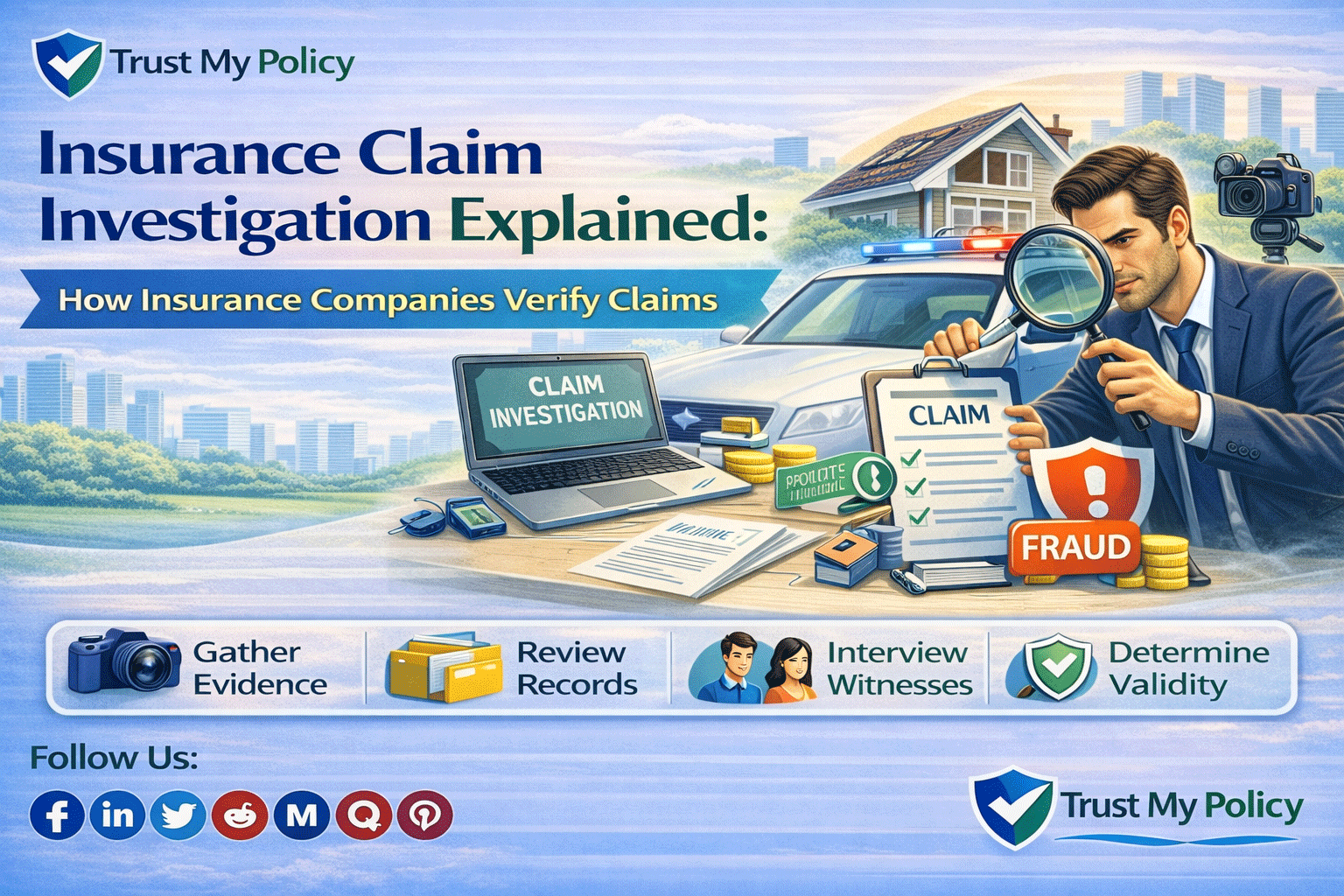
An insurance claim investigation is the insurer’s process of verifying a claim’s validity and value before paying it, and it’s a standard step for most claims above a minimal dollar threshold, not just a sign of suspected fraud. Investigations typically include document review, sometimes a recorded statement, a property or vehicle inspection, a review of your claims history, and for complex or high-value claims, a specialist assessment from an engineer, accountant, or other expert.
Table of Contents
ToggleInsurance Claim Investigation
Doreen Patel, 56, filed a legitimate $18,000 water damage claim in Sacramento and was unsettled to learn her insurer had ordered a recorded statement, a property inspection, and a review of her claims history before approving payment. She’d assumed an investigation only happened when fraud was suspected, not as a standard part of processing any sizable claim.
Insurance Claim Investigation in 2026 is a standard part of processing most claims above a minimal threshold, not just a response to suspected fraud. Investigations typically involve reviewing your documentation, sometimes a recorded statement, a property or vehicle inspection, your prior claims history, and occasionally a specialist like an engineer or forensic accountant for complex or high-value claims. This guide breaks down exactly what investigators check, what’s a routine step versus a red flag, and what your rights are throughout the process.
This article covers what a claim investigation actually involves, the difference between routine review and a fraud investigation, real scenarios showing the process, and how to navigate it confidently. By the end, you’ll understand exactly why your legitimate claim is still being investigated.
Quick Summary Table
| Feature | Details |
| What it is | The insurer’s process of verifying a claim’s validity and value before payment |
| Who it applies to | Most claims above a minimal threshold, regardless of suspected fraud |
| Common investigation steps | Document review, recorded statement, property/vehicle inspection, claims history review |
| Complex claim additions | Specialist assessments from engineers, accountants, or forensic experts |
| Key benefit | Protects the broader risk pool from fraudulent claims, keeping premiums fair for everyone |
| Key limitation | Can extend the timeline of an otherwise legitimate claim, which can feel frustrating |
| Regulator | State insurance departments (US); Financial Conduct Authority (UK) |
What Does an Insurance Claim Investigation Actually Involve?
Think of a claim investigation like an audit rather than an accusation. Tax audits happen to plenty of honest filers simply because certain claim sizes or patterns trigger standard review procedures, not because the filer is suspected of wrongdoing. Insurance claim investigations work similarly: most are routine verification steps, not fraud accusations.
An insurance claim investigation is the process an insurer uses to verify a claim’s facts, validity, and value before issuing payment. For most claims above a minimal dollar threshold, this is a standard procedural step, involving document review and sometimes a recorded statement or property inspection. For larger, more complex, or unusual claims, the investigation may extend to a review of your claims history and specialist assessments from engineers, forensic accountants, or other experts. Anyone whose legitimate claim triggers this process, like Doreen’s, needs to understand it’s a normal part of how insurers verify and value claims, not an accusation of wrongdoing.
How a Standard Claim Investigation Actually Proceeds — 5 Steps
- The insurer reviews your submitted documentation. This includes photos, receipts, estimates, and any reports you’ve provided, checking for consistency and completeness.
- A recorded statement may be requested. This is a formal, recorded account of the incident from you, used to establish a clear record of the facts as you understand them.
- A property, vehicle, or scene inspection may be conducted. An adjuster or independent inspector verifies the damage in person, comparing it against your claimed amount.
- Your prior claims history is reviewed. This helps the insurer understand whether the claim fits a consistent pattern or raises any unusual flags.
- For complex or high-value claims, specialist assessments may be ordered. Engineers, forensic accountants, or other experts may be brought in to verify specific technical aspects of the claim.
Comparison: Routine Investigation vs. Fraud Investigation
| Criteria | Routine Claim Investigation | Fraud Investigation |
| Trigger | Standard procedure for most claims above a minimal threshold | Specific red flags, like inconsistent statements or suspicious patterns |
| Typical steps | Document review, inspection, sometimes a recorded statement | All routine steps plus specialized fraud investigators, surveillance, or law enforcement referral |
| Claimant experience | Can feel intrusive but is a normal procedural step | More adversarial, often involving direct questioning about inconsistencies |
| Pros | Protects the risk pool and ensures fair claim valuation | Protects honest policyholders from costs caused by fraudulent claims |
| Cons | Can extend timeline and feel uncomfortable even for legitimate claims | Can be a stressful and lengthy process if wrongly triggered |
We recommend most readers understand that a standard investigation is routine and not a personal accusation, while remaining cooperative and consistent throughout to avoid unnecessarily escalating to a fraud-specific review.
4 Real-Life Scenarios
Scenario 1: Doreen, 56, homeowner in Sacramento. Doreen’s legitimate $18,000 water damage claim underwent a standard investigation, including a recorded statement and property inspection, before being approved in full. Verdict: investigation is a routine step for claims above a certain size, not evidence of suspicion. Action: Doreen cooperated fully and provided consistent, complete information throughout, leading to a smooth approval.
Scenario 2: A driver in Manchester whose claim included inconsistent statements about the accident’s circumstances. The inconsistency triggered an escalated fraud-specific review, including a more detailed interview and cross-referencing of the police report. Verdict: inconsistencies, even unintentional ones, can escalate a routine investigation into a more adversarial fraud review. Action: the driver worked with his insurer to clarify the inconsistency, which was ultimately resolved as an honest misunderstanding rather than fraud.
Scenario 3: A business owner in Houston filing a large fire damage claim. The claim’s size triggered a specialist forensic accountant review to verify the claimed business interruption losses. Verdict: high-value or complex claims commonly involve specialist assessments as a standard part of investigation. Action: the business owner provided detailed financial records promptly, supporting a fair and timely specialist review.
Scenario 4: A homeowner in Leeds whose claims history showed two similar prior claims within a short period. This pattern triggered additional scrutiny during the investigation, though the claim was ultimately approved after review. Verdict: claims history patterns can trigger additional scrutiny even without any actual wrongdoing. Action: the homeowner cooperated fully with the additional review, which resolved without further escalation.
Pros & Cons of the Claim Investigation Process
| Pros | Cons |
| Protects the broader risk pool from fraudulent claims, keeping premiums fairer for everyone. | Can extend the timeline of an otherwise legitimate, straightforward claim. |
| Ensures claims are valued accurately based on verified facts and documentation. | Can feel intrusive or uncomfortable, even when nothing improper has occurred. |
| Specialist assessments help ensure complex or high-value claims are handled fairly. | Inconsistencies, even unintentional ones, can unnecessarily escalate scrutiny. |
| A standard, routine process for most claims, not an automatic accusation. | Claims history patterns can trigger additional review even without wrongdoing. |
| Cooperation throughout typically leads to a smooth, fair resolution. | Claimants aren’t always told clearly that investigation is a normal procedural step. |
5 Common Mistakes People Make
- Assuming an investigation means the insurer suspects fraud. This happens because the word “investigation” sounds inherently adversarial. What to do instead: understand that routine investigation is standard procedure for most claims above a minimal threshold, not an accusation.
- Giving inconsistent statements at different points in the process. This happens because memory of stressful events isn’t always perfectly consistent. What to do instead: take time to recall details accurately and consistently, and clarify promptly if you realize you’ve given conflicting information.
- Being uncooperative or defensive during a routine investigation. This happens because the process can feel unfairly suspicious even when it’s standard. What to do instead: cooperate fully and provide complete, accurate information, since this is typically the fastest path to a smooth resolution.
- Not understanding why a recorded statement is being requested. This happens because this step can feel intimidating without context. What to do instead: ask your insurer to explain the purpose of the recorded statement, and feel free to consult a broker or attorney for guidance on significant claims.
- Assuming a specialist assessment delay means something is wrong. This happens because bringing in an outside expert can feel like an escalation. What to do instead: understand that specialist assessments are standard for complex or high-value claims, not necessarily a sign of suspicion.
⚠️ WARNING: Never provide inconsistent or inaccurate information during a claim investigation, even unintentionally. Discrepancies discovered later, even from honest mistakes, can escalate a routine investigation into a more adversarial fraud review and potentially jeopardize an otherwise legitimate claim.
Decision Table: How Should You Respond to an Investigation?
| Your Situation | Our Recommendation |
| Your claim has triggered a standard investigation | Yes — cooperate fully and provide complete, consistent documentation |
| You’ve been asked for a recorded statement | Yes — ask your insurer to explain its purpose, and consider consulting a broker for significant claims |
| You realize you’ve given inconsistent information | Yes — clarify promptly and proactively with your insurer rather than waiting to be asked |
| Your claim involves a specialist assessment (engineer, accountant) | Yes — provide requested records promptly to support a timely, fair review |
| Your claims history shows a pattern triggering extra scrutiny | Yes — cooperate fully, since this scrutiny doesn’t necessarily indicate wrongdoing |
| You feel an investigation has become unfairly adversarial | Yes — consider consulting an attorney or your state insurance department if you believe you’re being treated unfairly |
| You’re unsure why your claim is being investigated at all | Yes — ask your insurer directly for an explanation of the specific investigation steps being taken |
💡 TIP: The single golden rule for claim investigations: cooperate fully and provide consistent, accurate information throughout, since this is the most reliable way to keep a routine investigation from escalating unnecessarily.
Cost Table: How Investigation Scope Varies by Claim Type
| Scenario | Typical Investigation Scope | Notes |
| Minor auto claim under $2,000 | Minimal, often just document review | Rarely involves a recorded statement or inspection |
| Moderate home water damage claim, $10,000–$25,000 | Document review, recorded statement, property inspection | Standard procedure for claims of this size |
| Large fire or storm damage claim, $50,000+ | Full investigation plus specialist assessment | May include an engineer or forensic accountant review |
| Claim with inconsistent statements | Escalated to fraud-specific review | Involves more detailed interviews and cross-referencing of records |
| Claim with a pattern of similar prior claims | Additional scrutiny during standard investigation | Doesn’t necessarily indicate wrongdoing, but triggers closer review |
| Business interruption claim | Specialist forensic accounting review | Standard for verifying claimed lost income and expenses |
| Health insurance claim, in-network straightforward care | Minimal investigation, often automated | Rarely involves the more extensive steps seen in property claims |
Resources for Navigating a Claim Investigation
Independent insurance brokers — Brokers can help explain why a specific investigation step is being requested and advocate on your behalf. Cost range: typically free for the consumer. Best for: anyone wanting guidance through an active investigation. Rating: varies by broker, check licensing.
Public adjusters (US, for property claims) — Licensed professionals who can independently assess damage and help manage the investigation process for large or complex property claims. Cost range: typically 5%–15% of the claim payout. Best for: large or complex property damage claims. Rating: state-licensed, not insurer-affiliated.
An attorney specializing in insurance claims — Useful if an investigation feels unfairly adversarial or escalates toward a fraud allegation you believe is unwarranted. Cost range: varies, often hourly or contingency-based. Best for: significant claims facing unusually aggressive scrutiny. Rating: varies by firm, check state bar standing.
Your state insurance department (US) — Can assist if you believe an investigation is being conducted unfairly or improperly. Cost range: free to file a complaint. Best for: US policyholders facing concerns about investigation conduct. Rating: government regulatory body.
Financial Ombudsman Service (UK) — An independent UK body that can review concerns about how an insurer conducted a claim investigation. Cost range: free for consumers. Best for: UK policyholders with unresolved investigation-related concerns. Rating: independent statutory ombudsman.
We recommend an independent broker as best overall first step because they can quickly explain whether a specific investigation step is standard procedure or something worth questioning further.
Frequently Asked Questions
What is an insurance claim investigation?
An insurance claim investigation is the process an insurer uses to verify a claim’s facts, validity, and value before issuing payment, and it’s a standard step for most claims above a minimal dollar threshold.
Does an investigation mean my insurer suspects fraud?
Not necessarily. Most investigations are routine procedural steps for claims above a certain size, not an accusation of fraud, though inconsistencies or unusual patterns can escalate scrutiny.
What is a recorded statement, and do I have to give one?
A recorded statement is a formal, recorded account of the incident from your perspective, often required by your policy as part of cooperating with the claims process.
Why is my insurer ordering a property inspection for my claim?
Property inspections verify the extent and cause of the damage in person, comparing it against your claimed amount, and are standard for many home and property claims.
What triggers a fraud-specific investigation rather than a routine one?
Inconsistent statements, claims history patterns, or other unusual red flags can escalate a routine investigation into a more adversarial fraud-specific review.
Can my prior claims history affect a current investigation?
Yes. A pattern of similar prior claims can trigger additional scrutiny during an investigation, even if there’s no actual wrongdoing involved.
What is a specialist assessment in a claim investigation?
For complex or high-value claims, insurers may bring in specialists like engineers or forensic accountants to verify specific technical or financial aspects of the claim.
How should I respond if I’m asked to give a recorded statement?
Cooperate and provide accurate, consistent information; for significant claims, you can also ask your insurer to explain the statement’s purpose or consult a broker beforehand.
What happens if I accidentally give inconsistent information during an investigation?
Clarify the inconsistency proactively and promptly with your insurer, since addressing it directly is generally better than waiting for it to be discovered or questioned later.
Should I be concerned if my claim is being investigated?
Not necessarily. Investigation is a normal part of processing many claims, and cooperating fully with accurate, consistent information typically leads to a smooth, fair resolution.
Key Takeaways
- Understand that a standard claim investigation is routine procedure, not an automatic accusation.
- Provide complete, accurate, and consistent information throughout the process.
- Cooperate with requests for recorded statements, inspections, or specialist assessments.
- Clarify any inconsistencies proactively rather than waiting for them to be questioned.
- Understand that claims history patterns can trigger scrutiny even without wrongdoing.
- Consider a broker or attorney if an investigation feels unfairly adversarial.
- Escalate to a regulator or ombudsman if you believe an investigation was conducted improperly.
This article is for informational purposes only. Always consult a licensed insurance professional before making coverage decisions. Trust My Policy does not sell insurance products or represent any insurer.




Reader Comments (1)
[…] your policy against the stated reason. Check whether the cited exclusion genuinely applies to your specific […]