
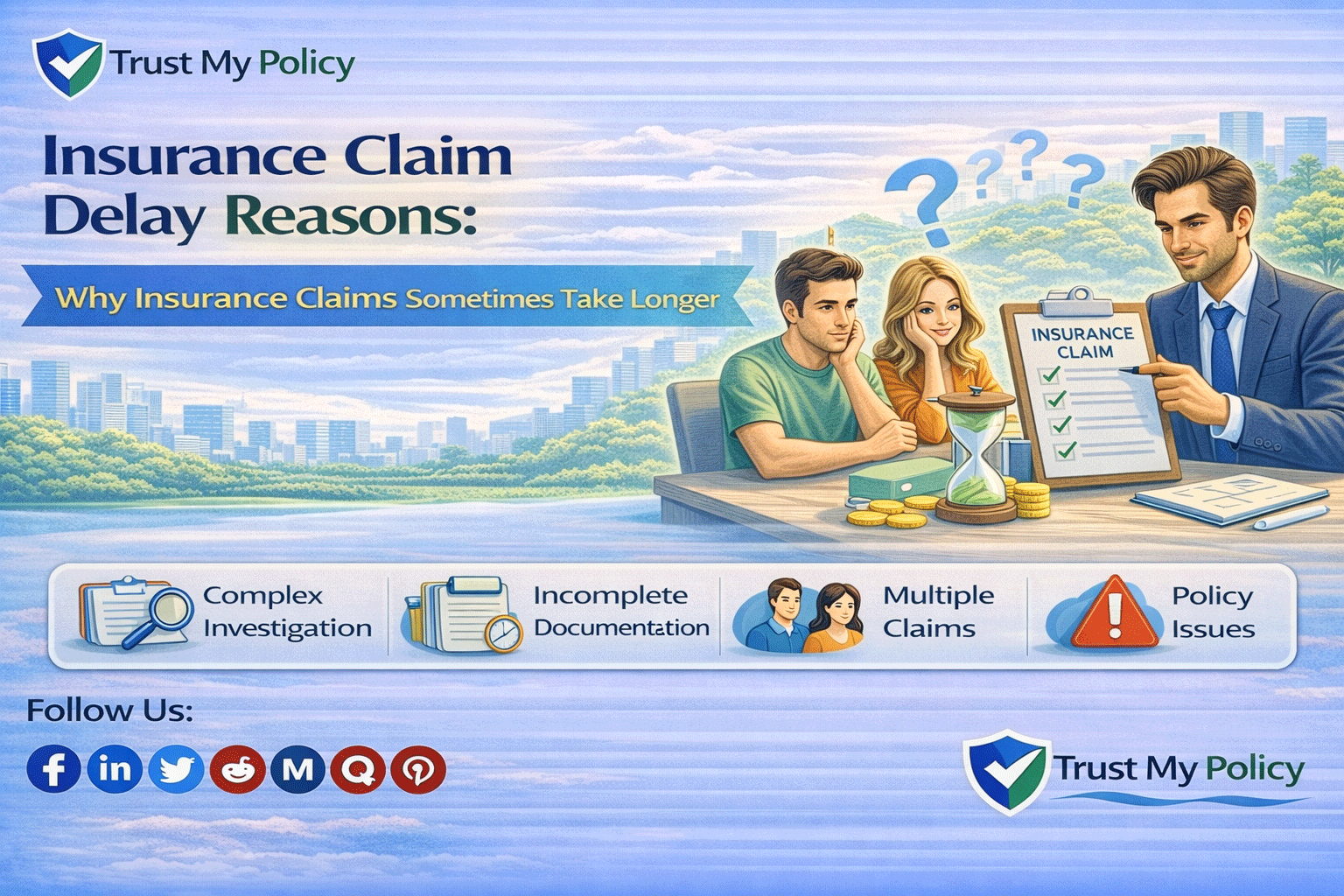
The most common reasons insurance claims are delayed include incomplete or missing documentation, adjuster backlogs after large weather events, third-party inspection or appraisal queues, internal coverage review for complex or high-value claims, and slow claimant responses to insurer requests. Identifying which category is causing your delay determines exactly what action to take.
Sandra Obi, 47, filed a home insurance claim after a burst pipe in Leeds and heard nothing for three weeks. When she finally called, her insurer told her the claim was waiting for a loss adjuster appointment, a step she hadn’t been told about and could have scheduled herself two weeks earlier with a simple phone call.
Insurance Claim Delay Reasons in 2026 fall into two distinct categories: delays caused by the claimant, like incomplete documentation or slow responses to insurer requests, and delays caused by the insurer, like adjuster backlogs, third-party inspection queues, or internal review processes. Understanding which category is causing your specific delay tells you exactly what action to take next.
This article covers the most common delay causes on both sides, real scenarios with specific timelines, how to identify which delay you’re facing, and what to do to move your claim forward. By the end, you’ll know exactly what question to ask to unstick a slow claim.
| Feature | Details |
| What it is | The specific reasons insurance claims take longer than expected |
| Who it applies to | Anyone whose claim has been pending longer than they expected |
| Claimant-side delays | Incomplete documentation, slow responses, missing third-party info |
| Insurer-side delays | Adjuster backlogs, inspection queues, internal coverage reviews |
| Key benefit | Identifying the cause tells you exactly what to do next |
| Key limitation | Some insurer-side delays, like post-disaster backlogs, genuinely can’t be accelerated |
| Regulator | State insurance departments (US); Financial Conduct Authority (UK) |
Think of a delayed claim like a traffic jam on a motorway. Some jams are caused by something you did, like taking the wrong exit and adding time to your journey. Others are caused by a genuine road incident two miles ahead that no amount of driving skill can bypass. Insurance claim delays work the same way, and the first step to resolving one is knowing whether the blockage is in your lane or theirs.
Insurance claim delays result from one of two categories: claimant-side issues, where missing documentation, slow responses, or incomplete information are holding things up, and insurer-side issues, where adjuster availability, third-party backlogs, or internal review processes are the actual cause. Either category can make a claim feel stuck, but the right action to take depends entirely on which side the delay is sitting on.
| Criteria | Claimant-Side Delays | Insurer-Side Delays |
| Common causes | Missing documentation, unanswered requests, incomplete third-party info | Adjuster backlogs, inspection queues, internal coverage reviews |
| What to do | Submit the missing item immediately and confirm receipt | Follow up in writing, request a specific timeline |
| Speed to resolve | Often fast, once the missing item is provided | Can take longer, especially post-disaster |
| Pros of knowing this | Claimant-side delays are almost always fixable quickly | Understanding insurer-side delays sets realistic expectations |
| Cons | Claimants don’t always know what’s missing until they ask | Some insurer-side delays genuinely can’t be shortened |
We recommend contacting your insurer as the immediate first step to determine which category your specific delay falls into.
Scenario 1: Sandra, 47, homeowner in Leeds. Sandra’s three-week delay was caused by an unscheduled loss adjuster appointment she hadn’t been told about. Verdict: a single missing scheduling step caused a delay that one phone call would have prevented. Action: Sandra scheduled the adjuster appointment immediately and received her approval within ten days of the inspection.
Scenario 2: A driver in Dallas after a hailstorm affecting thousands of vehicles. His auto claim was delayed five weeks because his insurer’s adjuster team was overwhelmed with regional claims from the same storm. Verdict: post-disaster adjuster backlogs are a genuine insurer-side delay that often can’t be individually accelerated. Action: the driver followed up weekly in writing to confirm his claim remained in the active queue.
Scenario 3: A small business owner in Manchester whose business interruption claim stalled because financial records hadn’t been submitted. The insurer’s request for three years of accounts had been sent but not acted upon. Verdict: this was a claimant-side delay caused by an unanswered documentation request. Action: the business owner submitted the records immediately and the claim moved forward within days.
Scenario 4: A homeowner in Phoenix whose large fire damage claim was referred for an internal coverage review. The claim’s size triggered a specialist review that wasn’t part of the standard adjuster process. Verdict: internal specialist reviews are a genuine insurer-side process that adds time on complex claims. Action: the homeowner confirmed the review was the only outstanding step and maintained weekly written follow-up until it concluded.
| Pros | Cons |
| Knowing the cause tells you exactly what action to take next. | Some insurer-side delays, like post-disaster backlogs, genuinely can’t be individually accelerated. |
| Claimant-side delays are almost always resolvable with a quick submission. | Not all insurers proactively communicate which stage a claim is in or what’s causing a delay. |
| Written follow-up often prompts faster action from the insurer’s claims team. | Identifying the delay sometimes requires multiple follow-up calls to get a clear answer. |
| Understanding post-disaster backlogs sets realistic expectations during stressful periods. | Internal coverage reviews can feel opaque even when they’re a legitimate, standard step. |
| Escalation options exist if insurer-side delays become unreasonable. | Escalation takes additional effort during an already stressful time. |
⚠️ WARNING: Never assume a long delay means your claim is being denied. Many delays, including significant ones, are caused by scheduling, documentation, or adjuster availability issues that have nothing to do with whether your claim will ultimately be approved.
| Your Situation | Our Recommendation |
| You haven’t contacted your insurer about the delay yet | Yes — call or email today and ask specifically which stage your claim is in |
| You have unanswered documentation requests from your insurer | Yes — submit the requested items immediately and confirm receipt in writing |
| Your region recently had a large weather event | Yes — expect an adjuster backlog and follow up weekly rather than daily |
| Your claim was referred for an internal coverage review | Yes — confirm this is the only outstanding step and request an estimated timeline |
| You’ve been following up verbally but not in writing | Yes — switch to written follow-up to create a documented record |
| Your delay has extended well beyond reasonable timelines with no explanation | Yes — escalate to your state insurance department or Financial Ombudsman Service |
| You’re unsure whether the delay is on your side or the insurer’s | Yes — ask directly, most insurers can tell you within one conversation |
💡 TIP: The single golden rule for resolving a claim delay: find out which stage your claim is in with one direct question, since this single piece of information tells you exactly what to do next.
| Scenario | Delay Cause | Typical Added Timeline |
| Missing contractor estimate not yet submitted | Claimant-side documentation gap | Resolved within days of submission |
| Unanswered financial records request | Claimant-side documentation gap | Resolved within days of submission |
| Post-disaster adjuster backlog (regional storm) | Insurer-side capacity issue | Often 3–8 additional weeks |
| Internal specialist coverage review | Insurer-side review process | Often 2–4 additional weeks |
| Third-party inspection scheduling queue | Third-party capacity issue | Often 1–3 additional weeks |
| Unscheduled loss adjuster appointment (like Sandra’s) | Communication gap, either side | Resolved with one scheduling call |
| Unreasonably extended delay with no explanation | Possible bad faith | Warrants regulatory complaint escalation |
Your insurer’s dedicated claims line or app — The fastest way to confirm which stage your claim is in and what’s outstanding. Cost range: free to use. Best for: immediate status check on any stalled claim. Rating: not applicable, primary contact channel.
Your state insurance department (US) — Can intervene if your claim has been delayed unreasonably or without explanation. Cost range: free to file a complaint. Best for: US policyholders facing genuinely unexplained long delays. Rating: government regulatory body.
Financial Ombudsman Service (UK) — Reviews unresolved claim disputes including unreasonable delays after an insurer’s internal process is exhausted. Cost range: free for consumers. Best for: UK policyholders with persistently stalled claims. Rating: independent statutory ombudsman.
Independent insurance brokers — Brokers can contact the insurer directly on your behalf and often get faster responses through their professional relationship. Cost range: typically free for existing policyholders. Best for: anyone wanting direct professional advocacy for a delayed claim. Rating: varies by broker, check licensing.
Public adjusters (US, for property claims) — Can push for faster adjuster scheduling and inspection on large or complex delayed property claims. Cost range: typically 5%–15% of claim payout. Best for: large or complex property claims experiencing significant adjuster delays. Rating: state-licensed.
We recommend contacting your insurer’s dedicated claims line as best overall first step, since identifying the specific delay cause takes one conversation and immediately tells you what action to take.
The most common reasons are incomplete documentation, adjuster backlogs after large weather events, third-party inspection queues, or an internal coverage review for complex or high-value claims.
Missing or incomplete documentation from the claimant, and adjuster availability backlogs following large regional weather events, are among the most frequently cited delay causes.
Submit complete documentation upfront, respond promptly to any insurer requests, follow up in writing regularly, and confirm which specific stage your claim is currently in.
Not at all. Many delayed claims are eventually approved in full — delays often reflect scheduling, documentation, or capacity issues rather than coverage problems.
Follow up in writing and request a specific timeline; if no response is forthcoming, escalate to your state insurance department or the Financial Ombudsman Service.
For straightforward claims, two to three weeks is a reasonable expectation; complex or disaster-related claims can legitimately take several months.
Yes. In the US, you can file a complaint with your state insurance department; in the UK, you can escalate to the Financial Ombudsman Service after completing your insurer’s internal process.
An adjuster backlog occurs when a large number of claims are filed simultaneously, typically after a regional weather event, causing delays as the insurer’s adjuster team works through the queue.
Email is generally better, since it creates a documented record; phone calls are useful for initial status checks but should always be followed up in writing.
An internal coverage review is an additional evaluation step for complex or high-value claims where a specialist, beyond the standard adjuster, needs to confirm coverage applies before a decision is issued.
This article is for informational purposes only. Always consult a licensed insurance professional before making coverage decisions. Trust My Policy does not sell insurance products or represent any insurer.

Jagadeesh Gutha is the founder of TrustMyPolicy.com, an independent insurance information platform covering life, health, car, home, and business insurance for US and UK readers. He researches insurance products, policy structures, and consumer rights to help everyday people make informed coverage decisions without the jargon. All content on TrustMyPolicy is independently researched, fact-checked, and written to educate — not to sell.



Insurance Guides for UK, USA & Worldwide We are not an insurer or broker.
Reader Comments (0)