
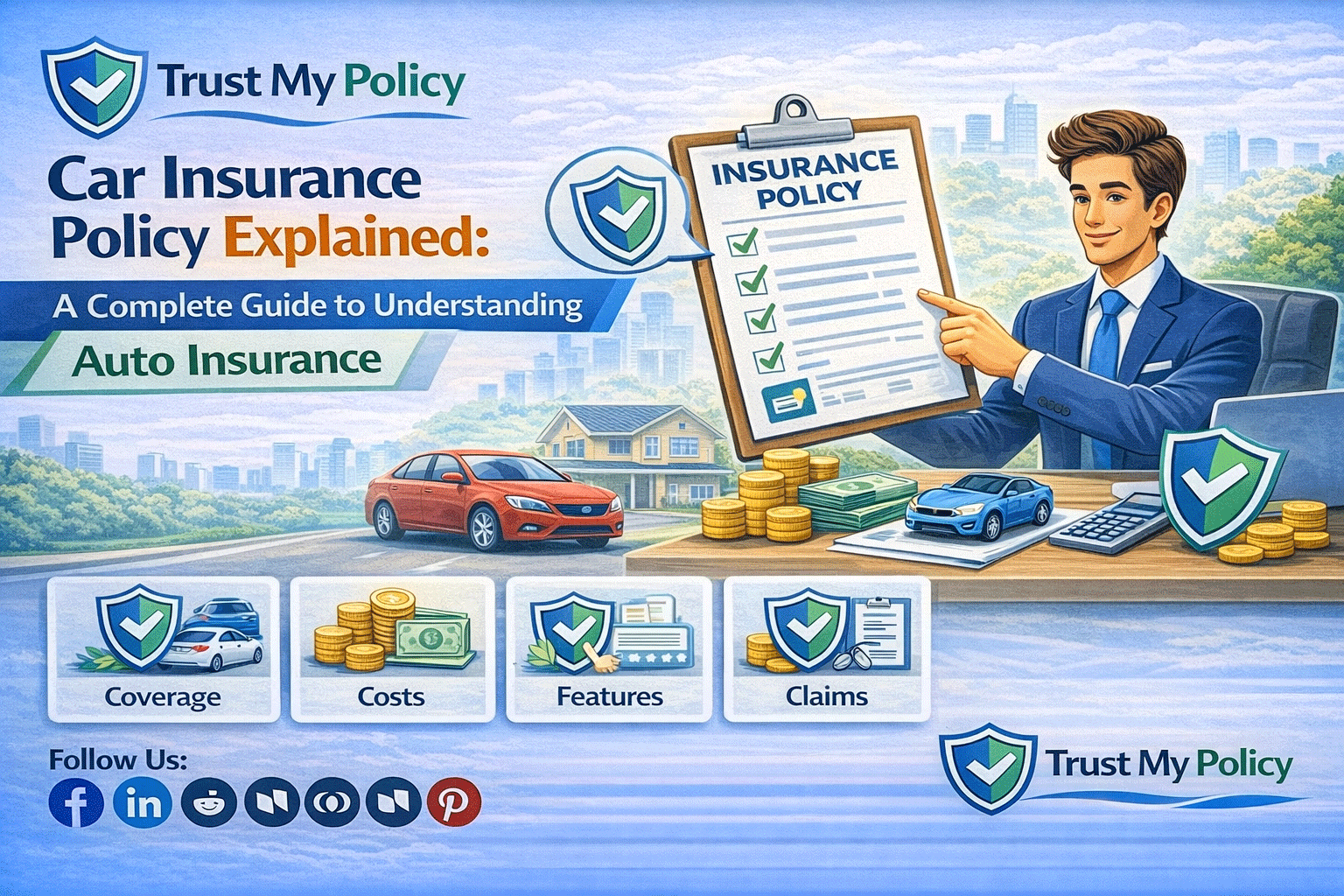
A car insurance policy is a legal contract divided into several key sections: the declarations page (your personalised coverage summary with limits, deductible, and premium), the insuring agreement (what the insurer agrees to cover), conditions (your obligations to keep coverage valid), exclusions (what isn’t covered), and endorsements (modifications to the base policy). Reading the declarations page alone takes under five minutes and answers most everyday coverage questions.
Jamie Prescott, 28, received her first car insurance policy documents after buying her first car in Phoenix and filed them away unread. When she later filed a claim after a hailstorm, she had no idea what her declarations page said, what her deductible was, or whether her comprehensive coverage was even active — information that would have taken five minutes to find if she’d read the documents when they arrived.
A Car Insurance Policy in 2026 is a legal contract between you and your insurer, typically divided into several distinct sections: the declarations page summarising your key coverage details, the insuring agreement setting out what’s covered, conditions you must meet to keep coverage valid, exclusions listing what isn’t covered, and endorsements modifying the base policy. Understanding each section means you’ll never be surprised by what your policy does or doesn’t do when you actually need it.
This article covers every section of a standard car insurance policy in plain language, what the declarations page actually contains, real scenarios showing where policy terms matter most, and how to review your own documents confidently. By the end, you’ll know exactly what’s in the file you’ve probably never fully read.
| Feature | Details |
| What it is | A legal contract between you and your insurer defining coverage terms |
| Key sections | Declarations page, insuring agreement, conditions, exclusions, endorsements |
| Most important for daily reference | Declarations page: coverage types, limits, deductible, premium, and policy period |
| Typical policy period | 6 or 12 months, renewing automatically unless cancelled |
| Key benefit | Understanding your policy prevents surprises when you actually file a claim |
| Key limitation | Most policyholders never read their policy until they need to make a claim |
| Regulator | State insurance departments (US); Financial Conduct Authority (UK) |
Think of your car insurance policy like a written rulebook for a game you’re playing whether you’ve read the rules or not. Not reading it doesn’t change the rules — it just means you find out what they say at the worst possible moment, usually while standing next to a damaged car.
A car insurance policy is a legally binding contract that defines the terms, conditions, coverage, and exclusions of your auto insurance arrangement. It’s typically delivered as a multi-section document, with the declarations page as the personalised summary at the front and the detailed legal terms following behind. Most everyday coverage questions — what am I covered for, what’s my deductible, what are my limits — are answered on the declarations page alone. Anyone who drives an insured vehicle benefits from spending a few minutes reviewing at least that section before ever needing to file a claim.
| Criteria | Declarations Page | Full Policy Document |
| Length | Typically 1–2 pages | Often 20–60 pages of legal terms |
| What it contains | Your specific coverage types, limits, deductible, premium, and policy period | All general terms, conditions, exclusions, and legal definitions |
| Best for | Answering everyday coverage questions quickly | Understanding specific exclusions or conditions before or after a claim |
| Pros | Fast, personalised reference for your specific coverage | Complete picture of every term that could affect a claim |
| Cons | Doesn’t explain conditions or exclusions in detail | Dense legal language that most people only read when prompted by a problem |
We recommend every policyholder read at least the declarations page fully for most readers, since it answers the vast majority of everyday coverage questions in under five minutes.
Scenario 1: Jamie, 28, driver in Phoenix after a hailstorm. Jamie had comprehensive coverage but didn’t know it until she finally checked her declarations page after the damage occurred. Verdict: most basic coverage questions are answered on the declarations page alone. Action: Jamie now reads her declarations page each time her policy renews.
Scenario 2: A rideshare driver in Manchester who assumed his standard policy covered his delivery work. The exclusions section of his policy specifically excluded commercial use, a clause he’d never read until his claim was denied. Verdict: exclusions are the section most likely to create an unwelcome surprise during a claim. Action: he added a specific delivery endorsement and confirmed in writing that it was attached to his policy.
Scenario 3: A homeowner in Dallas who missed a conditions requirement. She failed to report an accident within the timeframe specified in the conditions section, giving her insurer grounds to dispute the claim on procedural grounds. Verdict: the conditions section defines obligations that can affect a valid claim if not followed. Action: she now saves her insurer’s claims line number specifically so she can report any incident promptly.
Scenario 4: A driver in Leeds who added a named driver endorsement for her teenage son. This endorsement modified her base policy specifically to extend coverage to her son, while keeping her own base coverage unchanged. Verdict: endorsements are the mechanism through which specific modifications to a policy are made official and documented. Action: she confirmed the endorsement was correctly reflected on her updated declarations page after it was added.
| Pros | Cons |
| Understanding your declarations page prevents basic coverage surprises. | Most policyholders never read their policy until something goes wrong. |
| Knowing key exclusions helps you avoid denied claims from preventable gaps. | Full policy documents use dense legal language that takes real effort to read. |
| Reviewing conditions ensures you meet your obligations if a claim arises. | Policy terms can change at renewal, requiring a fresh review each period. |
| Endorsements let you customise coverage precisely for your specific situation. | Identifying which endorsements apply requires reading the back sections of the document. |
| Reading your policy once at renewal keeps you informed for the full policy period. | Some conditions are time-sensitive and can affect valid claims if missed. |
⚠️ WARNING: Never assume your coverage continues unchanged from one policy period to the next without checking your new declarations page. Insurers can modify specific terms, limits, or exclusions at renewal, and these changes may not be prominently highlighted in the renewal notice.
| Your Situation | Our Recommendation |
| You’ve never read your declarations page | Yes — read it now, it takes under five minutes |
| You use your car for rideshare or delivery work | Yes — check the exclusions section and confirm any relevant endorsement is attached |
| You’ve just added a named driver | Yes — confirm the endorsement appears correctly on your updated declarations page |
| You’re unsure what your deductible is | Yes — it’s on the declarations page, check it before filing any claim |
| You’re comparing renewal terms to last year | Yes — compare declarations pages side by side to spot any limit or coverage changes |
| You’ve recently had an incident | Yes — check the conditions section for reporting timeframes immediately |
| You’re unsure whether a specific event is covered | Yes — check the exclusions section directly against your specific circumstances |
💡 TIP: The single golden rule for car insurance policies: read your declarations page in full every time your policy renews — it’s the single most useful page in the document and answers most everyday coverage questions in under five minutes.
| Scenario | Policy Section That Applies | Real Financial Effect |
| Hailstorm damage discovered after policy renewal | Declarations page (confirms comprehensive coverage is active) | Claim approved if comprehensive is listed and active |
| Rideshare driving without a commercial use endorsement | Exclusions section | Claim denied, full repair cost out of pocket |
| Late claim reporting beyond the conditions timeframe | Conditions section | Insurer may dispute claim on procedural grounds |
| Named driver not added via endorsement involved in an accident | Endorsements section (gap) | Potential dispute over coverage for the unnamed driver |
| Coverage limit lower than repair cost | Declarations page (limit listed) | You pay the difference between the limit and the repair cost |
| Higher deductible than remembered at claim time | Declarations page (deductible listed) | Out-of-pocket cost higher than expected |
| Waiver of depreciation endorsement active | Endorsements section | Claim paid at replacement cost, not depreciated value |
Your insurer’s customer portal or app — Most insurers now provide a digital copy of your declarations page and full policy document accessible at any time. Cost range: free. Best for: quickly checking your coverage details before or after an incident. Rating: not applicable, primary service channel.
Independent insurance brokers — Brokers can walk through your declarations page and explain any section or term in plain language. Cost range: typically free for the consumer. Best for: anyone wanting a guided review of their specific policy terms. Rating: varies by broker, check state or FCA licensing.
Your state insurance department (US) — Publishes consumer guides explaining standard policy terms and your rights under your policy. Cost range: free public resource. Best for: US consumers wanting an authoritative plain-language guide. Rating: government regulatory body.
Financial Conduct Authority (UK) — Sets standards for how UK insurers must present and explain policy terms, and publishes consumer guidance. Cost range: free to consult. Best for: UK consumers wanting to understand their policy rights. Rating: government regulatory body.
NAIC consumer resources (US) — Provides a plain-language guide to standard auto insurance policy terms and sections. Cost range: free public resource. Best for: US consumers learning about policy structure for the first time. Rating: regulatory standards body.
We recommend your insurer’s customer portal as best overall starting point because it gives you immediate access to your own specific declarations page — the most practically useful document in your entire policy file.
A car insurance policy is a legal contract between you and your insurer that defines what coverage you have, under what conditions, for what period, and at what cost.
The declarations page is the personalised summary at the front of your policy document, showing your coverage types, limits, deductible, premium, and policy period in one place.
Exclusions are specific situations, events, or uses the policy does not cover, such as commercial use without an endorsement, intentional damage, or damage caused by a listed excluded driver.
Conditions are obligations you must meet to keep your coverage valid and maintain your right to claim, such as reporting incidents within a specific timeframe and cooperating with investigations.
An endorsement is a specific modification to your base policy, adding, removing, or changing a specific coverage element, like adding a rideshare endorsement or a named driver.
Most personal auto policies run for either 6 or 12 months, renewing automatically unless cancelled by either party before the renewal date.
Insurers are typically required to notify you of material changes at renewal, but comparing your new and previous declarations pages is the most reliable way to catch any changes.
Reading the full document isn’t always necessary for everyday purposes, but reading the declarations page and checking the exclusions section for any specific concern you have is strongly recommended.
Contact your insurer or broker directly and ask for a plain-language explanation of the specific section, since both are generally obligated to explain your policy terms clearly.
Failing to meet a condition, like not reporting a claim within the required timeframe, can give your insurer grounds to dispute an otherwise valid claim on procedural grounds.
This article is for informational purposes only. Always consult a licensed insurance professional before making coverage decisions. Trust My Policy does not sell insurance products or represent any insurer.

Jagadeesh Gutha is the founder of TrustMyPolicy.com, an independent insurance information platform covering life, health, car, home, and business insurance for US and UK readers. He researches insurance products, policy structures, and consumer rights to help everyday people make informed coverage decisions without the jargon. All content on TrustMyPolicy is independently researched, fact-checked, and written to educate — not to sell.



Insurance Guides for UK, USA & Worldwide We are not an insurer or broker.

Reader Comments (0)