
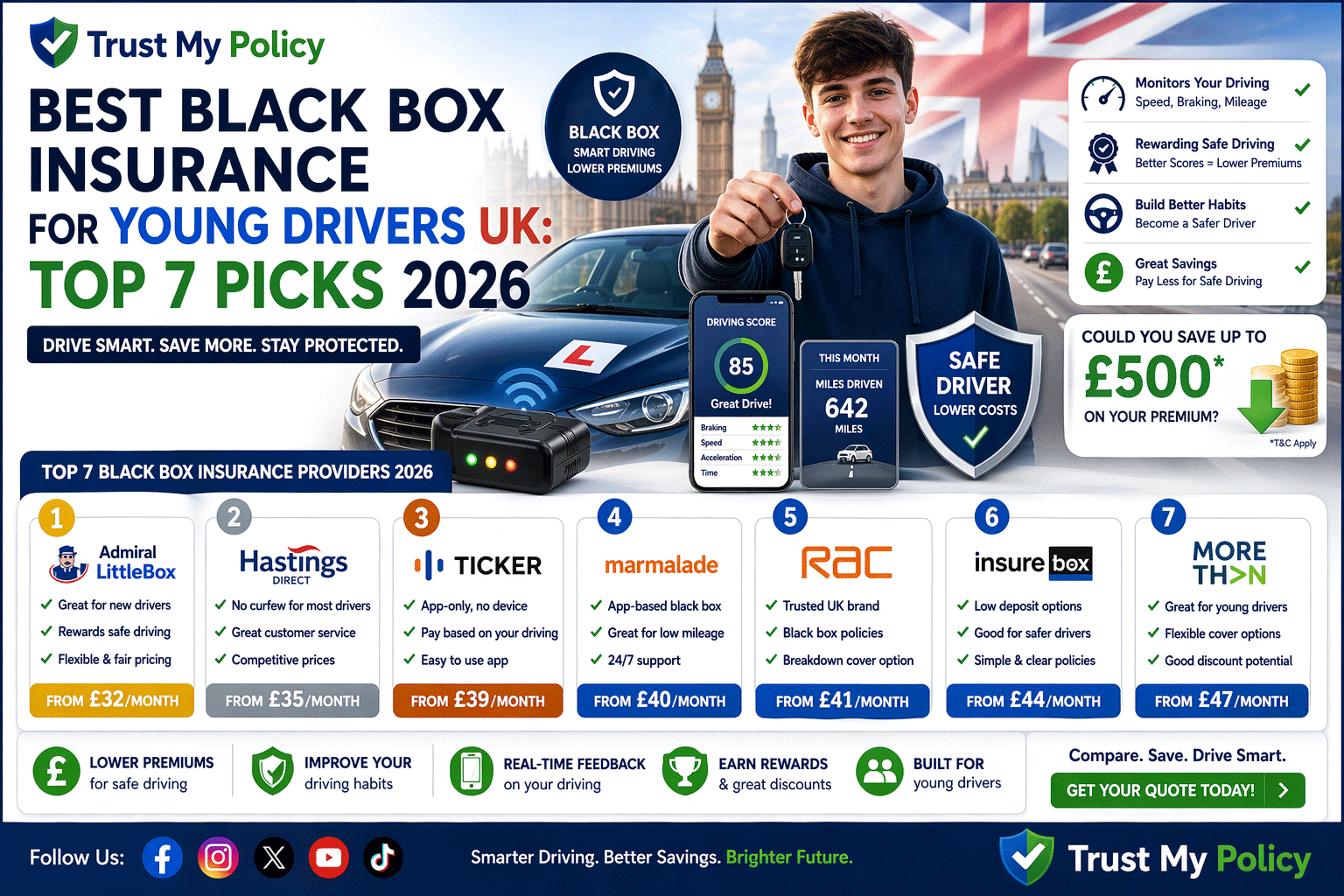
Best black box insurance for young drivers UK in 2026 saves an average of £379/year for drivers aged 17–20 (Brumble 2026 data). Young drivers aged 17–24 with a black box typically pay £1,313/year (Compare the Market, March 2026) vs £1,561/year on standard policies. Best overall: Admiral LittleBox (most trusted traditional system). Best app-only (no device): Zego Sense. Best for under-20s: Marmalade. Cheapest entry price: Hastings Direct YouDrive (10% of under-26 customers paid £504 or less).
When Emma passed her test at 18, her first insurance quote was £2,340/year. She nearly gave up on the idea of driving independently for a year. Her older brother suggested she look at black box policies. Her best black box quote: £1,580/year — £760 cheaper. She drove safely throughout the year. Her renewal came back at £1,020. In two years, she had saved over £1,300 compared to sticking with the standard market.
The best black box insurance for young drivers UK in 2026 can save an average of £379/year compared to standard policies — and 78% of drivers aged 17–20 get cheaper insurance with a telematics policy (Brumble, Q4 2025 Quotezone data). With the average young driver paying £1,561 comprehensive on standard policies, the maths are compelling.
This guide covers the seven best black box insurance providers for young drivers in the UK in 2026 — how each one works, what they measure, how scores translate into savings, real cost comparisons, and the five most common mistakes young drivers make with telematics policies.
| Feature | Details |
| What it is | Telematics car insurance that tracks your driving via a fitted device or phone app and prices your premium based on actual driving behaviour |
| Average saving for 17–20 year olds | £379/year vs standard policy (Brumble/Quotezone Q4 2025 data) |
| Percentage of young drivers saving money | 78% of drivers aged 17–20 pay less with a telematics policy |
| Average cost with black box (17–24) | £1,313/year comprehensive (Compare the Market, March 2026) |
| Average cost without black box (17–24) | £1,561/year comprehensive (Confused.com UK data Q4 2025–Q1 2026) |
| What is tracked | Speed, braking, cornering, acceleration, time of day, mileage — varies by provider |
| Types of device | Hard-wired black box, self-fit plug-in OBD device, or smartphone app — no device required |
| Regulated by | Financial Conduct Authority (FCA) — all UK telematics providers are FCA-authorised |
Think of it like a driving exam that never ends — but instead of a test examiner, it’s an app or a small device. The better you drive, the better your score. The better your score, the lower your renewal premium.
Black box insurance (also called telematics insurance) uses a small device or smartphone app to track how, when, and where you drive. Insurers analyse your speed, braking smoothness, cornering, acceleration, and what time of day you drive. Safe, smooth driving earns a high score. A high score translates to a lower renewal premium — or in some policies, an in-policy discount.
Who benefits most: Drivers aged 17–24 who have no driving history to prove they’re safe. Young drivers pay the highest standard premiums — up to £2,000+/year — because statistically, their age group has the highest accident rate. A black box lets them prove they are individually safer than the statistical average, and get priced accordingly.
| Criteria | Hard-Wired Black Box | Self-Fit OBD Plug-In | Smartphone App |
| Installation | Engineer-installed; 45–90 min appointment needed | You plug it in — takes minutes. Located under dashboard | Download the app. No physical device at all |
| Accuracy | Most accurate — permanently connected | Very accurate; can be unplugged (some policies flag this) | Relies on phone GPS and motion sensors; very accurate for newer smartphones |
| Setup time | 1–3 days to book engineer | Same day — device sent by post (1–2 days delivery) | Instant — download and register on day one |
| Can it be moved to another car? | No — engineer must remove and refit (costs £100–£200) | Yes — just unplug and replug | Yes — same app, same account |
| Examples | Admiral LittleBox, Ingenie, Bell | Marmalade (Tag), RAC/Ticker | Zego Sense, Hastings YouDrive, Aviva Drive |
| Best for | Long-term stability; serious commitment to telematics | Flexibility; trying telematics before committing long-term | Privacy-conscious drivers; no hardware installation preference |
| Winner | Hard-wired for accuracy and reliability; app for flexibility and zero installation hassle | ||
We recommend starting with an app-based policy if you are unsure about telematics. The zero-installation barrier makes it the easiest way to try the savings. Zego Sense and Hastings YouDrive both use app-only tracking with zero hardware.
Why recommended: Admiral is one of the UK’s longest-established telematics providers and consistently rated the best overall traditional black box system by comparison sites and industry reviewers. Their fitted device monitors all key driving factors, and their app provides clear, structured feedback. Admiral is particularly known for reliability of the scoring system and transparent renewal pricing based on your score. Defaqto 5-star rated. Very strong for drivers who want a well-established insurer with decades of telematics experience.
Cost: Competitive — typically 10–20% cheaper than Admiral’s standard policy for good-scoring young drivers.
Best for: Young drivers who want the most established and trusted telematics product from a household-name insurer.
Why recommended: Hastings Direct YouDrive has the best documented entry-level pricing for young drivers in 2026: 10% of customers under 26 paid £504 or less in December 2025. Defaqto 5-star rated. App-based tracking — no device installation required. 99% of motor claims accepted in 2024. Strong for urban young drivers and daily commuters. Their scoring focuses on smooth braking, speed discipline, and acceleration control.
Cost: From £504/year (10th percentile, under-26 customers, December 2025). Average for young drivers: typically £1,100–£1,400 range.
Best for: Budget-conscious young drivers who want the cheapest documented entry price and don’t want a physical device installed.
Why recommended: Marmalade has built its entire brand around young drivers and learners. Their black box setup uses a lightweight tag device rather than a bulky hard-wired box, making it less intrusive. Particularly popular with drivers under 20 and with parents who want visibility of their child’s early driving. Marmalade also offers learner driver insurance that builds a no-claims bonus before the test is passed — one of the strongest young driver features in the market.
Cost: Competitive for under-20s — typically one of the cheapest options for 17–19 year olds in low-insurance-group cars.
Best for: Drivers aged 17–20, learner drivers, and parents who want parental visibility of driving scores alongside the policy.
Why recommended: Zego Sense is the leading smartphone-app telematics product in the UK for 2026. No hardware installation — the app uses GPS and motion sensors. Zego has some of the cheapest telematics pricing available in the UK according to The Bromsgrove Standard (December 2025), particularly for confident, consistent drivers. Rewards system for safe driving. Strong for tech-savvy drivers who prefer app management.
Cost: Among the cheapest telematics options for good drivers according to December 2025 market analysis.
Best for: Tech-savvy young drivers aged 18–25 who want no physical installation and the most app-forward telematics experience.
Why recommended: Bell (part of Admiral Group) is designed for first-time drivers who want a clean, simple introduction to telematics. Their self-fit black box monitoring is beginner-friendly, with clear feedback on what you’re doing well and where to improve. Bell’s reporting is particularly accessible for younger drivers who haven’t used telematics before. Popular for its simplicity and Admiral Group financial strength behind it.
Cost: Competitive, particularly for first-year policies where no driving history is available.
Best for: First-time drivers aged 17–19 who want the simplest possible introduction to telematics with clear feedback.
Why recommended: RAC has partnered with Ticker (an award-winning telematics specialist rated Excellent on Trustpilot) for their black box product. Self-fit device sent by post, managed via the RAC Black Box app. Includes 30 days EU cover at the same level as UK cover, £50 off RAC mobile mechanic service, and £20 off replacement tyres. No curfews — you can drive at any time. For young drivers who value additional motoring benefits alongside the policy, RAC/Ticker is the strongest package.
Cost: Competitive with market; rewards for safe driving through the app.
Best for: Young drivers who want RAC brand reassurance, no curfews, EU cover included, and tangible rewards for safe driving beyond premium discounts.
Why recommended: Ingenie specialises in progress-driven telematics — frequent driving updates, personalised insights, and a development-focused approach that treats the policy as a coaching tool, not just an insurance product. Young drivers who enjoy tracking their improvement and watching scores grow find Ingenie particularly engaging. Regular feedback motivates better driving habits.
Cost: Mid-range for telematics — competitive for drivers who engage with the feedback system.
Best for: Young drivers aged 17–22 who are motivated by data, enjoy gamification of driving improvement, and want the most active feedback loop of any UK telematics provider.
👉 We recommend Admiral LittleBox as the best overall for most young UK drivers because it combines the most trusted traditional telematics system with Admiral’s financial strength, Defaqto 5-star cover, and transparent score-to-renewal pricing. For those who want zero installation, Hastings Direct YouDrive offers the best documented entry pricing.
| Factor Measured | What ‘Good’ Looks Like | What Reduces Your Score |
| Speed | Driving at or below speed limits consistently; proportionate to road conditions | Exceeding speed limits, even temporarily; high speed on residential roads |
| Braking | Smooth, progressive braking; anticipating hazards early | Hard or sudden braking; frequent emergency stops |
| Acceleration | Smooth, gradual acceleration from rest; no jackrabbit starts | Harsh acceleration; wheel spin; aggressive take-offs |
| Cornering | Balanced, smooth cornering; no excessive lean or squealing | Sharp cornering at speed; cutting bends |
| Time of day | Daytime driving; daylight hours; avoiding 11pm–5am | Late-night driving particularly affects Admiral LittleBox and similar products — the accident rate is significantly higher between 11pm and 5am |
| Mileage | Moderate annual mileage within declared estimate | Significantly exceeding declared mileage may trigger a policy review with some providers |
| ⚠️ WARNING: Late-Night Driving Significantly Damages Your Score
Most UK black box providers rate late-night driving (typically 11pm–5am) as the highest-risk category. A single regular pattern of late-night driving can drag your overall score from good to poor, regardless of how safely you drive during the day. If you regularly drive home from shifts, nights out, or university events after 11pm, check whether your policy penalises this — and how much. Admiral LittleBox and Bell both specifically flag late-night driving as a scoring factor. |
Standard quote: £2,340/year (Vauxhall Corsa, group 4). Black box quote: £1,580/year (Admiral LittleBox). Annual saving: £760.
Year 1 outcome: Emma drove safely throughout, scored consistently above 80/100, and drove primarily between 8am–10pm. Renewal: £1,020.
Year 2 outcome: With 1 year NCB and strong telematics history, Emma’s year 3 renewal without a black box was competitive at £830. Total 2-year saving vs standard: over £1,300.
Verdict: One year of good black box data is the best investment a young driver can make. It establishes a driving history that benefits renewals for years, whether you continue with telematics or switch to standard.
Situation: Jake works 10pm–6am three nights a week. His black box score is being damaged by consistent late-night driving despite his careful driving behaviour.
Analysis: Late-night driving is the highest-risk statistical period. Some black box providers weight this heavily. Jake has two options: (1) Switch to a provider that does not penalise time-of-day (RAC/Ticker has no curfews); (2) Accept the higher score cost and focus on perfect daytime scores to offset it.
Verdict: Not all black box policies treat time-of-day the same. If your working pattern means regular late-night driving, specifically look for providers that do not apply curfew-style time-of-day penalties. RAC/Ticker and Marmalade are more tolerant of irregular hours than Admiral LittleBox.
Situation: Amira has 2 years NCB and a clean record. Her standard comprehensive quote: £890. Her black box quote: £820.
Analysis: With 2 years NCB, the additional saving from a black box narrows significantly. The £70/year saving may not justify the monitoring and potential score damage from a bad journey or late-night habit.
Verdict: Black box insurance is most valuable in years 0–2 when no NCB exists. Once you have 3+ years NCB and a clean record, standard policies often become equally or more competitive. Compare both at renewal using a comparison site — don’t default to telematics just because it worked in year one.
Situation: Ryan will drive locally for 3 months, then park the car at home while at university. He’ll drive occasionally in holidays.
Best option: Marmalade or Hastings YouDrive black box policy with low declared annual mileage (3,000–5,000 miles). Low mileage declaration on a black box policy compounds the savings — lower risk + proven safe driving = significantly lower cost. Marmalade specifically designs policies for drivers in Ryan’s pattern.
Verdict: Students who drive infrequently but need a policy benefit most from the low mileage + good score combination. A black box with 3,000 declared miles and a high score can achieve premiums well under £1,000 for a 17-year-old in a group 1–3 car outside London.
| Pros | Cons |
| Average saving of £379/year for 17–20 year olds — 78% of young drivers pay less with telematics (Brumble Q4 2025 data) | Your score is affected by named drivers too — if a parent drives your car and drives poorly, their behaviour affects your score |
| Builds a driving history in year one that benefits future renewals whether telematics or standard | Late-night driving significantly reduces scores on most providers — problematic for shift workers and students |
| Driving data can protect you against false claims — objective telematics evidence helps resolve fault disputes | Hard-wired black box costs £100–£200 to transfer between vehicles — less flexible if you change cars mid-policy |
| Active driving feedback helps young drivers genuinely improve — not just save money | Some young drivers feel the monitoring is intrusive — data is kept by the insurer and used to determine renewal pricing |
| Comprehensive cover is often the same price or cheaper than TPFT for young drivers — black box compounds this advantage | Cancelling a black box policy mid-term incurs cancellation fees (Hastings: £45, Aviva: £38) plus potential device removal costs |
| Your Situation | Our Recommendation |
| You are 17–20 years old with no driving history | Yes — 78% of this age group save money. Compare Admiral LittleBox, Hastings YouDrive, and Marmalade. |
| You work night shifts and drive home after 11pm regularly | Compare carefully — use RAC/Ticker or Marmalade which penalise time-of-day less than other providers |
| You have 3+ years NCB and a clean record | Maybe not — standard policies may be equally or more competitive. Always compare both at renewal |
| You want to build driving history before buying a more expensive car | Yes — one year of strong telematics data significantly improves your risk profile for future renewals |
| You are a student who drives only in holidays | Yes — low mileage + good score on Marmalade or Hastings YouDrive achieves the lowest possible premiums |
| You object to being monitored | Standard policy without telematics is available — it will cost more, but you retain full privacy |
| You drive a car that is also used regularly by a named driver (e.g. parent) | Choose carefully — their driving affects your score. Discuss this with the insurer before buying |
| 💡 TIP: Buy Your Policy 21–26 Days Before Your Start Date
MoneySavingExpert analysis of 1 million+ quotes (November 2025–January 2026) found that buying car insurance 21–26 days before the policy start date saves an average of £346 compared to buying on renewal day (£377 vs £723). The optimal window is 25 days before. Set a reminder, compare quotes at exactly 25 days out, and buy immediately if you find the right price. |
The average saving for drivers aged 17–20 with a black box policy is £379/year compared to standard policies (Brumble 2026, Quotezone Q4 2025 data). Young drivers aged 17–24 with a black box typically pay £1,313/year for comprehensive insurance vs £1,561/year without telematics (Compare the Market, March 2026). Consistent safe driving throughout the year can achieve renewal savings of 20–40% beyond the first-year saving.
UK black box policies typically measure: speed (compliance with limits and appropriateness to conditions), braking smoothness, acceleration patterns, cornering, time of day (late-night 11pm–5am driving is consistently the highest-risk factor across all providers), and total annual mileage. You can view your scores and journey data via the insurer’s app, typically updated weekly. Most policies provide a single composite score out of 100, sometimes broken into subcategory scores.
Modern UK black box policies do not have hard curfews — you can drive at any time. However, most providers (including Admiral LittleBox and Bell) reduce your driving score for consistent late-night driving (typically 11pm–5am), which lowers your renewal price. RAC/Ticker and Marmalade are among the providers with less aggressive late-night scoring penalties. If you regularly drive late at night, compare how each provider weights time-of-day before choosing.
Yes. The majority of black box policies in the UK are comprehensive cover — the highest level of car insurance. In fact, comprehensive cover is often the same price or cheaper than third-party only for young drivers with telematics, because insurers view drivers who choose comprehensive as statistically lower risk. Always check the price of comprehensive cover when comparing, as assuming TPFT is cheaper for young drivers is a common and costly mistake.
Poor driving scores lead to a higher renewal premium — or in some cases, mid-policy notification to improve. Consistently very poor scores may result in the insurer writing to warn you, though outright cancellation for poor scores is rare in the current market. The most significant consequence of consistent poor driving is a substantially worse renewal quote. Some policies also have provisions that allow the insurer to cancel coverage for extreme and persistent violations of the policy’s safe driving guidelines.
For young drivers managing all the costs of their first policy, see our best car insurance for new drivers under 25 UK guide. For delivery drivers who are also young, our car insurance for delivery drivers UK article covers hire and reward options.
| 📋 Disclaimer
This article is for informational purposes only. Always check with your insurer for exact terms, conditions, and current pricing. Trust My Policy does not sell insurance products or represent any insurer. |

Jagadeesh Gutha is the founder of TrustMyPolicy.com, an independent insurance information platform covering life, health, car, home, and business insurance for US and UK readers. He researches insurance products, policy structures, and consumer rights to help everyday people make informed coverage decisions without the jargon. All content on TrustMyPolicy is independently researched, fact-checked, and written to educate — not to sell.


Insurance Guides for UK, USA & Worldwide We are not an insurer or broker.
Reader Comments (1)
[…] a full comparison of Admiral LittleBox against other black box providers in 2026 [ best black box insurance for young drivers UK — top 7 providers compared […]