
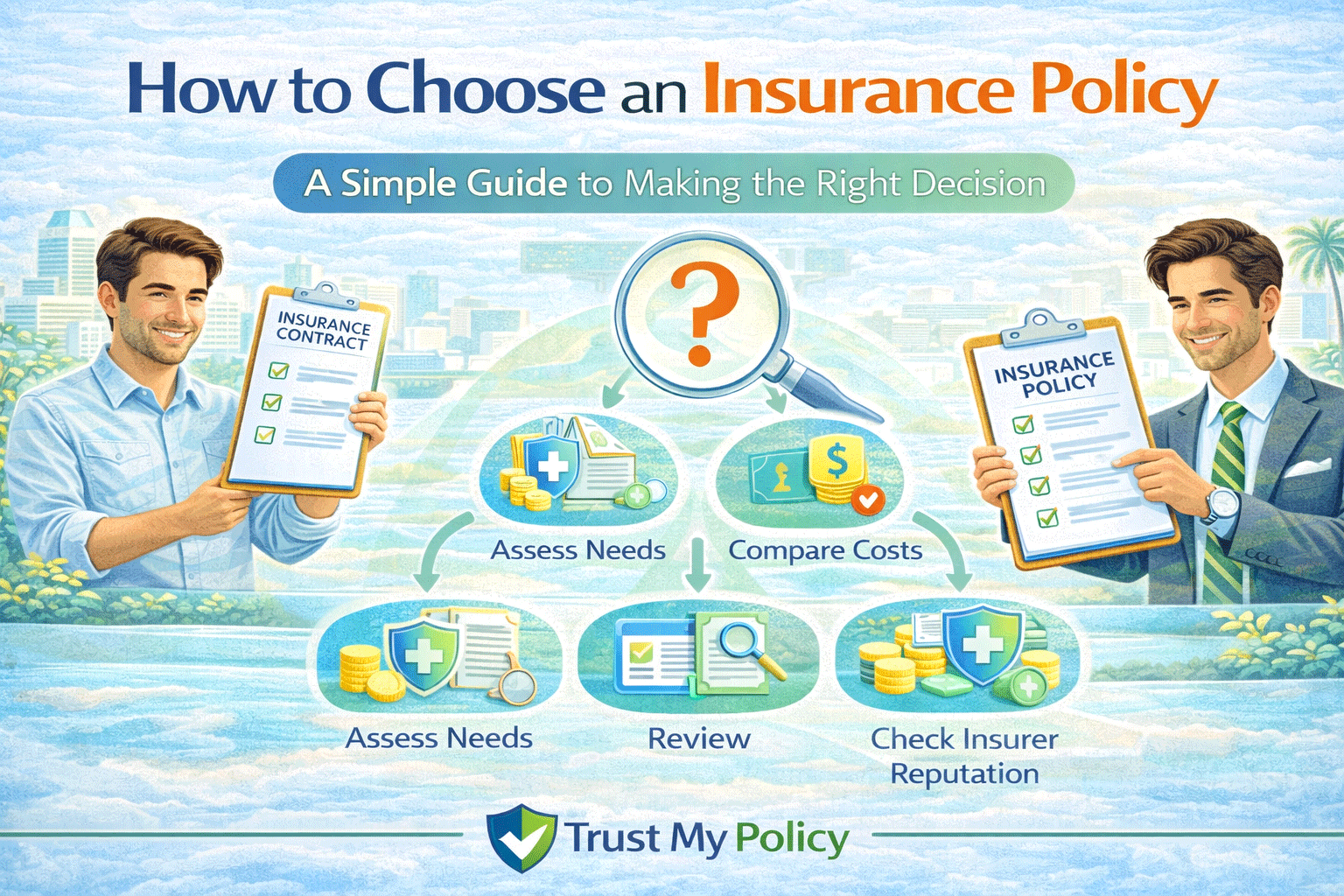
To choose an insurance policy, compare coverage limits, deductibles, exclusions, and the insurer’s financial strength rating across at least three quotes, not just the premium price. A policy that’s 20% cheaper but covers $40,000 less in dwelling or liability protection is rarely the better deal once you account for real-world claim scenarios.
Rachel Kim, 38, compared four homeowners insurance quotes in Denver and picked the cheapest one without checking the dwelling coverage limit. When a kitchen fire caused $180,000 in damage, her policy only covered $140,000 of rebuild cost, because the cheap quote had under-insured her home’s actual replacement value from the start.
How to Choose an Insurance Policy in 2026 means comparing more than just the premium: you need to check coverage limits, deductibles, exclusions, and the insurer’s financial strength rating before deciding. The cheapest quote is often cheap because it covers less, not because it’s a better deal. This guide gives you a clear, repeatable process for choosing any type of policy correctly.
This article covers a 5-step selection framework, what actually matters beyond price, real comparison scenarios, and a checklist you can reuse for any policy type. By the end, you’ll know exactly what to check before you buy.
| Feature | Details |
| What it is | A structured comparison process across price, coverage, and insurer quality |
| Who needs it | Anyone buying or renewing any type of insurance policy |
| Typical comparison set | At least 3 quotes from different insurers for the same coverage level |
| What to compare | Premium, deductible, coverage limits, exclusions, claims process, financial rating |
| Key benefit | Avoids being underinsured by a policy that looked cheap on price alone |
| Key limitation | The cheapest quote on price is frequently the most limited on coverage |
| Regulator | State insurance departments (US); Financial Conduct Authority (UK) |
Most people shop for insurance the way they’d shop for a flight — find the cheapest fare and book it. Insurance is closer to choosing a parachute. The price difference between options matters far less than whether it actually opens when you need it. A policy is only as good as its coverage limits and exclusions on the one day you have to use it.
Choosing the right insurance policy means matching coverage limits and terms to your actual financial exposure, not simply picking the lowest premium. Anyone renewing an existing policy or shopping for a new one — home, auto, health, or life — needs a repeatable process for this, since the wrong choice often isn’t obvious until a claim is filed.
| Criteria | Price-First Shopping | Coverage-First Shopping |
| Starting point | Lowest quoted premium | Actual financial exposure and required coverage limits |
| Risk of underinsurance | High | Low |
| Best for | Low-stakes, low-value items | Homes, vehicles, health, and life insurance |
| Pros | Saves money upfront | Avoids costly gaps discovered only at claim time |
| Cons | Can leave you significantly underinsured | Sometimes costs slightly more upfront |
We recommend coverage-first shopping for most readers because the cost of being underinsured during an actual loss almost always outweighs the upfront premium savings.
Scenario 1: Rachel, 38, homeowner in Denver. Rachel’s cheapest quote left her $40,000 short on dwelling coverage after a kitchen fire. Verdict: she compared premiums without verifying her actual rebuild cost first. Action: Rachel now gets a professional rebuild cost estimate before requesting any renewal quote.
Scenario 2: Anthony, 41, choosing between two auto policies in Florida. One quote was $200 cheaper annually but excluded rental car reimbursement and had a higher comprehensive deductible. Verdict: the cheaper policy would have cost Anthony more during a real claim. Action: Anthony chose the slightly pricier policy after calculating his actual likely out-of-pocket exposure.
Scenario 3: Sophie, 29, comparing UK health add-on insurance. Sophie picked a private medical insurance add-on with the lowest premium, not realizing it excluded pre-existing conditions she’d need covered. Verdict: the policy looked attractive on price but failed her specific need. Action: Sophie switched to a slightly more expensive plan with full moratorium underwriting covering her condition after two years.
Scenario 4: A small business owner comparing two liability insurers. One insurer was 15% cheaper but had a notably worse complaint ratio with the state insurance department. Verdict: price alone hid a real difference in claims-handling quality. Action: the owner chose the slightly more expensive, better-rated insurer for greater claims reliability.
| Pros | Cons |
| Prevents underinsurance discovered only after a real loss. | Takes more time upfront than simply picking the cheapest quote. |
| Reveals hidden exclusions before you need to rely on the policy. | Requires gathering information, like rebuild cost, you may not already have. |
| Identifies financially weaker insurers before you commit. | Slightly higher-priced policies with better coverage can feel like a worse deal upfront. |
| Builds a repeatable checklist you can reuse at every renewal. | Comparing exclusions across insurers can be tedious without a clear checklist. |
| Helps you negotiate or ask better questions with your insurer. | Some comparison sites don’t show every relevant insurer in your market. |
⚠️ WARNING: Never choose dwelling or liability coverage limits based on your mortgage balance or what feels affordable. Choose limits based on actual rebuild cost or realistic liability exposure, or you risk severe underinsurance at claim time.
| Your Situation | Our Recommendation |
| Two quotes have identical coverage, different price | Yes — choose the cheaper one |
| The cheaper quote has lower coverage limits | No — match coverage levels before comparing price |
| One insurer has a notably worse complaint history | No — choose the better-rated insurer even if pricier |
| You’re unsure of your home’s actual rebuild cost | Yes — get a professional estimate before choosing dwelling coverage |
| You can’t afford your chosen deductible in cash today | No — lower the deductible even if it raises your premium |
| You haven’t compared at least three quotes | Yes — get more quotes before deciding on any policy |
| Your current policy auto-renewed without review | Yes — re-shop now, even mid-term if your needs changed |
💡 TIP: The single golden rule for choosing a policy: always match coverage limits across quotes before comparing price, or you’re not actually comparing the same product.
| Scenario | Premium Difference | Coverage Trade-Off |
| Home insurance, lower dwelling limit | $200–$400/year cheaper | Could leave a $30,000–$60,000 rebuild gap |
| Auto insurance, higher deductible | $150–$300/year cheaper | Higher out-of-pocket cost per claim |
| Auto insurance, dropped rental reimbursement | $20–$50/year cheaper | No replacement vehicle covered during repairs |
| Health insurance, lower-tier plan | $100–$300/month cheaper | Higher out-of-pocket maximum and narrower network |
| Life insurance, shorter term length | $5–$15/month cheaper | Coverage may expire before your real financial need ends |
| Liability insurance, lower limit | $100–$250/year cheaper | Personal assets exposed beyond the lower limit in a lawsuit |
| Bundled home and auto policy | 5%–15% combined discount | Usually no coverage trade-off, often a pure savings |
AM Best — The leading US financial strength rating agency for insurers, useful for checking claims-paying ability before choosing a policy. Cost range: free to check ratings. Best for: anyone wanting to verify insurer financial stability. Rating: independent rating agency.
Defaqto — A UK-based independent ratings service scoring insurance products from 1 to 5 stars based on features and value. Cost range: free to check ratings. Best for: UK shoppers wanting a feature-based comparison beyond price. Rating: independent ratings provider.
NerdWallet — A free US comparison platform showing coverage details side by side, not just price. Cost range: free to use. Best for: US shoppers comparing multiple policy types. Rating: independent comparison service.
Compare the Market (UK) — A leading UK comparison platform showing policy features alongside price across multiple insurers. Cost range: free to use. Best for: UK shoppers wanting feature-level comparisons. Rating: FCA-regulated comparison service.
Your state insurance department (US) — Most US states publish insurer complaint ratios, a useful free check before committing to a policy. Cost range: free. Best for: verifying claims-handling reputation before buying. Rating: government regulatory resource.
We recommend checking AM Best or Defaqto ratings alongside any comparison site as best overall because price comparison alone never reveals an insurer’s actual financial stability or claims reliability.
Compare coverage limits, deductibles, exclusions, and insurer financial strength across at least three quotes at the same coverage level, not just the listed premium price.
Cheaper policies often have lower coverage limits, higher deductibles, or more exclusions, which can leave you significantly underinsured during an actual claim.
At least three quotes from different insurers at matched coverage levels is generally enough to identify meaningful differences in price and terms.
Check the deductible, coverage limits, specific exclusions, claims-handling reputation, and the insurer’s financial strength rating before deciding.
Yes, especially for long-term policies like life insurance, since a financially unstable insurer carries more risk regardless of how attractive its premium looks today.
A professional rebuild cost estimate, often available through your insurer or an independent appraiser, gives a far more accurate figure than market value or purchase price.
Choose a deductible you could realistically pay in cash today; a lower deductible costs more monthly but protects you if you don’t have savings to cover a higher one.
In most cases yes, though some policies apply a small cancellation fee, which is usually far less than the cost of staying underinsured.
Re-shop every renewal at minimum, and immediately after any major life change like moving, having a child, or a significant income change.
Often yes for the discount alone, but always confirm the bundled coverage limits still match what you’d choose if buying each policy separately.
This guide reflects the latest 2026 insurance data.
This article is for informational purposes only. Always consult a licensed insurance professional before making coverage decisions. Trust My Policy does not sell insurance products or represent any insurer.

Jagadeesh Gutha is the founder of TrustMyPolicy.com, an independent insurance information platform covering life, health, car, home, and business insurance for US and UK readers. He researches insurance products, policy structures, and consumer rights to help everyday people make informed coverage decisions without the jargon. All content on TrustMyPolicy is independently researched, fact-checked, and written to educate — not to sell.



Insurance Guides for UK, USA & Worldwide We are not an insurer or broker.

Reader Comments (0)