
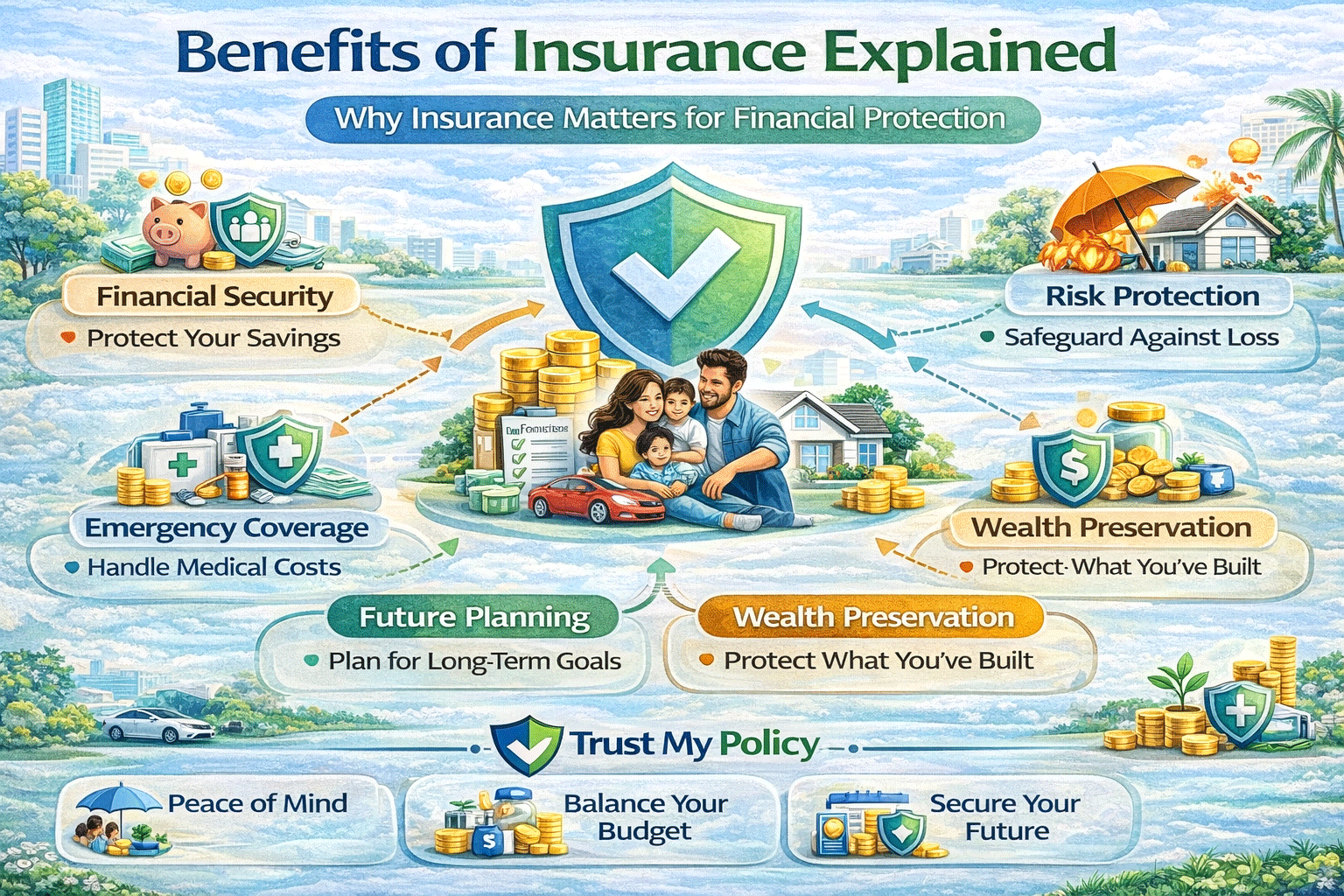
The core benefits of insurance are financial protection against large, unpredictable losses, predictable monthly budgeting, legal compliance where required, and the ability to take normal financial risks like buying a home or starting a business without catastrophic exposure. A single major claim, such as a $35,000 roof repair or a $500,000 life insurance payout, can be worth decades of premiums in one event.
Claire Dempsey, 36, runs a small bakery in Bristol and always saw her business insurance as a cost to minimize, until an electrical fault sparked a kitchen fire that closed her shop for seven weeks. Her business interruption coverage paid her lost income during the closure, the one part of her policy she’d almost cancelled the year before to save money.
The Benefits of Insurance in 2026 go well beyond simply covering a loss after it happens. Insurance provides financial protection against catastrophic costs, predictable budgeting through fixed premiums, legal compliance for things like auto liability, and genuine peace of mind that lets people take normal financial risks like buying a home or starting a business. This guide breaks down each specific benefit with real numbers behind it.
This article covers the core financial and practical benefits of holding insurance, how each one plays out in real situations, specific scenarios with dollar figures, and a framework for recognizing value you might be underestimating. By the end, you’ll see exactly what your premium buys you.
| Feature | Details |
| What it is | The financial and practical advantages gained from holding an insurance policy |
| Who benefits | Anyone with assets, dependents, debt, or legal coverage requirements |
| Typical premium cost | $80–$300/month for combined core US coverage; £50–£150/month UK equivalent |
| Coverage value when claimed | Often $10,000–$500,000+ depending on policy type |
| Key benefit | Converts an unpredictable, potentially catastrophic cost into a small, predictable one |
| Key limitation | Benefits are easy to underestimate in years without a claim |
| Regulator | State insurance departments (US); Financial Conduct Authority (UK) |
Most people think of insurance’s benefit as simple: it pays you back after something bad happens. That’s true, but it misses most of the actual value. Insurance is closer to a financial seatbelt — its biggest benefit isn’t the rare moment it’s actually used, it’s the freedom it gives you to drive normally every single day without fear of a catastrophic outcome.
The benefits of insurance include direct financial protection against large losses, predictable budgeting through fixed premiums instead of unpredictable costs, legal compliance for required coverage like auto liability, and the practical freedom to take on normal life risks — owning a home, running a business, raising a family — without catastrophic exposure. Anyone managing assets, dependents, or legal obligations needs to recognize these benefits clearly.
| Criteria | Visible Benefits (Claim Payouts) | Hidden Benefits (Ongoing Value) |
| When you notice it | Only after filing a successful claim | Every day your coverage is active, even without a claim |
| Example | $35,000 roof repair paid in full | Confidence to buy a home knowing it’s protected |
| Pros | Direct, tangible financial recovery | Enables bigger life decisions without catastrophic risk |
| Cons | Easy to overvalue relative to the hidden, everyday benefit | Easy to underestimate since it’s harder to quantify |
| Best for understanding | Comparing premium against worst-case loss | Comparing premium against the freedom it enables |
We recommend most readers weigh both types of benefit together, since judging insurance only by claim payouts misses the everyday value of simply having protection in place.
Scenario 1: Claire, 36, bakery owner in Bristol. Claire’s business interruption coverage paid her lost income during a seven-week closure after an electrical fire, the exact benefit she’d almost cancelled to save money the year before. Verdict: the least-used part of her policy turned out to be the most valuable. Action: Claire now reviews her full policy benefits annually rather than focusing only on the parts she expects to use.
Scenario 2: Marcus, 41, homeowner in Dallas with a $310,000 mortgage. Marcus’s lender required homeowners insurance as a loan condition, and a hailstorm later caused $18,000 in roof damage fully covered by that same required policy. Verdict: a legal requirement turned into direct financial protection. Action: Marcus now sees the mandatory coverage as a genuine asset, not just a loan condition.
Scenario 3: A young couple in Manchester who bought a £350,000 home after securing life insurance on both incomes. Their mortgage approval and personal confidence to buy depended partly on knowing the mortgage would be paid off if either of them died unexpectedly. Verdict: life insurance enabled a major financial decision they might have hesitated on otherwise. Action: they reviewed their coverage amount again after a recent pay rise to make sure it still matched their mortgage balance.
Scenario 4: A freelance photographer in Seattle relying on individual health insurance. A $14,000 emergency surgery bill was fully covered after her deductible, protecting her from a debt that could have ended her freelance career. Verdict: health insurance protected not just her finances but her ability to keep working independently. Action: she now treats her premium as a non-negotiable business cost rather than a discretionary expense.
| Pros | Cons |
| Converts unpredictable, potentially catastrophic costs into manageable premiums. | Ongoing premium cost exists even during years without a claim. |
| Enables bigger life and financial decisions with reduced catastrophic risk. | Some benefits, like peace of mind, are hard to quantify in a budget. |
| Meets legal and lender requirements that protect both you and others. | Underinsuring can leave gaps that undermine the protection you’re counting on. |
| Provides direct financial recovery when a covered loss does occur. | Comparing policies for hidden benefits takes more effort than comparing price alone. |
| Supports business continuity through coverage like business interruption insurance. | Not every benefit applies equally to every policyholder’s situation. |
⚠️ WARNING: Never assume a policy add-on you’ve never used has no value. Business interruption coverage, umbrella liability, and similar add-ons often provide the largest single benefit precisely because they’re used rarely but cover catastrophic situations.
| Your Situation | Our Recommendation |
| You’re considering cancelling a rarely-used policy add-on | No — review what it specifically covers before assuming it’s unnecessary |
| You haven’t reviewed your coverage since a major life change | Yes — reassess your policy benefits against your current situation |
| You’re a small business owner without business interruption coverage | Yes — consider adding it, since lost income during a closure can be catastrophic |
| You see your auto liability insurance as just a legal requirement | Yes — recognize it also protects your own finances from a lawsuit |
| You’re underinsured to save on your premium | No — increase your coverage to match your actual replacement cost or exposure |
| You’re deciding whether life insurance is worth it while healthy | Yes — the enabling benefit (confidence to take on a mortgage, etc.) applies even before any claim |
| You’ve never filed a claim and feel your premium was wasted | No — the protection still had value every day it was active |
💡 TIP: The single golden rule for recognizing insurance’s full benefit: count both the payout you might receive and the freedom it gives you to take on normal life and financial risks every single day it’s active.
| Scenario | Annual Premium | Benefit Realized |
| Small business interruption coverage | $300–$800/year | Lost income covered during a multi-week closure |
| Homeowners insurance, required by lender | $1,200–$2,400/year | $18,000+ roof or structural repair fully covered |
| Term life insurance, healthy 35-year-old | $300–$500/year | $500,000 payout enabling mortgage and family security |
| Individual health insurance, freelancer | $1,800–$5,400/year | Protection against a five-figure emergency medical bill |
| Auto liability insurance, clean record | $480–$1,000/year | Protection against a lawsuit potentially exceeding $50,000+ |
| Umbrella liability policy add-on | $150–$300/year | Extra $1,000,000 in liability protection beyond standard limits |
| Renters insurance | $150–$250/year | $10,000–$30,000+ in belongings replacement coverage |
Independent insurance brokers — Brokers can walk through your policy and highlight benefits you may not realize you have. Cost range: typically free for the consumer. Best for: anyone wanting a full review of their existing coverage. Rating: varies by broker, check state or FCA licensing.
NAIC consumer resources (US) — Publishes plain-language guidance explaining the practical benefits behind different insurance types. Cost range: free public resource. Best for: US consumers wanting unbiased educational material. Rating: regulatory standards body.
Citizens Advice (UK) — Offers free, independent guidance on understanding what UK insurance policies actually provide. Cost range: free. Best for: UK consumers wanting plain-language guidance. Rating: independent charity.
Policygenius (US) — A comparison platform that explains specific policy benefits alongside premium quotes. Cost range: free to use. Best for: US shoppers wanting to understand coverage details, not just price. Rating: independent comparison service.
Compare the Market (UK) — A UK comparison site that breaks down specific benefits across home, auto, and life insurance options. Cost range: free to compare. Best for: UK shoppers comparing coverage benefits side by side. Rating: FCA-regulated comparison service.
We recommend starting with an independent broker as best overall because a direct conversation about your specific policy is the fastest way to uncover benefits you may be underusing or unaware of.
The main benefits are financial protection against large losses, predictable budgeting through fixed premiums, legal compliance where required, and the freedom to take on normal financial risks without catastrophic exposure.
Yes. The protection and peace of mind insurance provides has value every day it’s active, regardless of whether you ever need to use it.
The freedom it provides to make bigger financial decisions, like buying a home or starting a business, without fear of a single event causing catastrophic financial damage.
Yes. Required coverage like auto liability insurance protects your own finances from a lawsuit, not just the other party involved in an accident.
Review your full policy document for add-ons or coverage types you may have forgotten about, such as business interruption or umbrella liability coverage.
For most small business owners, yes, since lost income during an extended closure can be far more damaging than the relatively low annual premium.
It’s a natural perception, but the absence of a claim means the protection worked exactly as intended, providing value through risk reduction even without a payout.
Yes. A new home, business, or dependent can shift which benefits matter most to you, making it worth reassessing your coverage regularly.
Possibly, if your current limits don’t match your actual replacement cost or liability exposure, since underinsuring reduces the real benefit you’re paying for.
Use an independent broker or comparison tool that breaks down specific coverage details and add-ons, rather than comparing premium price alone.
This guide reflects the latest 2026 insurance data.
This article is for informational purposes only. Always consult a licensed insurance professional before making coverage decisions. Trust My Policy does not sell insurance products or represent any insurer.

Jagadeesh Gutha is the founder of TrustMyPolicy.com, an independent insurance information platform covering life, health, car, home, and business insurance for US and UK readers. He researches insurance products, policy structures, and consumer rights to help everyday people make informed coverage decisions without the jargon. All content on TrustMyPolicy is independently researched, fact-checked, and written to educate — not to sell.



Insurance Guides for UK, USA & Worldwide We are not an insurer or broker.

Reader Comments (0)