
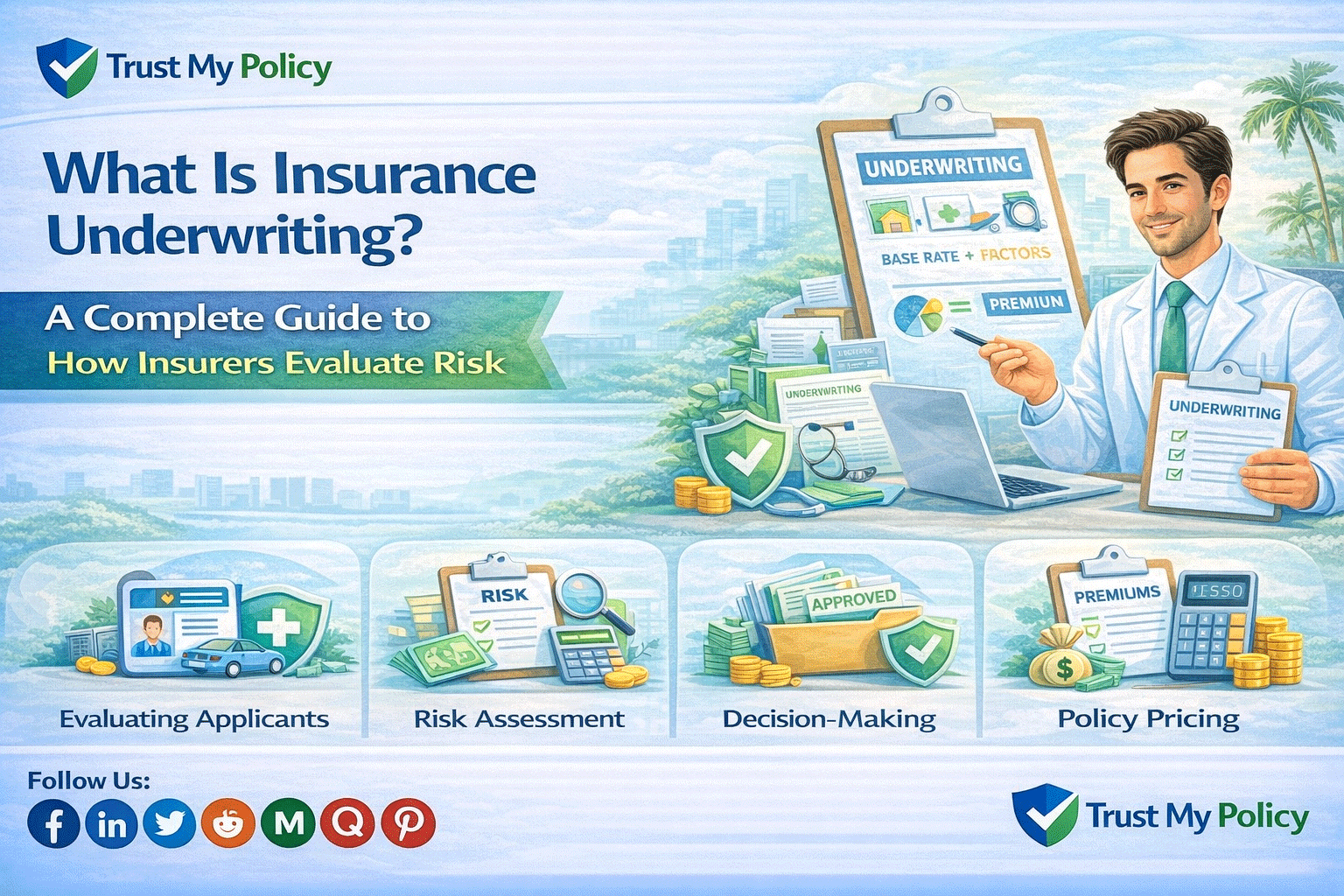
Insurance underwriting is the process insurers use to evaluate an applicant’s risk, decide whether to offer coverage, and determine the price. Underwriters review your application, supporting documents like medical records or driving history, and sometimes order additional reports, then classify you into a risk category. According to industry standard practice, this can result in approval at standard rates, approval at a higher rate, or in some cases a decline.
Daniel Okoro, 39, applied for a $750,000 life insurance policy in Atlanta and was surprised when the insurer requested a paramedical exam, his last two years of medical records, and a phone interview before issuing a final offer. He’d assumed filling out the online application was the entire process — he’d never heard the word “underwriting” before that point.
What Is Insurance Underwriting? It’s the process insurers use to evaluate an applicant’s risk, decide whether to offer coverage, and set the specific price if they do. Underwriters review your application, supporting documents, and sometimes additional reports or exams, then classify you into a risk category that determines your premium or whether you’re declined. This guide breaks down exactly what underwriters look at, how decisions get made, and how to make the process go smoothly.
This article covers the underwriting process step by step, what underwriters actually evaluate, real scenarios showing different outcomes, and how to prepare for your own application. By the end, you’ll understand exactly what happens behind the scenes after you hit submit.
| Feature | Details |
| What it is | The process of evaluating risk to decide coverage and pricing for an applicant |
| Who performs it | Underwriters, sometimes assisted by automated underwriting systems |
| Typical inputs reviewed | Application details, medical records, driving history, credit-based score, property condition |
| Possible outcomes | Approval at standard rate, approval at a higher rate, or decline |
| Key benefit | Ensures pricing matches actual risk and keeps the wider risk pool balanced |
| Key limitation | Can take additional time for complex applications requiring exams or extra documentation |
| Regulator | State insurance departments (US); Financial Conduct Authority and Prudential Regulation Authority (UK) |
Think of underwriting like a loan officer reviewing a mortgage application — they’re not just checking a box, they’re verifying your information, assessing your specific risk, and deciding both whether to approve you and on what terms. Insurance underwriting works the same way, just assessing the risk of a future claim instead of a future loan default.
Insurance underwriting is the process by which an insurer evaluates an applicant’s risk profile to decide whether to offer coverage and, if so, at what price. Underwriters review the application itself, plus any supporting documentation or reports relevant to the type of insurance, before classifying the applicant into a specific risk category. Anyone applying for life, health, auto, or home insurance goes through some form of underwriting, whether fully automated or manually reviewed by a person.
| Criteria | Automated Underwriting | Manual (Full) Underwriting |
| Speed | Often minutes to same-day decisions | Days to several weeks |
| Typical use case | Simpler policies, lower coverage amounts, straightforward risk profiles | Higher coverage amounts, complex health history, or unusual risk factors |
| Data sources | Algorithmic review of application data and instant database checks | Human review plus medical records, exams, interviews, or inspections |
| Pros | Fast, convenient, often available for simpler products | More accurate risk assessment for complex or borderline cases |
| Cons | May not catch nuanced risk factors that benefit from human judgment | Slower process, more documentation required from the applicant |
We recommend most readers expect automated underwriting for straightforward, lower-coverage applications and full manual underwriting for higher-value or more complex policies.
Scenario 1: Daniel, 39, applying for $750,000 in life insurance in Atlanta. Daniel’s high coverage amount triggered full underwriting, including a paramedical exam and medical records review, before his final offer. Verdict: higher coverage amounts typically require more thorough underwriting. Action: Daniel scheduled his exam promptly to avoid delaying his approval timeline.
Scenario 2: Sarah, 26, applying for a basic $250,000 term life policy in Leeds. Sarah’s application was approved within 48 hours through an automated underwriting program based on her age, health questionnaire answers, and a quick database check. Verdict: simpler, lower-risk applications often move through automated underwriting quickly. Action: Sarah confirmed her policy was active before assuming coverage had started.
Scenario 3: A driver in Dallas with two recent at-fault accidents applying for auto insurance. The underwriter reviewed his driving record and classified him into a higher-risk tier, resulting in a higher quoted premium than a clean-record driver would receive. Verdict: underwriting directly determines pricing tiers based on documented risk history. Action: he asked his insurer what specific changes could improve his risk classification at renewal.
Scenario 4: A homeowner applying for coverage on an older property with an aging roof in Florida. The underwriter required a property inspection before approval, ultimately requiring a roof replacement as a condition of coverage. Verdict: underwriting can include specific conditions, not just a simple approval or decline. Action: the homeowner replaced the roof and was then approved at standard rates.
| Pros | Cons |
| Ensures pricing accurately reflects each applicant’s actual risk. | Can take additional time for complex or higher-value applications. |
| Automated underwriting offers fast decisions for straightforward cases. | Automated systems may miss nuanced factors that benefit from human review. |
| Keeps the broader risk pool balanced by screening out severe mismatches. | Underwriting requirements like exams or inspections can feel intrusive. |
| Can include conditional approvals, like requiring a repair, rather than an outright decline. | A decline from one insurer doesn’t always explain clearly why, which can be frustrating. |
| Gives applicants a chance to provide additional context for unusual risk factors. | Inconsistent guidelines between insurers mean the same applicant can get very different offers. |
⚠️ WARNING: Never misrepresent or omit information on an insurance application to get better underwriting terms. If a claim is later filed, misrepresentation discovered during the claims investigation can result in a denied claim or a voided policy entirely.
| Your Situation | Our Recommendation |
| You’re applying for a high coverage amount that may require an exam | Yes — schedule any required exam promptly to avoid delays |
| You were declined by one insurer | Yes — apply with other insurers, since underwriting guidelines vary |
| You received a higher-rate offer and want to understand why | Yes — ask the underwriter or your broker for the specific factor driving the rate |
| You’re tempted to omit a health or risk detail on your application | No — always disclose accurate information to avoid voiding future claims |
| You’re applying for a low coverage amount likely to qualify for automated underwriting | Yes — expect a fast decision, but confirm your policy is active before assuming coverage |
| Your property or vehicle has a condition that could affect underwriting | Yes — consider addressing it (like a repair) before applying for potentially better terms |
| You’re unsure whether your specific risk factor is addressable | Yes — ask your insurer directly whether providing more context could change the outcome |
💡 TIP: The single golden rule for underwriting: always disclose accurate, complete information, since the short-term benefit of omitting something is never worth the risk of a denied claim later.
| Scenario | Underwriting Outcome | Notes |
| Healthy non-smoker, age 30, $500,000 term life | Standard or preferred rate | Often qualifies for automated underwriting |
| Smoker, age 30, $500,000 term life | Higher rate, often 2-3x standard pricing | Reflects elevated mortality risk in underwriting guidelines |
| Driver with two at-fault accidents in 3 years | Higher-risk tier pricing | Often a 30%–60% premium increase over a clean record |
| Homeowner with an aging roof requiring repair as a condition | Conditional approval pending repair | Common outcome rather than an outright decline |
| Applicant misrepresenting health history | Risk of denied claim or voided policy later | Discovered misrepresentation can undo coverage entirely |
| High-coverage life insurance application | Full manual underwriting, including possible exam | Typically required above certain coverage thresholds |
| Low-coverage, straightforward auto application | Automated underwriting, fast decision | Common for standard risk profiles |
Independent insurance brokers — Brokers understand how different insurers’ underwriting guidelines vary and can recommend the best fit for your specific risk profile. Cost range: typically free for the consumer. Best for: anyone with a borderline or complex risk profile. Rating: varies by broker, check state or FCA licensing.
NAIC consumer resources (US) — Publishes plain-language guidance on how underwriting decisions are regulated across US states. Cost range: free public resource. Best for: US consumers wanting unbiased educational material. Rating: regulatory standards body.
Financial Conduct Authority (UK) — Sets conduct standards for how UK insurers must treat applicants fairly during underwriting. Cost range: free to consult guidance. Best for: UK consumers wanting to understand underwriting fairness standards. Rating: government regulatory body.
Specialty insurance brokers — Brokers who specialize in higher-risk or complex underwriting cases, such as aviation, high-risk health conditions, or unusual property risks. Cost range: typically free for the consumer. Best for: applicants previously declined by standard insurers. Rating: varies by broker, check licensing.
Society of Actuaries and Institute and Faculty of Actuaries — Professional bodies offering public resources on how underwriting risk classification methods are developed. Cost range: free public resources available. Best for: readers wanting deeper technical understanding. Rating: professional actuarial bodies.
We recommend an independent broker as best overall because they can match your specific risk profile to the insurer most likely to offer favorable underwriting terms.
Insurance underwriting is the process insurers use to evaluate an applicant’s risk, decide whether to offer coverage, and determine the price based on that risk assessment.
Underwriting is performed either by a human underwriter, an automated underwriting system, or a combination of both, depending on the complexity and coverage amount of the application.
A decline from one insurer doesn’t mean you’re uninsurable everywhere; underwriting guidelines vary significantly between insurers, so applying elsewhere is often worthwhile.
Higher coverage amounts or certain health histories often trigger full underwriting, which can include a paramedical exam to verify your health status.
In many cases, yes. You can often provide additional documentation or context, such as updated medical records or a completed home repair, to request reconsideration.
Yes. Underwriting doesn’t just decide approval or decline, it also determines which specific rate tier you’re placed into, which directly affects your premium.
Not necessarily less accurate, but it’s generally better suited to simpler, lower-risk applications, while manual underwriting allows for more nuanced judgment on complex cases.
Misrepresentation discovered later, often during a claims investigation, can result in a denied claim or a voided policy, even if the original underwriting decision was favorable.
Automated underwriting can take minutes to a day, while full manual underwriting involving exams or inspections can take anywhere from several days to a few weeks.
Yes. Underwriters can offer conditional approval, such as requiring a property repair or a follow-up medical test, rather than declining the application outright.
This guide reflects the latest 2026 insurance data.
This article is for informational purposes only. Always consult a licensed insurance professional before making coverage decisions. Trust My Policy does not sell insurance products or represent any insurer.

Jagadeesh Gutha is the founder of TrustMyPolicy.com, an independent insurance information platform covering life, health, car, home, and business insurance for US and UK readers. He researches insurance products, policy structures, and consumer rights to help everyday people make informed coverage decisions without the jargon. All content on TrustMyPolicy is independently researched, fact-checked, and written to educate — not to sell.

[…] unstable through adverse selection, when mostly high-risk people join, which is why insurers use underwriting and risk classification to keep pools […]
[…] Insurance Underwriting Process in 2026 typically moves through five distinct internal stages: application intake, risk assessment, […]



Insurance Guides for UK, USA & Worldwide We are not an insurer or broker.
Reader Comments (3)
[…] every policy sits a chain that includes brokers and agents who help you buy coverage, insurers who underwrite and pay claims, reinsurers who insure the insurers against catastrophic losses, and regulators who […]