
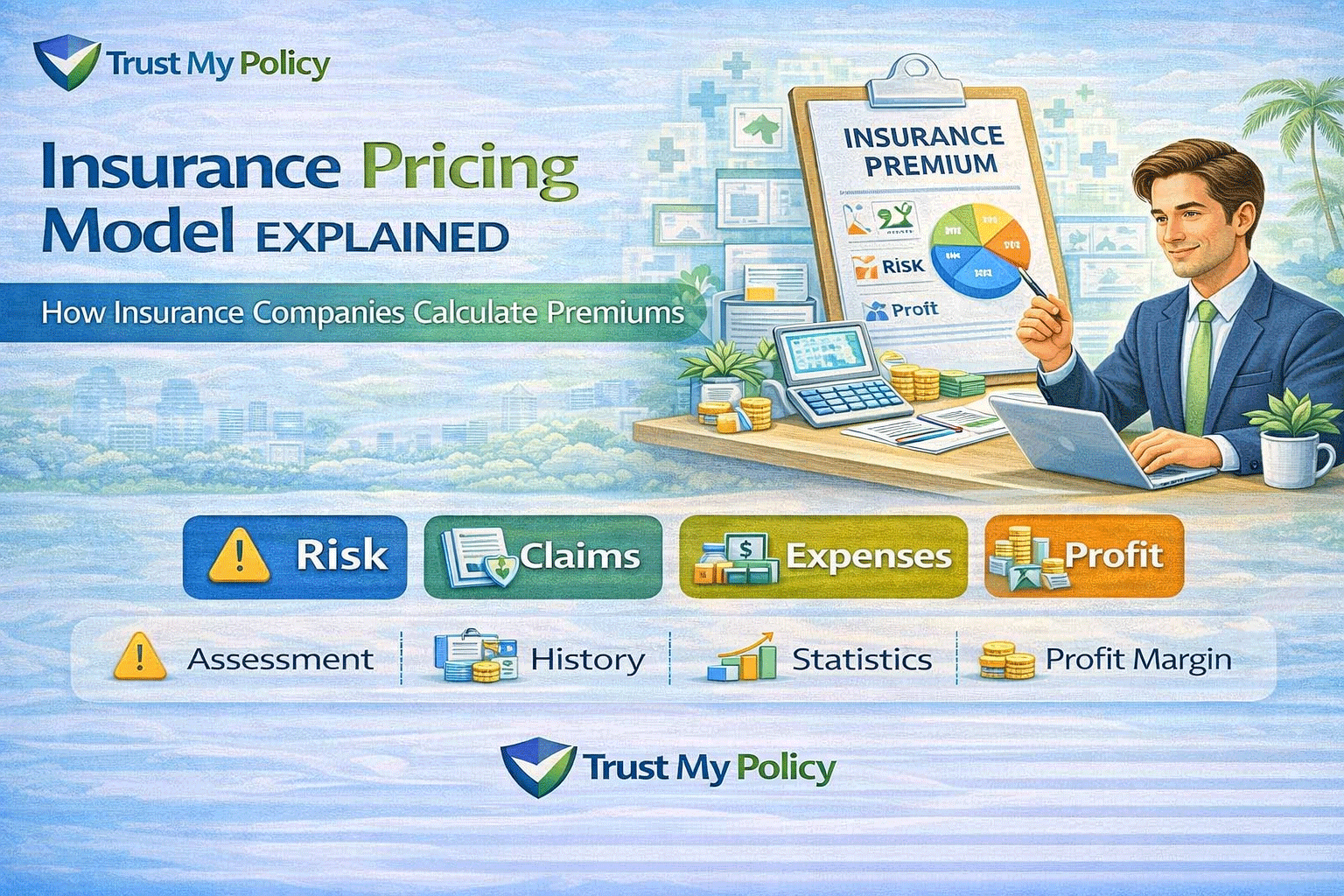
The main insurance pricing models are risk-based pricing, which sets your premium according to your individual risk factors, community rating, which charges everyone in a defined group the same price regardless of individual risk, and usage-based pricing, which adjusts your premium using real-time behavior data like driving habits. Auto and life insurance typically use risk-based pricing, many US ACA health plans use a modified community rating, and telematics-based auto insurance uses usage-based pricing.
Tyler Brooks, 25, installed a telematics app on his phone to qualify for a usage-based auto insurance discount in Denver, while his older brother in the same city paid a flat community-rated premium for his health insurance regardless of his specific driving habits or lifestyle. Both were buying insurance, but each policy used a completely different pricing model behind the scenes.
The Insurance Pricing Model used for any given policy depends heavily on the type of coverage and the country you’re in. The most common approaches are risk-based pricing, which ties your premium directly to your individual risk factors, community rating, which spreads cost evenly across a defined group regardless of individual risk, and usage-based pricing, which adjusts premiums based on real-time behavior data. This guide breaks down each model, where it’s used, and what it means for your premium.
This article covers the major pricing models used across the insurance industry, where each one applies, real scenarios showing the practical differences, and what this means for how you shop for coverage. By the end, you’ll understand why two similar policies can be priced so differently.
| Feature | Details |
| What it is | The underlying method an insurer uses to translate risk into a price |
| Who it affects | Anyone comparing insurance pricing across different policy types or countries |
| Common models | Risk-based pricing, community rating, usage-based (telematics) pricing |
| Where each is used | Risk-based for auto/life; modified community rating for US ACA health plans; usage-based for telematics auto programs |
| Key benefit | Different models balance fairness, simplicity, and individual accuracy differently |
| Key limitation | Some models (community rating) can mean low-risk individuals subsidize higher-risk ones |
| Regulator | State insurance departments and CMS (US); Financial Conduct Authority (UK) |
Think of pricing models like different ways a gym could charge membership fees. One gym might charge everyone the exact same flat fee regardless of how often they work out. Another might charge based on your specific fitness profile and injury risk. A third might track your actual usage and adjust your bill accordingly. Insurance pricing works the same way, just applied to risk instead of gym visits.
An insurance pricing model is the underlying methodology an insurer uses to convert risk into a price. The three most common models are risk-based pricing, which ties premiums closely to individual risk factors like age, health, or driving record; community rating, which charges a defined group the same price regardless of individual risk differences; and usage-based pricing, which adjusts premiums using real-time behavioral data. Anyone comparing pricing across different insurance types needs to understand which model applies, since it explains why similar-looking policies can be priced so differently.
| Criteria | Risk-Based Pricing | Community Rating | Usage-Based Pricing |
| Basis for price | Individual risk factors | Defined group characteristics | Real-time behavioral data |
| Common use case | Auto, life, home insurance | US ACA marketplace health plans | Telematics auto insurance programs |
| Fairness trade-off | Highly individualized, but can be expensive for high-risk individuals | Spreads cost evenly, but low-risk individuals subsidize higher-risk ones | Rewards safe behavior directly, but requires ongoing data sharing |
| Pros | Closely matches price to actual individual risk | Predictable, accessible pricing regardless of personal health status | Can meaningfully reward genuinely safe behavior |
| Cons | Can be costly for individuals with poor risk factors | Less individually tailored, can feel “unfair” to very low-risk individuals | Requires sharing ongoing personal data with the insurer |
We recommend understanding which model applies to a specific policy type for most readers, since it explains both the pricing logic and what, if anything, you can do to influence your own premium.
Scenario 1: Tyler, 25, driver in Denver using a telematics program. Tyler’s safe driving habits, tracked through a usage-based pricing app, earned him a 15% discount compared to the standard risk-based rate. Verdict: usage-based pricing directly rewarded his specific driving behavior. Action: Tyler kept the app active to maintain his ongoing discount at each renewal.
Scenario 2: Tyler’s brother, also in Denver, on an ACA marketplace health plan. His premium was priced using a modified community rating model, based on his age band and region, regardless of his personal health status. Verdict: community rating meant his price wasn’t directly tied to his individual health risk factors. Action: he compared plans by metal tier and network rather than expecting health-status-based pricing differences.
Scenario 3: A 60-year-old applying for life insurance in Leeds. His premium was calculated almost entirely through risk-based pricing, with age and health status as the dominant individual rating factors. Verdict: life insurance remains one of the clearest examples of pure risk-based pricing. Action: he applied for coverage promptly, since risk-based pricing for life insurance only gets more expensive with age.
Scenario 4: A small business comparing two commercial property insurers. One used a more individualized risk-based model considering specific building features, while the other used a broader regional rating approach. Verdict: even within commercial insurance, pricing models can differ meaningfully between insurers. Action: the business chose the more individualized risk-based quote, since its specific fire-resistant upgrades were rewarded with a lower rate.
| Pros | Cons |
| Risk-based pricing closely matches cost to individual risk, rewarding low-risk behavior. | Risk-based pricing can be expensive or restrictive for individuals with poor risk factors. |
| Community rating provides predictable, accessible pricing regardless of personal health status. | Community rating means low-risk individuals effectively subsidize higher-risk ones. |
| Usage-based pricing can directly reward genuinely safe, real-time behavior. | Usage-based pricing requires ongoing data sharing, which not everyone is comfortable with. |
| Regulation around community rating helps preserve access to health coverage for higher-risk individuals. | Regulatory restrictions can limit how individualized certain pricing models are allowed to be. |
| Multiple models existing side by side gives consumers some choice in how they’re priced. | Comparing pricing models across policy types can be genuinely confusing without context. |
⚠️ WARNING: Never assume a usage-based pricing program only offers discounts and never increases. Some telematics programs can raise your premium if the tracked behavior data reflects higher-risk driving, so read the program’s specific terms before enrolling.
| Your Situation | Our Recommendation |
| You’re shopping for auto insurance and have safe driving habits | Yes — consider a usage-based telematics program for a potential discount |
| You’re applying for US ACA marketplace health insurance | Yes — expect a modified community rating, not individual health-status pricing |
| You’re applying for life insurance | Yes — expect pure risk-based pricing, with age and health as dominant factors |
| You’re uncomfortable sharing ongoing behavioral data | No — stick with standard risk-based pricing rather than a usage-based program |
| You’re a business owner who has made specific risk-reduction investments | Yes — ask whether your insurer’s pricing model rewards those upgrades directly |
| You’re confused why two similar policies are priced so differently | Yes — ask which pricing model each insurer uses before comparing further |
| You’re considering a usage-based program with unclear terms | Yes — read the full terms first, since poor tracked behavior could raise your rate |
💡 TIP: The single golden rule for understanding pricing models: ask which specific model applies to your policy type before assuming your price works the same way as a different type of insurance you’ve bought before.
| Scenario | Pricing Model | Typical Effect on Premium |
| Safe driver enrolling in a telematics program | Usage-based | 5%–20% discount based on tracked behavior |
| Higher-risk driver enrolling in the same program | Usage-based | Discount may be reduced or, in some programs, premium increased |
| US ACA marketplace plan, age 30 vs. age 55 | Modified community rating | Older enrollees can be charged up to 3x more, but not based on health status |
| Healthy vs. unhealthy life insurance applicant, same age | Risk-based | Healthy applicant can pay significantly less due to preferred risk classification |
| Commercial property with fire-resistant upgrades | Risk-based (insurer-dependent) | Can result in a meaningful discount if the insurer’s model rewards the upgrade |
| Standard risk-based auto policy, clean record | Risk-based | Reflects individual driving and demographic risk factors directly |
| US Medicare (age-based, not full risk-based) | Modified, age and program-based | Reflects program-wide rules rather than full individual risk pricing |
NAIC (National Association of Insurance Commissioners) — Publishes consumer guidance on different pricing models and how they’re regulated across US states. Cost range: free public resource. Best for: US consumers researching pricing model regulation. Rating: regulatory standards body.
HealthCare.gov (US) — Explains how community rating rules apply specifically to ACA marketplace health plans. Cost range: free to use. Best for: US consumers understanding health insurance pricing rules. Rating: federal government marketplace.
Financial Conduct Authority (UK) — Sets standards for how UK insurers, including usage-based auto programs, must price and disclose terms fairly. Cost range: free to consult guidance. Best for: UK consumers researching pricing fairness rules. Rating: government regulatory body.
Independent insurance brokers — Brokers can explain which specific pricing model an insurer uses for a given product and how it might affect your quote. Cost range: typically free for the consumer. Best for: anyone comparing pricing models across multiple insurers. Rating: varies by broker, check state or FCA licensing.
Insurance Information Institute (US) and Association of British Insurers (UK) — Industry bodies publishing educational resources on pricing methodologies. Cost range: free public resources available. Best for: readers wanting deeper industry context. Rating: industry trade associations.
We recommend an independent broker as best overall because they can clearly explain which specific pricing model applies to the policy you’re comparing and what that means for your premium.
An insurance pricing model is the underlying methodology an insurer uses to convert risk into a price, with the most common models being risk-based pricing, community rating, and usage-based pricing.
Risk-based pricing sets your premium according to your individual risk factors, such as age, health, location, or claims history, and is commonly used for auto and life insurance.
Community rating charges everyone in a defined group the same price regardless of individual risk differences, and is used in a modified form for US ACA marketplace health plans.
Usage-based pricing adjusts your premium using real-time behavioral data, most commonly seen in telematics-based auto insurance programs that track driving habits.
US ACA marketplace plans use a modified community rating model that generally prohibits pricing based on individual health status, allowing only factors like age, tobacco use, and region.
Yes, in some programs. While usage-based pricing often offers discounts for safe driving, some programs can also raise your premium if tracked behavior reflects higher risk.
Life insurance almost always uses risk-based pricing, with age and health status as the dominant individual rating factors determining your premium.
Different insurers may use different pricing models or weight rating factors differently, even for seemingly similar policies, leading to genuinely different final premiums.
It depends on your perspective. Community rating spreads cost more evenly across a group, while risk-based pricing more closely matches cost to individual risk, each with different trade-offs.
It depends on your comfort with data sharing and your confidence in your own driving habits; if you’re a consistently safe driver, the potential discount is often worth considering.
This article is for informational purposes only. Always consult a licensed insurance professional before making coverage decisions. Trust My Policy does not sell insurance products or represent any insurer.

Jagadeesh Gutha is the founder of TrustMyPolicy.com, an independent insurance information platform covering life, health, car, home, and business insurance for US and UK readers. He researches insurance products, policy structures, and consumer rights to help everyday people make informed coverage decisions without the jargon. All content on TrustMyPolicy is independently researched, fact-checked, and written to educate — not to sell.

[…] core premium formula insurers use is: base rate, multiplied by a series of individual rating factors specific to the applicant, plus an expense load for administrative costs, plus a profit margin. […]

Insurance Guides for UK, USA & Worldwide We are not an insurer or broker.
Reader Comments (2)
[…] insurers use to evaluate an applicant’s risk, decide whether to offer coverage, and determine the price. Underwriters review your application, supporting documents like medical records or driving […]