

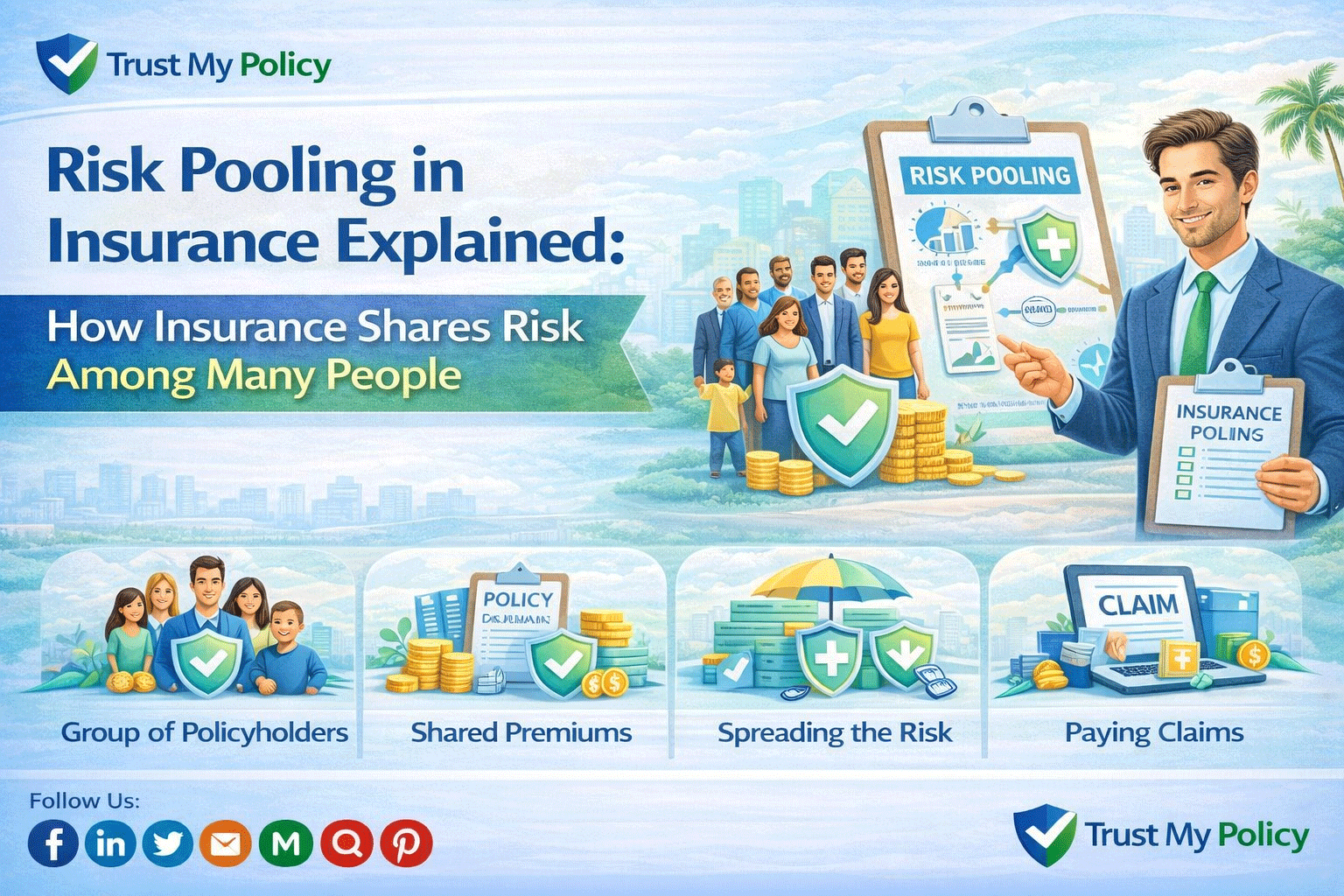
Risk pooling in insurance means combining premiums from a large group of people so that the rare, costly claims of a few can be paid from everyone’s combined contributions. It relies on the law of large numbers, which makes large-scale claims predictable even though individual claims aren’t. Pools become unstable through adverse selection, when mostly high-risk people join, which is why insurers use underwriting and risk classification to keep pools balanced.
Table of Contents
ToggleRisk Pooling in Insurance: Complete 2026 Guide
Naomi Patel, 36, runs a small yoga studio in Bristol and once asked her broker a blunt question: “If most of your customers never claim, why doesn’t everyone’s premium drop to almost nothing?” Her broker’s answer reshaped how she thought about insurance entirely — pools only work if enough low-risk people stay in them to balance out the people who do claim, and pricing has to account for that balance staying intact.
Risk Pooling in Insurance in 2026 is the mechanism that makes the entire industry possible: combining many people’s premiums into a shared fund large enough that the rare, expensive claims of a few can be paid from the contributions of the many. It only works reliably at scale, governed by a statistical principle called the law of large numbers, and it can break down if too many high-risk people join relative to low-risk ones. This guide breaks down exactly how pooling works, what threatens it, and why it shapes your premium.
This article covers the statistical mechanics behind risk pooling, what can destabilize a pool, real scenarios showing the effects, and what this means for how insurers price and structure coverage. By the end, you’ll understand the engine room of the entire insurance industry.
Quick Summary Table
| Feature | Details |
| What it is | Combining premiums from many policyholders to fund the claims of a few |
| Who it affects | Every insurance policyholder, since pricing depends on pool composition |
| Core principle | The law of large numbers, which makes group-level claims predictable |
| Main threat | Adverse selection, when high-risk people disproportionately join a pool |
| Key benefit | Spreads catastrophic individual risk across a large, stable group |
| Key limitation | Pools can become unstable or unaffordable if risk balance shifts too far |
| Regulator | State insurance departments (US); Financial Conduct Authority and Prudential Regulation Authority (UK) |
What Is Risk Pooling, Mechanically?
Picture a neighborhood where everyone chips in a small amount each month into a shared fund, on the assumption that only a few houses will ever need a major repair in any given year. As long as enough houses keep contributing and only a predictable few ever draw from the fund, the system works smoothly for everyone. The moment too many high-risk houses join and too many low-risk ones leave, the math falls apart.
Risk pooling is the practice of combining premiums from a large number of policyholders into a shared fund, so that the relatively few large claims that occur can be paid from everyone’s combined contributions rather than by any single individual. Anyone trying to understand why insurance pricing changes over time, or why insurers screen applicants carefully, needs to understand this mechanism specifically, separate from the broader concept of “how risk works.”
How Risk Pools Actually Function — 5 Steps
- A large group of people pays premiums into a shared fund. The fund needs enough people to make claims statistically predictable at the group level.
- The law of large numbers makes group-level outcomes predictable. While no individual claim is predictable, the total number and cost of claims across thousands of policies becomes statistically stable.
- Insurers classify applicants to keep the pool balanced. Underwriting and risk classification prevent the pool from filling up disproportionately with high-risk individuals.
- Claims get paid from the shared fund as they occur. The pool’s size and risk balance determine whether it can comfortably absorb a given year’s claims.
- Premiums get adjusted to keep the pool financially sound. If claims trends shift, or if the pool’s risk composition changes, premiums across the group are recalculated.
Comparison: A Balanced Risk Pool vs. an Unbalanced One
| Criteria | Balanced Risk Pool | Unbalanced Risk Pool (Adverse Selection) |
| Composition | A healthy mix of low-risk and high-risk participants | Disproportionately high-risk participants |
| Premium stability | Predictable, gradual adjustments over time | Volatile, often rising sharply as low-risk members leave |
| Long-term sustainability | Stable and sustainable for insurers and policyholders | Can become unaffordable or collapse without intervention |
| Pros | Lower, more stable premiums for everyone in the pool | None for long-term sustainability |
| Cons | Requires ongoing underwriting discipline to maintain | Drives a downward spiral of rising costs and departing low-risk members |
We recommend understanding pool balance for most readers because it explains pricing shifts that have nothing to do with your own personal claims history.
4 Real-Life Scenarios
Scenario 1: Naomi, 36, yoga studio owner in Bristol. Naomi assumed her low personal claims risk should mean a near-zero premium, until her broker explained that pool-wide balance, not just her own risk, determines pricing. Verdict: individual risk alone doesn’t set the price; pool composition does. Action: Naomi now understands her premium partly reflects how the entire pool of similar businesses is performing.
Scenario 2: A health insurance marketplace experiencing adverse selection. Mostly older, higher-cost individuals enrolled while younger, healthier people opted out, pushing average claims costs up across the pool. Verdict: this is a textbook example of adverse selection destabilizing a risk pool. Action: regulators introduced penalties for opting out and subsidies to encourage broader, more balanced enrollment.
Scenario 3: A life insurer with a large, stable book of term life policies. Despite the unpredictability of any single policyholder’s death, the insurer’s actuaries accurately projected total claims costs across tens of thousands of policies within a tight margin. Verdict: the law of large numbers made aggregate claims highly predictable even though individual deaths weren’t. Action: the insurer used this predictability to price policies competitively while remaining solvent.
Scenario 4: A small mutual insurance pool for a niche industry, like artisan bakers. A spike in claims from a handful of large fire losses strained the pool’s reserves because the pool was too small to absorb the shock. Verdict: smaller pools are more vulnerable to statistical volatility than larger ones. Action: the mutual purchased reinsurance to add a larger backstop against future large losses.
Pros & Cons of Risk Pooling as a System
| Pros | Cons |
| Spreads catastrophic individual losses across a large, stable group. | Requires careful underwriting to prevent adverse selection from destabilizing the pool. |
| Makes aggregate claims costs statistically predictable for insurers. | Smaller pools are more vulnerable to unpredictable large losses. |
| Enables affordable premiums for risks individuals couldn’t self-insure. | Pool-wide trends can raise your premium even with a personal clean record. |
| Supports broader access to coverage than individual self-insurance would allow. | Pools facing adverse selection can spiral into unaffordable pricing. |
| Reinsurance can backstop even large or niche risk pools against shocks. | Regulatory intervention is sometimes needed to keep certain pools (like health insurance) balanced. |
5 Common Mistakes People Make Understanding This
- Assuming their personal risk alone determines their premium. This happens because individual underwriting feels like the only visible factor. What to do instead: remember pool-wide claims trends and composition also directly affect your premium.
- Not understanding why mandatory enrollment rules exist in some health systems. This happens because mandates can feel unrelated to personal insurance needs. What to do instead: recognize that broad enrollment, including healthy people, is what keeps a pool’s pricing sustainable for everyone.
- Assuming a small, niche insurance pool is just as stable as a large one. This happens because pool size isn’t visible to the average policyholder. What to do instead: ask whether a niche insurer carries reinsurance to protect against large, unpredictable losses.
- Believing low personal claims should immediately translate into a much lower premium. This happens because people equate personal behavior with the entire pricing model. What to do instead: understand that pool stability, not just your own record, plays a major role in your rate.
- Not recognizing adverse selection when shopping for niche or optional coverage. This happens because people don’t realize who else is buying the same coverage. What to do instead: expect higher premiums for optional coverage types where mostly high-risk people tend to enroll.
⚠️ WARNING: Never assume a sharp, unexplained premium increase across an entire market is unique to you. Widespread increases often signal pool-wide instability, such as adverse selection or a shrinking pool of low-risk participants, which is worth researching before assuming it’s a personal issue.
Decision Table: What This Means for You
| Your Situation | Our Recommendation |
| Your premium rose along with seemingly everyone else’s in your market | Yes — research whether pool-wide trends, not personal risk, are driving it |
| You’re shopping for a niche or optional insurance product | Yes — ask whether the pool is large enough or backed by reinsurance |
| You’re considering opting out of a mandatory health insurance system | No — opting out contributes to the kind of adverse selection that raises costs for everyone, including you later |
| You manage risk for a small mutual or niche insurance pool | Yes — consider reinsurance to protect against pool-destabilizing large losses |
| You want to understand why your low personal risk doesn’t mean a near-zero premium | Yes — review how pool composition, not just individual risk, affects pricing |
| You’re comparing a large national insurer against a small niche one | Yes — ask about each insurer’s pool size and reinsurance arrangements |
| You’re unsure why an entire insurance market’s prices are rising | Yes — research broader claims trends and enrollment patterns in that market |
💡 TIP: The single golden rule for understanding risk pooling: your premium reflects the health of the entire pool you’re part of, not just your own personal risk profile.
Cost Table: How Pool Dynamics Show Up in Real Pricing
| Scenario | Effect on Premiums | Notes |
| Large, balanced auto insurance pool | Stable, gradually adjusting premiums | Reflects a healthy mix of risk levels |
| Health insurance market experiencing adverse selection | Premiums can rise 10%–30%+ over a few years | Reflects a shrinking share of low-risk enrollees |
| Small niche mutual insurance pool without reinsurance | Highly volatile premiums after a single large claim | Reflects insufficient pool size to absorb shocks |
| Same niche pool with reinsurance in place | More stable premiums despite occasional large claims | Reinsurance acts as a backstop against pool-destabilizing losses |
| Mandatory enrollment health system (broad pool) | More stable, predictable average premiums | Reflects a balanced mix of healthy and higher-cost enrollees |
| Optional add-on insurance (e.g., extended warranties) | Often priced high relative to payout odds | Reflects adverse selection toward likely claimants |
| Large life insurance book (tens of thousands of policies) | Highly predictable aggregate claims costs | Reflects the law of large numbers in action |
Resources for Understanding Risk Pooling
NAIC (National Association of Insurance Commissioners) — Publishes consumer and industry guidance on how risk pools are regulated across US states. Cost range: free public resource. Best for: US consumers and professionals researching pool regulation. Rating: regulatory standards body.
Financial Conduct Authority (UK) — Regulates how UK insurers manage risk pools and ensures pricing practices remain fair. Cost range: free to consult guidance. Best for: UK consumers wanting to understand pooling regulation. Rating: government regulatory body.
Society of Actuaries (US) — Offers educational resources on the law of large numbers and actuarial pricing methods used in risk pooling. Cost range: free public resources available. Best for: anyone wanting a deeper technical understanding. Rating: professional actuarial body.
Institute and Faculty of Actuaries (UK) — The UK’s professional actuarial body, with public resources explaining risk pooling principles. Cost range: free public resources available. Best for: UK readers wanting technical depth. Rating: professional actuarial body.
Independent insurance brokers — Brokers can explain how a specific insurer’s pool size and composition might affect your particular policy’s stability. Cost range: typically free for the consumer. Best for: anyone choosing between a large insurer and a smaller niche one. Rating: varies by broker, check state or FCA licensing.
We recommend the NAIC or Financial Conduct Authority resources as best overall starting point because both offer free, regulator-level explanations of how pooling rules are designed to protect consumers.
Frequently Asked Questions
What is risk pooling in insurance?
Risk pooling is the practice of combining premiums from a large group of policyholders into a shared fund, so the rare, costly claims of a few can be paid from everyone’s combined contributions.
How does the law of large numbers relate to risk pooling?
The law of large numbers means that while any single claim is unpredictable, the total number and cost of claims across a large pool becomes statistically stable and predictable, which is what allows insurers to price coverage accurately.
What is adverse selection in a risk pool?
Adverse selection happens when a disproportionate number of high-risk individuals join a pool relative to low-risk individuals, which drives up average costs and can destabilize pricing for everyone.
Why do some health insurance systems require broad or mandatory enrollment?
Broad enrollment, including healthy people, helps keep a risk pool balanced and prevents adverse selection from driving premiums up for everyone in the pool.
Can a risk pool become too small to function well?
Yes. Smaller pools are more vulnerable to unpredictable large losses, since there isn’t enough scale for the law of large numbers to smooth out individual claim variability.
How do insurers protect against pool instability?
Insurers use underwriting and risk classification to keep pools balanced, and many also purchase reinsurance to protect against unusually large or frequent claims.
Why did my premium rise even though I have no claims?
Your premium can rise due to broader pool-wide trends, such as adverse selection, rising claims costs across the group, or a shrinking share of low-risk participants, not just your own history.
Is risk pooling the same as how insurers calculate individual premiums?
They’re related but distinct. Risk pooling explains the underlying mechanism that makes insurance viable at all, while individual premium calculation applies your specific risk factors within that pool.
Does reinsurance affect risk pooling?
Yes. Reinsurance allows primary insurers to pass on a portion of their risk to a larger global pool, helping stabilize pricing even for smaller or niche insurance pools.
Why are optional add-on insurance products often poor value?
Optional coverage like extended warranties often experiences adverse selection, since people who expect to need it are more likely to buy it, which raises the relative cost for everyone in that smaller pool.
Key Takeaways
- Understand that your premium reflects your entire risk pool’s health, not just your personal record.
- Recognize adverse selection as a key driver of unexplained, market-wide premium increases.
- Expect smaller niche insurance pools to be more volatile without reinsurance backing.
- Support broad enrollment in mandatory systems, since it helps keep pricing stable for everyone, including you.
- Ask any niche or specialty insurer about their reinsurance arrangements before committing.
- Research broader market trends before assuming a premium increase is personal to you.
- Expect optional add-on insurance to often carry weaker value due to adverse selection effects.
This guide reflects the latest 2026 insurance data.
This article is for informational purposes only. Always consult a licensed insurance professional before making coverage decisions. Trust My Policy does not sell insurance products or represent any insurer.





Reader Comments (2)
[…] insurance premium is the amount you pay, usually monthly or annually, to keep a policy active. It’s calculated based on your personal risk factors — like age, location, and claims […]