
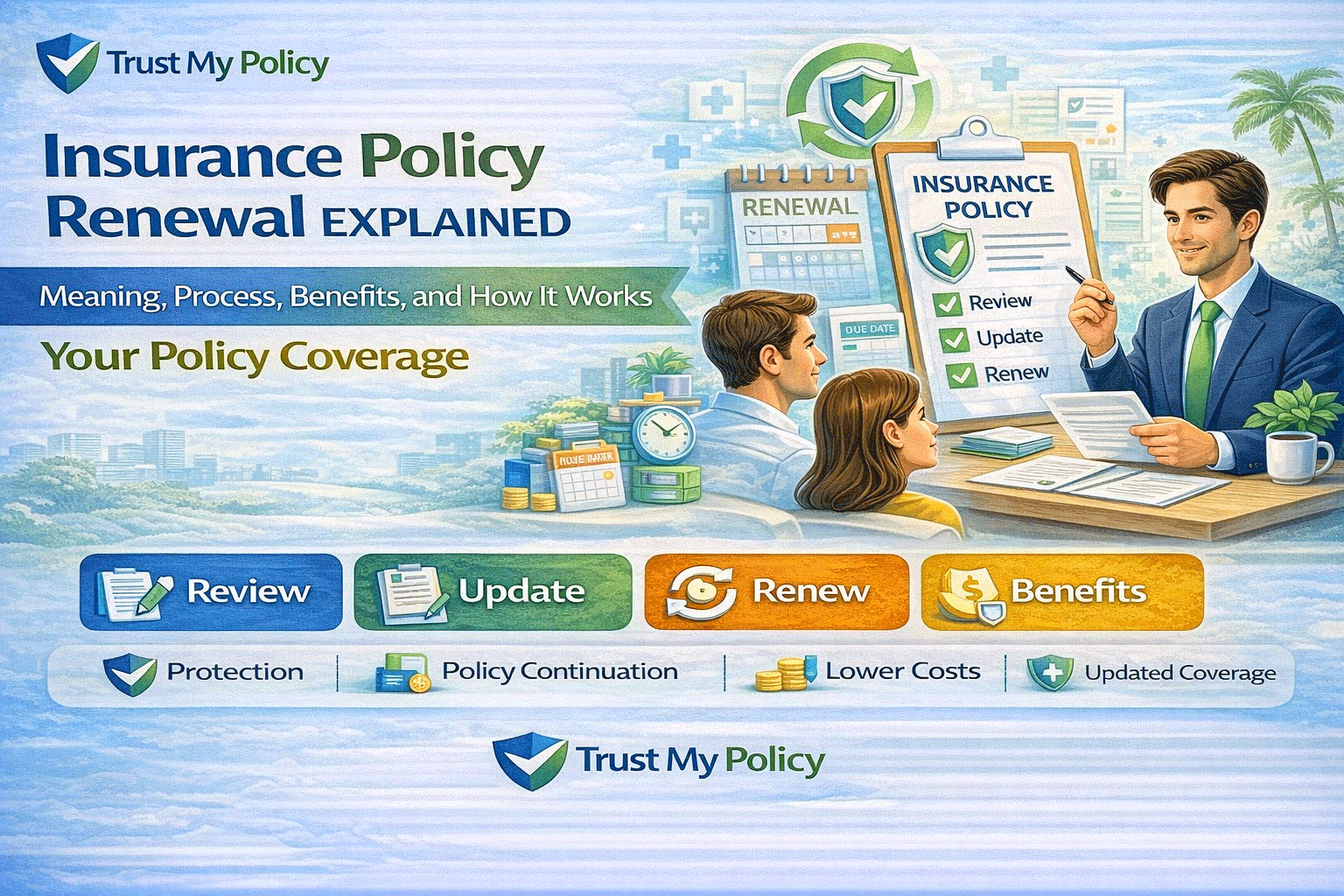
Insurance policy renewal is the process where your insurer offers to continue your coverage for another term, usually with an updated premium based on your current risk factors and broader claims trends. Most policies auto-renew unless cancelled, though insurers can choose not to renew, called a non-renewal, in specific circumstances like excessive claims. Comparing quotes at each renewal can often save 10%–20% versus accepting the renewal price automatically.
Owen Mitchell, 41, let his home insurance auto-renew for six straight years in Phoenix without ever comparing quotes elsewhere. When a friend finally convinced him to shop around, he found an identical policy for $340 less a year from a different insurer — money he’d been quietly overpaying simply by letting renewal happen on autopilot.
Insurance Policy Renewal in 2026 is the process by which your insurer offers to continue your coverage for another term, typically with an updated premium reflecting your current risk factors and broader market trends. Most renewals happen automatically unless you cancel or the insurer chooses not to renew, called a non-renewal. This guide breaks down exactly how renewal works, what can go wrong, and how to make sure you’re not quietly overpaying.
This article covers the renewal process step by step, what triggers a non-renewal, real scenarios showing the financial impact, and a clear framework for handling your next renewal notice. By the end, you’ll know exactly what to check before letting any policy auto-renew again.
| Feature | Details |
| What it is | The process of continuing your insurance coverage for another policy term |
| Who it applies to | Anyone with auto, home, health, or life insurance |
| Typical renewal cycle | 6 or 12 months for auto and home; annual for most health plans |
| What changes at renewal | Premium, sometimes coverage terms, based on updated risk factors |
| Key benefit | An opportunity to reassess coverage and compare pricing |
| Key limitation | Auto-renewal can mean quietly overpaying if you never compare quotes |
| Regulator | State insurance departments (US); Financial Conduct Authority (UK) |
Think of a renewal notice like a subscription service automatically charging your card each year. Unless you actively review it, the price can creep upward without you ever noticing, simply because reviewing it requires an active decision that most people skip.
Insurance policy renewal is the point at which your current policy term ends and your insurer offers to continue coverage for another term, typically with a premium reflecting your updated risk factors and any broader market trends. Most policies are structured to auto-renew unless you cancel, though insurers retain the right to decline renewal under specific circumstances. Anyone holding an ongoing insurance policy needs to understand this cycle, since it’s the recurring opportunity to catch overpayment or reassess coverage.
| Criteria | Auto-Renewing Without Review | Actively Shopping at Renewal |
| Effort required | None, happens automatically | Requires comparing a few quotes |
| Typical cost outcome | Often gradually overpaying over multiple years | Frequently saves 10%–20% compared to the renewal price |
| Coverage review | None, terms simply continue as-is | An opportunity to reassess whether coverage still fits your needs |
| Pros | Convenient, no action required | Can meaningfully reduce your premium and improve coverage fit |
| Cons | Risk of quietly overpaying for years | Takes a bit of time and effort each renewal cycle |
We recommend actively reviewing every renewal notice for most readers, since the convenience of auto-renewal often comes at the cost of paying more than necessary.
Scenario 1: Owen, 41, homeowner in Phoenix. Owen let his home insurance auto-renew for six years before comparing quotes and finding an identical policy for $340 less annually elsewhere. Verdict: prolonged auto-renewal without comparison can mean significant overpayment over time. Action: Owen now sets a calendar reminder to shop quotes 30 days before every renewal.
Scenario 2: A driver in Manchester who received a non-renewal notice after three claims in two years. Her insurer declined to renew her policy, citing the elevated claims frequency in her file. Verdict: insurers can decline renewal under specific risk-based circumstances, not just raise the price. Action: she shopped for a new insurer through a broker who specialized in higher-risk driving profiles.
Scenario 3: A small business owner in Texas whose liability insurer exited the state market entirely. All policyholders, regardless of claims history, received non-renewal notices as the insurer withdrew from offering that coverage type in the state. Verdict: non-renewal isn’t always about your personal risk; sometimes it reflects a broader business decision by the insurer. Action: the owner worked with a broker to quickly secure coverage with a different insurer before his policy lapsed.
Scenario 4: A family in Florida whose health insurance renewal included a significantly higher deductible without clear notice. They almost missed the deductible change buried in their renewal paperwork. Verdict: renewals can include coverage changes beyond just the premium, which are easy to overlook. Action: they now read the full renewal notice each year, not just the premium summary line.
| Pros | Cons |
| Renewal provides a regular, built-in opportunity to reassess your coverage. | Auto-renewal can lead to years of unnoticed overpayment. |
| Comparing quotes at renewal frequently reveals meaningful savings. | Shopping quotes each cycle takes some time and effort. |
| Insurers must typically provide advance notice before a non-renewal. | A non-renewal can leave you needing to find new coverage quickly. |
| Renewal notices can reveal coverage changes you’d otherwise miss. | Coverage terms, not just price, can change without obvious notice. |
| Many insurers offer loyalty discounts that reward long-term renewal. | Loyalty discounts don’t always outweigh switching to a cheaper competitor. |
⚠️ WARNING: Never let a policy lapse while waiting too long to respond to a renewal or non-renewal notice. A coverage gap, even briefly, can leave you fully exposed and can also make it harder to get favorable terms on your next policy.
| Your Situation | Our Recommendation |
| You’ve auto-renewed the same policy for several years without comparing | Yes — get quotes from at least two other insurers this cycle |
| You received a non-renewal notice | Yes — shop immediately with other insurers or a specialty broker to avoid a coverage gap |
| Your renewal notice shows a significantly higher premium | Yes — ask your insurer for a specific explanation before accepting or shopping elsewhere |
| Your renewal includes a coverage change you didn’t expect | Yes — read the full notice and ask questions before the new term begins |
| You’re satisfied with your insurer and renewal price seems fair | No immediate action — but still compare periodically to confirm you’re not falling behind on pricing |
| Your industry or region has seen many insurers exit recently | Yes — start shopping early in case your own renewal is affected |
| You’re unsure why you received a non-renewal | Yes — ask your insurer directly for the specific reason, which they’re often required to disclose |
💡 TIP: The single golden rule for renewals: treat every renewal notice as an active decision point, not a formality, since comparing quotes even once a year can meaningfully reduce what you pay over time.
| Scenario | Cost Impact | Notes |
| Auto-renewing the same home policy for 5+ years without comparing | $200–$500+/year in potential overpayment | Reflects common savings found when finally shopping around |
| Comparing quotes at every renewal | 10%–20% potential savings | Common range found by switching to a more competitively priced insurer |
| Non-renewal due to claims frequency | Often a higher premium with a new insurer | Reflects the elevated risk classification following multiple claims |
| Non-renewal due to insurer market exit | Comparable premium with a new insurer, if shopped promptly | Not necessarily tied to your personal risk profile |
| Missing a renewal deadline entirely (lapse) | Full exposure during the gap, plus likely higher future premiums | One of the costliest renewal mistakes possible |
| Loyalty discount from a long-term insurer | 5%–10% discount, varies by insurer | Worth comparing against a fresh competitor quote regardless |
| Bundling at renewal time with the same insurer | 10%–15% combined discount | Often available if adding a second policy type at renewal |
Independent insurance brokers — Brokers can quickly compare renewal pricing against the broader market for your specific situation. Cost range: typically free for the consumer. Best for: anyone wanting an efficient renewal comparison. Rating: varies by broker, check state or FCA licensing.
Policygenius (US) and Compare the Market (UK) — Comparison platforms that let you check renewal pricing against multiple other insurers quickly. Cost range: free to use. Best for: shoppers wanting a fast renewal-time comparison. Rating: independent comparison services.
Your state insurance department (US) — Can clarify your rights regarding non-renewal notices and required disclosure timelines. Cost range: free to contact. Best for: US policyholders who received a non-renewal and want to understand their rights. Rating: government regulatory body.
Financial Conduct Authority (UK) — Sets standards for how UK insurers must communicate renewal pricing and changes to existing customers. Cost range: free to consult guidance. Best for: UK consumers wanting to understand renewal disclosure rules. Rating: government regulatory body.
NAIC consumer resources (US) — Publishes plain-language guidance on renewal and non-renewal rules across US states. Cost range: free public resource. Best for: US consumers researching their renewal rights. Rating: regulatory standards body.
We recommend an independent broker as best overall because a quick comparison at every renewal is the most reliable way to confirm you’re not quietly overpaying.
Insurance policy renewal is the process where your insurer offers to continue your coverage for another term, typically with an updated premium based on your current risk factors and broader market trends.
Most do, unless you actively cancel or the insurer issues a non-renewal, though it’s worth confirming your specific policy’s renewal terms.
A non-renewal is when an insurer chooses not to continue your coverage at the end of a term, often due to excessive claims, increased risk, or the insurer exiting a specific market.
Yes, in most cases. Comparing quotes at renewal frequently reveals savings of 10%–20% compared to simply accepting the renewal price.
Yes. Renewals can include changes to deductibles, coverage limits, or exclusions, so it’s important to read the full notice, not just the premium line.
Shop promptly with other insurers or a specialty broker to avoid a coverage gap, and ask your current insurer for the specific reason behind the non-renewal.
No. While some insurers offer loyalty discounts, new customers sometimes receive better introductory pricing, so it’s worth comparing regardless of tenure.
This varies by state and country, but many regulators require a minimum advance notice period, often 30–60 days, before a non-renewal takes effect.
You risk a coverage gap with full financial exposure during that period, and reapplying after a lapse can result in higher future premiums.
Sometimes. It’s worth calling your insurer directly, especially if you have a competing quote, since some insurers will adjust pricing to retain a customer.
This article is for informational purposes only. Always consult a licensed insurance professional before making coverage decisions. Trust My Policy does not sell insurance products or represent any insurer.

Jagadeesh Gutha is the founder of TrustMyPolicy.com, an independent insurance information platform covering life, health, car, home, and business insurance for US and UK readers. He researches insurance products, policy structures, and consumer rights to help everyday people make informed coverage decisions without the jargon. All content on TrustMyPolicy is independently researched, fact-checked, and written to educate — not to sell.


Insurance Guides for UK, USA & Worldwide We are not an insurer or broker.
Reader Comments (0)