

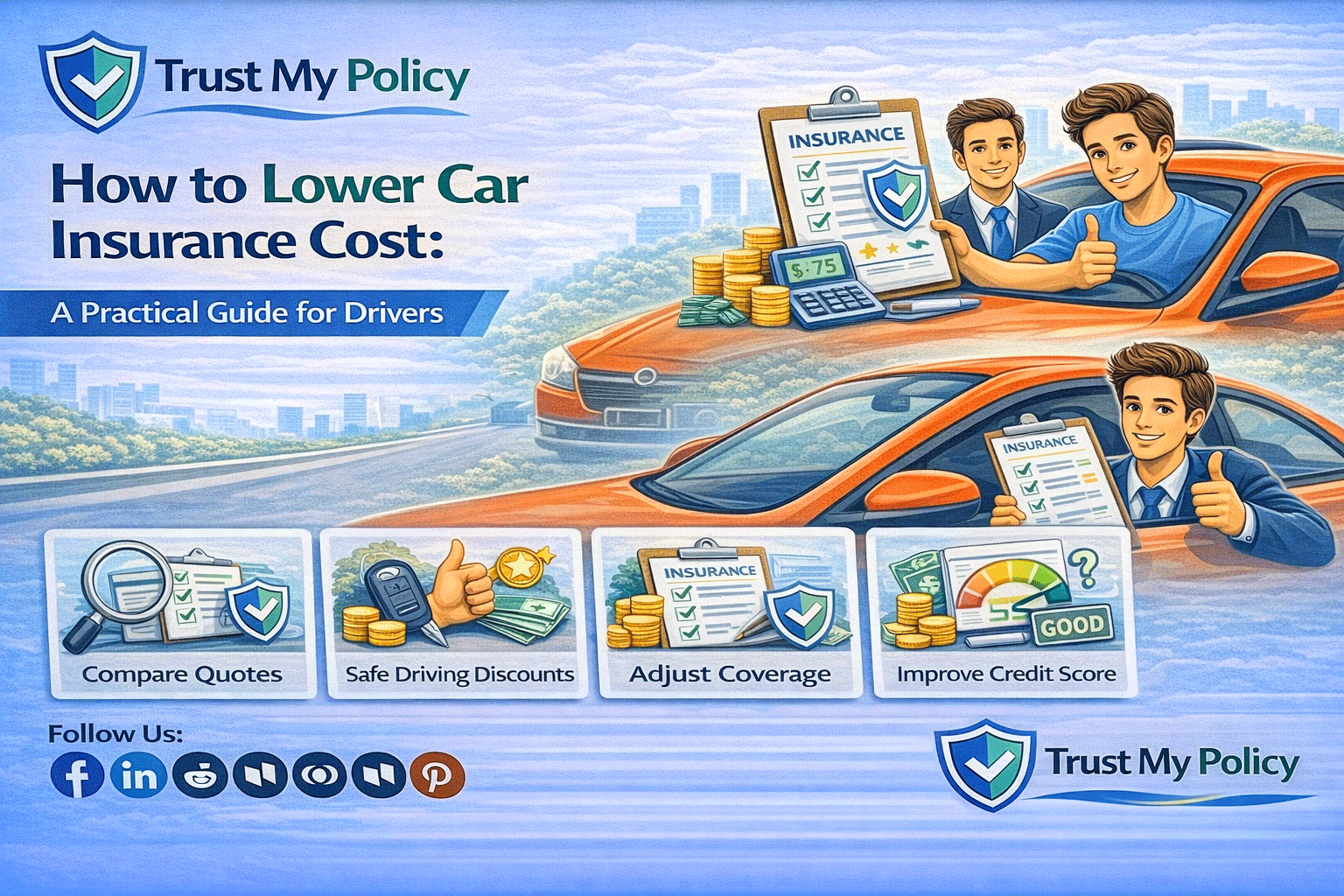
To lower your car insurance cost, compare quotes from at least three insurers at every renewal, stack all eligible discounts (bundling, telematics, good student, loyalty), raise your deductible to the highest amount you can comfortably pay, remove coverage that exceeds your car’s current value, and enrol in a telematics programme if you’re a consistently safe driver. Together, these actions can cut a premium by 25%–45% compared to passively auto-renewing.
Table of Contents
ToggleHow to Lower Car Insurance Cost
Karen Osei, 44, had paid the same auto insurer for nine years and assumed her loyalty was reflected in her rate. When she finally compared three quotes, she found one offering identical coverage for $61 less a month. She hadn’t done anything wrong — she’d simply never taken the 20 minutes to look.
How to Lower Car Insurance Cost in 2026 comes down to six specific, actionable levers: switching insurers when a better rate exists, stacking every eligible discount, raising your deductible to the highest amount you can afford in cash, removing coverage that no longer matches your car’s value, enrolling in a telematics programme if you’re a safe driver, and maintaining a clean record and continuous coverage over time. This guide gives you each lever with specific numbers and the realistic savings each one delivers.
This article covers every proven cost-reduction tactic with dollar figures, a comparison of which levers deliver the most savings, real scenarios, and a clear action checklist. By the end, you’ll know exactly which actions to take before your next renewal.
Quick Summary Table
| Feature | Details |
| What it is | A set of specific, actionable levers for reducing your auto insurance premium |
| Who it applies to | Any driver currently paying for car insurance |
| Typical combined savings potential | 25%–45% compared to passive auto-renewal |
| Single biggest lever | Comparing and switching insurers at renewal |
| Key benefit | Most tactics require no reduction in coverage quality |
| Key limitation | Some tactics, like a higher deductible, increase out-of-pocket risk if a claim occurs |
| Regulator | State insurance departments (US); Financial Conduct Authority (UK) |
Why Most Drivers Overpay — and What Actually Fixes It
Think of auto insurance renewal like a gym membership that silently increases each year while new members get offered a promotional rate you’ll never see unless you ask. Most insurers price loyalty customers at a higher rate than they’d offer to win the same driver as a new customer. The gap between your renewal price and your competitive rate widens every year you don’t check.
Lowering your car insurance cost requires taking specific, deliberate actions rather than waiting for your insurer to proactively offer a better deal, since most won’t. The six most effective levers — switching, stacking discounts, adjusting your deductible, removing unnecessary coverage, enrolling in telematics, and protecting your record — each produce measurable savings, and stacking several of them together typically compounds those savings significantly.
How to Lower Your Car Insurance Cost — 5 Steps
- Compare at least three quotes every renewal before making any other decision. This single action most consistently reveals the largest available saving for most drivers.
- Audit every discount you might qualify for and actively claim each one. Bundling, telematics, good student, multi-car, and loyalty discounts each require a specific action to receive.
- Raise your deductible to the highest amount you could pay in cash within a week. This single change commonly reduces your premium by 10%–20%.
- Remove collision and comprehensive from any vehicle whose value doesn’t justify the premium. If your car’s value is below roughly three to four times your annual combined premium for those coverages, dropping them is often worth considering.
- Enrol in a telematics programme if your driving habits are consistently safe. Safe, low-mileage drivers frequently earn discounts of 10%–20% through usage-based programmes.
Comparison: Active Cost-Reduction vs. Passive Auto-Renewal
| Criteria | Active Cost-Reduction | Passive Auto-Renewal |
| Typical annual premium | 25%–45% lower than passive | Typically creeps upward year on year |
| Effort required | An hour annually at renewal, plus periodic discount audits | None, but the cost compounds silently |
| Insurer motivation | Competing insurers price aggressively to win your business | Your existing insurer has little incentive to reduce your rate |
| Pros | Consistent, reliable savings over multiple years | No effort, no decision-making needed |
| Cons | Requires setting aside dedicated renewal-comparison time | Routinely leaves significant savings unclaimed |
We recommend active cost-reduction for every driver without exception, since the consistent savings over multiple years far outweigh the modest annual effort required.
4 Real-Life Scenarios
Scenario 1: Karen, 44, driver in Houston. Karen’s nine-year loyalty to the same insurer was costing her $61 a month more than her best available alternative. Verdict: insurer loyalty rarely translates into the most competitive rate. Action: Karen now sets a calendar reminder to compare three quotes every renewal date, regardless of her satisfaction with the current insurer.
Scenario 2: A driver in Leeds who bundled home and auto insurance with one insurer. The bundling discount alone reduced his combined premium by 11%, equivalent to £180 a year, with no change in either policy’s coverage. Verdict: bundling is one of the most reliably available and easily claimed discounts. Action: he reviews the bundled discount annually to confirm it still beats separate policy pricing.
Scenario 3: A 58-year-old safe driver in California who enrolled in a telematics programme. Her low-mileage, smooth-braking driving style earned her a 17% telematics discount within her first review period. Verdict: experienced, low-mileage drivers are often the biggest beneficiaries of telematics programmes. Action: she now considers telematics enrolment a standard part of any new policy evaluation.
Scenario 4: A driver in Florida who removed collision and comprehensive from a car worth $3,200. His annual collision and comprehensive premium for that car was $890, meaning he was paying 28% of the car’s total value annually for coverage that would pay out at most $3,200 minus a $1,000 deductible. Verdict: removing physical damage coverage from low-value vehicles is often sound financial logic. Action: he now assesses his car’s current value against his physical damage premium at every renewal.
Pros & Cons of Each Cost-Reduction Lever
| Pros | Cons |
| Comparing insurers annually consistently reveals the largest savings available. | Switching insurers takes more effort than auto-renewing. |
| Telematics programmes reward safe drivers directly with real-time pricing. | Telematics requires ongoing data sharing and penalises certain driving patterns. |
| Raising the deductible produces an immediate, predictable premium reduction. | A higher deductible increases your financial exposure if a claim occurs. |
| Removing unnecessary coverage is free to implement and saves immediately. | Removing coverage creates real risk if the car is damaged and uninsured for that loss. |
| Bundling discounts are widely available and easy to claim with one question. | Bundled pricing should still be compared against separate best-available quotes annually. |
5 Common Mistakes People Make
- Auto-renewing without comparing at least three quotes. This happens because renewal is designed to be frictionless and effortless. What to do instead: block 45 minutes in your calendar specifically for renewal comparison every year.
- Not asking their insurer for a complete discount eligibility list. This happens because insurers don’t always proactively volunteer every discount you might qualify for. What to do instead: call or message your insurer and ask directly for a full list of available discounts and your eligibility for each.
- Keeping collision and comprehensive on a low-value car indefinitely. This happens because dropping coverage feels risky even when the maths doesn’t support keeping it. What to do instead: calculate your car’s current value versus your annual physical damage premium and deductible at every renewal.
- Choosing a deductible without doing the cash-available calculation. This happens because the premium saving looks compelling without fully thinking through the worst-case out-of-pocket cost. What to do instead: only raise your deductible to an amount you could genuinely pay in cash within a few days.
- Not considering telematics because of data-sharing concerns. This happens because privacy concerns outweigh the potential saving in some drivers’ minds without their actually evaluating the specific discount on offer. What to do instead: get the specific discount range available for your profile before deciding whether the trade-off is worth it.
⚠️ WARNING: Never remove liability coverage to save money. While removing or reducing physical damage coverage can sometimes be financially justified for low-value vehicles, liability coverage protects you against claims that can run to hundreds of thousands of dollars, and no premium saving justifies removing it.
Decision Table: Which Levers Should You Pull?
| Your Situation | Our Recommendation |
| You haven’t compared quotes in over a year | Yes — compare at least three quotes before your next renewal |
| You haven’t checked your discount eligibility recently | Yes — ask your insurer directly for a full discount list |
| You have a savings cushion of over $1,000 | Yes — consider raising your deductible to reduce your premium |
| Your car is worth less than $4,000–$5,000 | Yes — calculate whether collision and comprehensive still justify their cost |
| You’re a consistently safe, low-mileage driver | Yes — enrol in a telematics programme |
| You have home and auto policies with different insurers | Yes — ask about a bundling discount with one insurer |
| You’re considering removing liability coverage | No — this is the one coverage that should never be reduced to save money |
💡 TIP: The single golden rule for lowering your car insurance cost: compare at least three quotes at every renewal — this single habit consistently delivers the largest available saving, no matter how many other tactics you also use.
Cost Table: What Each Lever Actually Saves
| Tactic | Typical Annual Saving | Notes |
| Switching insurers at renewal | $300–$800 | Most variable, most impactful single action |
| Bundling home and auto with one insurer | $100–$300 | Widely available, easy to claim |
| Raising deductible from $500 to $1,000 | $150–$300 | Immediate, predictable saving |
| Enrolling in a telematics programme (safe driver) | $100–$400 | Varies by insurer and individual driving behaviour |
| Good student discount (qualifying GPA) | $80–$250 | Requires annual GPA verification |
| Removing collision/comprehensive from a low-value car | $400–$900 | Eliminates the entire physical damage premium component |
| Maintaining continuous coverage (no lapse) | $100–$500 | Prevents the rate penalty applied to lapsed policies |
Resources for Lowering Your Car Insurance Cost
Policygenius and The Zebra (US) — Comparison platforms showing real quotes from multiple insurers side by side. Cost range: free to use. Best for: US drivers wanting the fastest multi-insurer comparison. Rating: independent comparison services.
Compare the Market and Confused.com (UK) — UK comparison sites covering auto insurance quotes from multiple providers, including telematics options. Cost range: free to use. Best for: UK drivers comparing standard and telematics policies at the same time. Rating: FCA-regulated comparison services.
Your insurer’s discount portal or app — Most US and UK insurers list available discounts in their customer portal or app, often with an eligibility checker. Cost range: free. Best for: quickly auditing every discount you might qualify for with your current insurer. Rating: not applicable, primary service channel.
Independent insurance brokers — Brokers can compare both pricing and discount stacking opportunities across multiple insurers simultaneously. Cost range: typically free for the consumer. Best for: anyone wanting a comprehensive review of all available savings levers. Rating: varies by broker, check state or FCA licensing.
We recommend starting with a comparison platform as best overall because the competitive quote comparison is consistently the single most impactful first step, and these platforms make it the easiest it’s ever been.
Frequently Asked Questions
How can I lower my car insurance cost?
Compare at least three quotes at renewal, stack all eligible discounts, raise your deductible to the maximum you can afford in cash, remove unnecessary physical damage coverage from low-value cars, and enrol in telematics if you’re a safe driver.
What is the single most effective way to lower car insurance?
Comparing and switching insurers at renewal consistently delivers the largest available saving, since competing insurers offer new-customer pricing your existing insurer rarely matches proactively.
Does raising my deductible really save money?
Yes. Raising your deductible from $500 to $1,000 typically saves $150–$300 annually, though it increases your out-of-pocket cost if you file a claim.
Should I remove collision coverage from an older car?
It depends on your car’s value versus the annual premium cost. If your car is worth significantly less than several years of combined collision and comprehensive premiums plus your deductible, removing it is often financially justified.
Do telematics programmes actually save money?
Yes, for consistently safe, low-mileage drivers. Discounts typically range from 10%–20%, with some insurers offering higher savings for exceptional driving data.
Will bundling home and auto insurance always save money?
Usually, though not always. It’s still worth comparing the bundled price against separate best-available quotes to confirm the bundle is genuinely the better deal.
What happens if I let my coverage lapse to save money?
A lapse in coverage signals higher risk to insurers, typically resulting in a significantly higher premium when you reapply, which costs more than the short-term saving.
Can I negotiate my car insurance premium directly with my insurer?
You can ask about available discounts and better pricing, and some insurers will match a competitor’s quote for existing customers, though there’s no formal negotiation process as such.
How much can I realistically save by combining these tactics?
Combining comparison shopping, discount stacking, and a deductible adjustment can produce total savings of 25%–45% compared to simply accepting a renewal notice.
Is it worth switching insurers mid-term to get a better price?
Sometimes. Check whether your current insurer charges a cancellation fee and whether the mid-term saving justifies it, versus simply switching at your next renewal date.
Key Takeaways
- Compare at least three quotes at every renewal rather than auto-renewing.
- Ask your insurer for a full discount eligibility list and actively claim each one you qualify for.
- Raise your deductible to the highest amount you could comfortably pay in cash within a few days.
- Assess your car’s current value against your physical damage premium at every renewal.
- Enrol in a telematics programme if you’re a consistently safe and low-mileage driver.
- Bundle home and auto insurance with one insurer if the bundled price genuinely beats separate quotes.
- Never remove liability coverage — it’s the one protection that should never be compromised to save money.
This article is for informational purposes only. Always consult a licensed insurance professional before making coverage decisions. Trust My Policy does not sell insurance products or represent any insurer.



Reader Comments (1)
[…] since new drivers face the highest base rates and telematics is the most effective tool for lowering them. In the UK, dedicated young driver telematics policies routinely cost 20%–35% less than […]