
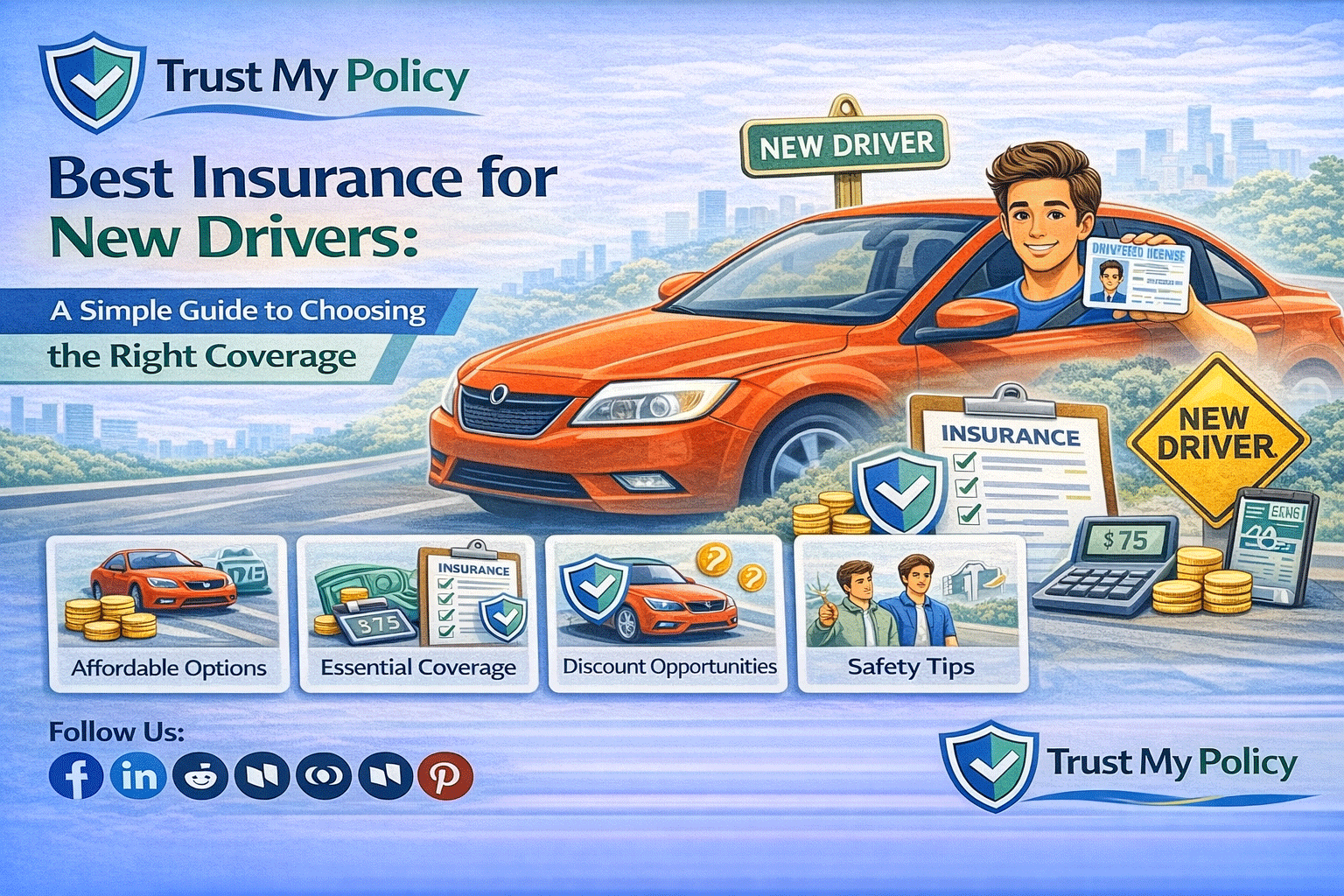
The best insurance for new drivers is typically a telematics policy, which tracks your driving behaviour and rewards safe habits with discounts, since new drivers face the highest base rates and telematics is the most effective tool for lowering them. In the UK, dedicated young driver telematics policies routinely cost 20%–35% less than equivalent standard policies. In the US, adding a young driver to a family policy with a telematics programme is usually the cheapest starting point.
Ethan Cole, 17, passed his driving test in Manchester last autumn and his parents assumed adding him to their existing policy would be the cheapest option. Their insurer quoted an additional £1,840 a year, while a specialist young driver insurer offered Ethan a telematics policy for £1,120 — a £720 annual saving that came from one comparison call they nearly didn’t make.
Best Insurance for New Drivers in 2026 almost always means a telematics (black box) policy for younger drivers in the UK, or a usage-based telematics program from a mainstream US insurer, since both reward provably safe driving with discounts that static pricing can’t match. The right provider depends on whether you’re a US teen on a family policy or a newly licensed UK driver buying independently. This guide breaks down the best options, real costs, and the specific discounts that matter most at this stage.
This article covers the best policy types for new drivers, which discounts actually move the needle, real scenarios with specific numbers, and the providers consistently most competitive for beginners. By the end, you’ll know exactly where to get the best price without sacrificing the cover you actually need.
| Feature | Details |
| What it is | Auto insurance specifically priced or structured for newly licensed drivers |
| Who needs it | Drivers within their first 1–3 years of holding a licence |
| Cheapest starting point | Telematics policy (UK) or family policy with telematics add-on (US) |
| Typical UK cost | £800–£2,500/year depending on age, car, and location |
| Typical US cost | $150–$400/month on a family policy; higher as a sole named driver |
| Key discounts | Telematics, good student, driver training, multi-policy bundling |
| Regulator | State insurance departments (US); Financial Conduct Authority (UK) |
Think of a new driver’s insurance premium like the price of a hotel room for a first-time booking with no review history. The hotel can’t verify you’ll leave the room in good condition, so they charge a higher rate until your track record speaks for itself. Insurance underwriters price new drivers the same way: no claims history, no track record, so statistical data for the age group sets the price instead. Telematics changes this by creating your personal track record in real time, letting your actual driving behaviour lower your rate faster than simply waiting another year.
New driver insurance is expensive because statistical claims data for young or newly licensed drivers shows significantly higher accident frequency and severity than experienced drivers. The most effective tools for reducing this premium are telematics policies, which replace group statistical pricing with individual driving behaviour data, combined with specific discounts like good student reductions and driver training courses that signal lower risk. Anyone insuring a new driver needs to understand both why the price is high and specifically what moves it lower.
| Criteria | Telematics Policy | Standard Policy |
| Cost | Often 20%–35% lower for safe drivers | Full statistical group rate, often the highest available |
| Pricing basis | Your individual driving behaviour (braking, speed, time of day) | Statistical average for your age and risk group |
| Best for | New drivers willing to share driving data to prove their safety | Drivers who prefer no tracking or who drive at higher-risk times |
| Pros | Fastest path to meaningful premium reduction for a new driver | No data sharing required, complete freedom over driving patterns |
| Cons | Penalises late-night driving and hard braking regardless of circumstances | Pays the full age-group statistical rate with no way to reduce it through safe behaviour |
We recommend telematics policies for most new drivers because individually demonstrated safe driving is the single most effective tool for reducing the premium beyond the statistical group rate.
Scenario 1: Ethan, 17, new driver in Manchester. Ethan’s parents’ insurer quoted an additional £1,840 a year to add him; a specialist young driver telematics insurer offered £1,120. Verdict: comparing specialist young driver insurers against existing policy add-on quotes routinely reveals significant savings. Action: Ethan took the telematics policy, improved his score within three months, and saw a mid-year premium reduction.
Scenario 2: Caitlin, 19, new driver in Texas on her parents’ family policy. Adding Caitlin to her parents’ policy cost $145 a month, compared to a standalone quote of $320 a month for similar coverage as a sole named driver. Verdict: staying on a family policy is typically significantly cheaper for US new drivers than buying independently. Action: Caitlin enrolled in the family policy’s telematics programme specifically to earn an additional discount on her portion of the premium.
Scenario 3: A 22-year-old new driver in London choosing between two cars. Car A (a 1.6-litre hatchback, insurance group 20) quoted £2,100; Car B (a 1.0-litre city car, insurance group 8) quoted £1,340 for an otherwise identical risk profile. Verdict: car choice is one of the single largest pricing levers available to new drivers. Action: she chose Car B specifically with the insurance cost difference in mind.
Scenario 4: A 20-year-old US student maintaining a 3.5 GPA and completing an accredited driver training course. Combined, the good student discount and driver training discount reduced her annual premium by $620 on a standard policy. Verdict: stacking two specific discounts can offset a significant portion of the new driver surcharge. Action: she documents her GPA and training certificate specifically to present at each renewal.
| Pros | Cons |
| Demonstrates individual safe driving rather than paying the full group statistical rate. | Penalises driving late at night, which is statistically higher-risk but sometimes unavoidable. |
| Can produce mid-term premium reductions in the UK, not just at renewal. | Requires ongoing data sharing, which some drivers find intrusive. |
| Builds a documented safe driving record that benefits future renewals. | A poor telematics score can raise rather than lower your premium in some programmes. |
| Often the most competitive policy type for new drivers with no prior claims history. | Requires discipline about driving patterns, especially in the first few months. |
| Specialist young driver insurers offer features like curfew waivers for emergencies. | Not all telematics programmes are equally transparent about how scoring works. |
⚠️ WARNING: Never choose a car based on what you love driving and then look up the insurance cost afterward. For new drivers, the insurance group of the vehicle is one of the most powerful determinants of your premium, and the wrong car choice can add hundreds of pounds or dollars a year to your cost regardless of any other discount.
| Your Situation | Our Recommendation |
| You’re a UK new driver under 25 | Yes — compare telematics specialist insurers before standard market quotes |
| You’re a US new driver on your parents’ policy | Yes — add a telematics programme on the family policy for an additional discount |
| You’re a US new driver buying independently | Yes — compare both family policy add-on and standalone quotes before deciding |
| You’re a student maintaining a qualifying GPA | Yes — ask your insurer directly about the good student discount |
| You haven’t completed a driver training course yet | Yes — consider an accredited course specifically for the insurance discount |
| You’re choosing between two cars with different insurance groups | Yes — get quotes for both before finalising the car purchase |
| You’ve had your licence for a year with no claims | Yes — re-shop your renewal rather than auto-continuing |
💡 TIP: The single golden rule for new driver insurance: get your insurance quote before you finalise your car purchase, not after, since the car you choose is one of the largest levers you have over your starting premium.
| Scenario | Typical Cost | Notes |
| UK new driver, age 17, standard policy, mid-range car | £1,800–£3,000/year | Full statistical group rate, no telematics discount |
| UK new driver, age 17, telematics policy, same car | £1,100–£2,000/year | Reflects typical telematics discount for safe driving |
| UK new driver, age 17, lower insurance group car | £900–£1,600/year | Combined effect of telematics and lower-risk vehicle |
| US teen added to family policy, no telematics | $120–$200/month additional | Varies significantly by state and existing policy |
| US teen added to family policy, with telematics | $90–$160/month additional | Reflects typical telematics programme discount |
| US new driver buying standalone policy | $250–$450/month | Significantly more expensive than family policy addition |
| Good student discount applied (US) | 5%–15% premium reduction | Requires qualifying GPA and enrolment verification |
Marmalade (UK) — A specialist young driver insurer offering telematics policies specifically designed for new and learner drivers, with mid-term premium adjustments for good driving. Cost range: competitive young driver telematics pricing. Best for: UK new drivers wanting a specialist-designed telematics product. Rating: Defaqto 4-5 Star.
Hastings Direct (UK) — A major UK insurer with competitive young driver telematics offerings and clear scoring transparency. Cost range: competitive UK telematics pricing. Best for: UK new drivers wanting a well-known mainstream brand with telematics. Rating: Defaqto 4 Star.
Progressive (US) — Offers the Snapshot telematics programme with meaningful discounts for safe driving, well suited to new drivers on a family policy. Cost range: competitive US pricing. Best for: US new drivers wanting a transparent telematics programme. Rating: AM Best A+.
State Farm (US) — Offers the Steer Clear programme specifically for drivers under 25, combining safe driving monitoring with a discount on completion. Cost range: competitive US pricing. Best for: US new drivers wanting a completion-based training and discount structure. Rating: AM Best A++.
GEICO (US) — Competitive pricing for adding young drivers to family policies, with good student discounts clearly advertised. Cost range: competitive US family policy pricing. Best for: US families wanting straightforward good student discount application. Rating: AM Best A++.
We recommend Marmalade for UK new drivers and Progressive for US new drivers as best overall because both offer the clearest telematics programmes specifically designed to reward the safe driving behaviour new drivers can control.
A telematics policy is typically the best starting point for new drivers, since it replaces expensive group statistical pricing with individual driving behaviour data, producing meaningful discounts for safe drivers.
In the UK, new driver premiums typically range from £900 to £3,000 a year depending on age, car, and location. In the US, adding a new driver to a family policy typically adds $90–$200 a month.
Yes, in almost every case, since telematics is the single most effective tool for reducing the statistical group rate that new drivers are otherwise charged.
Usually yes. Adding a new driver to a family policy is typically significantly cheaper than buying a standalone policy, and staying on the family policy also benefits from any multi-driver discounts.
Most US insurers offer a 5%–15% premium reduction for students who maintain a qualifying GPA, typically B average or better, which can meaningfully offset the new driver surcharge.
Yes, in many cases. An accredited driver training course can qualify you for a specific discount with many US and UK insurers, and is worth completing for the premium benefit alone.
Significantly. Lower-powered, lower-value cars in lower insurance groups carry materially cheaper premiums, and choosing the right car is one of the most powerful pricing levers available before you even start comparing quotes.
Yes. A year of claims-free driving meaningfully improves your competitive position, and re-shopping each renewal rather than auto-continuing is one of the most reliable ongoing savings habits.
A telematics policy from a specialist young driver insurer is typically cheapest in the UK; in the US, a family policy add-on with a telematics programme is typically cheapest.
Yes, but the premium will be significantly higher. Choosing a lower insurance group car is one of the clearest cost-reduction steps available at this stage.
This article is for informational purposes only. Always consult a licensed insurance professional before making coverage decisions. Trust My Policy does not sell insurance products or represent any insurer.

Jagadeesh Gutha is the founder of TrustMyPolicy.com, an independent insurance information platform covering life, health, car, home, and business insurance for US and UK readers. He researches insurance products, policy structures, and consumer rights to help everyday people make informed coverage decisions without the jargon. All content on TrustMyPolicy is independently researched, fact-checked, and written to educate — not to sell.



Insurance Guides for UK, USA & Worldwide We are not an insurer or broker.
Reader Comments (1)
[…] higher accident rates for this age group. The most effective cost-reduction tactics are telematics (black box) policies, being added as a named driver on a parent’s policy first, choosing a […]