
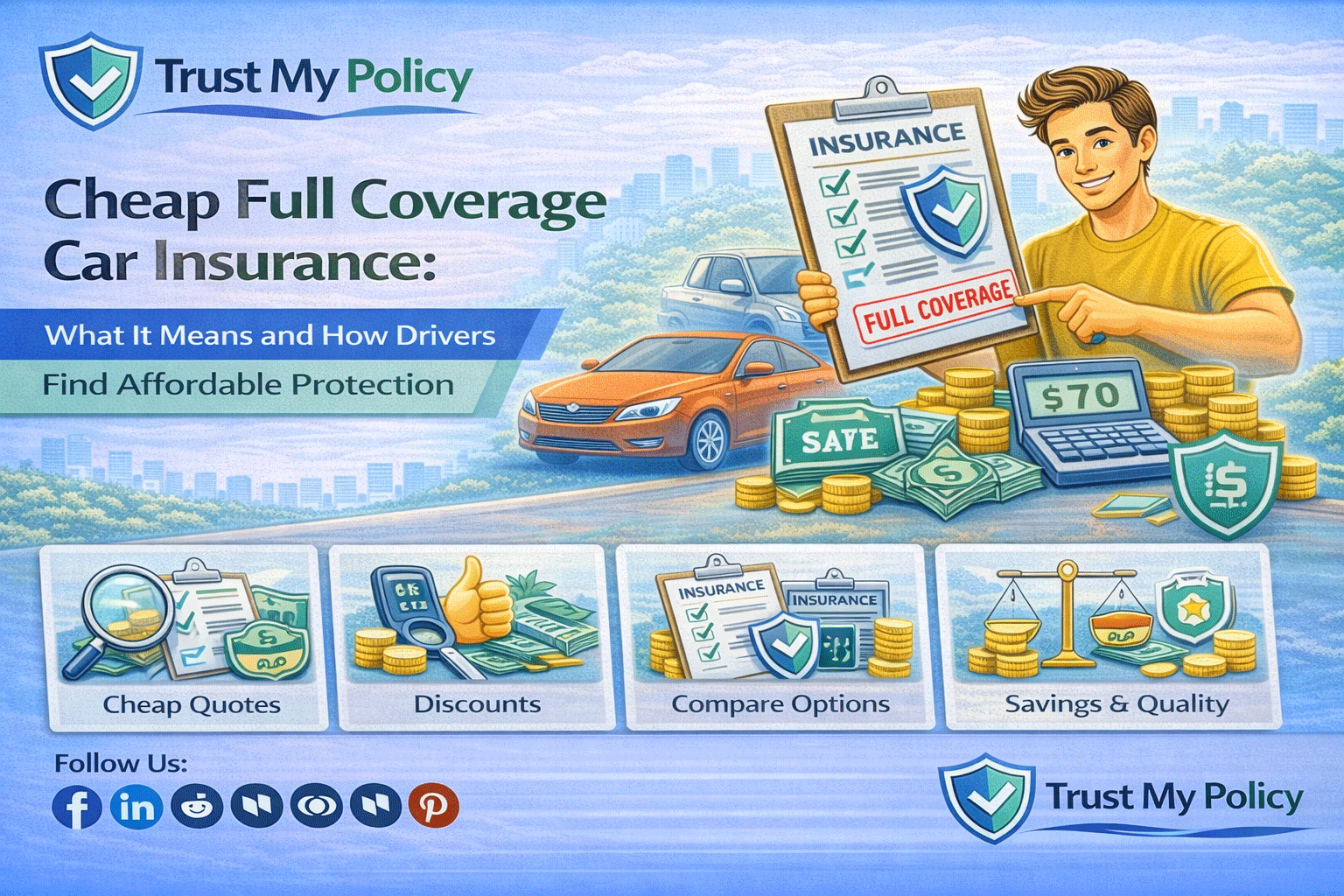
Cheap full coverage car insurance combines liability, collision, and comprehensive coverage at the lowest available price, typically $100–$180 a month for a clean-record driver in the US. The most reliable ways to lower it are choosing a higher deductible, bundling with home or renters insurance, enrolling in a telematics programme, and shopping at least three insurers at every renewal rather than auto-renewing.
Diane Cho, 31, assumed full coverage car insurance would always be significantly more expensive than liability-only, until her broker showed her that choosing a higher deductible, bundling with renters insurance, and switching to a telematics-friendly insurer brought her full coverage premium to just $12 more per month than her old liability-only rate at a different company.
Cheap Full Coverage Car Insurance in 2026 means combining collision and comprehensive coverage with liability at the lowest realistic total cost — which almost always requires actively stacking discounts, choosing the right deductible, and comparing at least three insurers rather than renewing automatically. Most drivers pay significantly more than necessary for full coverage simply by not shopping around. This guide breaks down exactly how to get genuinely low-cost full coverage without sacrificing the protection that makes it worth having.
This article covers what full coverage actually includes, which tactics lower its cost most effectively, the providers most competitive on full coverage pricing, and real scenarios with specific numbers. By the end, you’ll know exactly how to cut your full coverage bill without cutting your protection.
| Feature | Details |
| What it is | Liability, collision, and comprehensive coverage combined at the lowest available price |
| Who needs it | Anyone with a financed or leased vehicle, or a higher-value car they couldn’t replace out of pocket |
| Typical cost | $100–$180/month for a clean-record driver in the US; £500–£900/year in the UK |
| Key cost levers | Higher deductible, bundling discounts, telematics programme, multi-insurer shopping |
| Key benefit | Full protection for your own vehicle at a genuinely competitive price |
| Key limitation | Full coverage always costs more than liability-only; the goal is minimising that gap |
| Regulator | State insurance departments (US); Financial Conduct Authority (UK) |
Think of full coverage like a comprehensive gym membership versus a basic one. The basic membership (liability-only) covers what happens to other people if you cause a problem, but nothing for you. Full coverage adds protection for your own body — your car — meaning the insurer has to price in a much broader set of potential payouts.
Full coverage car insurance is not a single policy type but a combination of three coverage components: liability insurance, which covers damage or injury you cause to others; collision insurance, which covers damage to your own car from an accident; and comprehensive insurance, which covers non-collision events like theft, fire, hail, or vandalism. The additional cost of full coverage over liability-only reflects the insurer’s added exposure across these two extra components. Most drivers pay more than necessary for this combination simply because they never actively compare prices or apply available discounts systematically.
| Criteria | Auto-Renewing Without Shopping | Actively Shopping 3+ Insurers |
| Typical outcome | Premium often rises 5%–15% each year | Frequently reveals 10%–30% lower rate elsewhere |
| Effort required | None | A modest time investment at each renewal |
| Insurer incentive | None to proactively offer existing customers their best rate | Competing insurers price aggressively to win new customers |
| Pros | Convenient | Consistently the most reliable way to lower full coverage cost |
| Cons | Leaves real savings unclaimed year after year | Requires setting aside time before each renewal date |
We recommend active comparison shopping at every renewal for most readers, since this single habit consistently produces the largest full coverage savings available.
Scenario 1: Diane, 31, driver in Seattle. By raising her deductible, bundling with renters insurance, and switching insurers, Diane brought her full coverage premium to just $12 more per month than her old liability-only rate at a different company. Verdict: stacking multiple tactics together can make full coverage surprisingly affordable. Action: Diane now shops three insurers every renewal as a standing habit.
Scenario 2: A 45-year-old driver in Manchester switching to a telematics-based fully comprehensive policy. His tracked safe driving earned him a 14% discount on his comprehensive premium within six months. Verdict: telematics programmes can meaningfully reward safe driving behaviour even on full UK comprehensive policies. Action: he kept the programme active to maintain the ongoing discount.
Scenario 3: A family in Texas bundling home and two auto full coverage policies with a single insurer. The multi-policy bundling discount reduced their combined annual spend by $430 compared to three separate policies at different companies. Verdict: bundling multiple policies is one of the most reliably available full coverage discounts. Action: the family reviews their bundled pricing annually to confirm it still beats separate policy pricing.
Scenario 4: A 26-year-old driver in Ohio with a financed car and a $250 deductible. Raising the deductible to $1,000 saved $28 a month while she kept the equivalent savings in a dedicated emergency fund. Verdict: a higher deductible paired with a savings buffer is one of the most cost-efficient full coverage strategies. Action: she plans to drop collision coverage entirely once her loan is paid off and her car’s value drops below $5,000.
| Pros | Cons |
| Protects your own vehicle from accidents, theft, weather, and other non-collision events. | Always costs more than liability-only coverage; the goal is minimising that gap. |
| Required by most lenders and leasing companies until a vehicle loan is paid off. | Keeping full coverage on a low-value, older car can cost more annually than the car is worth. |
| Comprehensive component covers theft and weather events liability-only never would. | Savings from discounts vary widely by driver profile, location, and insurer. |
| Multiple tactics combined can close the gap significantly compared to liability-only. | Telematics programmes require ongoing data sharing, which not everyone prefers. |
| Switching insurers at renewal often produces the largest single savings opportunity. | Filing small claims near the deductible can raise premiums more than the claim is worth. |
⚠️ WARNING: Never drop full coverage on a financed or leased vehicle to save money. Most auto loans and leases require collision and comprehensive coverage as a contractual condition, and driving without it could put you in breach of your loan agreement in addition to leaving you unprotected.
| Your Situation | Our Recommendation |
| You haven’t compared insurers in over a year | Yes — get at least three comparison quotes before your next renewal |
| You have a $250–$500 deductible and a strong savings cushion | Yes — consider raising it to $1,000 to lower your monthly premium |
| You have home or renters insurance with a different insurer | Yes — ask about bundling both with one insurer for a multi-policy discount |
| You’re a consistently safe, low-mileage driver | Yes — consider a telematics or usage-based programme |
| Your car’s value is below $5,000–$6,000 and your loan is paid off | Yes — reassess whether collision and comprehensive still make financial sense |
| Your lender still requires full coverage | No — don’t drop it; focus instead on lowering the cost through discounts and deductibles |
| You’ve never asked your insurer about available discounts | Yes — request a full list and check your eligibility for each one |
💡 TIP: The single golden rule for cheap full coverage: compare at least three insurers at every renewal, since this one habit consistently produces the largest available savings on full coverage car insurance.
| Scenario | Typical Monthly Cost | Notes |
| Full coverage, clean-record driver, age 35, $500 deductible | $120–$160/month | Standard baseline full coverage for a moderate-risk profile |
| Same driver, deductible raised to $1,000 | $100–$135/month | Saves $15–$30/month with no change to coverage scope |
| Same driver, telematics discount applied (safe driver) | $100–$130/month | Additional 5%–15% reduction based on tracked driving behaviour |
| Same driver, bundled with home insurance | $95–$125/month | 8%–15% multi-policy discount applied to the auto portion |
| All three tactics combined | $85–$115/month | Stacked savings can bring full coverage close to liability-only rates |
| UK fully comprehensive, clean-record driver, age 35 | £500–£800/year | UK equivalent full coverage baseline |
| Young driver (age 22) full coverage, US | $200–$350/month | Reflects elevated age-based risk classification |
GEICO (US) — Consistently competitive on full coverage pricing with strong digital discount tools and telematics programme options. Cost range: among the lowest nationally for full coverage. Best for: drivers wanting low-cost full coverage with an easy digital experience. Rating: AM Best A++.
Progressive (US) — Offers flexible deductible options and a well-regarded usage-based telematics programme specifically designed for full coverage policyholders. Cost range: competitive, especially for safe drivers enrolled in telematics. Best for: safe drivers wanting to actively lower their full coverage cost. Rating: AM Best A+.
State Farm (US) — Broad availability and strong bundling discounts make it competitive for full coverage policyholders also holding home insurance. Cost range: competitive, especially with multi-policy discounts applied. Best for: drivers wanting to bundle home and auto full coverage with one insurer. Rating: AM Best A++.
Admiral (UK) — Consistently competitive on fully comprehensive car insurance with multi-car discounts and black box telematics options. Cost range: competitive UK fully comprehensive pricing. Best for: UK drivers wanting affordable comprehensive coverage with telematics options. Rating: Defaqto 5 Star.
Aviva (UK) — A major UK insurer offering fully comprehensive policies with strong bundling options alongside home insurance. Cost range: competitive UK pricing. Best for: UK drivers wanting to bundle home and auto comprehensive coverage. Rating: Defaqto 5 Star.
We recommend comparing GEICO and Progressive for US readers and Admiral for UK readers as best starting points, since all three are consistently among the most competitive full coverage options in their respective markets.
It’s liability, collision, and comprehensive coverage combined at the lowest available price for your specific driver profile, achieved through deductible choices, discounts, and active insurer comparison.
A clean-record driver in the US typically pays $100–$180 a month for full coverage, while UK equivalent comprehensive policies often cost £500–£900 a year, both varying significantly by driver profile and location.
Yes, but the gap can be minimised substantially through deductible choices, bundling, telematics programmes, and active comparison shopping.
Choose the highest deductible you could comfortably pay in cash within a few days of an accident, since this is the most direct and predictable way to lower your full coverage premium.
Yes, bundling typically saves 8%–15% on the combined premium, making it one of the most consistently available discounts for full coverage policyholders.
If you’re a consistently safe driver, yes — telematics programmes can reduce full coverage premiums by 5%–20% based on actual tracked driving behaviour.
Consider dropping collision and comprehensive when your car’s market value drops below roughly $5,000–$6,000 and your loan is fully paid off, though never while a lender still requires it.
At every renewal, ideally, since full coverage pricing varies significantly between insurers and competitive rates change year to year.
Not always, but stacking discounts, raising your deductible, bundling, and switching to a more competitive insurer can narrow the gap substantially.
Broadly yes — UK fully comprehensive coverage includes your own vehicle damage alongside third-party liability, the same scope as US full coverage.
This article is for informational purposes only. Always consult a licensed insurance professional before making coverage decisions. Trust My Policy does not sell insurance products or represent any insurer.

Jagadeesh Gutha is the founder of TrustMyPolicy.com, an independent insurance information platform covering life, health, car, home, and business insurance for US and UK readers. He researches insurance products, policy structures, and consumer rights to help everyday people make informed coverage decisions without the jargon. All content on TrustMyPolicy is independently researched, fact-checked, and written to educate — not to sell.



Insurance Guides for UK, USA & Worldwide We are not an insurer or broker.

Reader Comments (0)