
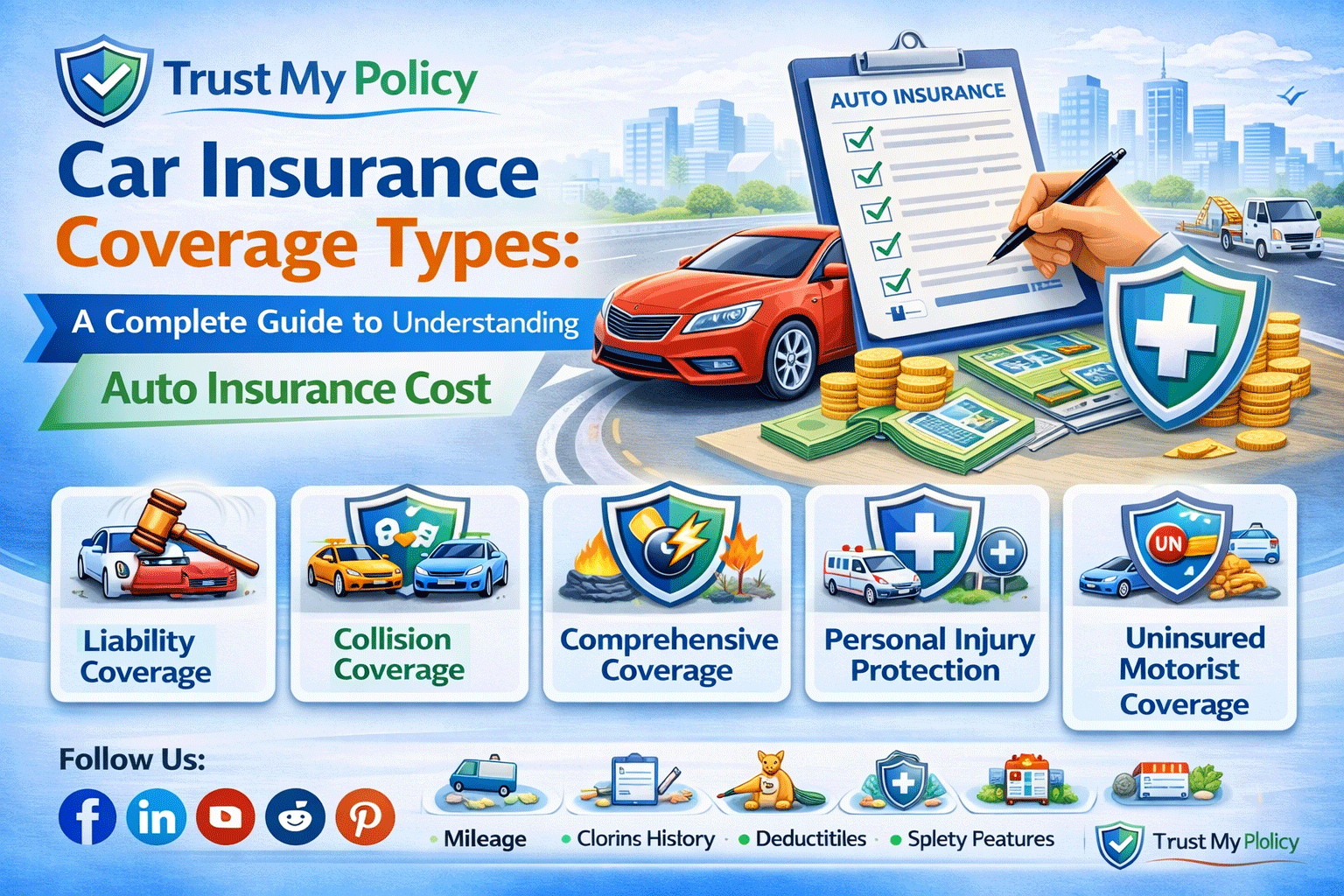
The six main car insurance coverage types are liability (covers damage you cause to others), collision (covers damage to your own car in a crash), comprehensive (covers non-crash damage like theft or weather), uninsured/underinsured motorist (covers you when the at-fault driver lacks adequate insurance), medical payments or personal injury protection (covers medical costs), and gap insurance (covers the difference between your car’s value and what you owe). Liability is legally required almost everywhere; the rest are optional unless required by a lender.
Jamie Tran, 28, chose the cheapest car insurance policy she could find when she bought her first car in Austin, only to discover after a hailstorm that she had no comprehensive coverage and no protection for her own vehicle at all. She’d bought liability-only coverage without fully understanding the difference between the six types of car insurance available to her.
Car Insurance Coverage Types in 2026 fall into six distinct categories: liability, collision, comprehensive, uninsured/underinsured motorist, medical payments or personal injury protection, and gap insurance. Each one covers a different category of risk, and understanding what each does is the difference between a policy that truly protects you and one that leaves you exposed when something actually happens.
This article covers every major car insurance coverage type, what each one pays for, when you need each, real scenarios with costs, and a clear decision framework. By the end, you’ll know exactly which types belong on your policy.
| Feature | Details |
| What it is | Six distinct coverage categories that together make up a full car insurance policy |
| Who needs all six | Drivers with financed vehicles, limited savings, and anyone in uninsured-motorist-prone areas |
| Minimum legal requirement | Liability coverage in nearly every US state and the UK |
| Typical full coverage cost | $100–$250/month combining all relevant types |
| Key benefit | Each type protects against a different, specific category of financial risk |
| Key limitation | Buying only the legal minimum leaves significant personal exposure in many scenarios |
| Regulator | State insurance departments (US); Financial Conduct Authority (UK) |
Think of car insurance coverage types like the different zones of protection on a body armour vest. Each panel covers a different area, and removing any one of them leaves a specific part of you exposed. Buying only liability insurance is like wearing a vest with only the front panel — you’re covered for what you do to others, but completely exposed for what happens to you.
Car insurance is not a single product but a bundle of distinct coverage types, each responding to a different scenario. Liability covers the damage or injury you cause to others. Collision covers your own car after a crash. Comprehensive covers non-collision events like theft or weather. Uninsured and underinsured motorist coverage steps in when the other driver can’t pay. Medical payments or personal injury protection covers your own medical costs. Gap insurance covers the shortfall between your car’s actual cash value and what you still owe on a loan.
| Coverage Type | What It Pays For | Required? | Typical Cost |
| Liability | Injury or property damage you cause to others | Yes, legally required almost everywhere | $40–$90/month |
| Collision | Damage to your own car from any crash | No, but required by most lenders | $15–$40/month |
| Comprehensive | Non-crash damage: theft, weather, animals, vandalism | No, but required by most lenders | $10–$40/month |
| Uninsured/Underinsured Motorist | Your injuries and damage when the at-fault driver lacks adequate insurance | Required in some states | $10–$25/month |
| MedPay / Personal Injury Protection | Your own medical costs regardless of fault | Required in some states (PIP) | $5–$20/month |
| Gap Insurance | The gap between your car’s value and your loan balance if the car is totalled | No, but valuable when loan exceeds car value | $20–$40/month |
We recommend carrying at least the first four coverage types for most readers, since together they address the most statistically common and most financially serious risks drivers face.
Scenario 1: Jamie, 28, driver in Austin. Jamie’s liability-only policy left her with zero payout after a hailstorm dented and shattered her windshield. Verdict: comprehensive coverage specifically addresses this non-crash event, and skipping it left Jamie fully exposed. Action: Jamie added both collision and comprehensive at her next renewal.
Scenario 2: A driver in Manchester hit by an uninsured motorist. Her uninsured motorist coverage paid her repair and medical costs when the at-fault driver had no insurance, since standard liability coverage only pays for damage you cause to others. Verdict: uninsured motorist coverage addresses a gap most drivers never consider until they need it. Action: she confirmed her uninsured motorist limit was adequate for her area’s uninsured driver rate.
Scenario 3: A driver in Houston who totalled a financed car worth $18,000 but still owed $24,000 on the loan. Without gap insurance, he would have received the car’s actual cash value payout but still owed $6,000 to the lender. Verdict: gap insurance specifically closes this common shortfall for financed vehicles. Action: he added gap insurance through his lender before his next vehicle purchase.
Scenario 4: A driver in Leeds involved in a collision requiring medical treatment. Her personal injury protection covered her medical costs regardless of fault, allowing immediate treatment without waiting for a fault determination. Verdict: MedPay and PIP address medical costs that liability coverage alone wouldn’t pay for. Action: she confirmed her PIP limit was sufficient given her area’s average medical costs.
| Pros | Cons |
| Each coverage type protects against a genuinely different category of risk. | Combining all six types adds meaningful cost compared to liability-only coverage. |
| Comprehensive and collision together protect your own vehicle, not just others. | Some types, like gap insurance, are only valuable for a limited time period. |
| Uninsured motorist coverage addresses a risk outside your control. | Coverage needs evolve as your car depreciates and your loan balance decreases. |
| MedPay and PIP provide immediate medical cost coverage regardless of fault. | Many drivers carry minimum liability limits that may be inadequate for serious accidents. |
| Gap insurance prevents a loan shortfall from creating significant out-of-pocket debt. | Reviewing which types you still need requires active attention at each renewal. |
⚠️ WARNING: Never assume your basic car insurance policy includes all six coverage types automatically. Many budget policies include only liability, leaving collision, comprehensive, and uninsured motorist coverage entirely absent unless you specifically add them.
| Your Situation | Our Recommendation |
| You have a financed or leased vehicle | Yes — add collision and comprehensive, required by most lenders |
| You live in a state with a high uninsured driver rate | Yes — add uninsured/underinsured motorist coverage |
| Your car’s value is significantly lower than your loan balance | Yes — add gap insurance |
| You have a fully paid-off older car with low resale value | No — consider dropping collision and comprehensive if the premium exceeds likely payout |
| You live in a no-fault state | Yes — confirm PIP requirements for your specific state |
| You only have the legal minimum liability coverage | Yes — review whether your limits are adequate for your actual assets |
| Your gap insurance loan is nearly paid off | No — reassess whether gap insurance is still needed |
💡 TIP: The single golden rule for car insurance coverage types: review which of the six types you carry at every renewal as your car’s value and loan balance change, since the right combination changes over time.
| Coverage Type | Typical Monthly Cost | Notes |
| Liability only (state minimum) | $40–$70/month | Cheapest legal option, covers others not yourself |
| Liability with higher limits ($100k+) | $70–$90/month | Recommended if you have significant personal assets |
| Collision coverage | $15–$40/month | Varies by car value and deductible choice |
| Comprehensive coverage | $10–$40/month | Higher in high-theft or high-weather areas |
| Uninsured/underinsured motorist | $10–$25/month | Often a very affordable addition relative to its protection value |
| MedPay or PIP | $5–$20/month | Often required in no-fault states |
| Gap insurance | $20–$40/month | Only valuable while loan balance exceeds car value |
GEICO (US) — Offers all six coverage types with competitive pricing and a fast digital claims process. Cost range: competitive across most US states. Best for: drivers wanting comprehensive coverage at a competitive price. Rating: AM Best A++.
Progressive (US) — Known for flexible coverage bundles and side-by-side comparison tools showing the cost of each coverage type individually. Cost range: competitive US pricing. Best for: drivers wanting to compare coverage type costs clearly. Rating: AM Best A+.
Admiral (UK) — A leading UK insurer offering fully comprehensive cover including uninsured driver protection. Cost range: competitive UK pricing. Best for: UK drivers wanting broad protection in one policy. Rating: Defaqto 4-5 Star.
State Farm (US) — Broad agent network for in-person guidance on which coverage types fit your specific situation. Cost range: competitive, varies by state. Best for: drivers wanting personalised coverage advice. Rating: AM Best A++.
Aviva (UK) — Offers comprehensive car insurance with strong financial backing and optional add-ons for specific coverage gaps. Cost range: competitive UK pricing. Best for: UK drivers wanting a financially stable insurer with flexible options. Rating: Defaqto 5 Star.
We recommend Progressive for US readers and Admiral for UK readers as best overall because both make it straightforward to compare individual coverage types and build a policy that matches your specific needs.
The six main types are liability, collision, comprehensive, uninsured/underinsured motorist, medical payments or PIP, and gap insurance, each covering a different category of risk.
Liability coverage is required in nearly every US state and the UK, while some states also require PIP or uninsured motorist coverage.
No. Liability insurance only covers damage or injury you cause to others. Collision and comprehensive coverage protect your own vehicle.
Consider dropping them when your car’s value falls to the point where the annual premium cost approaches a significant portion of the car’s worth.
Gap insurance covers the difference between your car’s actual cash value and what you still owe on your loan if the car is totalled. It’s most valuable early in a loan term when the balance may exceed the car’s value.
It covers your own injuries and vehicle damage when the at-fault driver has no insurance or insufficient insurance to cover your losses.
No. “Full coverage” is an informal term typically meaning liability plus collision plus comprehensive together, not a formal policy type.
Both cover medical costs after an accident regardless of fault, but PIP is broader and may also cover lost wages and other expenses, while MedPay typically covers medical costs only.
At minimum, carry liability and, if you have a financed car, collision and comprehensive. Adding uninsured motorist and MedPay or PIP provides meaningful additional protection at relatively low cost.
Yes, in most cases you can add or remove coverage types at renewal or during your policy term, though mid-term additions may be subject to specific conditions.
This article is for informational purposes only. Always consult a licensed insurance professional before making coverage decisions. Trust My Policy does not sell insurance products or represent any insurer.

Jagadeesh Gutha is the founder of TrustMyPolicy.com, an independent insurance information platform covering life, health, car, home, and business insurance for US and UK readers. He researches insurance products, policy structures, and consumer rights to help everyday people make informed coverage decisions without the jargon. All content on TrustMyPolicy is independently researched, fact-checked, and written to educate — not to sell.
[…] compare car insurance effectively, look beyond the monthly premium to compare coverage types and limits, deductibles, approved repair shop networks, claims satisfaction ratings, and the insurer’s […]
[…] insurance pays for different things depending on which coverage types you’ve included. Liability coverage pays for injuries or property damage you cause to others. Collision coverage pays for damage to […]
[…] full coverage car insurance combines liability, collision, and comprehensive coverage at the lowest available price, typically $100–$180 a month for a clean-record driver in the US. […]
[…] US states require a minimum of 25/50/25 liability coverage — $25,000 per person for bodily injury, $50,000 per accident, and $25,000 for property damage — […]



Insurance Guides for UK, USA & Worldwide We are not an insurer or broker.
Reader Comments (5)
[…] Two separate optional coverages, often bundled together as “full coverage” […]