
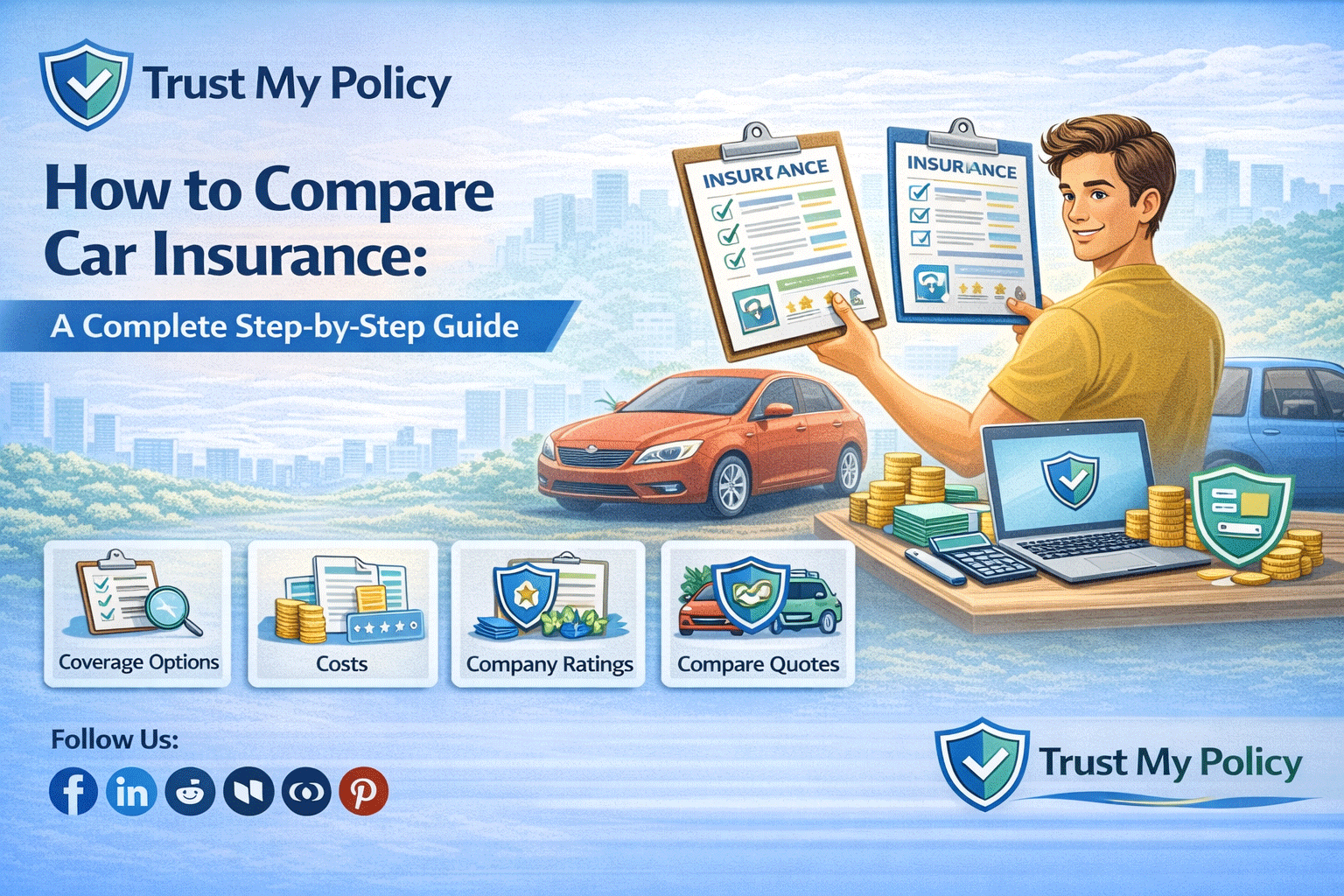
To compare car insurance effectively, look beyond the monthly premium to compare coverage types and limits, deductibles, approved repair shop networks, claims satisfaction ratings, and the insurer’s financial strength rating. According to J.D. Power’s 2024 US Auto Claims Satisfaction Study, claims satisfaction varies by over 100 points on a 1,000-point scale between the highest and lowest-rated insurers, meaning the difference between the best and worst isn’t just price.
Rachel Kim, 29, spent twenty minutes comparing car insurance quotes online and chose the cheapest option, saving $38 a month. Six months later, after a rear-end collision, she discovered her chosen insurer had one of the lowest claims satisfaction ratings in her state, and her repair took eleven weeks instead of the industry average of two because of slow claims handling.
How to Compare Car Insurance in 2026 means comparing far more than price. The meaningful comparison points are coverage types and limits, deductibles, network of approved repair shops, claims satisfaction ratings, and financial strength, alongside the premium. This guide walks through exactly how to compare each factor, so the cheapest quote also turns out to be genuinely good coverage.
This article covers the key comparison factors beyond price, how to use comparison tools effectively, real scenarios showing what the wrong comparison misses, and a clear comparison checklist. By the end, you’ll know exactly how to find the best value, not just the lowest premium.
| Feature | Details |
| What it is | A structured process for comparing car insurance beyond price alone |
| Who it applies to | Anyone shopping for new car insurance or reviewing their renewal |
| Key comparison factors | Premium, coverage types, limits, deductibles, claims satisfaction, financial strength |
| Biggest mistake | Comparing only the monthly premium and ignoring coverage quality |
| Key benefit | Finding the best value across all factors, not just the lowest sticker price |
| Key limitation | Comparison tools typically show price but don’t always surface claims satisfaction data |
| Regulator | State insurance departments (US); Financial Conduct Authority (UK) |
Think of comparing car insurance like comparing smartphones. Most people start with price, but two phones at the same price can differ enormously in battery life, camera quality, and software support. The phone that looks cheapest might cost you more in replacements and frustration within a year. Car insurance comparisons work exactly the same way, with claims satisfaction, network access, and coverage quality being the battery life and camera quality of the insurance world.
Comparing car insurance effectively means evaluating six distinct factors: the premium, which is the most visible but least complete comparison point; the specific coverage types included; the coverage limits for each type; the deductibles; the insurer’s claims satisfaction record; and the insurer’s financial strength. Anyone using price alone as their comparison point is making the same mistake Rachel made.
| Criteria | Price-Only Comparison | Full-Factor Comparison |
| What it finds | The cheapest premium | The best overall value |
| What it misses | Claims satisfaction, network access, coverage quality | Nothing significant |
| Time required | Minutes | 30–60 minutes of additional research |
| Pros | Fast, simple | Reveals meaningful differences price alone hides |
| Cons | Often results in a lower-quality insurer | Requires checking additional data sources |
We recommend full-factor comparison for every car insurance purchase for most readers, since the 30-60 minutes of additional research can prevent the kind of outcome Rachel experienced.
Scenario 1: Rachel, 29, driver who compared by price only. Rachel’s lowest-premium insurer had one of the lowest claims satisfaction ratings in her state, resulting in an 11-week repair versus the industry average of two. Verdict: price-only comparison missed the single most important factor for the one time insurance actually matters. Action: Rachel switched to an insurer with a top-quartile claims satisfaction rating at her next renewal, paying $22 more a month.
Scenario 2: A driver in Leeds comparing three insurers at the same premium level. Two charged identical premiums but had meaningfully different approved repair network sizes, with one covering nearly twice as many local garages. Verdict: identical premiums can hide meaningful differences in practical convenience. Action: the driver chose the insurer with the broader local repair network.
Scenario 3: A new driver in Dallas comparing full coverage quotes. All four quotes he received had identical coverage types but significantly different deductibles, from $500 to $1,500, without this being clearly highlighted in the initial comparison. Verdict: deductible differences can completely change the real cost of coverage when a claim occurs. Action: he compared total annual cost including his estimated deductible before choosing.
Scenario 4: A family in Phoenix considering a very cheap insurer with a B- AM Best rating. A broker pointed out that this rating indicated financial weakness relative to top-tier carriers. Verdict: financial strength matters if the insurer needs to pay a large claim. Action: the family chose a financially stronger insurer at a slightly higher premium.
| Pros | Cons |
| Reveals meaningful quality differences that price alone hides. | Requires checking multiple data sources beyond a comparison website. |
| Prevents choosing an insurer with poor claims handling. | Claims satisfaction data isn’t always easily accessible in one place. |
| Identifies deductible differences that affect real out-of-pocket costs. | Some insurers aren’t rated by independent agencies in all markets. |
| Confirms financial strength before committing to a policy. | Takes more time than a simple price comparison. |
| Checks repair network access before it becomes an issue mid-claim. | Network size isn’t always disclosed prominently by insurers. |
⚠️ WARNING: Never choose a car insurer based on price alone without checking claims satisfaction data. The difference in claims experience between the highest and lowest-rated insurers can be significant, and you only find out which category your insurer falls into when you actually need to make a claim.
| Your Situation | Our Recommendation |
| You’ve only looked at the premium so far | Yes — also check claims satisfaction, financial strength, and deductibles |
| Your quotes have different coverage types or limits | Yes — standardize them before comparing prices |
| You haven’t checked claims satisfaction ratings | Yes — look up J.D. Power (US) or Defaqto (UK) ratings before deciding |
| You’re considering a smaller or newer insurer | Yes — check their AM Best or FCA authorization status |
| Your preferred repair shop isn’t on an insurer’s approved list | Yes — factor this in before choosing, since out-of-network repairs can delay your claim |
| Two quotes have the same premium but different deductibles | Yes — compare total cost including a realistic deductible estimate |
| You’re comparing more than three quotes and feeling overwhelmed | Yes — narrow to two final options and compare them across all six factors |
💡 TIP: The single golden rule for comparing car insurance: check the claims satisfaction rating before choosing any insurer, since this is the factor that matters most the one time you actually need to make a claim.
| Scenario | Price-Only Finding | Full-Factor Finding |
| Cheapest premium insurer | $80/month | Bottom-quartile claims satisfaction rating |
| Second-cheapest premium insurer | $98/month | Top-quartile claims satisfaction, broader repair network |
| Identical premium, different deductibles | Both $110/month | $500 vs. $1,500 deductible — significant real cost difference |
| Identical premiums, different financial strength | Both $105/month | AM Best A++ vs. AM Best B — significant solvency difference |
| Cheapest insurer in post-disaster backlog area | $75/month | Historically slow claims resolution in high-claim regions |
| Mid-priced insurer with best repair network locally | $102/month | Twice as many approved local garages as the cheapest option |
| Older-brand insurer vs. digital-first insurer | Both $95/month | Meaningful differences in claims processing speed and ease |
Policygenius and The Zebra (US) — Comparison platforms showing real quotes from multiple insurers side by side. Cost range: free. Best for: starting a premium comparison across multiple US insurers. Rating: independent comparison services.
Compare the Market and Confused.com (UK) — Leading UK comparison sites for car insurance quotes. Cost range: free. Best for: UK drivers comparing multiple insurer quotes quickly. Rating: FCA-regulated comparison services.
J.D. Power Auto Claims Satisfaction Study (US) — Annual independent rating of US auto insurer claims satisfaction, published each year. Cost range: free to access. Best for: checking claims satisfaction rankings before choosing a US insurer. Rating: independent research organization.
AM Best (US) — Independent financial strength ratings for US and global insurers. Cost range: free public ratings. Best for: confirming an insurer’s financial stability before purchasing. Rating: industry-standard rating agency.
Defaqto (UK) — Independent star ratings for UK insurance products covering both quality and claims experience. Cost range: free public ratings. Best for: UK drivers wanting an independent quality rating alongside price. Rating: independent financial research firm.
We recommend checking J.D. Power (US) or Defaqto (UK) ratings alongside any comparison website as best overall, since these are the most reliable independent sources for claims satisfaction data that price-comparison tools typically don’t surface.
Compare premium, coverage types and limits, deductibles, claims satisfaction ratings, financial strength, and approved repair networks, rather than price alone.
Claims satisfaction is arguably the most important, since it determines your actual experience when you need to use your coverage, which is the only time the policy’s quality truly matters.
In the US, check J.D. Power’s annual Auto Claims Satisfaction Study; in the UK, check Defaqto ratings and Trustpilot reviews for independent assessments.
A lower premium with a much higher deductible can end up costing you significantly more when you file a claim, making the total annual cost comparison more meaningful than the monthly premium alone.
Yes, as a starting point for prices, but comparison sites typically don’t show claims satisfaction or financial strength data, which you’ll need to check separately.
A financial strength rating, like AM Best in the US, indicates an insurer’s ability to pay claims, with higher ratings reflecting stronger financial reserves and lower risk of inability to pay.
No. Approved repair network size varies significantly, and using an out-of-network garage can add delays and additional costs to your claim.
Sometimes, but often a significantly lower premium reflects either a higher deductible, thinner coverage, or lower claims quality, all of which matter more than the premium when you actually need to claim.
At least three, to see a meaningful range of price and coverage, but narrow to two final options and compare them across all six factors before making a final decision.
At every renewal, since premiums, available plans, and insurer quality all shift over time, and switching regularly is one of the most reliable ways to avoid overpaying.
This article is for informational purposes only. Always consult a licensed insurance professional before making coverage decisions. Trust My Policy does not sell insurance products or represent any insurer.

Jagadeesh Gutha is the founder of TrustMyPolicy.com, an independent insurance information platform covering life, health, car, home, and business insurance for US and UK readers. He researches insurance products, policy structures, and consumer rights to help everyday people make informed coverage decisions without the jargon. All content on TrustMyPolicy is independently researched, fact-checked, and written to educate — not to sell.



Insurance Guides for UK, USA & Worldwide We are not an insurer or broker.

Reader Comments (0)