
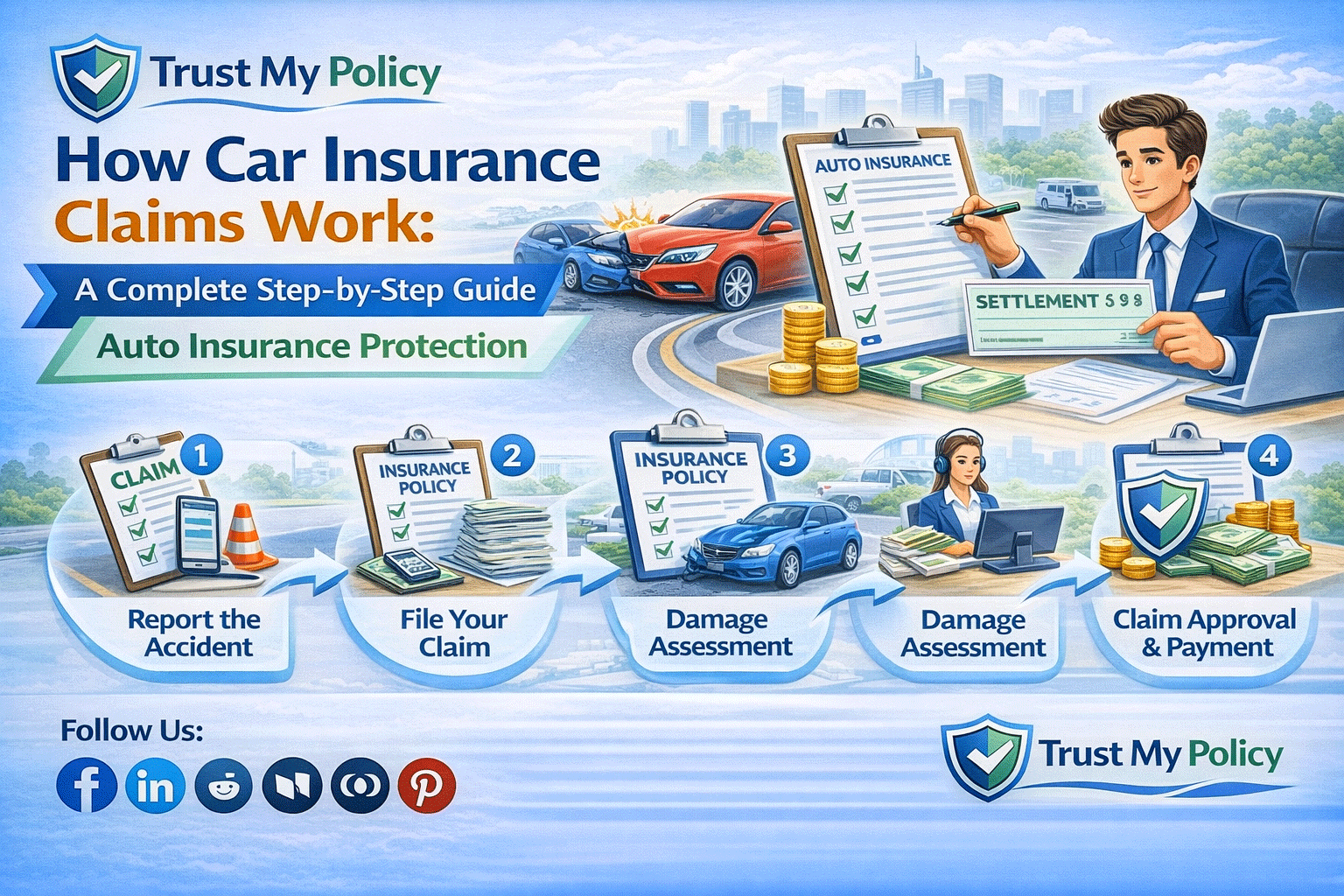
Car insurance claims work in five stages: document the scene immediately with photos and the other driver’s details, report the incident to your insurer within 24–48 hours, work with an assigned adjuster who reviews the claim, receive a damage assessment and fault or coverage determination, and finally receive a settlement payment. The whole process typically takes one to three weeks for straightforward claims.
Ben Hartley, 31, was in his first accident near Leeds and froze completely, not knowing whether to call the police first, his insurer first, or just exchange details and drive away. He called his mum. By the time he finally reported the incident to his insurer three days later, his delayed notification had created a complication his adjuster had to manually override.
How Car Insurance Claims Work in 2026 starts at the accident scene, not at home later. The process moves through five stages: scene documentation, prompt reporting to your insurer, the assignment of an adjuster, a damage assessment and fault determination, and final settlement. Understanding each stage in advance means you’ll know exactly what to do while still standing next to a dented car in the rain.
This article covers every stage of the car insurance claims process in plain language, what happens inside your insurer’s operation at each step, real scenarios with timelines, and the most common mistakes that slow claims down. By the end, you’ll know exactly what to do from the moment an accident happens.
| Feature | Details |
| What it is | The end-to-end process from an accident through to a final insurance payout |
| Who it applies to | Any driver involved in an accident or experiencing a covered vehicle loss |
| Typical reporting deadline | 24–48 hours after the incident for most policies |
| Typical resolution timeline | 1–3 weeks for straightforward claims; longer for disputed or injury claims |
| Key benefit | Understanding the process in advance prevents costly documentation mistakes at the scene |
| Key limitation | Delays in reporting or incomplete scene documentation can complicate even valid claims |
| Regulator | State insurance departments (US); Financial Conduct Authority (UK) |
Think of a car insurance claim like a relay race where each leg hands the baton to the next. You run the first leg at the accident scene by gathering evidence. Your insurer runs the second by assigning an adjuster. The adjuster runs the third by assessing damage. The settlement team runs the final leg. If you drop the baton in your leg by failing to document the scene or report promptly, the rest of the race slows significantly.
A car insurance claim is the formal process of requesting payment from your insurer after a covered vehicle-related loss. It starts at the accident scene with you, moves through your insurer’s internal review and adjustment process, and ends with a settlement payment. Every stage has specific actions and timelines, and understanding them in advance is the single most effective way to ensure your claim moves smoothly.
| Criteria | At-Fault Claim | Not-at-Fault Claim |
| Which coverage responds | Your collision coverage (for your car) and your liability (for others) | The at-fault driver’s liability (for you) or your own uninsured motorist coverage |
| Effect on your premium | Typically raises your premium at next renewal | Usually doesn’t raise your own premium, but varies by insurer |
| Deductible applies | Yes, on your collision coverage | Not from your insurer; may apply from the at-fault driver’s insurer |
| Best approach | Cooperate fully with your adjuster | Report to both your insurer and the at-fault driver’s insurer |
We recommend reporting every incident to your own insurer regardless of fault for most readers, since this protects you if the other party’s account differs from yours.
Scenario 1: Ben, 31, driver near Leeds. Ben’s three-day reporting delay created a manual override complication that added two weeks to his otherwise straightforward claim. Verdict: prompt reporting is one of the most important steps in the entire process. Action: Ben saved his insurer’s claims line number directly in his phone contacts.
Scenario 2: Maria, 34, driver in Phoenix hit by an uninsured driver. Maria reported to her own insurer immediately, filed under her uninsured motorist coverage, and had her vehicle repaired within two weeks. Verdict: knowing which coverage type to file under speeds up the entire process. Action: Maria confirmed her uninsured motorist limit was adequate at her next renewal.
Scenario 3: A driver in Dallas whose car was declared a total loss. The adjuster determined the repair cost exceeded the car’s actual cash value and issued a total loss settlement check, minus the deductible, within ten days. Verdict: total loss claims follow the same stages but result in a cash payout instead of repair authorisation. Action: the driver researched the fair market value of their car before accepting the settlement offer.
Scenario 4: A driver in Manchester whose windscreen was damaged by a flying stone. The claim was filed under comprehensive coverage with no deductible required under his specific policy’s glass damage terms. Verdict: different claim types have different deductible rules within the same policy. Action: he confirmed his glass-specific deductible terms with his insurer before deciding whether to claim.
| Pros | Cons |
| A structured five-stage process ensures consistent claim handling. | Delays at any stage can extend the overall timeline significantly. |
| Dedicated claims apps and lines now make initial reporting much faster. | Not-at-fault claims can still be affected if the at-fault driver’s insurer disputes liability. |
| Total loss valuations provide a clear, documented basis for settlement. | Some drivers dispute total loss valuations, requiring additional negotiation time. |
| Uninsured motorist coverage provides a direct claim pathway when the other driver has no insurance. | Missing scene documentation can weaken an otherwise valid claim significantly. |
| Understanding the process in advance reduces stress during an already difficult situation. | Premium increases after an at-fault claim can persist for several renewal cycles. |
⚠️ WARNING: Never admit fault at the accident scene, even if you believe you were responsible. Fault is determined by adjusters and, if necessary, investigators based on all evidence. An on-scene admission can affect your claim and your premium even if the full evidence later tells a different story.
| Your Situation | Our Recommendation |
| You’ve just been in an accident | Yes — document the scene with photos before moving vehicles |
| It’s been more than 24 hours since an incident and you haven’t reported it | Yes — report immediately and explain the delay to your insurer |
| The other driver has no insurance | Yes — file under your uninsured motorist coverage |
| Your car has been declared a total loss | Yes — research comparable sale listings before accepting the settlement |
| The insurer’s repair estimate seems too low | Yes — get an independent estimate and present it to your adjuster |
| You’re unsure whether a minor scratch is worth claiming | Yes — weigh the claim amount against your deductible and potential premium increase |
| You were not at fault and want to claim from the other driver’s insurer | Yes — also report to your own insurer to protect your position |
💡 TIP: The single golden rule for car insurance claims: treat the accident scene like your claim starts right now, because it does — the evidence you gather in the first ten minutes is what your entire claim will be built on.
| Scenario | Your Out-of-Pocket Cost | Notes |
| At-fault collision, $2,000 damage, $500 deductible | $500 deductible + future premium increase | Premium increase typically persists 3–5 years |
| Not-at-fault claim through other driver’s insurer | Often $0 | No deductible if the other driver’s liability pays |
| Uninsured motorist claim | Your UM deductible, if any | Many UM policies have no deductible |
| Comprehensive claim (hail, theft, weather) | Your comprehensive deductible, typically $250–$1,000 | Glass claims sometimes have no deductible |
| Total loss settlement | Deductible + any gap between ACV and loan balance | Gap insurance covers the loan shortfall |
| Minor scratch or dent below your deductible | Full repair cost out of pocket | Often better to pay directly than file a small claim |
| Windscreen replacement (UK, no-deductible glass cover) | £0 with appropriate cover | Many UK comprehensive policies include free glass replacement |
USAA (US) — Consistently rated highest for claims satisfaction among US auto insurers by J.D. Power. Cost range: competitive, available to military members and families. Best for: eligible US drivers wanting the fastest, highest-rated claims experience. Rating: AM Best A++.
GEICO (US) — Known for fast digital claims processing with a highly rated mobile app for initial reporting. Cost range: competitive across most US states. Best for: tech-savvy drivers wanting a streamlined digital claims process. Rating: AM Best A++.
Direct Line (UK) — A UK insurer known for fast, direct claims handling without going through a broker. Cost range: competitive UK pricing. Best for: UK drivers wanting direct, fast claims resolution. Rating: Defaqto 4-5 Star.
Progressive (US) — Offers a concierge claims service that manages the entire repair process on the driver’s behalf. Cost range: competitive US pricing. Best for: drivers who want a fully managed repair experience. Rating: AM Best A+.
Aviva (UK) — Offers comprehensive UK car insurance with strong financial backing and a dedicated claims app. Cost range: competitive UK pricing. Best for: UK drivers wanting a financially stable insurer with digital claims tools. Rating: Defaqto 5 Star.
We recommend USAA for eligible US drivers and Direct Line for UK drivers as best overall because both consistently deliver faster and more straightforward claims experiences.
A car insurance claim follows five stages: documenting the scene, reporting to your insurer within 24–48 hours, working with an assigned adjuster, receiving a damage assessment and coverage decision, and accepting a settlement.
Straightforward claims typically resolve in one to three weeks. Claims involving injury, disputed fault, or significant damage can take several weeks to a few months.
Yes, in most cases, since many policies require prompt notification regardless of claim size, and unreported incidents can create complications if the other party later makes a claim.
You can claim through the at-fault driver’s liability insurance; you should also report to your own insurer to protect your position in case accounts differ.
In most cases yes, though some policies offer preferred networks with streamlined repair guarantees; using a non-preferred shop is usually still permitted.
A total loss occurs when the repair cost exceeds the car’s actual cash value; the insurer pays you the car’s value minus your deductible instead of authorising repairs.
Adjusters managing multiple complex claims, inspection scheduling delays, or disputes about fault can all extend the adjuster stage beyond initial estimates.
No. Exchange details politely but avoid making statements about fault; fault is determined based on all evidence reviewed by adjusters, not on-scene admissions.
Photos of the damage and scene, the other driver’s insurance and contact details, a police report if applicable, and your own policy number and details.
At-fault claims typically raise your premium at the next renewal and can persist for three to five years; not-at-fault claims usually don’t raise your premium, though rules vary by insurer.
This article is for informational purposes only. Always consult a licensed insurance professional before making coverage decisions. Trust My Policy does not sell insurance products or represent any insurer.

Jagadeesh Gutha is the founder of TrustMyPolicy.com, an independent insurance information platform covering life, health, car, home, and business insurance for US and UK readers. He researches insurance products, policy structures, and consumer rights to help everyday people make informed coverage decisions without the jargon. All content on TrustMyPolicy is independently researched, fact-checked, and written to educate — not to sell.





Insurance Guides for UK, USA & Worldwide We are not an insurer or broker.
Reader Comments (1)
[…] car insurance deductible is the amount you pay out of pocket on a covered collision or comprehensive claim before your insurer pays the rest. Common deductible options range from $250 to $2,500, with a […]