

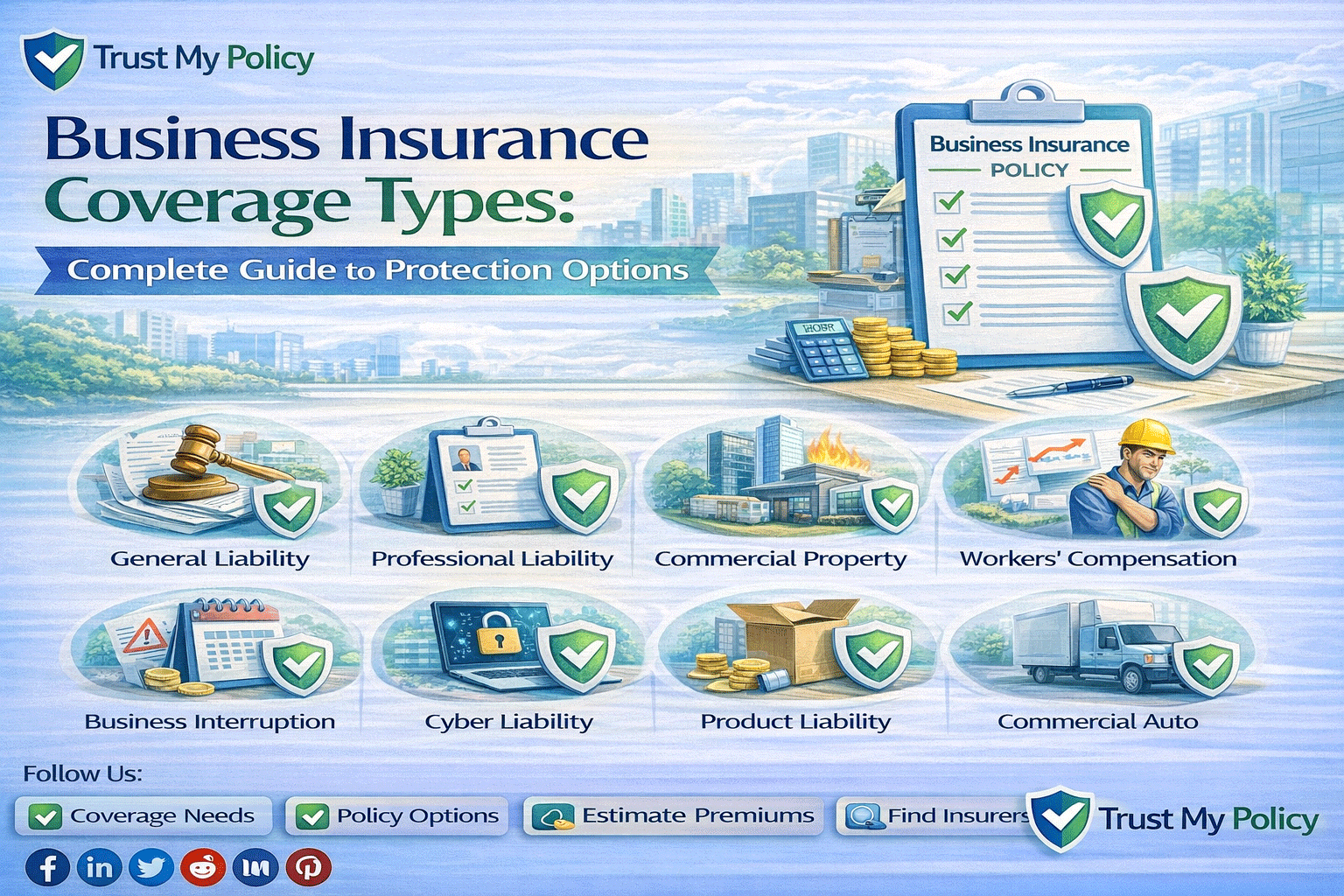
The major business insurance coverage types include general liability, commercial property, a business owner’s policy (BOP), workers’ compensation, professional liability, commercial auto, business interruption, cyber liability, directors and officers (D&O), employment practices liability (EPLI), umbrella policies, and inland marine insurance for movable equipment. Which combination you need depends on your industry, employee count, and whether you have a board or significant equipment in transit.
Table of Contents
ToggleBusiness Insurance Coverage Types: Complete 2026 Guide
Owen Bramwell, 52, took over his family’s printing business in Manchester after his father retired and inherited a stack of insurance renewal notices for policies he’d never heard explained in plain language: a BOP, an umbrella policy, EPLI, and something simply labeled “inland marine.” He spent an entire weekend researching what each one actually meant before his first renewal decision.
Business Insurance Coverage Types in 2026 span a wide range, from foundational coverage like general liability and commercial property, to specialized types like directors and officers (D&O), employment practices liability (EPLI), cyber liability, and umbrella policies that extend limits across multiple underlying policies. This guide works as a complete reference, explaining every major type in plain language so you’re never staring at an unfamiliar renewal notice again.
This article covers every major business insurance coverage type explained individually, which businesses typically need which combination, real scenarios illustrating each type, and a clear reference table for quick lookup. By the end, you’ll be able to read any business insurance renewal notice and understand exactly what you’re looking at.
Quick Summary Table
| Coverage Type | What It Covers |
| General liability | Third-party bodily injury and property damage claims |
| Commercial property | Damage to your building, equipment, and inventory |
| Business owner’s policy (BOP) | Bundles general liability and property at a lower combined cost |
| Workers’ compensation | Employee injuries and related medical/lost wage costs |
| Professional liability (E&O) | Claims related to professional advice or service errors |
| Commercial auto | Vehicles used for business purposes |
| Business interruption | Lost income and ongoing expenses after a covered disaster |
| Cyber liability | Data breaches and cyberattack-related costs |
| Directors and officers (D&O) | Claims against company leadership for corporate decisions |
| Employment practices liability (EPLI) | Wrongful termination, discrimination, and harassment claims |
| Umbrella/excess liability | Extends limits beyond underlying policies’ caps |
| Inland marine | Equipment or goods in transit or at non-fixed locations |
What Are All the Business Insurance Coverage Types, Explained?
Think of business insurance coverage types like the different specialists in a hospital. A general practitioner (general liability) handles the most common, everyday issues. But a cardiologist (D&O), a dermatologist (EPLI), and a radiologist (cyber liability) each handle something specific that a general practitioner simply isn’t equipped to address. Knowing which specialist to call requires knowing what each one actually does.
Business insurance coverage types fall into several categories. Foundational coverage includes general liability, commercial property, and business owner’s policies, which bundle the two. Employee-related coverage includes workers’ compensation and employment practices liability. Professional and technology-related coverage includes professional liability and cyber liability. Leadership and governance coverage includes directors and officers insurance. Specialized coverage includes commercial auto, business interruption, umbrella policies, and inland marine insurance for movable property. Anyone reviewing a business insurance renewal notice benefits from understanding which category each unfamiliar term falls into.
How to Use This Coverage Type Reference — 5 Steps
- Identify your foundational coverage first. General liability, commercial property, or a bundled BOP form the base layer nearly every business needs.
- Check whether you have employees. If yes, workers’ compensation is typically legally required, and employment practices liability becomes increasingly relevant as your team grows.
- Check whether you provide professional services or handle data. Professional liability and cyber liability address two distinct, commonly needed specialized risks.
- Check whether you have a board or outside investors. Directors and officers insurance becomes relevant the moment outside stakeholders are involved in governance.
- Check whether your underlying limits are sufficient for your actual risk. An umbrella policy extends coverage beyond your other policies’ individual limits if a single large claim exceeds them.
Comparison: Foundational vs. Specialized Coverage Types
| Criteria | Foundational Coverage (GL, Property, BOP, Workers’ Comp) | Specialized Coverage (D&O, EPLI, Cyber, Umbrella, Inland Marine) |
| Who needs it | Nearly every business | Businesses with specific risk factors: boards, employees, data, equipment in transit |
| Typical trigger | Simply operating a business with customers, premises, or employees | A specific risk factor like outside investors, growing headcount, or sensitive data |
| Cost | $500–$3,000/year combined for most small businesses | $1,000–$15,000+/year depending on the specific specialized type and limits |
| Pros | Addresses the most statistically common business risks | Closes specific, often severe gaps foundational coverage doesn’t touch |
| Cons | Doesn’t address governance, employment, or technology-specific risks | Requires identifying your specific trigger factors correctly |
We recommend using this reference to map your own specific risk factors, like having a board or growing headcount, to the relevant specialized coverage types, rather than assuming foundational coverage alone is sufficient.
4 Real-Life Scenarios
Scenario 1: Owen, 52, printing business owner in Manchester. Owen spent a full weekend researching unfamiliar terms on his renewal notice, including an umbrella policy and inland marine coverage for his delivery vehicles’ cargo. Verdict: understanding each coverage type individually made his renewal decisions far more confident. Action: Owen now reviews each line item on his renewal with his broker rather than renewing on assumption alone.
Scenario 2: A venture-backed software startup in San Francisco closing its Series A round. The lead investor required directors and officers insurance as a condition of the round closing, a coverage type the founders hadn’t previously needed as a bootstrapped team. Verdict: D&O insurance becomes relevant specifically once outside investors and a board are involved. Action: the founders secured a D&O policy before the round officially closed.
Scenario 3: A 25-employee retail chain in Leeds facing a wrongful termination claim. The claim was covered under the company’s employment practices liability policy, a coverage type they’d added only the previous year as their headcount grew. Verdict: EPLI addressed a risk that had become statistically more significant as the team expanded. Action: the company reviewed its EPLI limit alongside its overall headcount growth at the next renewal.
Scenario 4: A construction equipment rental company in Houston whose generators were stolen from a job site. Since the equipment wasn’t at a fixed business location, standard commercial property insurance didn’t apply; inland marine coverage specifically addressed this movable equipment risk. Verdict: inland marine insurance fills a gap that standard property coverage, tied to fixed locations, doesn’t address. Action: the company expanded its inland marine coverage to include all equipment regularly moved between job sites.
Pros & Cons of Understanding the Full Coverage Type Landscape
| Pros | Cons |
| Allows you to confidently read and evaluate any business insurance renewal notice. | The sheer number of distinct coverage types can feel overwhelming at first. |
| Helps you identify specific gaps tied to your own risk factors, like a board or movable equipment. | Some specialized types require their own underwriting process, separate from foundational coverage. |
| Prevents assuming foundational coverage automatically extends to specialized risks. | Premiums increase as you add more specialized coverage types to your stack. |
| Supports better conversations with brokers about what you actually need. | Coordinating many policy types across potentially different insurers takes active management. |
| Provides a clear framework for triaging renewal notices full of unfamiliar terms. | Industry-specific nuances mean this reference is a starting point, not a complete substitute for broker guidance. |
5 Common Mistakes Business Owners Make
- Assuming general liability or a BOP covers every type of business risk. This happens because foundational coverage is often marketed as broadly comprehensive. What to do instead: map your specific risk factors, like a board or sensitive data, to the relevant specialized coverage types beyond your foundational policy.
- Not adding D&O insurance until an investor specifically requires it. This happens because D&O insurance isn’t on most founders’ radar until outside investors are involved. What to do instead: research D&O coverage proactively once you begin considering outside investment or add a formal board.
- Assuming standard commercial property covers equipment that moves between locations. This happens because “property” sounds broad enough to cover anything the business owns. What to do instead: add inland marine coverage specifically for equipment or goods that aren’t at a single fixed location.
- Not adding employment practices liability insurance as headcount grows. This happens because this risk feels abstract until an actual employment-related claim arises. What to do instead: add this coverage proactively as your team grows, rather than waiting for a claim to reveal the gap.
- Not considering an umbrella policy when underlying limits feel insufficient. This happens because business owners don’t realize this option exists to extend coverage beyond individual policy caps. What to do instead: ask your broker whether an umbrella policy makes sense if a single large claim could exceed your existing limits.
⚠️ WARNING: Never assume an unfamiliar term on your business insurance renewal notice is unimportant or automatically covered elsewhere. Terms like inland marine, EPLI, or umbrella coverage each address a specific, sometimes significant risk that foundational coverage simply doesn’t touch.
Decision Table: Which Coverage Types Do You Need?
| Your Situation | Our Recommendation |
| You’re not sure what’s on your current renewal notice | Yes — review each line item with your broker rather than renewing on assumption |
| You have outside investors or a formal board | Yes — secure directors and officers (D&O) insurance |
| Your headcount has grown into the teens or beyond | Yes — add employment practices liability (EPLI) insurance |
| You handle any client or customer data electronically | Yes — add cyber liability insurance |
| Your equipment regularly moves between job sites or locations | Yes — add inland marine insurance, not just standard commercial property |
| You’re concerned a single large claim could exceed your current limits | Yes — ask your broker about an umbrella or excess liability policy |
| You assumed your BOP covers every possible business risk | No — confirm specifically which specialized types your situation might still need |
💡 TIP: The single golden rule for navigating business insurance coverage types: map your own specific risk factors — a board, growing headcount, sensitive data, movable equipment — to the matching specialized coverage type, rather than assuming foundational coverage handles everything.
Cost Table: What Each Coverage Type Typically Costs
| Coverage Type | Typical Annual Cost | Notes |
| General liability | $400–$1,200/year | Foundational coverage for most small businesses |
| Business owner’s policy (BOP) | $800–$2,000/year | Bundles general liability and property affordably |
| Workers’ compensation | $1,500–$6,000/year | Varies significantly by industry classification and payroll |
| Professional liability (E&O) | $500–$3,000/year | Varies by profession and coverage limit |
| Cyber liability | $1,000–$5,000/year | Varies by data sensitivity and business size |
| Directors and officers (D&O) | $2,000–$15,000+/year | Scales with funding stage, board size, and industry risk |
| Employment practices liability (EPLI) | $1,000–$3,000/year | Typically added as headcount grows beyond a small team |
| Umbrella/excess liability | $500–$2,000/year per $1M of extended coverage | Extends limits beyond underlying policies |
| Inland marine | $300–$1,500/year | Varies by total value of movable equipment covered |
Resources for Navigating Business Insurance Coverage Types
Independent insurance brokers — Brokers can map your specific business risk factors to the exact combination of coverage types you need. Cost range: typically free for the consumer. Best for: any business owner facing an unfamiliar renewal notice. Rating: varies by broker, check state or FCA licensing.
The Hartford and Chubb (US) — Offer a full range of business coverage types from foundational to specialized, often through a single carrier relationship. Cost range: competitive across business sizes. Best for: US businesses wanting a consolidated coverage provider. Rating: AM Best A and A++ respectively.
Simply Business (UK) — A UK comparison platform covering the full range of business insurance types across many industries. Cost range: free to compare. Best for: UK businesses comparing multiple coverage types at once. Rating: FCA-regulated comparison service.
Insurance Information Institute (US) and Association of British Insurers (UK) — Industry bodies publishing plain-language guidance on the full landscape of business insurance types. Cost range: free public resources available. Best for: readers wanting deeper educational context on any specific type. Rating: industry trade associations.
NAIC (National Association of Insurance Commissioners) — Publishes consumer guidance on how various business coverage types are regulated across US states. Cost range: free public resource. Best for: US business owners researching specific coverage type regulation. Rating: regulatory standards body.
We recommend an independent broker as best overall because they can translate an unfamiliar renewal notice, like Owen’s, into a clear explanation of exactly which coverage types your specific business needs.
Frequently Asked Questions
What are the main types of business insurance coverage?
The main types include general liability, commercial property, a business owner’s policy, workers’ compensation, professional liability, commercial auto, business interruption, cyber liability, directors and officers insurance, employment practices liability, umbrella policies, and inland marine insurance.
What is a business owner’s policy (BOP)?
A BOP bundles general liability and commercial property insurance together, typically at a lower combined cost than purchasing each policy separately.
What is directors and officers (D&O) insurance?
D&O insurance protects a company’s leadership from claims related to corporate decisions, and is often required by investors once outside funding and a formal board are involved.
What is employment practices liability insurance (EPLI)?
EPLI covers claims related to employment practices, such as wrongful termination, discrimination, or harassment allegations, becoming increasingly relevant as a company’s headcount grows.
What is inland marine insurance?
Inland marine insurance covers equipment, goods, or property that move between locations or aren’t tied to a single fixed business address, a gap standard commercial property insurance doesn’t address.
What is an umbrella or excess liability policy?
An umbrella policy extends coverage limits beyond what your underlying policies, like general liability or commercial auto, individually provide, protecting against unusually large claims.
Does a BOP cover professional errors or cyber risks?
No. A BOP covers general liability and property risks specifically; professional liability and cyber liability require separate, dedicated policies.
When does a business typically need D&O insurance?
Most commonly once a company takes on outside investors or forms a formal board, since many institutional investors require this coverage as a condition of funding.
How do I know which specialized coverage types my business needs?
Map your specific risk factors, such as having a board, growing headcount, handling sensitive data, or moving equipment between locations, to the coverage type designed for that exact risk.
Is it worth working with a broker to understand all these coverage types?
Yes, generally. Brokers can quickly translate unfamiliar terms on a renewal notice into a clear picture of which types genuinely apply to your specific business situation.
Key Takeaways
- Use this reference to map your specific risk factors to the matching coverage type.
- Don’t assume foundational coverage like a BOP extends to specialized risks like D&O or cyber liability.
- Add D&O insurance once outside investors or a formal board are involved.
- Add EPLI as your headcount grows beyond a small founding team.
- Add inland marine coverage for any equipment that moves between locations.
- Consider an umbrella policy if a single large claim could exceed your underlying limits.
- Review unfamiliar renewal notice line items with a broker rather than renewing on assumption.
This article is for informational purposes only. Always consult a licensed insurance professional before making coverage decisions. Trust My Policy does not sell insurance products or represent any insurer.




Reader Comments (1)
[…] Business Interruption Insurance in 2026 covers the income and ongoing expenses a business loses while it can’t operate due to a covered property loss, like a fire, storm, or other physical damage. It’s a separate policy from property insurance, which only covers the physical rebuild, not the lost revenue during that downtime. This guide breaks down exactly what’s covered, what’s excluded, and how to calculate the right coverage amount. […]