

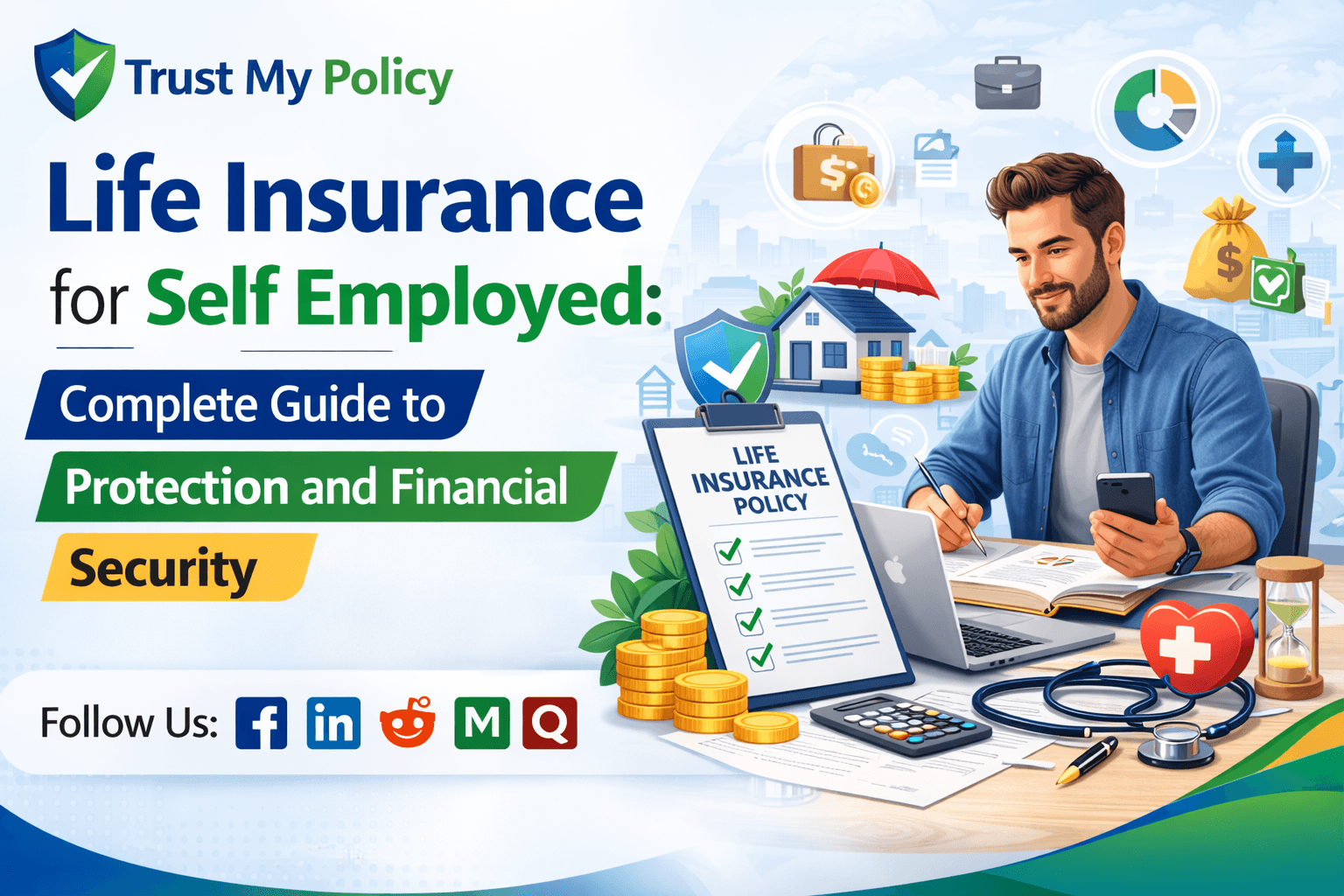
Self-employed people typically need two types of life insurance: personal term life insurance to replace the group policy they lost when leaving employment, and potentially key person life insurance payable to their business. Personal term life for a healthy self-employed person in their 30s typically costs $15–$40 a month for $500,000 in coverage. Self-employed individuals in the US can also deduct life insurance premiums paid through a business structure in specific circumstances.
Table of Contents
ToggleLife Insurance for Self Employed
Nina Okafor, 38, ran a successful freelance UX design practice in Chicago and had never thought seriously about life insurance until her accountant pointed out that she was the business. If she died tomorrow, her clients would be gone, her income would stop, and her partner — who’d left their own job to manage their home — would be left with a mortgage and no income replacement whatsoever. Her employer had provided a basic group life policy before she went independent. Nobody replaced it when she left.
Life Insurance for Self Employed people in 2026 addresses a gap most newly independent workers don’t notice until someone points it out: when you leave employment, your employer’s group life policy stops, and nobody replaces it automatically. Beyond personal cover, self-employed people who run a business also need to consider key person life insurance, which pays the business itself if they die, and in some cases business loan protection. This guide breaks down the specific life insurance needs of the self-employed and how to prioritise them.
This article covers which life insurance types apply to self-employed individuals and their businesses, how the tax treatment works, real scenarios with specific numbers, and a clear action framework. By the end, you’ll know exactly what Nina’s accountant spotted.
Quick Summary Table
| Feature | Details |
| What it is | Personal and business-level life insurance specifically structured for self-employed individuals |
| Who needs it | Any self-employed person with dependents, a partner, a mortgage, or a business with other stakeholders |
| Typical cost | $15–$40/month for $500,000 term life at age 30–40 |
| Tax treatment (US) | Business-owned key person life is generally not deductible; personally owned life is not income tax deductible |
| Key benefit | Replaces the group life policy that ended when you left employment |
| Key limitation | Many self-employed people don’t realise their employer’s policy ended with their job |
| Regulator | State insurance departments (US); Financial Conduct Authority (UK) |
What Life Insurance Gap Does Self-Employment Create?
Think of employer-provided life insurance like a uniform that comes with a job. The moment you hand in your notice, the uniform goes back. Most employees never consciously chose the life policy their employer provided — it was just there. The moment they become self-employed, it isn’t, and nobody sends a letter to remind them.
Life insurance for self-employed people addresses a gap created by losing employer-provided group coverage, which typically provides a basic death benefit of one to four times your salary. Once self-employed, you’re responsible for replacing that cover entirely, sizing it correctly for your current income and obligations, and in some cases adding key person coverage that protects your business itself rather than just your personal dependents. Anyone who has recently become self-employed or who has been self-employed without life cover should treat this review as urgent rather than optional.
How to Structure Life Insurance as a Self-Employed Person — 5 Steps
- Establish your personal life insurance need first. This is the cover that replaces your income for your dependents — partner, children, or anyone else who relies on your earnings.
- Size the cover to your current self-employed income, not your old salary. Your income may have changed significantly since you were last employed, so base your cover on your actual current earnings and obligations.
- Choose term life insurance as your primary personal cover. For most self-employed people, a 20- or 25-year level term policy provides the right balance of cost and protection.
- Consider key person life insurance if your business would struggle without you. This policy is owned by your business and pays out to the business itself — used to fund recruitment, client transition, or loan repayment if you die.
- Check whether business loan protection is needed. If your business has taken on loans that a partner or guarantor would inherit on your death, a dedicated policy sized to that liability may be appropriate.
Comparison: Personal Term Life vs. Key Person Life Insurance
| Criteria | Personal Term Life Insurance | Key Person Life Insurance |
| Who owns the policy | You personally | Your business entity |
| Who receives the payout | Your named beneficiary (partner, family) | The business itself |
| What it’s designed to replace | Your income for your personal dependents | Business revenue, recruitment costs, or loan exposure |
| Typical cost | $15–$40/month for $500,000, age 30–40 | Varies by coverage amount; often higher than personal cover |
| Tax treatment (US) | Premiums generally not deductible | Premiums generally not deductible; payouts may be subject to tax depending on structure |
| Best for | Every self-employed person with personal dependents | Self-employed people whose businesses have financial exposure beyond personal income |
We recommend every self-employed person with any dependent or debt start with personal term life insurance, and add key person cover if their business generates revenue other people or lenders depend on.
4 Real-Life Scenarios
Scenario 1: Nina, 38, freelance UX designer in Chicago. Nina had no life insurance since leaving her employer two years earlier, leaving her partner with a mortgage and no income replacement if she died. Verdict: losing employer group life cover is the single most common self-employment life insurance gap. Action: Nina applied for a $750,000, 20-year term policy within a month of her accountant’s observation, at $34 a month.
Scenario 2: Marcus, 45, owner of a three-person web agency in Manchester. Marcus’s agency had a bank loan and two employees whose salaries depended on client revenue he personally generated. Verdict: both his family and his business had significant financial exposure to his death. Action: Marcus held personal term life for his family and a separate key person policy payable to the business, sized to cover 18 months of revenue replacement and loan repayment.
Scenario 3: Priya, 31, sole trader graphic designer in Leeds with no employees. Priya had no dependents, no mortgage, and no business debt. Verdict: even without a current dependent, Priya chose a modest term policy to lock in a low rate for a future mortgage and anticipated family. Action: she applied for a $300,000, 25-year term policy at $12 a month, primarily to lock in the rate.
Scenario 4: A business partnership in Texas where two co-founders each owned 50%. If one partner died, the surviving partner needed funds to buy out the deceased’s estate interest rather than having an unknown heir inherit business control. Verdict: this specific need required a cross-option agreement backed by a life policy — each partner insured the other’s life with the business as beneficiary. Action: both partners put in place agreed-value life policies and a formal buy-sell agreement.
Pros & Cons of Life Insurance for Self-Employed People
| Pros | Cons |
| Replaces the employer group life cover that ended with employment — often unnoticed. | Self-employed people bear the full premium cost with no employer contribution. |
| Term life provides substantial cover at a low monthly cost while young and healthy. | Premiums increase with age, so delay has a direct financial cost. |
| Key person cover protects a business’s financial continuity in a way personal cover cannot. | Key person premiums are generally not tax-deductible in the US or UK. |
| Locking in a policy early captures a lower rate class that won’t be available later. | Determining the right key person cover amount requires genuinely estimating business value. |
| Buy-sell agreement backing provides legal clarity when a business partnership loses a founder. | Setting up a properly structured business continuation arrangement often requires professional legal advice. |
5 Common Mistakes Self-Employed People Make
- Not noticing when their employer group life policy ended. This happens because the policy was invisible while it was in place. What to do instead: include a life insurance review as a specific item when transitioning to self-employment.
- Not updating their cover amount to reflect their current self-employed income. This happens because people base their thinking on their last salary rather than their current actual income. What to do instead: recalculate your cover amount based on your actual current self-employed earnings and obligations.
- Assuming personal term life covers their business’s financial exposure too. This happens because people conflate personal and business risk. What to do instead: assess business risk separately and add key person cover if the business genuinely has its own financial exposure.
- Putting off applying because the business income feels “unstable.” This happens because self-employed people feel they should wait until their income “settles.” What to do instead: apply now while healthy, since every year of delay raises the cost of a new policy.
- Not putting a buy-sell agreement in place when self-employment involves a co-founder. This happens because the legal documentation feels secondary to running the business. What to do instead: consult a solicitor or attorney about a buy-sell agreement and ensure your life policy specifically backs it.
⚠️ WARNING: Never assume the group life insurance you had with your last employer is still in place. Unless you specifically converted or individually replaced that policy, it ended on your last working day — and replacing it after a health change may cost significantly more or be refused altogether.
Decision Table: What Should You Put in Place?
| Your Situation | Our Recommendation |
| You’ve gone self-employed and haven’t reviewed life cover | Yes — treat this as an urgent first action, not a “later” task |
| You have a partner or children depending on your income | Yes — apply for personal term life immediately |
| You have a mortgage or significant personal debt | Yes — size your term cover to at least cover the outstanding balance |
| Your business has employees, lenders, or revenue others depend on | Yes — add key person life insurance owned by the business |
| You have a business co-founder with no buy-sell agreement | Yes — consult a solicitor or attorney and put a backed agreement in place |
| You’re waiting until your business income “stabilises” | No — apply now; rates only rise with time |
| You had group life with your last employer | Yes — confirm in writing whether any conversion option existed and what cover you currently have |
💡 TIP: The single golden rule for self-employed life insurance: apply for personal term life immediately after going self-employed — the cost of delay compounds every year, and a new health condition at any point can permanently raise your rate class.
Cost Table: What Self-Employed Life Insurance Costs
| Scenario | Typical Monthly Cost | Notes |
| Personal term life, healthy age 30, $500,000, 20-year term | $15–$25/month | Lowest available cost range; rates rise with every year of delay |
| Personal term life, healthy age 38, $500,000, 20-year term | $25–$45/month | Reflects age increase since leaving employment |
| Personal term life, healthy age 45, $500,000, 20-year term | $55–$90/month | Demonstrates cost of delaying application by 7–10 years |
| Key person life, business owner, $500,000, 10-year term | $40–$80/month | Paid by the business; amount varies by role and revenue |
| Buy-sell agreement backed life policy, 50/50 partnership | $30–$70/month each partner | Each partner insures the other at the business’s ownership value |
| UK personal term life, healthy age 35, £300,000, 20-year term | £12–£25/month | Comparable affordability to US equivalent |
| UK relevant life policy (business-owned, employer-treated) | £20–£60/month | Tax-efficient structure available to director-shareholders in the UK |
Resources for Self-Employed Life Insurance
Haven Life (US) — A digital-first term life insurer suited to healthy self-employed applicants wanting a fast, fully online application. Cost range: competitive term pricing. Best for: US self-employed people wanting to replace employer group cover quickly. Rating: backed by MassMutual, AM Best A++.
Policygenius (US) — A comparison platform that shows real term life quotes across multiple insurers for self-employed applicants. Cost range: free to compare. Best for: US self-employed people wanting to compare personal term life options side by side. Rating: independent comparison service.
Aviva (UK) — Offers both personal term life and relevant life policies (a tax-efficient business-owned structure) for UK director-shareholders. Cost range: competitive UK pricing. Best for: UK self-employed directors wanting a tax-efficient business-owned policy. Rating: Defaqto 5 Star.
Legal & General (UK) — Offers personal and business life insurance including key person cover and relevant life policies for UK self-employed individuals. Cost range: competitive UK pricing. Best for: UK self-employed people wanting both personal and business cover from one provider. Rating: Defaqto 5 Star.
Independent insurance brokers — Brokers can structure both personal and business cover together, advise on key person sizing, and flag UK-specific options like relevant life policies. Cost range: typically free for the consumer. Best for: anyone wanting comprehensive self-employed life insurance guidance beyond a single policy type. Rating: varies by broker, check state or FCA licensing.
We recommend an independent broker as best overall because the self-employed life insurance need typically spans personal cover, key person cover, and potentially a buy-sell agreement — a combination that benefits from coordinated professional advice rather than piecemeal individual purchases.
Frequently Asked Questions
Why do self-employed people need separate life insurance?
When you become self-employed, any employer-provided group life insurance ends automatically, and unlike an employer plan, no one replaces it on your behalf.
What is key person life insurance?
Key person life insurance is a policy owned by a business that pays out to the business itself if a key individual — typically the founder or an essential revenue-generator — dies.
How much personal term life insurance should a self-employed person buy?
A common starting point is 10 times your annual income, though the right amount should reflect your specific mortgage, debts, and dependants’ financial needs.
Is life insurance tax-deductible for self-employed people?
In the US, personally owned life insurance premiums are not income tax-deductible for the self-employed. Business-owned key person premiums are also generally not deductible. UK director-shareholders may have access to a relevant life policy with more favourable tax treatment.
What is a relevant life policy in the UK?
A relevant life policy is a UK-specific, employer-funded life insurance structure available to director-shareholders that offers tax-efficient personal life cover through their business.
How is key person insurance different from personal life insurance?
Personal life insurance pays your named beneficiary (partner or family); key person insurance pays the business itself to cover revenue loss, recruitment, or loan repayment.
Do self-employed people without dependants still need life insurance?
Not as urgently, but applying while young and healthy locks in a low rate class for when dependants or a mortgage arrive later.
What is a buy-sell agreement and why does it need life insurance?
A buy-sell agreement is a legal contract ensuring a deceased co-founder’s business interest is bought from their estate by the surviving partner; life insurance funds that purchase.
Can I convert my old employer’s group life policy to an individual policy?
Sometimes, but conversion options are typically time-limited after leaving employment. Check with your former employer’s HR or insurer immediately if you’ve recently left.
How quickly can self-employed people get life insurance?
Many digital term life insurers approve straightforward applications in 24–48 hours; applications requiring a medical exam typically take one to three weeks.
Key Takeaways
- Review life cover as a specific priority action when transitioning to self-employment.
- Size your personal term life to your current actual income and obligations, not your last salary.
- Add key person life insurance if your business generates revenue others or lenders depend on.
- Apply while young and healthy — every year of delay raises the premium.
- Establish a buy-sell agreement backed by life insurance if you have a business co-founder.
- UK director-shareholders should specifically ask about relevant life policies for tax efficiency.
- Use an independent broker to coordinate personal and business cover together.
This article is for informational purposes only. Always consult a licensed insurance professional before making coverage decisions. Trust My Policy does not sell insurance products or represent any insurer.



Reader Comments (1)
[…] health insurance, disability or income protection, business liability insurance, and often life insurance. Health insurance is usually the largest cost, ranging from $400–$700 a month unsubsidized in the […]