
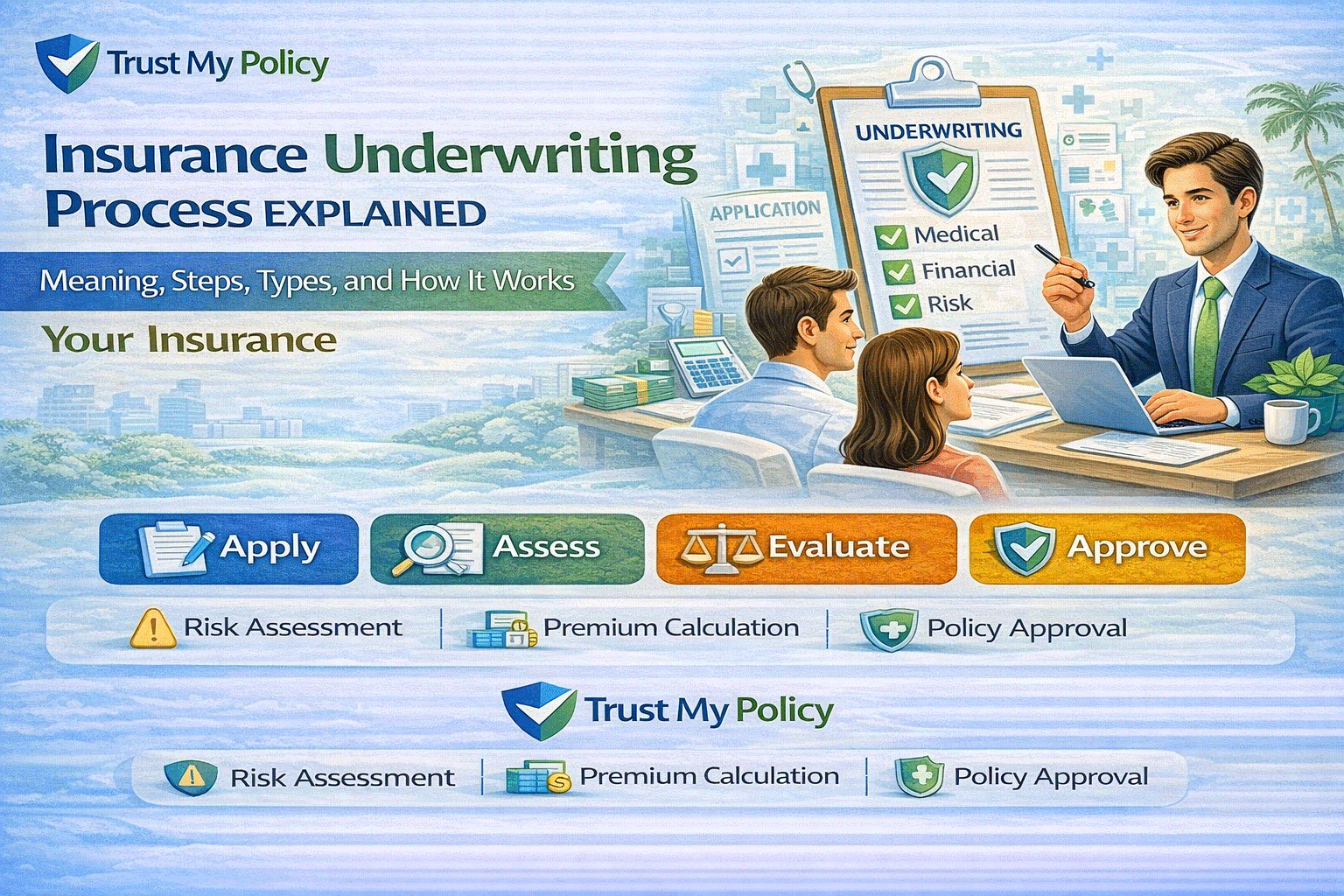
The insurance underwriting process typically involves five stages: application intake, risk assessment, risk classification, the underwriting decision, and policy issuance. Simple applications often move through an automated version of this process in minutes, while complex or high-value applications involve manual review, additional documentation requests, and sometimes inspections or exams at each stage.
Felix Adebayo, 41, applied for commercial property insurance for his Manchester warehouse and was surprised to learn his application would pass through four distinct internal stages before he received a final offer, including a third-party inspection he hadn’t anticipated. Understanding the actual workflow helped him stop calling for updates every other day and instead anticipate exactly when each stage would likely conclude.
The Insurance Underwriting Process in 2026 typically moves through five distinct internal stages: application intake, risk assessment, classification, decisioning, and policy issuance, with an ongoing review stage at each renewal. Each stage involves specific people, data sources, and decision points inside the insurer’s operations. This guide walks through exactly what happens at each stage, so you know what to expect and when.
This article covers the full internal workflow stage by stage, who’s involved at each point, real scenarios showing the process in action, and how to keep your application moving smoothly. By the end, you’ll understand the operational journey your application actually takes.
| Feature | Details |
| What it is | The internal stage-by-stage workflow insurers use to evaluate and decide on an application |
| Who is involved | Underwriters, automated underwriting systems, inspectors, and sometimes medical examiners |
| Typical stages | Intake, risk assessment, classification, decision, policy issuance |
| Typical timeline | Minutes for automated cases; days to weeks for manual, complex cases |
| Key benefit | A structured process ensures consistent, data-driven decisions across applicants |
| Key limitation | Complex cases requiring inspections or exams can extend the timeline significantly |
| Regulator | State insurance departments (US); Financial Conduct Authority and Prudential Regulation Authority (UK) |
Picture the underwriting process like an assembly line at a factory, where your application moves from station to station, each one adding a specific piece of analysis before passing it to the next. Understanding which station your application is currently at helps explain both the timeline and what’s actually happening behind the scenes.
The insurance underwriting process is the internal sequence of stages an insurer uses to move an application from initial submission to a final coverage decision. While automated systems can compress this into a near-instant process for simple cases, complex or high-value applications move through each stage individually, often involving multiple people and external data sources. Anyone applying for life, health, property, or commercial insurance benefits from understanding this workflow, since it explains both the timeline and the documentation requests along the way.
| Criteria | Automated Underwriting Workflow | Manual Underwriting Workflow |
| Typical timeline | Minutes to same-day | Days to several weeks |
| Stages involved | Compressed, algorithm-driven version of all five stages | Each stage handled individually, often by different specialists |
| Best suited for | Simple, lower-coverage, straightforward risk profiles | Complex, high-value, or unusual risk profiles |
| Pros | Fast, convenient, consistent decisioning for simple cases | More thorough, accommodates nuance and special circumstances |
| Cons | May not capture context that benefits from human judgment | Slower, requires more applicant effort and patience |
We recommend most readers expect an automated workflow for simpler applications and budget extra time for manual workflows on complex or high-value coverage.
Scenario 1: Felix, 41, warehouse owner in Manchester. Felix’s commercial property application moved through all five stages, including a third-party property inspection during risk assessment, before reaching a final decision. Verdict: commercial and high-value applications typically require the full manual workflow. Action: Felix scheduled his inspection promptly once he understood it was a required stage, shortening his overall timeline.
Scenario 2: A 28-year-old applying for a basic $300,000 term life policy in Austin. Her application moved through an automated underwriting workflow, completing intake, assessment, classification, and decision within 24 hours. Verdict: simple, lower-coverage life insurance applications are well suited to automated workflows. Action: she confirmed her policy was officially issued before assuming coverage had started.
Scenario 3: A driver in Leeds with a recent at-fault accident applying for auto insurance. His application required manual risk assessment because the automated system flagged his recent claim for human review. Verdict: automated systems often flag certain risk factors for escalation to manual review rather than handling them automatically. Action: he provided additional context about the accident circumstances, which the underwriter considered during classification.
Scenario 4: A small business applying for liability insurance with an unusual operational risk. The underwriter requested additional documentation about specific safety procedures before completing risk classification. Verdict: unusual or unique risks often trigger additional information requests mid-process. Action: the business provided its safety protocol documentation promptly, avoiding further delay.
| Pros | Cons |
| A structured, stage-based process ensures consistent evaluation criteria. | Manual workflows for complex cases can take weeks to complete. |
| Automated workflows provide fast decisions for straightforward applications. | Automated systems sometimes flag and escalate cases unnecessarily, adding delay. |
| Each stage allows for additional context or documentation if something is flagged. | Applicants aren’t always told clearly which stage their application is currently in. |
| Ongoing review at renewal helps keep pricing accurate over time. | Multiple specialists involved in manual workflows can mean slower communication. |
| Clear stages make it easier to identify exactly what’s causing a delay. | Inspections or exams required mid-process can extend the timeline significantly. |
⚠️ WARNING: Never assume your coverage is active simply because an automated system gave an initial approval. Confirm directly with your insurer that your policy has been fully issued and your first payment has been processed before assuming you’re covered.
| Your Situation | Our Recommendation |
| Your application has been pending for several weeks with no update | Yes — contact your insurer and ask which stage it’s currently in |
| You’ve been asked for an inspection, exam, or additional document | Yes — complete it promptly to avoid further delay |
| You received an automated approval and assume you’re covered | Yes — confirm with your insurer that the policy is fully issued before assuming coverage |
| Your application was escalated from automated to manual review | Yes — this is a normal part of the process, not necessarily a bad sign |
| You have a known risk factor likely to be flagged | Yes — proactively provide context for it rather than waiting to be asked |
| You’re applying for a high-value or complex policy | Yes — budget extra time for the full manual workflow |
| You’re unsure why your application moved to a different stage | Yes — ask your underwriter or broker for a plain-language explanation |
💡 TIP: The single golden rule for navigating the underwriting process: ask which specific stage your application is in and what’s needed to move it forward, rather than waiting passively for an update.
| Scenario | Process Path | Typical Timeline |
| Basic term life policy, healthy applicant, lower coverage | Automated workflow, all stages compressed | Minutes to 24 hours |
| Term life policy, higher coverage requiring a paramedical exam | Manual workflow with medical underwriting stage | 1–3 weeks |
| Standard auto insurance, clean driving record | Automated workflow | Minutes to same-day |
| Auto insurance with a recent at-fault claim | Escalated to manual risk assessment | A few days to 1 week |
| Commercial property insurance requiring inspection | Full manual workflow with inspection stage | 2–6 weeks |
| Home insurance, straightforward property | Automated or lightly manual workflow | 1–5 business days |
| Renewal underwriting review (existing policyholder) | Lighter version of the full workflow | Often completed automatically unless a flag arises |
Independent insurance brokers — Brokers can track which stage your application is in and follow up directly with the underwriter on your behalf. Cost range: typically free for the consumer. Best for: anyone wanting active progress tracking on a complex application. Rating: varies by broker, check state or FCA licensing.
Your insurer’s applicant portal or app — Many insurers now provide a status tracker showing which underwriting stage your application has reached. Cost range: free to use. Best for: checking real-time status without needing to call. Rating: not applicable, primary service channel.
NAIC consumer resources (US) — Publishes plain-language guidance on how the underwriting process is regulated across US states. Cost range: free public resource. Best for: US consumers wanting unbiased educational material. Rating: regulatory standards body.
Financial Conduct Authority (UK) — Sets conduct standards for how UK insurers must communicate underwriting timelines and decisions fairly. Cost range: free to consult guidance. Best for: UK consumers wanting to understand fair process standards. Rating: government regulatory body.
Specialty insurance brokers — Brokers experienced with complex commercial or high-value underwriting cases that require multiple inspection or documentation stages. Cost range: typically free for the consumer. Best for: applicants with unusual or complex risk profiles. Rating: varies by broker, check licensing.
We recommend an independent broker as best overall because they can actively track and follow up on your application’s progress through each stage, rather than leaving you to wait passively.
The insurance underwriting process is the internal sequence of stages an insurer uses to move an application from submission through risk assessment, classification, and a final coverage decision.
Most underwriting processes involve five core stages: application intake, risk assessment, risk classification, the underwriting decision, and policy issuance.
Automated workflows for simple applications can take minutes to a day, while manual workflows for complex or high-value applications can take anywhere from several days to a few weeks.
This usually happens when a specific risk factor, like a recent claim or unusual property feature, is flagged for human review rather than an automatic decision.
The underwriter or automated system gathers relevant data, such as medical records, driving history, or a property inspection report, to evaluate your specific risk.
Yes, in many cases, by promptly completing any requested exams, inspections, or documentation, and by proactively providing context for any known risk factors.
Usually, but not always; some automated approvals remain subject to a final review stage, so it’s worth confirming with your insurer that your policy has been fully issued.
Once approved, the insurer formally issues the policy documents and establishes the coverage start date, officially activating your protection under the agreed terms.
Yes, typically in a lighter form, where the insurer reviews any new information, like recent claims, before confirming your renewal terms and pricing.
Commercial applications often require additional stages, like property inspections or detailed risk documentation, reflecting the typically more complex and varied nature of business risks.
This article is for informational purposes only. Always consult a licensed insurance professional before making coverage decisions. Trust My Policy does not sell insurance products or represent any insurer.

Jagadeesh Gutha is the founder of TrustMyPolicy.com, an independent insurance information platform covering life, health, car, home, and business insurance for US and UK readers. He researches insurance products, policy structures, and consumer rights to help everyday people make informed coverage decisions without the jargon. All content on TrustMyPolicy is independently researched, fact-checked, and written to educate — not to sell.


Insurance Guides for UK, USA & Worldwide We are not an insurer or broker.
Reader Comments (0)