
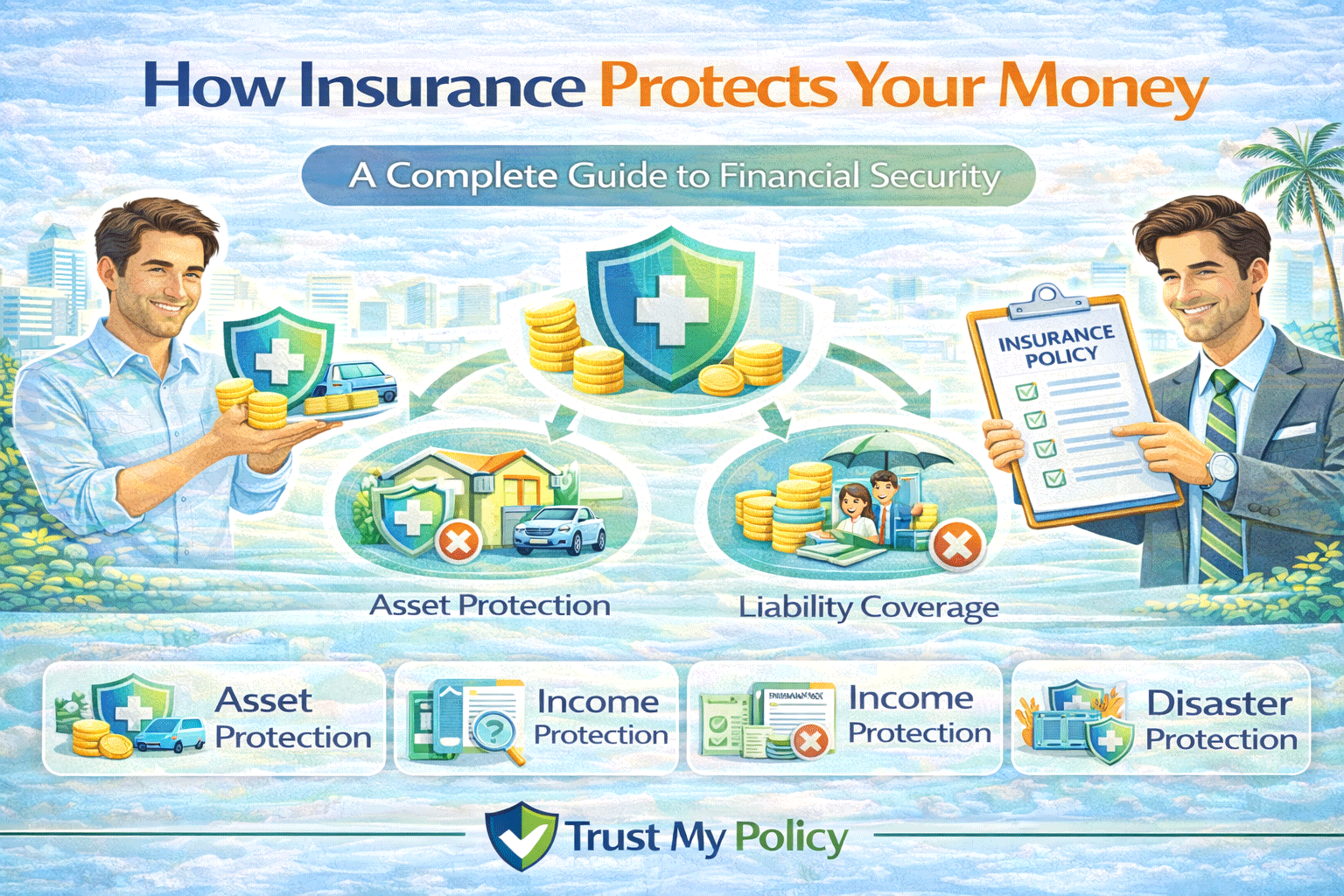
Insurance protects your money by transferring the cost of large, unpredictable losses — medical bills, lawsuits, property damage, or lost income — to an insurer in exchange for a small premium. Without it, a single event like Nadia’s $310,000 accident claim could wipe out years of savings and create lasting debt instead of being fully absorbed by a policy.
Nadia Hussain, 44, had spent eleven years building a $90,000 emergency fund in Chicago. A single severe car accident — not even her fault — generated $310,000 in medical bills and legal claims from the other driver. Her auto liability coverage absorbed the entire amount. Without it, her entire savings would have been gone in one afternoon, and she’d still have owed hundreds of thousands more.
How Insurance Protects Your Money in 2026 works by shielding your savings, assets, and future income from financial shocks too large to absorb alone. Instead of draining your emergency fund or going into debt after a major loss, your premium transfers that risk to an insurer with the financial capacity to pay it. This guide breaks down exactly how each core type of insurance protects different parts of your financial life.
This article covers how insurance shields your savings, assets, and income specifically, real scenarios with dollar amounts, and how to make sure your coverage actually matches what you have to protect. By the end, you’ll know exactly where your money is most exposed without it.
| Feature | Details |
| What it is | A financial mechanism that shields savings, assets, and income from large losses |
| Who needs it | Anyone with savings, a home, a car, dependents, or earned income |
| Typical core premium cost | $500–$2,500/year for auto and home combined in the US; £300–£1,200 in the UK |
| Money it protects | Emergency savings, home equity, future income, and retirement funds |
| Key benefit | Prevents a single event from erasing years of accumulated savings |
| Key limitation | Coverage limits that are too low can still leave a financial gap |
| Regulator | State insurance departments (US); Financial Conduct Authority (UK) |
Think of your savings like a dam holding back years of careful work. Insurance acts like a spillway, redirecting the force of a sudden flood — a lawsuit, an accident, an illness — away from that dam so it doesn’t burst all at once. Without that spillway, even one large event can wipe out everything behind it.
Insurance protects your money by absorbing the cost of large, unpredictable losses that would otherwise come directly out of your savings, assets, or future income. Anyone who has spent years building savings, equity, or retirement funds needs adequate coverage, since a single uninsured event can erase that progress instantly.
| Criteria | Self-Insuring (No Coverage) | Transferring Risk (With Insurance) |
| Who absorbs a major loss | You, directly from savings or future income | The insurer, up to your policy limits |
| Financial exposure | Potentially unlimited | Capped at your premium plus any deductible |
| Best suited for | Very small, easily affordable risks | Large, rare, potentially catastrophic risks |
| Pros | No ongoing premium cost | Predictable, budgetable cost regardless of loss size |
| Cons | Full exposure to catastrophic losses | Ongoing premium cost even without a claim |
We recommend transferring large risks through insurance for most readers because self-insuring only makes sense for losses small enough that you could comfortably absorb them without disrupting your financial stability.
Scenario 1: Nadia, 44, accident victim in Chicago. Nadia’s $310,000 in accident-related liability claims were fully absorbed by her auto liability coverage, protecting her $90,000 emergency fund entirely. Verdict: her coverage limit matched a realistic worst-case scenario. Action: Nadia reviewed her liability limits again at renewal to confirm they still match current legal cost trends.
Scenario 2: A small business owner in Texas without business interruption coverage. A fire forced a two-month closure, and lost revenue depleted nearly all of the owner’s retained earnings. Verdict: property coverage alone didn’t protect the business’s actual cash flow. Action: the owner added business interruption coverage to protect future revenue gaps.
Scenario 3: A 41-year-old father in Leeds with a £400,000 term life policy. After his unexpected death, the payout covered the remaining mortgage and replaced three years of his income for his family. Verdict: the policy directly protected his family’s long-term financial stability. Action: his widow used part of the payout to rebuild an emergency fund rather than relying on credit.
Scenario 4: A self-employed contractor in Arizona who became unable to work after a injury. Her disability insurance replaced 60% of her income for eight months, preventing her from draining her retirement savings. Verdict: income protection preserved her long-term financial progress, not just her short-term cash flow. Action: she increased her coverage percentage at renewal after seeing how close she came to needing more.
| Pros | Cons |
| Prevents a single event from erasing years of accumulated savings. | Requires an ongoing premium cost even during loss-free years. |
| Protects future income, not just current assets, through life and disability coverage. | Coverage limits that are too low can still leave a real financial gap. |
| Allows you to budget for risk with a predictable cost instead of an unpredictable one. | Comparing coverage limits and exclusions takes more effort than just comparing price. |
| Frees up savings to be used for goals instead of held as a self-insurance buffer. | Some events, like normal market losses, aren’t insurable at all. |
| Supports long-term financial planning by reducing catastrophic uncertainty. | Premiums can rise over time even without a personal claim. |
⚠️ WARNING: Never assume your emergency fund alone can replace liability coverage. Lawsuit damages can exceed even a substantial savings balance, leaving you personally responsible for the remainder.
| Your Situation | Our Recommendation |
| Your liability limits haven’t been reviewed in years | Yes — compare them against current local legal and medical cost trends |
| You have savings but no disability insurance | Yes — consider income protection, since savings alone may not last through an extended disability |
| You’re a small business owner without interruption coverage | Yes — add it to protect cash flow during a covered closure |
| Your home’s rebuild cost has risen since you last checked | Yes — update your dwelling coverage to match current rebuild costs |
| You’re relying on savings instead of insurance for a large risk | No — reserve self-insuring for smaller, more manageable risks |
| You haven’t reviewed your life insurance coverage since a major life change | Yes — update your coverage amount after marriage, children, or a new mortgage |
| Your savings have grown significantly since you set your coverage limits | Yes — reassess whether your current limits still make sense |
💡 TIP: The single golden rule for protecting your money with insurance: reserve self-insuring for risks small enough to comfortably absorb, and use insurance for anything that could realistically exceed your savings.
| Scenario | Annual Premium | Money Protected If a Loss Occurs |
| US auto liability insurance, $100,000 limit | $500–$900 | Up to $100,000 in lawsuit and medical claims |
| US homeowners insurance, full rebuild coverage | $1,200–$2,500 | $200,000–$500,000+ in rebuild and replacement costs |
| UK home insurance, full rebuild coverage | £250–£600 | £150,000–£400,000+ in rebuild and replacement costs |
| US term life insurance, $500,000, healthy 35-year-old | $250–$450 | $500,000 in income replacement for dependents |
| US disability insurance, 60% income replacement | $300–$700 | Tens of thousands per year in protected income during disability |
| Small business interruption coverage | $500–$2,000 | Months of protected revenue during a covered closure |
| Umbrella liability policy, $1,000,000 extra coverage | $200–$400 | An additional $1,000,000 in protection beyond standard policy limits |
State Farm — Offers bundled home, auto, and umbrella liability coverage useful for protecting savings against lawsuits. Cost range: competitive, varies by state. Best for: US households wanting comprehensive asset protection. Rating: AM Best A++.
Policygenius (US) — A comparison platform specializing in life and disability insurance for income protection. Cost range: free to compare. Best for: US buyers focused on protecting future income. Rating: independently reviewed comparison service.
Aviva — A leading UK insurer offering home, life, and income protection coverage with strong financial strength ratings. Cost range: competitive UK pricing. Best for: UK households wanting comprehensive financial protection. Rating: Defaqto 5 Star.
Chubb — Known for high-limit liability and umbrella policies that protect substantial assets and savings. Cost range: higher-tier pricing for higher coverage limits. Best for: individuals with significant assets to protect. Rating: AM Best A++.
Compare the Market (UK) — A leading UK comparison site for home, life, and income protection insurance quotes. Cost range: free to compare. Best for: UK shoppers wanting to compare financial protection options quickly. Rating: FCA-regulated comparison service.
We recommend Policygenius or Compare the Market as best overall starting point because both make it easy to compare life and income protection options that specifically guard your long-term financial stability.
Insurance protects your money by transferring the cost of large, unpredictable losses — lawsuits, property damage, medical bills, or lost income — to an insurer in exchange for a small, predictable premium.
Not for large risks. Emergency funds work well for small, manageable expenses, but liability lawsuits and major losses can easily exceed even a substantial savings balance.
Liability coverage absorbs lawsuit and medical claim costs that could otherwise come directly out of your savings, sometimes for amounts far larger than most people have saved.
Yes. Life insurance specifically protects your dependents’ financial future by replacing lost income, covering debts like a mortgage, and preventing a sudden drop in their standard of living.
Often yes, since an extended disability can drain savings faster than expected, and disability insurance specifically protects your ongoing earning power during recovery.
Compare your limits against realistic local costs for lawsuits, medical care, and rebuilding your home, and consider an umbrella policy if your assets exceed standard limits.
An umbrella policy adds extra liability protection beyond your standard home and auto limits, which is useful for protecting significant savings or assets from a large lawsuit.
Yes. Business interruption coverage protects cash flow and revenue during a covered closure, which property coverage alone doesn’t address.
Review your coverage limits every year at renewal and immediately after any major financial change, like a salary increase, new asset, or paid-off mortgage.
Yes, for risks small enough that you could comfortably absorb the loss yourself, self-insuring can be more cost-effective than paying ongoing premiums.
This guide reflects the latest 2026 insurance data.
This article is for informational purposes only. Always consult a licensed insurance professional before making coverage decisions. Trust My Policy does not sell insurance products or represent any insurer.

Jagadeesh Gutha is the founder of TrustMyPolicy.com, an independent insurance information platform covering life, health, car, home, and business insurance for US and UK readers. He researches insurance products, policy structures, and consumer rights to help everyday people make informed coverage decisions without the jargon. All content on TrustMyPolicy is independently researched, fact-checked, and written to educate — not to sell.


Insurance Guides for UK, USA & Worldwide We are not an insurer or broker.

Reader Comments (0)