

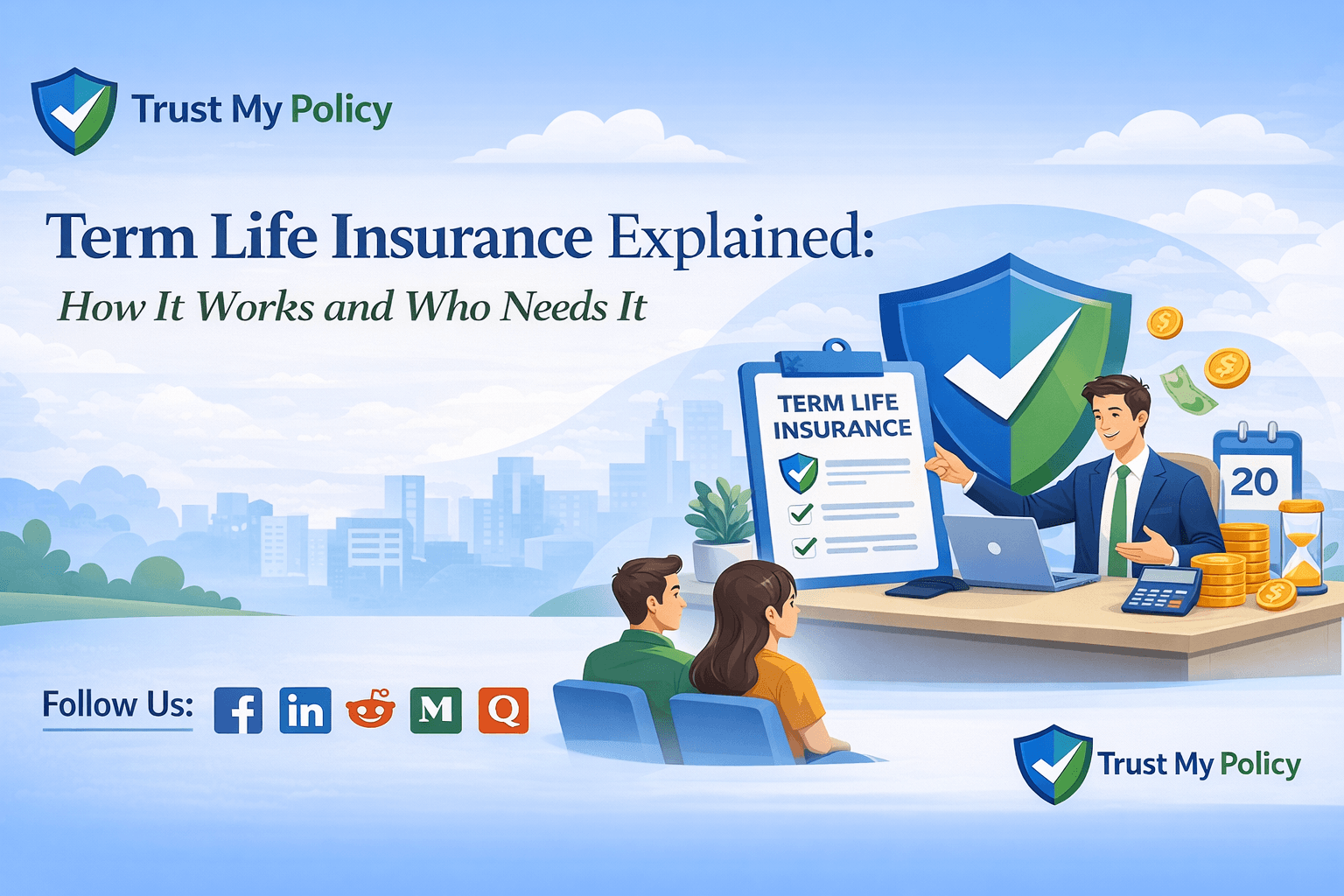
Term life insurance provides a fixed death benefit for a set period — typically 10, 15, 20, or 30 years — at a fixed monthly premium. A healthy 32-year-old male can get $500,000 of 20-year term coverage for approximately $20–$30 a month. Unlike whole life insurance, term has no cash value and expires at the end of the term. It’s the recommended starting point for most people who need life insurance.
Table of Contents
ToggleTerm Life Insurance
James Fielding, 32, spent three months comparing whole life and universal life policies with a financial adviser before his wife pointed out they just needed enough money to cover the mortgage and raise the kids if something happened to him. A 20-year term policy gave him $750,000 in coverage for $28 a month. The whole life policy for the same amount would have cost $680 a month.
Term Life Insurance in 2026 is the most straightforward, affordable, and widely held type of life insurance: a fixed death benefit paid to your beneficiary if you die during the policy term, at a fixed monthly premium that doesn’t change for the life of the term. There’s no cash value, no investment component, and no complexity — just protection at the lowest possible cost for the years your family needs it most. This guide covers everything you need to choose the right policy.
This article covers exactly how term life insurance works, how to choose the right coverage amount and term length, how premiums are set, real costs by age, the best providers, and when to consider converting to a permanent policy. By the end, you’ll know exactly what to buy and why.
Quick Summary Table
| Feature | Details |
| What it is | Fixed death benefit for a fixed term at a fixed monthly premium |
| Typical term lengths | 10, 15, 20, 25, or 30 years |
| Typical coverage amounts | $100,000 to $5,000,000+ |
| Typical cost | $15–$30/month for $500,000 at age 25–35 |
| Cash value | None |
| What happens at term end | Coverage expires; some policies offer renewal at a higher rate or conversion to permanent |
| Regulator | State insurance departments (US); Financial Conduct Authority (UK) |
What Is Term Life Insurance, Really?
Think of term life insurance like renting protection rather than buying it. You pay a fixed monthly amount for a fixed period — your “lease” on coverage. If you die during that period, your beneficiary receives the full agreed amount. If you don’t, the term ends and you’ve had the security of knowing your family was protected throughout. Unlike whole life insurance, you don’t build equity in the policy, and there’s nothing to cash out at the end — but the cost is dramatically lower for the same level of protection.
Term life insurance is the simplest and most affordable form of life insurance, providing a fixed death benefit if you die during the specified policy term, at a premium that stays level throughout that term. It has no cash value component, no investment element, and no savings function — it exists purely to protect the people who depend on your income during the years they’re most financially vulnerable. The vast majority of independent financial advisers and insurers recommend term life as the appropriate starting point for people who need life insurance.
How Term Life Insurance Actually Works — 5 Steps
- You choose a coverage amount and term length at application. Coverage amounts typically range from $100,000 to $5 million or more; term lengths most commonly run for 10, 15, 20, 25, or 30 years.
- You’re underwritten based on your age, health, and lifestyle. This is where your premium is set — the better your health profile, the lower your rate class and monthly cost.
- You pay a fixed monthly premium throughout the entire term. Unlike annual renewable term, level term premiums don’t increase year by year — they stay exactly the same from month one to the final month.
- If you die during the term, your beneficiary receives the death benefit tax-free. The insurer pays the full coverage amount regardless of how recently you started paying or how much premium you’ve paid in total.
- If you outlive the term, the policy expires. Depending on your policy, you may have the option to renew at a higher rate, convert to a permanent policy, or simply let the coverage end.
Comparison: Term Life vs. Whole Life Insurance
| Criteria | Term Life Insurance | Whole Life Insurance |
| Monthly cost ($500,000, age 32, male) | $20–$35/month | $500–$700/month |
| Coverage duration | Fixed term (10–30 years) | Permanent (lifetime) |
| Cash value | None | Builds over time |
| Complexity | Simple — pure protection | Complex — insurance plus savings component |
| Best for | Most people who need affordable, substantial protection for a defined period | Those specifically wanting permanent coverage or a cash value component |
| Pros | Maximum coverage for minimum cost | Guaranteed coverage regardless of future health changes |
| Cons | No cash value; coverage ends at term | Dramatically higher cost for the same death benefit |
We recommend term life insurance for most readers because the cost difference is so large that most people are far better served buying substantial term cover and investing the difference separately.
4 Real-Life Scenarios
Scenario 1: James, 32, with a mortgage and two young children. James’s 20-year, $750,000 term policy at $28 a month gives him full protection through the years his children are most financially dependent and his mortgage is outstanding. Verdict: a 20-year term aligned to his mortgage payoff and his youngest child reaching adulthood is the textbook correct term choice. Action: James set a calendar reminder to review his coverage needs at year 15.
Scenario 2: A 25-year-old teacher in Manchester with no dependants and no mortgage. She bought a modest £200,000, 25-year term policy at £9 a month, locking in a rate that will cover her for the entire period she expects to build a family and take on a mortgage. Verdict: buying term early to lock in a low rate is one of the clearest financial advantages of term life. Action: she noted a calendar reminder to increase her cover if she takes on a mortgage or has children.
Scenario 3: A 55-year-old small business owner in Dallas who let his 20-year term lapse and reapplied. His new 10-year policy for $500,000 cost $185 a month — nearly seven times what he’d paid at 32. Verdict: the cost of delaying or letting term coverage lapse for even a few years is substantial by middle age. Action: he set up autopay on his new policy to ensure it would never lapse again.
Scenario 4: A 40-year-old who bought a 30-year term policy instead of a 20-year. She paid a modestly higher premium for the longer term but secured coverage through her late 60s rather than mid-50s, giving her family protection through potential late-stage income disruption years. Verdict: choosing a slightly longer term as insurance against income needs extending beyond the expected period is a reasonable strategy. Action: she confirmed the policy included a conversion option if she later wanted permanent coverage.
Pros & Cons of Term Life Insurance
| Pros | Cons |
| The most affordable form of life insurance by a significant margin. | No cash value — the policy has no monetary value if you outlive the term. |
| Fixed premiums throughout the term provide completely predictable monthly costs. | Coverage expires at the end of the term, requiring a new application at a higher cost if extended. |
| High coverage amounts are accessible at low cost during early and mid-career years. | If your health deteriorates, renewing or replacing at term end can be significantly more expensive. |
| Simple structure with no investment complexity or ongoing management. | Doesn’t build any asset value over the term — all premiums are “spent” on protection. |
| Many policies include a conversion option to permanent coverage. | Won’t cover you if you die after the term ends unless you’ve renewed or converted. |
5 Common Mistakes People Make
- Choosing too short a term to save on premium. This happens because a 10-year term is significantly cheaper than a 20-year term. What to do instead: choose a term that covers your family until your youngest child is financially independent and your mortgage is paid off.
- Under-insuring to keep the premium low. This happens because a larger coverage amount feels extravagant. What to do instead: calculate what your family would actually need to replace your income and maintain their lifestyle for the full term.
- Letting a term policy lapse because of financial pressure. This happens because the premium feels discretionary during a tight month. What to do instead: set up autopay so the payment is never missed, and contact your insurer if financial hardship is temporary.
- Waiting until your 40s or later to apply. This happens because life insurance feels like something for people at a “later stage.” What to do instead: apply as early as possible — the premium increase from waiting even 5 years is significant and a new health condition in that window could raise it far more.
- Not including a conversion option in the original policy. This happens because conversion feels unnecessary at the time. What to do instead: ensure your policy includes a conversion right so you retain the option to move to permanent coverage without new medical underwriting.
⚠️ WARNING: Never let your term life policy lapse without a replacement plan in place. If your health has changed since you originally applied, reinstating or replacing cover may cost significantly more — and in some cases, a new application could be declined entirely.
Decision Table: How Should You Structure Your Term Cover?
| Your Situation | Our Recommendation |
| You have young children and a mortgage | Yes — a 20- or 25-year level term policy is the standard recommended structure |
| You’re in your 20s with no current dependants | Yes — buy a modest term now to lock in your current health-based rate |
| You’re weighing term versus whole life | Yes — term life for most people; invest the premium difference separately |
| Your current term is ending in the next 5 years | Yes — review your ongoing needs now and apply for a new term before the old one expires |
| You let a previous term lapse and want to reapply | Yes — apply immediately; further delay only increases the cost |
| You’re unsure how long a term you need | Yes — cover through your youngest child’s financial independence or mortgage payoff, whichever is later |
| You want the option to convert to permanent cover later | Yes — ensure your policy includes a guaranteed conversion right |
💡 TIP: The single golden rule for term life insurance: choose a term long enough to cover the full period your family depends on your income — not the shortest term that minimises your monthly premium.
Cost Table: Term Life Insurance Premiums by Age
| Scenario | Monthly Premium | Notes |
| Age 25, healthy, $500,000, 20-year term | $15–$22/month | Among the lowest rates available for any coverage level |
| Age 30, healthy, $500,000, 20-year term | $18–$28/month | Still very affordable; most advisers recommend applying by this age |
| Age 35, healthy, $500,000, 20-year term | $25–$38/month | Noticeable but still highly affordable rate |
| Age 40, healthy, $500,000, 20-year term | $45–$70/month | Meaningful premium increase versus 10 years earlier |
| Age 45, healthy, $500,000, 20-year term | $80–$130/month | Cost roughly 4–5x the age-25 equivalent |
| Age 55, male, $500,000, 10-year term | $160–$220/month | Demonstrates compounding cost of delay |
| UK, age 32, healthy, £300,000, 20-year term | £12–£22/month | Comparable affordability to US equivalent |
Best Providers for Term Life Insurance
Haven Life (US) — A fully digital term life insurer offering fast online applications, often approved same-day for healthy applicants. Cost range: competitive term pricing. Best for: US applicants wanting the fastest, most straightforward application experience. Rating: backed by MassMutual, AM Best A++.
Banner Life (US) — Offers flexible term lengths and consistently competitive pricing, particularly for 20- and 30-year terms. Cost range: competitive US term pricing. Best for: US applicants wanting flexibility in both term length and coverage amount. Rating: AM Best A+.
Legal & General (UK) — One of the UK’s largest and most competitively priced term life providers with a straightforward online application. Cost range: competitive UK term pricing. Best for: UK applicants wanting an established, financially strong insurer. Rating: Defaqto 5 Star.
Aviva (UK) — Offers both personal term life and relevant life options with strong financial backing and a well-regarded claims service. Cost range: competitive UK pricing. Best for: UK applicants wanting a broad term life and additional cover option from one insurer. Rating: Defaqto 5 Star.
Protective Life (US) — Known for strong term pricing and a track record of approving applicants with borderline health histories at competitive rates. Cost range: competitive US term pricing. Best for: US applicants with a non-standard health history wanting full underwriting consideration. Rating: AM Best A+.
We recommend Haven Life for straightforward US applications and Legal & General for UK applications as best overall, since both combine competitive pricing with fast, simple application processes.
Frequently Asked Questions
What is term life insurance?
Term life insurance provides a fixed death benefit if you die during a specified policy term, at a fixed monthly premium, with no cash value or investment component.
How long should my term life policy last?
Choose a term that covers your family until your youngest child is financially independent and your mortgage is paid off — typically 20 to 25 years for most applicants in their 30s.
What happens if I outlive my term life policy?
The coverage expires. Depending on your policy, you may be able to renew at a higher rate, convert to a permanent policy, or simply let the coverage end if you no longer need it.
How much term life insurance do I need?
A common starting point is 10 to 12 times your annual income, though the right amount should reflect your specific mortgage, debts, and your dependants’ financial needs.
Is term life insurance worth it?
Yes for most people with dependants. It provides substantial protection at the lowest possible cost for the years your family is most financially vulnerable.
Can I convert my term life policy to whole life?
Many term policies include a guaranteed conversion option, allowing you to switch to permanent coverage without new medical underwriting. Confirm this is included when you apply.
What is a level term life insurance policy?
A level term policy maintains the same death benefit and premium throughout the entire term, unlike decreasing term (common for mortgage protection) where the benefit reduces over time.
Can I have more than one term life policy?
Yes. Many people hold multiple term policies to cover different financial needs — a larger policy for income replacement and a smaller policy specifically for mortgage protection, for example.
Why is term life so much cheaper than whole life insurance?
Term life is cheaper because it only provides pure protection — there’s no cash value accumulation or investment component to fund on top of the death benefit.
What is a conversion option in a term life policy?
A conversion option is a contractual right that allows you to convert your term policy to a permanent policy without new medical underwriting, regardless of any health changes since the original application.
Key Takeaways
- Choose a term long enough to cover the full period your family depends on your income.
- Apply as early as possible — the cost increases with every year of delay.
- Choose term life over whole life for most needs and invest the premium difference separately.
- Ensure your policy includes a guaranteed conversion right.
- Size your coverage to your family’s actual financial need, not the minimum that feels affordable.
- Set up autopay to ensure the policy never lapses due to a missed payment.
- Review your ongoing coverage needs at least once in the middle of the term.
This guide reflects the latest 2026 insurance data.
This article is for informational purposes only. Always consult a licensed insurance professional before making coverage decisions. Trust My Policy does not sell insurance products or represent any insurer.



Reader Comments (2)
[…] Term life insurance is the simplest, most affordable form of life cover. You choose a coverage amount — the death benefit — and a policy term: 10, 15, 20, 25, or 30 years. If you die within that term, your beneficiaries receive the death benefit income-tax-free. If you outlive the term, coverage ends with no payout and no cash value returned. […]