
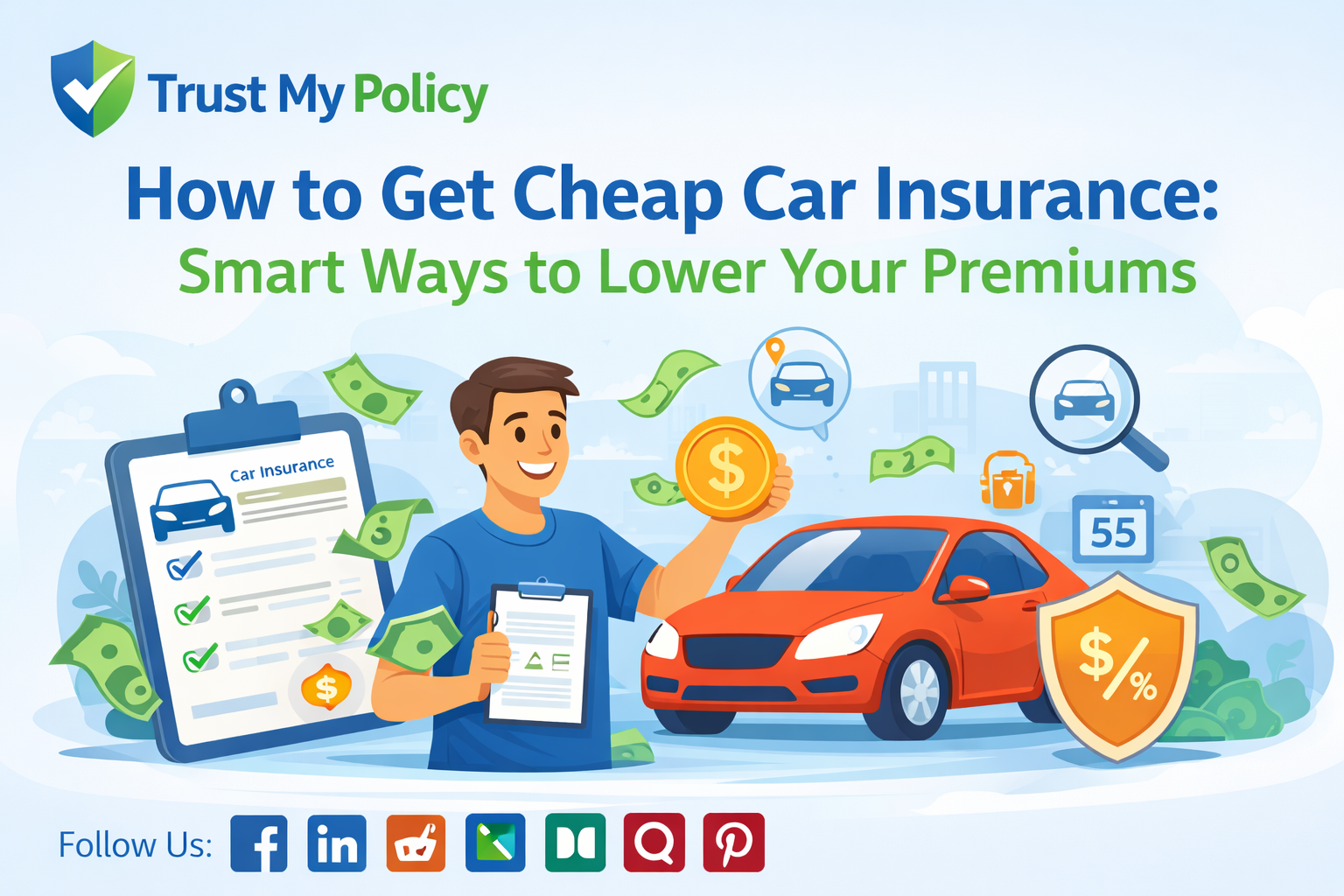
To get cheap car insurance, shop quotes from at least three insurers every renewal rather than auto-renewing, stack discounts like bundling, safe driver, and good student discounts, choose the highest deductible you can comfortably afford, and consider a usage-based telematics program if you’re a safe driver. Together, these tactics can often reduce a premium by 20–40% compared to simply accepting a renewal notice.
Derek Sanchez, 33, had renewed his auto policy with the same insurer for six years in Phoenix, assuming loyalty would keep his rate competitive. When he finally compared quotes after a friend’s suggestion, he found an identical policy for $43 less a month from a different insurer, despite his “loyal” insurer never once offering him that lower rate on its own.
How to Get Cheap Car Insurance in 2026 comes down to a specific set of actionable tactics: shopping multiple insurers every renewal, stacking every discount you actually qualify for, choosing the highest deductible you can comfortably afford, and maintaining a clean driving record over time. This guide walks through each tactic with real numbers, so you know exactly where the savings actually come from.
This article covers the specific tactics that genuinely lower your premium, which discounts matter most, real scenarios with dollar figures, and a clear action checklist. By the end, you’ll know exactly what to do before your next renewal.
| Feature | Details |
| What it is | A specific set of tactics for actively lowering your auto insurance premium |
| Who it applies to | Any driver, regardless of current insurer or driving history |
| Typical combined savings | 20%–40% compared to passively accepting a renewal |
| Key tactics | Shopping quotes, stacking discounts, raising deductibles, usage-based programs |
| Key benefit | Most tactics require no change in coverage quality, just active comparison |
| Key limitation | Some tactics, like a higher deductible, increase your out-of-pocket cost if you do claim |
| Regulator | State insurance departments (US); Financial Conduct Authority (UK) |
Think of your auto insurance renewal like a subscription service that quietly raises its price every year, betting that most customers won’t bother to check if a better deal exists elsewhere. Insurers rely heavily on this same inertia, which is exactly why active comparison shopping tends to be the single biggest lever for lowering your premium.
Getting cheap car insurance isn’t about finding one secret cheap insurer, it’s about consistently applying a specific set of tactics: comparing quotes regularly, claiming every discount you actually qualify for, and making coverage choices, like your deductible, that match your real financial situation. Anyone currently paying for auto insurance can apply these tactics regardless of their driving history or current insurer.
| Criteria | Passive Renewal (Auto-Renew) | Active Shopping Every Renewal |
| Typical outcome | Premium often increases gradually over time | Frequently reveals a meaningfully lower rate elsewhere |
| Effort required | None | A modest amount of time comparing 3+ quotes |
| Insurer incentive | Insurers have little incentive to proactively lower a renewing customer’s rate | Competing insurers price aggressively to win new customers |
| Pros | Convenient, no effort needed | Often the single largest lever for genuine savings |
| Cons | Frequently leaves real savings unclaimed | Requires setting aside time each renewal cycle |
We recommend active shopping at every renewal for most readers, since this single habit is consistently the most reliable way to find genuine savings without changing your actual coverage quality.
Scenario 1: Derek, 33, driver in Phoenix. Derek’s six years of loyal auto-renewal left $43 a month in unclaimed savings on the table, found the moment he finally compared quotes elsewhere. Verdict: loyalty rarely translates into the best available rate from an existing insurer. Action: Derek now shops three insurers every renewal as a standing habit.
Scenario 2: Sarah, 27, driver in Leeds who bundled her auto and home insurance with one insurer. The bundling discount alone reduced her combined premium by 12% compared to separate policies. Verdict: bundling is one of the most reliably available discounts for most drivers. Action: Sarah now reviews her bundled discount annually to confirm it still beats separate policy pricing.
Scenario 3: Marcus, 24, safe driver in Austin who enrolled in a telematics program. His tracked driving behavior earned him a 15% discount within his first six-month review period. Verdict: usage-based programs can offer real, meaningful savings for genuinely safe drivers. Action: Marcus kept the program active to maintain his ongoing discount.
Scenario 4: A family in Manchester raising their auto deductible from £100 to £350. This single change lowered their annual premium by roughly 15%, with the family confirming they could comfortably afford the higher deductible if needed. Verdict: a higher deductible is one of the most direct, immediate ways to lower a premium. Action: they kept the savings difference in a dedicated emergency fund specifically for this purpose.
| Pros | Cons |
| Shopping multiple quotes every renewal often reveals significant unclaimed savings. | Requires setting aside time each renewal cycle to compare options. |
| Stacking discounts can compound into substantial combined savings. | Not every discount applies to every driver; eligibility varies. |
| Raising your deductible provides an immediate, predictable premium reduction. | A higher deductible means more out-of-pocket cost if you do need to claim. |
| Usage-based programs can meaningfully reward genuinely safe driving. | These programs require ongoing data sharing, which not everyone prefers. |
| Maintaining continuous coverage and a clean record compounds savings over time. | A single lapse or violation can undo years of accumulated savings quickly. |
⚠️ WARNING: Never let your coverage lapse to save money temporarily, even briefly. Insurers treat a coverage lapse as a risk signal, and the resulting rate increase when you reapply typically costs far more than whatever you saved by skipping payments.
| Your Situation | Our Recommendation |
| You’ve auto-renewed with the same insurer for several years | Yes — shop at least three quotes before your next renewal |
| You haven’t asked your insurer about available discounts | Yes — request a full list and check your eligibility for each |
| You have at least $500–$1,000 in available savings | Yes — consider raising your deductible to lower your premium |
| You’re a consistently safe driver | Yes — consider enrolling in a usage-based telematics program |
| You’re tempted to let coverage lapse to save money short-term | No — this typically costs more in future premium increases than it saves |
| You have multiple policies with different insurers | Yes — ask about bundling them with a single insurer for a discount |
| You’re a young driver with a clean record for several years running | Yes — ask specifically whether your insurer offers a long-term safe driver discount |
💡 TIP: The single golden rule for cheap car insurance: shop at least three quotes every single renewal, since this one habit consistently produces the largest savings of any single tactic available.
| Scenario | Typical Savings | Notes |
| Shopping three quotes instead of auto-renewing | 10%–25% | Often the single largest available savings lever |
| Bundling auto and home insurance with one insurer | 8%–15% combined | Common, widely available discount |
| Raising deductible from $500 to $1,000 | 10%–20% | Immediate, predictable premium reduction |
| Enrolling in a usage-based telematics program (safe driver) | 5%–20% | Varies based on actual tracked driving behavior |
| Good student discount (qualifying GPA) | 5%–15% | Common discount for young drivers maintaining strong grades |
| Low-mileage discount | 5%–10% | Available for drivers under a specific annual mileage threshold |
| Maintaining a clean record for 5+ years | 10%–20% cumulative | Compounds favorably the longer it’s maintained |
Policygenius and The Zebra (US) — Comparison platforms letting you see real auto insurance quotes from multiple insurers side by side. Cost range: free to compare. Best for: US drivers wanting a fast, comprehensive quote comparison. Rating: independent comparison services.
Compare the Market and Confused.com (UK) — Leading UK comparison sites for auto insurance quotes from multiple providers. Cost range: free to compare. Best for: UK drivers wanting fast multi-carrier quotes. Rating: FCA-regulated comparison services.
Progressive and GEICO (US) — Both offer competitive usage-based telematics programs alongside standard policies. Cost range: competitive US pricing. Best for: drivers wanting to compare standard versus usage-based options directly. Rating: AM Best A+ and A++ respectively.
Independent insurance brokers — Brokers can identify every discount you might qualify for across multiple insurers at once. Cost range: typically free for the consumer. Best for: anyone wanting a thorough discount eligibility check. Rating: varies by broker, check state or FCA licensing.
Your state insurance department (US) — Can confirm whether a specific discount or rate practice is standard or worth questioning. Cost range: free to contact. Best for: US consumers with specific pricing questions. Rating: government regulatory body.
We recommend Policygenius or The Zebra for US readers and Compare the Market or Confused.com for UK readers as best overall because comparing real quotes side by side is the single most effective tactic for genuine savings.
Shop quotes from at least three insurers every renewal, stack every discount you qualify for, choose the highest deductible you can comfortably afford, and consider a usage-based program if you’re a safe driver.
Yes, often significantly. Insurers rarely proactively offer their best rate to existing customers, so actively comparing quotes frequently reveals meaningful unclaimed savings.
Common discounts include bundling with home insurance, safe driver discounts, good student discounts, low-mileage discounts, and loyalty or multi-policy discounts.
Yes. Raising your deductible from $500 to $1,000 commonly lowers your premium by 10%–20%, though it increases your out-of-pocket cost if you do need to file a claim.
For consistently safe drivers, often yes, since these programs can offer meaningful discounts of 5%–20% based on your actual tracked driving behavior.
No, not in the long run. A coverage lapse is typically viewed as a risk signal by insurers, which can raise your premium significantly when you reapply for coverage.
At every renewal, ideally, since premiums and available discounts can shift meaningfully from year to year, even without any change in your personal driving record.
Usually, though not always. It’s still worth comparing the bundled price against separate policies from different insurers to confirm it’s genuinely the better deal.
Combining several tactics, like shopping quotes, stacking discounts, and raising your deductible, can often produce a combined savings of 20%–40% compared to a passive renewal.
Generally not, as long as you confirm your new policy starts before your old one ends, ensuring there’s no gap in your coverage during the switch.
This article is for informational purposes only. Always consult a licensed insurance professional before making coverage decisions. Trust My Policy does not sell insurance products or represent any insurer.

Jagadeesh Gutha is the founder of TrustMyPolicy.com, an independent insurance information platform covering life, health, car, home, and business insurance for US and UK readers. He researches insurance products, policy structures, and consumer rights to help everyday people make informed coverage decisions without the jargon. All content on TrustMyPolicy is independently researched, fact-checked, and written to educate — not to sell.



Insurance Guides for UK, USA & Worldwide We are not an insurer or broker.
Reader Comments (0)