
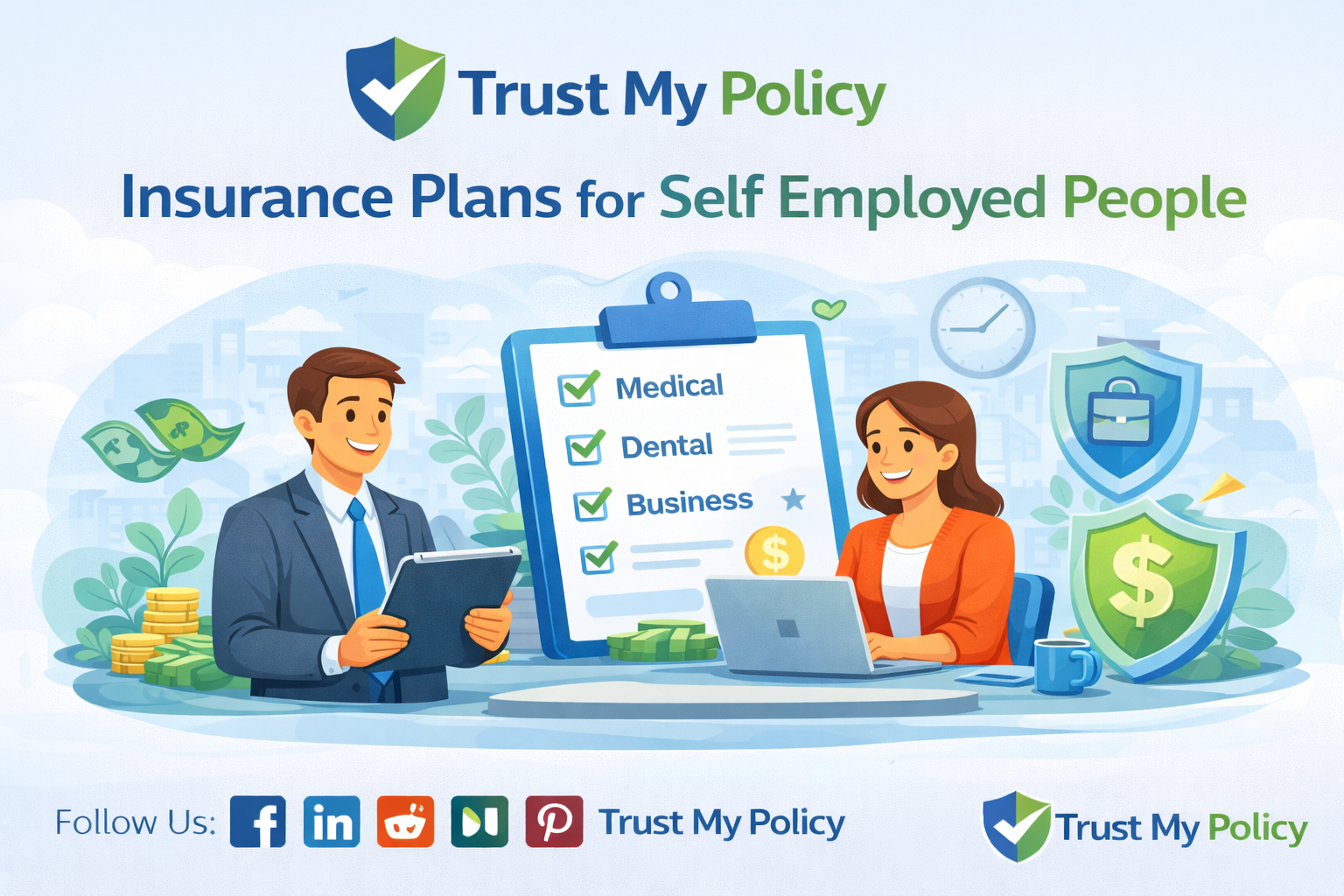
Self-employed people need to replace four types of coverage an employer typically provides: health insurance, disability or income protection, business liability insurance, and often life insurance. Health insurance is usually the largest cost, ranging from $400–$700 a month unsubsidized in the US, while disability and liability coverage together often add $50–$150 a month depending on your specific occupation and risk.
Gabriel Ortiz, 39, left his corporate job to run his own consulting practice in Chicago and assumed health insurance was the only coverage he’d need to replace. A year in, a client dispute and a six-week wrist injury that kept him off his laptop taught him that losing an employer also means losing four distinct types of protection at once, not just health coverage.
Insurance Plans for Self Employed People in 2026 need to replace an entire bundle of protection an employer normally provides: health insurance, disability or income protection, business liability coverage, and often life insurance, since none of these come automatically once you work for yourself. This guide breaks down each piece of that bundle, what it costs, and how to prioritize building it out.
This article covers the full insurance bundle self-employed people need to replace, what each piece costs, real scenarios showing the gaps in practice, and a clear framework for prioritizing your own setup. By the end, you’ll know exactly what your old employer was quietly providing.
| Feature | Details |
| What it is | The bundle of health, disability, liability, and life coverage self-employed people must arrange themselves |
| Who needs it | Sole proprietors, consultants, freelancers, and small business owners without an employer plan |
| Typical combined cost | $500–$900/month for a full coverage bundle in the US; lower in the UK given NHS access |
| Tax benefit | Self-employed health insurance premiums are generally deductible on Schedule 1 (US) |
| Key benefit | Replaces the full safety net an employer would otherwise provide automatically |
| Key limitation | Requires proactively researching and purchasing each piece separately |
| Regulator | State insurance departments and CMS (US); Financial Conduct Authority (UK) |
Picture your old employer’s benefits package as a four-piece toolkit they handed you automatically: health coverage, paid disability protection, liability coverage tied to your work, and sometimes a group life insurance policy. When you become self-employed, none of these four tools come with the job anymore — you have to go buy each one individually, often without realizing all four existed in the first place.
The self-employed insurance bundle consists of four distinct coverage types: health insurance, since you no longer have employer-sponsored coverage; disability or income protection, since there’s no employer-paid sick leave or short-term disability; business liability insurance, since your own assets are now directly exposed to claims related to your work; and often life insurance, since any employer-provided group policy disappeared the moment you left. Anyone newly self-employed needs to deliberately rebuild this entire bundle rather than assuming health insurance alone covers the full gap.
| Criteria | Employer-Provided Benefits | Self-Employed Replacement Coverage |
| Health insurance | Often partially employer-subsidized | Fully self-funded through marketplace or private plans |
| Disability/income protection | Often included as a free or low-cost benefit | Must be purchased individually as disability insurance |
| Liability protection | Covered under the employer’s business insurance | Must be purchased as your own business liability policy |
| Life insurance | Often included as a basic group policy | Must be purchased individually, usually as term life insurance |
| Pros | Convenient, often partially subsidized | Fully customizable to your specific needs and risk |
| Cons | Coverage ends the moment you leave the job | Requires proactive setup and full personal cost |
We recommend treating all four pieces as a connected bundle for most readers, rather than addressing only health insurance and assuming the rest isn’t urgent.
Scenario 1: Gabriel, 39, consultant in Chicago. A six-week wrist injury left Gabriel with zero income replacement, since he’d only set up health insurance and had no disability coverage in place. Verdict: health insurance alone doesn’t address the income-loss risk of self-employment. Action: Gabriel added an individual disability insurance policy covering 60% of his typical monthly income.
Scenario 2: Sarah, 34, freelance graphic designer in Leeds. A client threatened legal action over a missed deadline clause, and Sarah discovered she had no professional liability coverage to respond with. Verdict: self-employed professionals carry direct personal liability exposure without business insurance. Action: Sarah purchased a professional indemnity policy specifically covering claims related to her design work.
Scenario 3: Marcus, 45, self-employed electrician in Houston with two young children. Marcus had health insurance through the marketplace but no life insurance, leaving his family financially exposed if anything happened to him. Verdict: losing employer group life insurance is a commonly overlooked gap for the newly self-employed. Action: Marcus applied for a $750,000 term life policy within a month of recognizing the gap.
Scenario 4: A self-employed yoga instructor in Bristol renting studio space. A student’s injury during a class led to a liability claim that her landlord’s insurance didn’t cover, since it only protected the building itself. Verdict: even service-based self-employed work carries real liability exposure. Action: she purchased a general liability policy covering instructor-related injury claims going forward.
| Pros | Cons |
| Fully customizable to your specific income, risk, and family situation. | Requires proactively researching and purchasing each piece individually. |
| Self-employed health insurance premiums are generally tax-deductible in the US. | No employer subsidy means you bear the full cost of every piece. |
| You can scale coverage amounts directly with your actual business growth. | It’s easy to address only the most obvious piece (health) and neglect the rest. |
| Disability and liability coverage can be tailored precisely to your occupation. | Comparing quotes across all four coverage types takes meaningfully more effort. |
| You maintain full control over coverage even if you change clients or projects. | Premiums for some coverage types rise as you age, rewarding early setup. |
⚠️ WARNING: Never assume a landlord’s, client’s, or platform’s insurance covers your own personal liability as a self-employed worker. In nearly every case, you need your own dedicated liability policy specific to your work.
| Your Situation | Our Recommendation |
| You’re newly self-employed with no coverage in place yet | Yes — start with health insurance, then build out the rest of the bundle within months |
| You rely entirely on your own income with no savings cushion | Yes — prioritize disability insurance soon after health coverage |
| Your work involves any client-facing risk or physical service delivery | Yes — get liability insurance specific to your occupation |
| You have dependents or debt relying on your income | Yes — apply for term life insurance to replace any lost employer group policy |
| You assumed a client’s or landlord’s insurance covers you | No — purchase your own dedicated liability policy regardless |
| You’re unsure how much disability coverage to buy | Yes — aim for roughly 60% of your typical monthly income as a starting point |
| You’ve been self-employed for years without reviewing this bundle | Yes — reassess all four pieces now, since your income and risk likely changed |
💡 TIP: The single golden rule for self-employed insurance: budget for the full four-piece bundle — health, disability, liability, and life — rather than stopping once health insurance is in place.
| Scenario | Cost | Notes |
| Individual health insurance, subsidized (US) | $0–$240/month | Varies significantly by income and household size |
| Individual health insurance, unsubsidized (US) | $400–$700/month | Standard Bronze to Silver tier range |
| Individual disability insurance | $50–$150/month | Varies by income replacement amount and occupation risk |
| Professional liability insurance | $25–$75/month | Varies by occupation and claims history |
| General liability insurance (service-based business) | $30–$100/month | Covers third-party injury or property claims related to your work |
| Term life insurance, healthy 35-year-old, $500,000 | $25–$45/month | Lower cost while young and healthy |
| UK equivalent bundle (health supplement, income protection, liability, life) | £80–£200/month combined | Generally lower overall cost given NHS baseline access |
HealthCare.gov (US) — The federal marketplace for individual health insurance, the typical starting point for the bundle. Cost range: free to compare, premiums vary by plan. Best for: US self-employed workers without other health coverage. Rating: federal government marketplace.
Policygenius (US) — A comparison platform covering term life and disability insurance quotes from multiple providers. Cost range: free to compare. Best for: US self-employed workers comparing life and disability options. Rating: independent comparison service.
Hiscox and The Hartford (US) — Specialize in small business and professional liability insurance for self-employed and sole proprietor businesses. Cost range: competitive small business pricing. Best for: US freelancers and consultants needing liability coverage. Rating: AM Best A.
Compare the Market (UK) — A UK comparison site covering private medical insurance, income protection, and life insurance for the self-employed. Cost range: free to compare. Best for: UK self-employed workers building out their bundle. Rating: FCA-regulated comparison service.
Independent insurance brokers — Brokers can assess your specific occupation and recommend which combination of coverage genuinely applies to your situation. Cost range: typically free for the consumer. Best for: anyone unsure which pieces of the bundle they actually need. Rating: varies by broker, check state or FCA licensing.
We recommend an independent broker as best overall because they can review your specific income, occupation, and dependents to recommend a complete bundle rather than letting you discover gaps one at a time.
Self-employed people typically need health insurance, disability or income protection, business liability insurance, and often life insurance, replacing the full bundle an employer would otherwise provide.
Unsubsidized individual health insurance in the US typically costs $400–$700 a month, though many self-employed people qualify for a premium tax credit that significantly lowers this cost.
Yes, in the US, self-employed health insurance premiums are generally deductible on Schedule 1 of Form 1040, which can meaningfully reduce your taxable income.
Yes, in most cases, since there’s no employer-paid sick leave or short-term disability benefit to replace your income if illness or injury prevents you from working.
Professional liability insurance, sometimes called errors and omissions insurance, covers claims related to mistakes, missed deadlines, or disputes arising from your professional services.
Yes, if anyone depends on your income or you have significant debt, since any employer-provided group life insurance ends the moment you leave traditional employment.
A common starting point is coverage equal to roughly 60% of your typical monthly income, though your specific needs may vary based on expenses and other income sources.
No, in nearly every case. Client or platform insurance typically doesn’t extend personal liability protection to you as an independent, self-employed worker.
Yes, in most cases, since even non-physical services can create liability exposure, such as a client injury during an in-person session or a property damage claim.
Review the full bundle at least annually, and immediately after any significant change in income, client base, or family circumstances.
This article is for informational purposes only. Always consult a licensed insurance professional before making coverage decisions. Trust My Policy does not sell insurance products or represent any insurer.

Jagadeesh Gutha is the founder of TrustMyPolicy.com, an independent insurance information platform covering life, health, car, home, and business insurance for US and UK readers. He researches insurance products, policy structures, and consumer rights to help everyday people make informed coverage decisions without the jargon. All content on TrustMyPolicy is independently researched, fact-checked, and written to educate — not to sell.


Insurance Guides for UK, USA & Worldwide We are not an insurer or broker.

Reader Comments (0)