

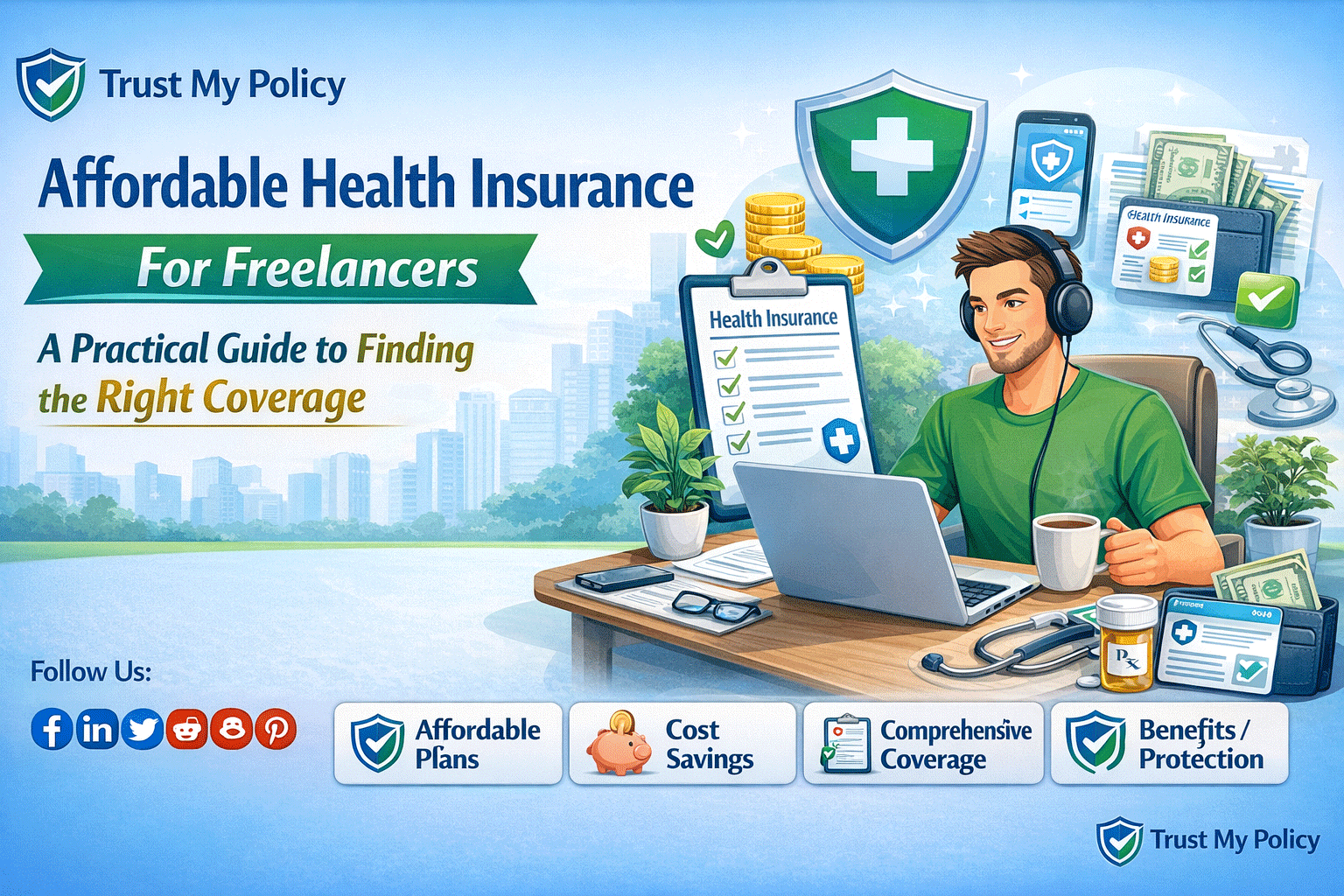
In the US, affordable health insurance for freelancers usually means a subsidized HealthCare.gov marketplace plan, with many lower-income freelancers paying $0–$240 a month after a premium tax credit. In the UK, freelancers already have free NHS access as their baseline, with private medical insurance available as an optional supplement typically costing £30–£100 a month for faster specialist access.
Table of Contents
ToggleAffordable Health Insurance for Freelancers: Complete 2026 Guide
Maya Lindqvist, 30, left her marketing job to freelance full-time from Brooklyn and assumed health coverage would cost her over $500 a month no matter what. After actually applying through the federal marketplace, a premium tax credit cut her bill to $180 a month for a plan nearly identical to her old employer coverage.
Affordable Health Insurance for Freelancers in 2026 is more achievable than most people assume, especially in the US, where marketplace subsidies can dramatically lower costs for those earning under roughly 400% of the federal poverty level. In the UK, freelancers already have NHS access as a baseline, with private medical insurance available as an optional, relatively affordable supplement. This guide breaks down exactly where to find affordable coverage in both countries.
This article covers the main affordable coverage paths in the US and UK, what they actually cost, real scenarios with specific numbers, and a clear framework for choosing the right option. By the end, you’ll know exactly where to start.
Quick Summary Table
| Feature | Details |
| What it is | Health coverage options for self-employed individuals without employer-sponsored insurance |
| Who needs it | Freelancers, independent contractors, and sole proprietors in the US and UK |
| Typical US cost | $0–$240/month subsidized; $400–$700/month unsubsidized marketplace plans |
| Typical UK cost | £0 for NHS baseline access; £30–£100/month for optional private medical insurance |
| Key benefit | US subsidies and UK’s NHS baseline both make affordable coverage genuinely achievable |
| Key limitation | US freelancers above the subsidy threshold can face high unsubsidized premiums |
| Regulator | State insurance departments and CMS (US); NHS England and the FCA (UK) |
What Makes Health Insurance Affordable for Freelancers?
Freelancers without an HR department often assume health insurance pricing works the same for everyone, the way a fixed-price menu item costs the same regardless of who orders it. In reality, especially in the US, the price you actually pay depends heavily on your income relative to specific subsidy thresholds, not a single fixed rate.
Affordable health insurance for freelancers in the US generally means finding the lowest net cost after applying for a premium tax credit through the HealthCare.gov marketplace, since this single step can cut a freelancer’s bill dramatically depending on income. In the UK, affordability starts from the fact that NHS coverage is already free and universal, with private medical insurance functioning as a genuinely optional, moderately priced supplement rather than a primary necessity. Anyone self-employed in either country needs to understand which system applies to them before assuming coverage is unaffordable.
How to Find Affordable Coverage — 5 Steps
- Estimate your actual freelance income for the year. In the US, this directly determines your premium tax credit eligibility through the marketplace.
- Apply through the official marketplace or NHS registration. US freelancers should apply via HealthCare.gov; UK freelancers should ensure they’re registered with a local NHS GP practice as their baseline.
- Compare plans by total cost, not premium alone. Look at deductibles and out-of-pocket maximums in the US, or specific wait-time benefits in UK private medical plans.
- Consider whether a supplement makes sense. US freelancers above the subsidy threshold might compare off-exchange private plans; UK freelancers might consider private medical insurance for faster specialist access.
- Update your income estimate and reapply each enrollment period. Freelance income often fluctuates, so reassessing eligibility regularly helps keep your US coverage affordable.
Comparison: US Subsidized Marketplace Plans vs. UK NHS Plus Private Supplement
| Criteria | US Subsidized Marketplace Plan | UK NHS Plus Private Supplement |
| Baseline cost | $0–$240/month, income-dependent | £0, funded through taxation |
| Optional supplement | Off-exchange private plans, no subsidy available | Private medical insurance, £30–£100/month |
| Best for | US freelancers under roughly 400% of the federal poverty level | Any UK freelancer wanting faster non-emergency specialist access |
| Pros | Can dramatically reduce net premium cost for eligible freelancers | NHS baseline removes most catastrophic cost risk by default |
| Cons | Subsidy eligibility requires accurate, ongoing income estimation | Private supplement still costs extra even though NHS access is free |
We recommend US freelancers check their specific subsidy eligibility before assuming coverage is unaffordable, and UK freelancers treat private medical insurance as a genuinely optional add-on rather than a necessity.
4 Real-Life Scenarios
Scenario 1: Maya, 30, freelance marketer in Brooklyn. Maya’s premium tax credit cut her marketplace plan to $180 a month, far below the $500+ she’d assumed coverage would cost. Verdict: subsidy eligibility can make US freelance coverage genuinely affordable. Action: Maya now updates her income estimate every quarter to keep her subsidy accurate.
Scenario 2: Tom, 35, freelance graphic designer in Manchester. Tom relied solely on NHS access for years until a six-month specialist wait led him to add a £42/month private medical plan. Verdict: UK freelancers can add affordable private cover specifically to address NHS wait times. Action: Tom kept his NHS registration active alongside his new private supplement.
Scenario 3: A freelance photographer in Seattle earning $95,000 a year. Her income placed her above the steepest subsidy tier, but she still qualified for a partial premium tax credit that lowered her plan to $310 a month. Verdict: even higher-earning freelancers often benefit from a partial subsidy. Action: she compared marketplace and off-exchange plans before settling on the subsidized option.
Scenario 4: A freelance writer in rural Wales relying entirely on NHS coverage. With no urgent need for faster specialist access, he decided private medical insurance wasn’t worth the added cost for his situation. Verdict: not every UK freelancer needs a private supplement; it depends on personal circumstances. Action: he reassessed annually based on whether NHS wait times in his area became a practical concern.
Pros & Cons of Freelancer Health Coverage Options
| Pros | Cons |
| US premium tax credits can make marketplace coverage genuinely affordable for many freelancers. | US freelancers above the subsidy threshold can still face high unsubsidized premiums. |
| UK NHS access provides a free, universal baseline regardless of freelance income. | UK private medical insurance doesn’t replace the need for NHS registration. |
| Both systems offer some form of guaranteed baseline access to care. | US subsidy eligibility requires ongoing, accurate income estimation. |
| UK private medical insurance is relatively affordable as an optional supplement. | Comparing US plans by premium alone can miss important deductible differences. |
| Self-employed individuals in both countries can deduct relevant costs in various ways. | Freelance income volatility can complicate consistent coverage planning in either country. |
5 Common Mistakes People Make
- Assuming marketplace coverage is automatically unaffordable without checking subsidy eligibility. This happens because list-price premiums look high before any subsidy is applied. What to do instead: always check your actual subsidy-adjusted cost on HealthCare.gov before assuming coverage is out of reach.
- Not updating income estimates as freelance earnings change. This happens because freelance income naturally fluctuates more than a salaried paycheck. What to do instead: update your marketplace income estimate whenever your earnings shift significantly during the year.
- UK freelancers assuming private medical insurance replaces NHS access. This happens because private cover can feel comprehensive on its own. What to do instead: keep NHS registration active regardless of any private medical insurance you hold.
- Comparing US plans by premium alone, ignoring deductibles. This happens because the monthly number is the most visible figure. What to do instead: compare total likely annual cost, including the deductible, not just the premium.
- Letting marketplace coverage lapse during a slow freelance period. This happens because cash flow gaps can make premiums feel like the first expense to cut. What to do instead: check whether a lower-tier plan or adjusted subsidy estimate could keep coverage active and affordable during lean periods.
⚠️ WARNING: Never go without health coverage to save money during a slow freelance period. A single unexpected medical event can cost far more than months, or even years, of premiums, regardless of how tight cash flow feels at the time.
Decision Table: What Should You Do?
| Your Situation | Our Recommendation |
| You’re a US freelancer who hasn’t checked your subsidy eligibility | Yes — apply on HealthCare.gov to see your actual subsidized cost |
| You’re a UK freelancer relying solely on the NHS with no wait-time concerns | No — private medical insurance may not be necessary for your situation |
| You’re a UK freelancer facing long NHS specialist wait times | Yes — consider a private medical insurance supplement |
| Your US freelance income fluctuates significantly month to month | Yes — update your marketplace income estimate regularly |
| You’re comparing US plans purely by premium price | Yes — also compare deductibles and out-of-pocket maximums |
| You’re tempted to drop coverage during a slow freelance period | No — look for a lower-tier plan instead of going uninsured |
| You’re a higher-earning US freelancer assuming you get no subsidy at all | Yes — check anyway, since partial subsidies often still apply |
💡 TIP: The single golden rule for affordable freelancer health coverage: in the US, always check your actual subsidy-adjusted cost before assuming you can’t afford marketplace coverage; in the UK, treat private medical insurance as optional, not essential.
Cost Table: What Freelancers Actually Pay
| Scenario | Cost | Notes |
| US freelancer, income ~$30,000, subsidized Silver plan | $0–$60/month | Among the lowest net costs available through the marketplace |
| US freelancer, income ~$60,000, subsidized Silver plan | $150–$240/month | Reflects a moderate subsidy tier |
| US freelancer, income ~$95,000, partially subsidized plan | $280–$340/month | Partial subsidy still applies above the steepest tier |
| US freelancer, income $140,000+, unsubsidized Bronze plan | $400–$550/month | No subsidy available at this income level |
| UK freelancer relying on NHS only | £0 | Funded through taxation, available to all UK residents |
| UK freelancer adding individual private medical insurance | £30–£100/month | Varies by age, health, and insurer |
| UK freelancer adding family private medical insurance | £80–£250/month | Covers multiple dependents under one policy |
Best Providers to Compare
Blue Cross Blue Shield (US) — One of the largest US health insurance networks with broad nationwide marketplace availability. Cost range: competitive marketplace pricing. Best for: US freelancers wanting wide network access. Rating: AM Best A.
Oscar Health (US) — A digital-first ACA marketplace insurer available in several US metro areas, often appealing to freelancers comfortable with app-based management. Cost range: competitive in available counties. Best for: tech-savvy US freelancers in supported metro areas. Rating: AM Best A-.
Kaiser Permanente (US) — An integrated US health insurance and care provider known for coordinated, often lower-cost plans. Cost range: competitive in available regions. Best for: US freelancers in Kaiser’s service areas. Rating: AM Best A.
Bupa (UK) — A leading UK private medical insurance provider offering fast specialist access alongside NHS care. Cost range: competitive UK private medical pricing. Best for: UK freelancers wanting reduced NHS wait times. Rating: Defaqto 5 Star.
AXA Health (UK) — A major UK private medical insurer with flexible individual plans suited to self-employed applicants. Cost range: competitive UK pricing. Best for: UK freelancers comparing private medical options. Rating: Defaqto 5 Star.
We recommend checking your subsidy eligibility on HealthCare.gov first for US readers, and starting with Bupa or AXA Health for UK readers considering a private supplement, since both represent strong starting points in each system.
Frequently Asked Questions
What is the most affordable health insurance for freelancers in the US?
For most freelancers, a subsidized HealthCare.gov marketplace plan is the most affordable option, with many lower-income applicants paying $0–$240 a month after a premium tax credit.
Do UK freelancers need to buy health insurance?
Not necessarily. UK freelancers already have free NHS access as their baseline; private medical insurance is an optional supplement mainly useful for reducing wait times on non-emergency care.
How do I check my US health insurance subsidy eligibility?
Apply directly through HealthCare.gov and enter your estimated freelance income; the platform will calculate your premium tax credit eligibility based on your household size and income.
Is it worth buying private medical insurance as a UK freelancer?
It depends on your situation. If NHS wait times for non-urgent care are a real concern for you, a private medical insurance supplement, typically £30–£100 a month, can be worthwhile.
What happens if my freelance income changes during the year in the US?
You should update your income estimate on HealthCare.gov as soon as it changes significantly, since this directly affects your premium tax credit and can prevent a surprise repayment at tax time.
Can I deduct health insurance premiums as a self-employed freelancer?
In the US, yes, self-employed individuals can typically deduct 100% of qualifying health insurance premiums, which can meaningfully lower taxable income.
Should I go without health insurance during a slow freelance period?
No. A single unexpected medical event can cost far more than the premiums saved, so it’s better to look for a lower-tier plan or adjusted subsidy than to go uninsured.
Is off-exchange private health insurance ever cheaper for US freelancers?
Rarely, unless your income is too high for any subsidy. Off-exchange plans never qualify for premium tax credits, so subsidized marketplace plans are usually cheaper for eligible freelancers.
Do higher-earning freelancers still qualify for any US subsidy?
Often yes, in a partial amount, even above the steepest subsidy tier, so it’s worth checking your specific eligibility rather than assuming you qualify for nothing.
How often should freelancers reassess their health coverage?
At every open enrollment period in the US, and at least annually in the UK, particularly if your income, health needs, or freelance work patterns have changed.
Key Takeaways
- Check your actual subsidy-adjusted cost on HealthCare.gov before assuming US coverage is unaffordable.
- Keep your NHS registration active regardless of any UK private medical insurance you buy.
- Update your US marketplace income estimate whenever your freelance earnings change significantly.
- Compare US plans by total likely cost, including deductibles, not just the monthly premium.
- Avoid going uninsured during a slow freelance period; look for a lower-tier plan instead.
- Check for a partial US subsidy even if you assume your income is too high to qualify.
- Reassess UK private medical insurance annually based on your actual NHS wait-time experience.
This article is for informational purposes only. Always consult a licensed insurance professional before making coverage decisions. Trust My Policy does not sell insurance products or represent any insurer.


Reader Comments (0)