
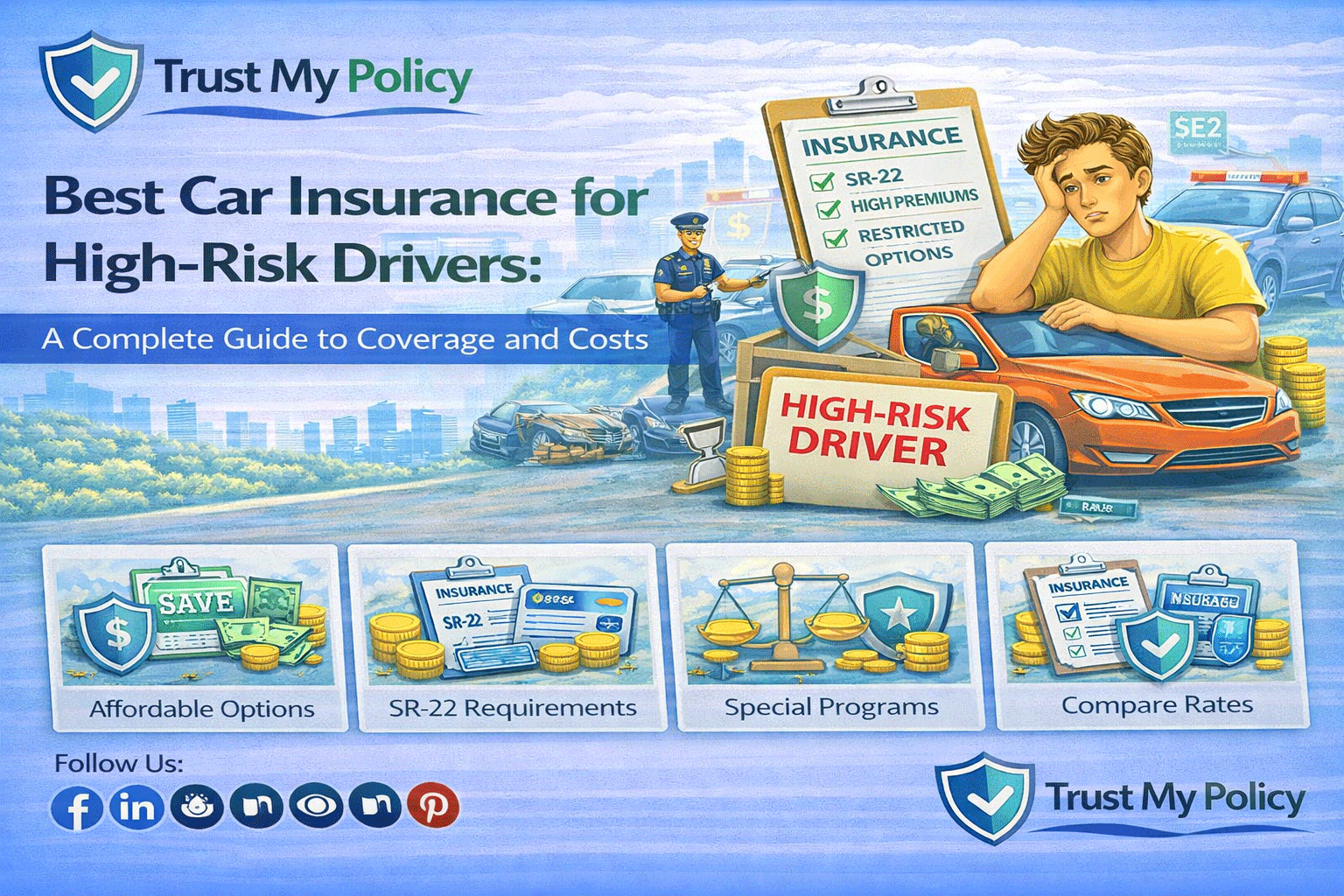
High-risk drivers — those with multiple at-fault accidents, a DUI, serious violations, or a coverage lapse — often need to apply with specialist non-standard insurers or dedicated high-risk programmes from major carriers. In the US, companies like The General, Progressive, and Dairyland consistently insure high-risk drivers. In the UK, specialist brokers like Adrian Flux handle non-standard risk profiles. Expect to pay 30%–150% more than a clean-record driver for similar coverage.
Kwame Asante, 33, had two at-fault accidents within 18 months in Atlanta and found his existing insurer cancelled his policy at renewal. Three companies declined his application before a specialist high-risk insurer offered him coverage at $285 a month — still high, but legal, and with a clear pathway for the rate to improve over the following two years.
Best Car Insurance for High-Risk Drivers in 2026 means finding the most competitive coverage from an insurer willing to write your specific risk profile, since high-risk drivers are routinely declined or offered non-competitive rates by standard carriers. High-risk classifications include multiple at-fault accidents, serious traffic violations like DUI, a lapse in coverage, or being a very young or very inexperienced driver. This guide breaks down which companies handle high-risk drivers best, what you’ll actually pay, and how to start improving your rate.
This article covers who qualifies as high-risk, which insurers specifically serve this market, real cost scenarios, and a clear roadmap for reducing your classification over time. By the end, you’ll know exactly where to apply and what to expect.
| Feature | Details |
| What it is | Car insurance specifically designed or competitively priced for drivers classified as higher risk |
| Who needs it | Drivers with multiple accidents, serious violations (DUI/DWI), coverage lapses, or very limited experience |
| Typical cost premium above standard | 30%–150% higher than a clean-record equivalent |
| US specialist providers | The General, Dairyland, Bristol West, progressive non-standard programmes |
| UK specialist providers | Adrian Flux, Hastings Direct, specialist non-standard brokers |
| Key benefit | Maintains legal coverage and starts a track record that can lower rates over time |
| Regulator | State insurance departments (US); Financial Conduct Authority (UK) |
Think of high-risk classification like a credit score, but for driving. Just as a low credit score doesn’t permanently bar you from credit, a high-risk driving classification doesn’t permanently bar you from affordable insurance — it just means you’re in a more expensive tier until your record improves, which it will with time and clean driving.
A high-risk driver is someone whose specific risk factors place them in a more expensive insurance classification than the standard market. Common reasons include multiple at-fault accidents within a short period, a DUI or DWI conviction, serious traffic violations like reckless driving, a significant lapse in coverage history, being a very young or newly licensed driver, or having a poor credit-based insurance score in states where this is permitted. Most standard insurers will still cover some of these profiles, but at elevated rates; others require a specialist insurer entirely.
| Criteria | Standard Carriers | Specialist High-Risk Insurers |
| Who they prefer | Clean or near-clean records | Drivers with multiple violations, DUI, or lapses |
| Pricing | Competitive for standard profiles, expensive for high-risk | Higher baseline but often the only available option |
| Programme availability | Some have dedicated non-standard divisions | Built specifically for non-standard risk |
| Pros | May be competitive for mild high-risk profiles | Will write coverage when standard carriers won’t |
| Cons | Often decline or heavily surcharge serious violations | Higher premiums, sometimes less favourable policy terms |
We recommend applying with both standard carriers’ non-standard programmes and specialist insurers for most high-risk readers, since the most competitive quote is rarely obvious without comparing both markets.
Scenario 1: Kwame, 33, driver in Atlanta after two at-fault accidents. Three standard carriers declined him before a specialist insurer offered coverage at $285 a month with a clear pathway for improvement. Verdict: specialist insurers exist specifically for profiles standard carriers won’t write. Action: Kwame committed to clean driving and re-applied to standard carriers at his next renewal, receiving a quote $90 a month lower.
Scenario 2: A driver in Manchester with a drink-driving conviction. Standard UK insurers quoted well above £3,000 a year, while a specialist non-standard broker found coverage at £1,950 a year for the same vehicle and limits. Verdict: specialist brokers can access insurer panels unavailable to standard comparison sites. Action: the driver used the specialist broker rather than a standard comparison site for their renewal.
Scenario 3: A young driver in Texas with a DUI at age 21. SR-22 filing was required by the state, which most standard insurers would not file; a specialist insurer provided coverage and filed the SR-22 as part of the policy. Verdict: an SR-22 requirement narrows the insurer field significantly, making specialist providers often the only realistic option. Action: the driver confirmed the SR-22 was correctly filed with the state before assuming legal coverage.
Scenario 4: A driver in Ohio with a 6-month coverage lapse. The lapse was treated as a significant risk factor by three standard carriers, raising quotes to $215 a month. A fourth carrier with a specific lapse-friendly programme offered $158 a month for the same coverage. Verdict: not all standard carriers treat coverage lapses equally, making comparison across multiple providers especially valuable. Action: the driver re-established continuous coverage immediately and set up autopay to prevent any future lapse.
| Pros | Cons |
| Maintains legal coverage and keeps you on the road regardless of driving history. | Premiums are significantly higher than standard market rates. |
| Specialist insurers provide access to coverage standard carriers won’t offer. | Some high-risk policies have less favourable terms than standard policies. |
| Clean driving during a high-risk period actively improves your future rate. | SR-22 or FR-44 requirements add an administrative filing step in some US states. |
| Re-shopping every 6–12 months can reveal meaningful rate improvements as your record ages. | High-risk classification can persist for 3–5 years depending on the specific incident. |
| Comparing both standard and specialist markets often reveals better options than expected. | Coverage lapses during a high-risk period can compound the rate increase significantly. |
⚠️ WARNING: Never drive uninsured while trying to find cheaper coverage as a high-risk driver. A second uninsured driving offence on top of an existing high-risk classification can result in a licence suspension, making any future coverage even more expensive or unavailable.
| Your Situation | Our Recommendation |
| You were declined by a standard carrier | Yes — apply to specialist high-risk insurers immediately |
| Your state requires an SR-22 filing | Yes — confirm this is included in your policy and correctly filed |
| You have a DUI conviction | Yes — use a specialist non-standard broker rather than a standard comparison site |
| You have a 6-month or longer coverage lapse | Yes — compare both standard lapse-friendly programmes and specialist options |
| You let coverage lapse to save money | No — restore coverage immediately, the compounding cost of a lapse exceeds the short-term saving |
| You haven’t re-shopped your high-risk rate in over a year | Yes — re-apply to standard carriers to check whether your aging record now qualifies |
| You’re a young driver classified as high-risk | Yes — consider a telematics black box policy, which specifically rewards safe actual behaviour |
💡 TIP: The single golden rule for high-risk drivers: maintain continuous coverage and clean driving every month, since your rate actively improves as incidents age and your record builds — but a lapse resets that clock.
| Scenario | Typical Monthly Cost | Notes |
| One at-fault accident within past 3 years | $140–$200/month | Moderate surcharge above standard rates |
| Two at-fault accidents within 3 years | $200–$300/month | Significant surcharge, some standard carriers decline |
| DUI/DWI conviction | $250–$400/month | Among the highest surcharges; SR-22 filing may be required |
| Serious traffic violation (reckless driving) | $180–$280/month | Reflects elevated statistical risk |
| Coverage lapse of 6+ months | $160–$240/month | Lapse treated as a risk signal across most insurers |
| UK drink-driving conviction | £1,500–£3,500/year | Specialist broker typically required |
| Young driver with poor record | $300–$500/month | Combination of age and record surcharges |
The General (US) — A well-known specialist insurer for non-standard and high-risk drivers, including those requiring SR-22 filings. Cost range: higher than standard market but often competitive among specialists. Best for: US drivers declined by standard carriers. Rating: AM Best A-.
Progressive (US) — Has a dedicated non-standard programme alongside its standard offering, often competitive even for higher-risk profiles. Cost range: competitive in the non-standard segment. Best for: drivers with a moderate high-risk profile who might still qualify for a standard carrier’s non-standard programme. Rating: AM Best A+.
Dairyland Insurance (US) — Specialises in non-standard auto insurance, including SR-22 and FR-44 filings, and is available in most US states. Cost range: competitive for specialist high-risk coverage. Best for: US drivers requiring SR-22 or FR-44 certification. Rating: AM Best A.
Bristol West (US) — A specialist non-standard insurer focused on high-risk drivers including those with DUIs and multiple violations. Cost range: competitive specialist pricing. Best for: US drivers with serious violation records. Rating: AM Best A-.
Adrian Flux (UK) — A leading UK specialist broker specifically handling non-standard and high-risk profiles including convictions and multiple claims. Cost range: varies by risk profile, often lower than standard market for serious conviction cases. Best for: UK drivers with convictions or multiple claims needing non-standard coverage. Rating: FCA-regulated specialist broker.
We recommend comparing Progressive’s non-standard programme alongside The General or Dairyland for most US readers, and using Adrian Flux or a specialist non-standard broker for UK readers, since both approaches access markets unavailable through standard comparison sites.
A high-risk driver typically has multiple at-fault accidents, a DUI or DWI, serious traffic violations, a significant coverage lapse, or is a very young or inexperienced driver.
High-risk drivers typically pay 30%–150% more than a clean-record driver for similar coverage, depending on the specific risk factor and insurer.
An SR-22 is a state-required certificate of financial responsibility filed by your insurer confirming you meet minimum coverage requirements, commonly required after a DUI or serious violation in many US states.
Yes, but typically only through specialist non-standard insurers or dedicated non-standard programmes from major carriers, usually at a significantly higher premium.
Most high-risk factors reduce in impact or expire from your driving record after 3–5 years of clean driving, though DUI convictions can affect rates for longer.
No. A coverage lapse compounds your high-risk classification and makes future coverage even more expensive, so maintaining continuous coverage is almost always the better long-term decision.
Yes, in some cases. Telematics programmes that assess actual driving behaviour can reward improved driving habits, regardless of past record, which can help reduce premiums over time.
Yes. As high-risk incidents age off your record and you build a clean driving history, standard carriers will reconsider your application, often resulting in meaningfully lower rates.
In the US, search specifically for non-standard auto insurers or work with an independent broker who has access to both standard and specialist markets. In the UK, use a specialist non-standard broker like Adrian Flux.
Yes, in many cases. A state-approved defensive driving course can reduce your insurance premium directly or contribute to record improvement that lowers your rate over time.
This article is for informational purposes only. Always consult a licensed insurance professional before making coverage decisions. Trust My Policy does not sell insurance products or represent any insurer.

Jagadeesh Gutha is the founder of TrustMyPolicy.com, an independent insurance information platform covering life, health, car, home, and business insurance for US and UK readers. He researches insurance products, policy structures, and consumer rights to help everyday people make informed coverage decisions without the jargon. All content on TrustMyPolicy is independently researched, fact-checked, and written to educate — not to sell.




Insurance Guides for UK, USA & Worldwide We are not an insurer or broker.
Reader Comments (1)
[…] push premiums higher. These forces affect everyone in a region’s risk pool, not just individual high-risk drivers. This guide breaks down each driver so you understand exactly what you’re paying […]