
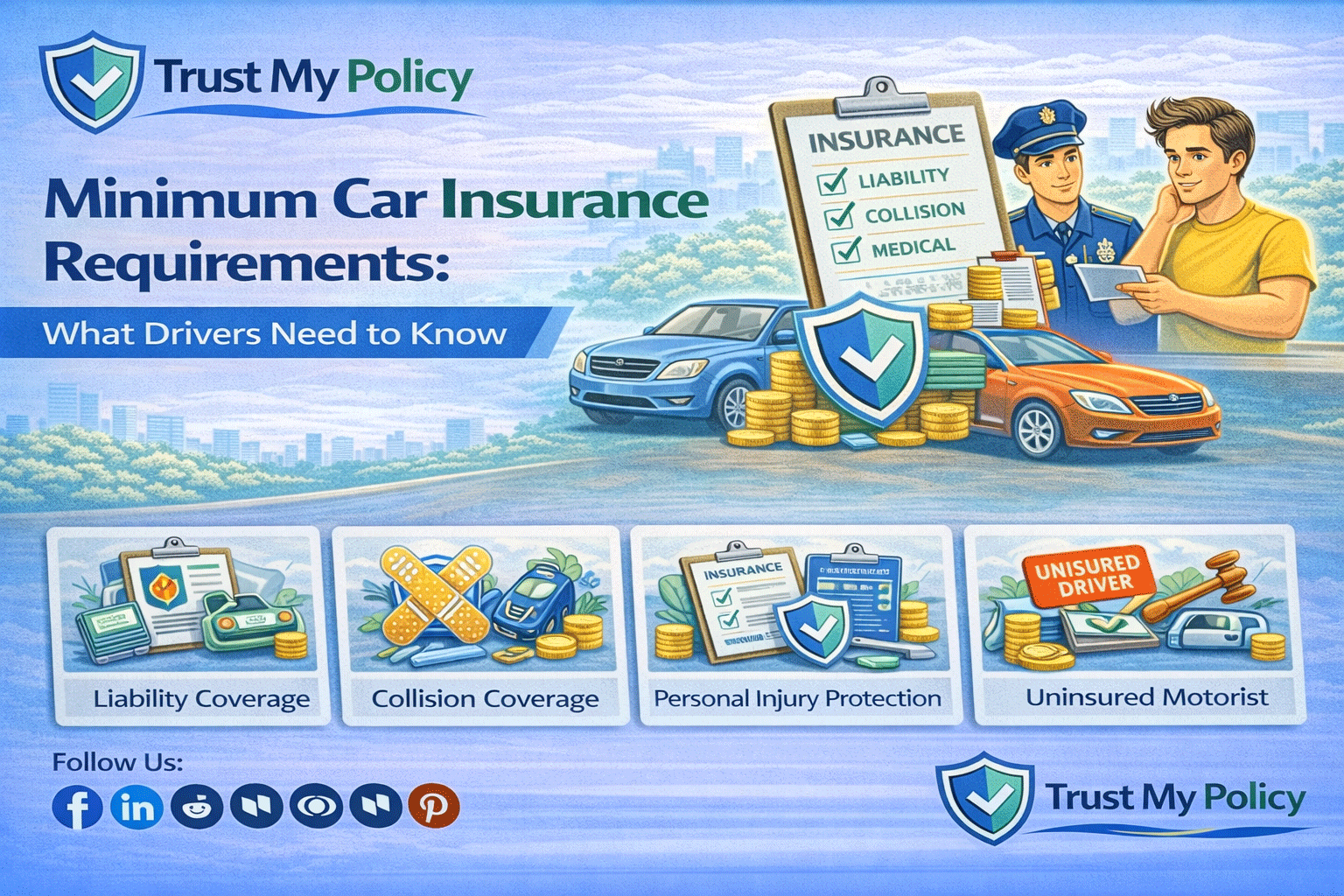
Most US states require a minimum of 25/50/25 liability coverage — $25,000 per person for bodily injury, $50,000 per accident, and $25,000 for property damage — though requirements vary significantly by state. Some states like Florida require personal injury protection instead of or alongside bodily injury liability. The UK requires at minimum third-party liability insurance. These minimums are legal floors, not recommended coverage levels.
Tyler Marsh, 24, moved from Ohio to Florida and kept his Ohio minimum coverage policy active assuming it would still be sufficient. He didn’t realise Florida’s minimum requirements were structured differently — specifically around personal injury protection — until a routine traffic stop flag showed him his coverage didn’t fully meet Florida’s specific requirements.
Minimum Car Insurance Requirements in 2026 vary significantly by US state and differ fundamentally from UK requirements, but they share a common principle: they set the legal floor for coverage, not the recommended amount. In nearly every case, the legal minimum leaves you personally exposed to significant costs if a serious accident occurs. This guide breaks down the exact requirements in key states and the UK, why minimums often aren’t enough, and what you should actually carry.
This article covers the specific minimum requirements by state and country, what minimums actually protect and don’t protect, real scenarios showing the financial gaps, and the right coverage amounts to consider above the minimum. By the end, you’ll know exactly what your state requires and why that’s rarely enough.
| Feature | Details |
| What it is | The legally required minimum level of car insurance in a given state or country |
| Who it applies to | Every driver who owns, finances, or operates a vehicle on public roads |
| Common US minimum | 25/50/25 liability limits, though requirements vary significantly by state |
| UK minimum | Third-party liability insurance (third-party only, or third-party fire and theft) |
| Key benefit | Satisfies the legal requirement to drive legally |
| Key limitation | Minimum coverage almost always leaves significant personal financial exposure |
| Regulator | State insurance departments (US); DVLA and Financial Conduct Authority (UK) |
Think of minimum car insurance like a smoke alarm in your kitchen — it’s the legally required baseline that protects others, but it won’t stop your whole house from burning down if a serious fire starts. The minimum satisfies the legal requirement, but in a significant accident, it can leave you personally responsible for thousands or even tens of thousands of dollars beyond what your policy covers.
Minimum car insurance requirements define the least amount of coverage a driver must carry to legally operate a vehicle on public roads. In the US, this is typically a state-mandated minimum level of liability insurance expressed as three numbers representing bodily injury per person, bodily injury per accident, and property damage per accident. Some states also require personal injury protection or uninsured motorist coverage. In the UK, the minimum is third-party liability coverage, which only covers damage and injury to others and provides no protection for your own vehicle. Anyone relying on minimum coverage needs to understand precisely what it does and doesn’t cover.
| Criteria | Minimum Required Coverage | Recommended Coverage |
| Bodily injury per person (US typical) | $25,000 | $100,000 or more |
| Bodily injury per accident (US typical) | $50,000 | $300,000 or more |
| Property damage (US typical) | $25,000 | $100,000 or more |
| Covers your own vehicle | No | Yes, with collision and comprehensive added |
| Covers your own medical costs | Only in PIP states | Yes, with MedPay or PIP added |
| Best for | Satisfying the legal requirement | Genuinely protecting your personal finances |
We recommend carrying coverage well above the state minimum for most readers, since a serious accident can generate costs that outpace minimum limits very quickly.
Scenario 1: Tyler, 24, driver who moved from Ohio to Florida. Tyler’s Ohio minimum coverage didn’t fully meet Florida’s specific requirements, particularly around personal injury protection, discovered during a traffic stop. Verdict: minimum requirements vary by state and must be re-verified any time you move or register a vehicle in a new state. Action: Tyler updated his policy to meet Florida’s specific requirements within the same week.
Scenario 2: A driver in Texas with 25/50/25 minimum coverage causing a serious accident. The other party’s medical bills totalled $68,000, well above the $25,000 per-person and $50,000 per-accident limit. The at-fault driver was personally sued for the $18,000 gap. Verdict: minimum liability limits are routinely exceeded by real-world accident costs. Action: the driver increased coverage to 100/300/100 at their next renewal.
Scenario 3: A UK driver with third-party only minimum coverage whose own car was stolen. The minimum UK third-party policy paid nothing toward replacing the stolen vehicle, since it only covers damage to others. Verdict: the UK minimum covers nothing for your own vehicle, making it inadequate for anyone who couldn’t replace their car out of pocket. Action: the driver upgraded to fully comprehensive coverage at the next renewal.
Scenario 4: A driver in a no-fault US state (Florida) relying solely on minimum PIP coverage. A hospitalisation after an accident exceeded their $10,000 minimum PIP limit, leaving them personally responsible for the excess medical costs. Verdict: no-fault state minimums can be outpaced quickly by real medical costs. Action: the driver added supplemental MedPay coverage to address the gap above the minimum PIP limit.
| Pros | Cons |
| Satisfies the legal requirement at the lowest possible premium cost. | Rarely provides adequate protection in a serious or multi-vehicle accident. |
| Appropriate as a short-term bridge while arranging upgraded coverage. | Leaves you personally responsible for costs above the minimum limit. |
| Some specific situations — very low-value, paid-off older cars — may justify minimum-only. | Provides zero protection for your own vehicle in any scenario. |
| Lower premium frees up budget for other financial priorities in the short term. | A single serious accident can result in a lawsuit for costs above minimum limits. |
| Meets insurer and registration requirements for legal driving. | Moving states requires re-verifying minimums, since they vary significantly. |
⚠️ WARNING: Never assume minimum coverage is the right long-term solution simply because it satisfies the legal requirement. The legal minimum is the floor, not the recommendation, and carrying only minimum limits can leave you personally liable for tens of thousands of dollars above your policy’s cap in a serious accident.
| Your Situation | Our Recommendation |
| You just moved to a new US state | Yes — re-verify that state’s specific minimum requirements immediately |
| You own a financed or leased vehicle | No — your lender requires full coverage, minimum liability-only isn’t permitted |
| Your car is a very old, low-value vehicle fully paid off | Possibly — but check whether the liability limit itself is still adequate |
| You have significant personal savings or assets | No — increase liability limits to protect your assets from a lawsuit above minimum |
| You’re a UK driver relying on third-party only | Yes — check your coverage level; third-party provides zero protection for your own car |
| You’re between registrations or in a very short-term situation | Yes — minimum coverage can serve as a temporary bridge |
| You drive in a no-fault US state with minimum PIP only | Yes — consider supplemental MedPay above the minimum PIP limit |
💡 TIP: The single golden rule for minimum car insurance requirements: always check your specific state’s requirements when moving or buying a new car, and always carry above the minimum if you have assets worth protecting or couldn’t replace your vehicle out of pocket.
| Scenario | Minimum Coverage Cost | Recommended Coverage Cost |
| US liability minimum (25/50/25), clean record | $40–$70/month | $70–$120/month for 100/300/100 limits |
| US full coverage minimum deductible | $100–$160/month | $110–$170/month with $1,000 deductible |
| Florida minimum (PIP + property damage) | $60–$100/month | $100–$180/month with added BI and UM coverage |
| UK third-party only minimum | £300–$500/year | £500–$900/year for fully comprehensive |
| UK third-party fire and theft | £350–$550/year | Middle ground between minimum and fully comprehensive |
| US uninsured motorist coverage add-on | $10–$20/month | Well worth adding wherever not automatically required |
| US PIP/MedPay add-on above minimum | $10–$25/month | Covers your own medical costs a minimum policy may not |
GEICO (US) — Competitive pricing on both minimum and above-minimum liability coverage nationwide. Cost range: among the most competitive nationally. Best for: drivers wanting minimum coverage or looking to add layers affordably. Rating: AM Best A++.
State Farm (US) — Offers clear guidance on state-by-state minimum requirements through its agent network. Cost range: competitive, varies by state. Best for: drivers who’ve moved states and want in-person guidance on new requirements. Rating: AM Best A++.
Progressive (US) — Provides flexible coverage-limit selection across most states including both minimum and enhanced options. Cost range: competitive US pricing. Best for: drivers wanting to compare minimum versus enhanced liability options side by side. Rating: AM Best A+.
LV= General Insurance (UK) — Offers third-party, third-party fire and theft, and fully comprehensive options with clear coverage-level comparisons. Cost range: competitive UK pricing. Best for: UK drivers comparing minimum versus comprehensive coverage options. Rating: Defaqto 5 Star.
Direct Line (UK) — A well-known UK insurer with clear minimum and comprehensive coverage options and no need to go through a broker. Cost range: competitive UK pricing. Best for: UK drivers wanting a direct comparison of coverage levels. Rating: Defaqto 4-5 Star.
We recommend checking your state insurance department’s website (US) or the DVLA guidance (UK) as the most authoritative source for your specific minimum requirements, then comparing providers for pricing above that floor.
Most states require a minimum of 25/50/25 liability coverage — $25,000 per person for bodily injury, $50,000 per accident, and $25,000 for property damage — though specific requirements vary significantly by state.
The UK legally requires at minimum third-party liability insurance, which covers injury or damage you cause to others but provides no protection for your own vehicle.
No. US minimum liability coverage and UK third-party minimum coverage both only pay for damage or injury you cause to others, not damage to your own vehicle.
Rarely. A single serious accident can generate liability costs well above minimum limits, leaving you personally responsible for the difference.
Yes. Each US state sets its own requirements independently, so you must re-verify your coverage meets the new state’s specific minimums when you move.
No-fault states require personal injury protection (PIP) as part of the minimum, since each driver’s own insurer covers their medical costs regardless of who caused the accident.
Minimum coverage may be appropriate as a very short-term bridge or for extremely low-value fully paid-off vehicles, but is generally inadequate for long-term coverage for anyone with assets to protect.
Uninsured motorist coverage pays for your costs if you’re hit by a driver who has no insurance; it’s required in some states and optional but strongly recommended in others.
Yes. If the costs from an accident you caused exceed your liability limits, the other party can sue you personally for the difference.
Check your state’s department of insurance website, which publishes the current required minimum limits for that state.
This article is for informational purposes only. Always consult a licensed insurance professional before making coverage decisions. Trust My Policy does not sell insurance products or represent any insurer.

Jagadeesh Gutha is the founder of TrustMyPolicy.com, an independent insurance information platform covering life, health, car, home, and business insurance for US and UK readers. He researches insurance products, policy structures, and consumer rights to help everyday people make informed coverage decisions without the jargon. All content on TrustMyPolicy is independently researched, fact-checked, and written to educate — not to sell.
[…] Wyoming’s minimum required coverage first. The state requires at least $25,000 per person and $50,000 per accident for bodily injury, […]
[…] before the asset or risk exists, not after. Auto insurance should be active before you drive off the lot; life insurance should be active before, not after, a […]



Insurance Guides for UK, USA & Worldwide We are not an insurer or broker.
Reader Comments (3)
[…] law requires all drivers to maintain minimum liability insurance under the Texas Financial Responsibility Law. The state minimum — known as 30/60/25 — […]