
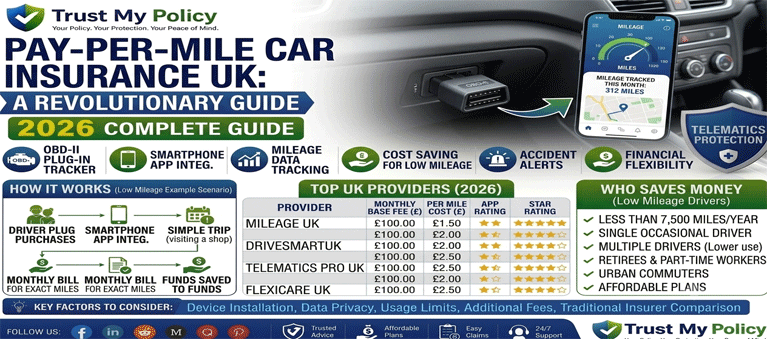
Pay-per-mile car insurance in the UK splits your premium into a fixed base rate (covering the parked car) and a variable per-mile charge for every mile driven — typically 2p-10p per mile depending on your risk profile. The best UK providers in 2026 are By Miles, Cuvva, and LV= Pay By Mile. Pay-per-mile saves money for drivers covering fewer than 6,000-7,000 miles per year — typical savings are GBP 150-GBP 400/year against a standard comprehensive policy. A plug-in OBD-II device or smartphone app tracks mileage. All UK pay-per-mile policies are FCA-regulated and provide fully comprehensive cover.
Helen Ward, 58, a retired librarian from Shrewsbury, drove just 3,200 miles in 2023 — mostly short trips to a supermarket, her GP surgery, and monthly visits to her daughter 18 miles away. Her annual comprehensive car insurance cost GBP 624. When she switched to a pay-per-mile policy with By Miles in January 2024, she paid GBP 164 in base premium plus GBP 148 in mileage charges — a total of GBP 312 for the year. She saved GBP 312 without changing a single thing about how she drove.
Pay-per-mile car insurance in 2026 is a type of telematics-based car insurance where your total premium divides into two parts: a fixed daily or monthly base rate covering the car while parked, and a variable per-mile charge for every mile you actually drive. The less you drive, the less you pay. According to the Association of British Insurers (ABI) 2024, UK drivers travel an average of 7,400 miles per year — but millions of low-mileage drivers significantly overpay on traditional annual policies. Standard car insurance prices your premium based on factors including your postcode, age, vehicle, and claimed annual mileage; our guide on what drives your car insurance premium explains in full why two drivers with the same car and history can pay very different amounts.
This guide explains exactly how pay-per-mile insurance works, who it saves money for, which UK providers offer it in 2026, how the telematics tracking operates, a direct comparison against standard and black box insurance, four real-life scenarios, the five most common mistakes, a decision guide, a full cost table, and ten FAQs.
| Feature | Details |
| What It Is | Car insurance where premium = fixed base rate + per-mile charge for miles actually driven |
| Who It Suits | Low-mileage drivers: retirees, remote workers, second-car owners, city residents, young drivers with restricted use |
| Typical Base Rate | GBP 1-GBP 4/day or GBP 30-GBP 120/month depending on provider and risk profile |
| Typical Per-Mile Rate | 2p-10p per mile (average 5p-7p for most standard adult risk profiles) |
| Break-Even vs Standard Cover | Typically 6,000-7,000 miles/year — below this, pay-per-mile usually saves money |
| Coverage Level | Fully comprehensive on all major UK providers |
| How Mileage Is Tracked | OBD-II plug-in device, self-install black box, or smartphone GPS app |
| Top UK Providers (2026) | By Miles, Cuvva, LV= Pay By Mile, Marmalade (young drivers) |
| Regulator | Financial Conduct Authority (FCA) |
| Key Limitation | Not cost-effective for drivers above 8,000-10,000 miles/year |
Standard annual car insurance charges a flat premium based on your estimated annual mileage, postcode, age, claims history, and vehicle value. The premium stays the same whether you drive 2,000 miles or 10,000 miles in the year — the insurer uses your stated mileage as an approximation and prices accordingly. Low-mileage drivers effectively subsidise higher-mileage drivers within the same risk pool. Our explanation of how car insurance premiums are calculated shows exactly how mileage is weighted alongside other rating factors — and why the mileage estimate you give at purchase date rarely reflects what you actually drive.
Pay-per-mile insurance solves this by splitting the premium into two components. The base rate — sometimes called the standing charge — covers the car while it is parked, reflecting fire, theft, accidental damage while stationary, and third-party liability on a public road. The mileage rate reflects the risk of actually driving: the more miles you cover, the greater your statistical exposure to accidents, and the more you pay. Think of it like a utility bill: a standing charge for being connected to the network, plus a usage charge for what you actually consume.
Pay-per-mile is distinct from black box (telematics) insurance, which monitors full driving behaviour including speed, braking, cornering, and time of day to set a behavioural score. Black box insurance for young drivers uses that behavioural scoring to reduce premiums over time — a different mechanism aimed at a different problem. Pay-per-mile tracks only one variable — distance driven — not driving style. This makes it simpler, less intrusive, and specifically targeted at drivers who simply do not use their car very much.
Pay-per-mile suits: retired drivers who no longer commute, remote workers whose daily mileage dropped sharply after 2020, city residents who use public transport most days and drive only at weekends, second-car owners, new or young drivers with restricted daily use, and anyone who has recently moved closer to work. It does not suit sales representatives, delivery drivers, commuters covering more than 30 miles each way, or anyone whose work involves significant road time.
| Criteria | Pay-Per-Mile | Standard Annual | Black Box (Telematics) |
| Premium Structure | Base rate + per-mile charge | Single flat annual premium | Annual premium adjusted by driving behaviour score |
| Mileage Tracking | Yes — every mile recorded | No — stated estimate only | Yes — plus speed, braking, time of day |
| Driving Behaviour Monitored | No — mileage only | No | Yes — curfews, speed, cornering all scored |
| Best For | Low-mileage drivers under 7,000 miles/year | Average to high-mileage drivers | Young or high-risk drivers seeking lower premiums through safe driving |
| Flexibility | High — pay for actual use | Low — fixed cost regardless of use | Medium — locked into behavioural scoring |
| Typical Annual Cost (3,000 miles) | GBP 250-GBP 400 | GBP 500-GBP 900 | GBP 350-GBP 600 |
| Typical Annual Cost (8,000 miles) | GBP 550-GBP 900 | GBP 500-GBP 900 | GBP 450-GBP 700 |
| Privacy Concern Level | Low — mileage only; location not shared | None | High — full journey data retained by insurer |
| Curfew Restrictions | None | None | Often — late-night driving penalised |
| Coverage Level | Fully comprehensive | Varies — comp/TPFT/TP | Fully comprehensive |
| FCA Regulated | Yes | Yes | Yes |
We recommend pay-per-mile for drivers covering fewer than 6,500 miles per year. Between 6,500-9,000 miles, compare both options using your actual previous year’s mileage. Above 9,000 miles, a standard annual policy is almost always cheaper.
| Provider | Best For | Base Rate | Per-Mile Rate |
| By Miles | Most established; best app; daily 150-mile cap | GBP 1.40-GBP 3.50/day | 4p-9p/mile |
| Cuvva | Maximum flexibility; app-only; pause option | GBP 25-GBP 80/month | 5p-10p/mile |
| LV= Pay By Mile | Trusted mutual brand; strong claims service | GBP 35-GBP 110/month | 4p-8p/mile |
| Marmalade | Young drivers 17-30; black box included | GBP 30-GBP 90/month | 5p-12p/mile |
By Miles is the UK’s market-leading pay-per-mile insurer by number of policies and the most established specialist in the segment. Founded in 2016, it has paid over GBP 7 million in claims. Its OBD-II Miles Tracker plugs into the car’s diagnostic port in under two minutes and connects to its app, which shows real-time mileage, cost-to-date, and a trip log. By Miles caps mileage charges at 150 miles per day — protecting drivers who occasionally make long-distance trips from a single inflated daily charge. Its comprehensive policy is underwritten by a panel of A-rated insurers and is FCA-regulated. Base rate: GBP 1.40-GBP 3.50/day. Per-mile rate: 4p-9p/mile. Best for: drivers covering 1,000-7,000 miles per year who want the most transparent per-mile billing in the UK market.
Cuvva started as a pay-as-you-go hourly insurer and has expanded into monthly pay-per-mile subscriptions. It uses your smartphone GPS rather than a physical device — no hardware installation required. Its monthly subscription model allows you to pause the policy and stop being charged the base rate during extended periods when the car is not in use, such as a holiday abroad. Claims are handled by Cuvva’s underwriting partner Zurich, which carries an AA financial strength rating from Standard and Poor’s. Base rate: GBP 25-GBP 80/month. Per-mile rate: 5p-10p/mile. Best for: urban drivers, second-car owners, and drivers who want fully app-based policy management with no physical device.
LV= (Liverpool Victoria) is a mutual insurer with over 175 years of history and consistently high customer satisfaction scores. Its Pay By Mile product uses an OBD-II plug tracker and is backed by LV=’s full claims team — the same operation handling its standard annual motor policies. LV= is Defaqto 5-star rated across its motor products and paid 99% of motor claims in 2023. For drivers who want the pay-per-mile pricing model but prefer the reassurance of a large, established mutual insurer over a newer specialist, LV= is the most straightforward choice. Base rate: GBP 35-GBP 110/month. Per-mile rate: 4p-8p/mile. Best for: older or more cautious drivers who want the pay-per-mile model with a well-established insurer behind it.
Marmalade specialises in car insurance for young drivers aged 17-30 and offers a pay-per-mile product specifically designed for newly qualified drivers who drive infrequently. Young drivers face the highest standard premiums in the UK market — the average annual policy for a 17-year-old exceeded GBP 2,700 in 2023 (ABI 2024). Marmalade’s pay-per-mile product includes a black box tracker and produces significantly lower total annual costs than standard annual policies for young drivers covering under 4,000 miles per year. Its per-mile rates are higher than adult-focused providers, reflecting the higher actuarial risk of young drivers. For a broader look at how young drivers can reduce their annual premiums beyond pay-per-mile, our guide on the best car insurance for new drivers under 25 in the UK covers telematics, vehicle choice, and named driver strategies in full. Base rate: GBP 30-GBP 90/month. Per-mile rate: 5p-12p/mile. Best for: young drivers aged 17-25 covering under 4,000 miles per year.
We recommend By Miles as the best overall UK pay-per-mile provider in 2026: most transparent billing, most established claims experience in the specialist segment, comprehensive app, and the daily 150-mile cap that protects drivers who occasionally make long journeys.
Helen’s standard comprehensive policy cost GBP 624/year. She switched to By Miles: base rate GBP 1.60/day, total 3,200 miles at 4.6p/mile. Final bill: GBP 164 base + GBP 148 mileage = GBP 312 total. Annual saving: GBP 312. Verdict: Pay-per-mile halved Helen’s car insurance cost for identical comprehensive cover. Action: If you drive fewer than 5,000 miles per year and pay more than GBP 400 in standard annual premiums, get a pay-per-mile quote before your next renewal.
James stopped commuting in 2021 and now drives only for supermarket runs and weekend trips. His standard policy: GBP 780/year. His By Miles equivalent: GBP 190 base rate + GBP 252 mileage at 5.6p/mile = GBP 442 total. Annual saving: GBP 338. In a heavier driving year with a summer road trip adding 800 extra miles, his total rose to GBP 487 — still GBP 293 cheaper than his standard policy. Verdict: Even a higher-than-typical driving year still produced a significant saving for a driver under 6,000 miles. Action: Remote and hybrid workers whose mileage dropped after 2020 should recalculate their annual mileage and compare — most are still paying standard premiums set before their commute ended.
Aisha kept her parents’ second car at university, driving mainly at weekends. Her standard young driver quote: GBP 2,340/year. Marmalade’s pay-per-mile: GBP 55/month base (GBP 660/year) + GBP 210 mileage at 10p/mile = GBP 870 total. Annual saving: GBP 1,470. The significant premium difference for young drivers between standard and pay-per-mile products stems from the same factors covered in our guide on what determines a young driver’s car insurance premium — age, experience, and statistical claims risk. Verdict: Pay-per-mile saved Aisha GBP 1,470 — 63% of the standard young driver premium — for the same comprehensive cover. Action: Young drivers using a car only at weekends or during university holidays should always compare pay-per-mile against standard annual policies before purchasing.
David drives extensively for work — client visits, trade shows, and motorway commuting. His standard comprehensive policy: GBP 720/year. A pay-per-mile equivalent at 6p/mile: GBP 1,080 mileage + GBP 600 base rate = GBP 1,680 — GBP 960 more expensive than his standard policy. Verdict: Pay-per-mile is significantly more expensive for high-mileage drivers. Action: If you drive more than 10,000 miles per year, do not switch to pay-per-mile — the per-mile charges accumulate well past the cost of a standard annual policy.
| Factor | Pros | Cons |
| Cost for Low Mileage | Saves GBP 150-GBP 500/year for drivers under 6,000 miles — saving is directly proportional to mileage reduction | Costs significantly more than standard for drivers above 8,000-10,000 miles/year |
| Fairness | You pay exactly for the risk you create — low mileage directly reflects lower accident exposure | Standard policies already offer estimated mileage discounts for declared low-mileage drivers at renewal |
| Transparency | Real-time app shows exact cost-to-date, trip log, and projected annual bill | Some drivers dislike mileage tracking even though location data is not typically shared |
| Flexibility | No annual mileage estimate required — pay for actual use with no underdeclaration risk | Base rate is charged every day, even in months where the car is barely used at all |
| Privacy | Mileage only — no monitoring of speed, braking, or time of day unlike black box policies | OBD-II device has access to vehicle diagnostic data beyond just mileage |
| Young Drivers | Can reduce young driver premiums by GBP 1,000+ for low-mileage university students | Per-mile rates for young drivers are 2-3x higher than adult rates, reflecting actuarial risk |
Mistake 1: Switching without checking your actual annual mileage. Many drivers overestimate how little they drive. Before switching, check your actual mileage using your MOT history — the mileage recorded at each test is a reliable baseline. The DVLA’s free online MOT history checker at check-mot.service.gov.uk shows mileage at every test. Divide the difference between your two most recent readings by the months between tests to get your true annual figure. If it exceeds 8,000 miles, pay-per-mile is unlikely to save you money at typical per-mile rates.
Mistake 2: Ignoring the base rate when comparing costs. The base rate is charged daily or monthly regardless of whether you drive. A driver who parks the car for three weeks during a holiday abroad still pays the base rate every day. When comparing pay-per-mile against a standard policy, always add the full annual base rate to your projected mileage charges before concluding which is cheaper. This same principle applies to any insurance comparison — our guide on how to compare car insurance in the UK walks through a structured total-cost methodology that applies equally to pay-per-mile and standard policies.
Mistake 3: Assuming pay-per-mile covers business use. Most standard pay-per-mile policies cover social, domestic, and pleasure use only. If you use your car for any business purpose — visiting clients, travelling between work sites, or carrying business goods — you need business use cover declared specifically on the policy. Driving for undeclared business purposes on a pay-per-mile policy is a material non-disclosure that can void a claim entirely.
Mistake 4: Not checking OBD device compatibility before purchasing. OBD-II plug-in trackers work with most petrol and diesel vehicles manufactured after 2001 and most modern electric vehicles. However, some older vehicles, some hybrid models, and some European imports have non-standard OBD configurations. Check your vehicle’s compatibility with the provider’s online checker before purchasing — most major providers list compatible makes and models on their websites.
| ⚠️ WARNING: Daily Mileage Caps Vary Significantly Between Providers
Not all pay-per-mile providers cap your daily mileage charge. By Miles caps at 150 miles per day — protecting you on long trips. Some providers have no daily cap at all, meaning a 400-mile return journey is charged in full at the per-mile rate: GBP 28 at 7p/mile for that day alone. If you make occasional long-distance trips — family visits, holidays by car, driving a child to university — always confirm whether your chosen provider has a daily mileage cap and what that cap is before purchasing. An uncapped policy is significantly more expensive for drivers who mix low daily use with occasional long journeys. |
Mistake 5: Forgetting to SORN the car if you stop using it entirely. Pay-per-mile insurance does not remove the legal requirement to insure a vehicle kept on a public road. If you stop using the car for an extended period, you must either keep the pay-per-mile policy active or formally declare the vehicle off-road with a Statutory Off Road Notification via the DVLA. Driving without insurance — even a lapsed pay-per-mile policy — carries a GBP 300 fixed penalty and 6 penalty points under the Road Traffic Act 1988. If cost is the primary concern during a period of low or no driving, our guide on the cheapest flexible car insurance options in the UK covers the full range of short-term and low-commitment products alongside pay-per-mile.
| Your Situation | Our Recommendation |
| I drive fewer than 5,000 miles per year | Yes — pay-per-mile will almost certainly save money; get a quote from By Miles or LV= first |
| I drive 5,000-7,000 miles per year | Yes — compare both options using your actual previous year’s mileage; saving is likely but smaller |
| I drive more than 9,000 miles per year | No — standard annual policy will be cheaper; per-mile charges accumulate past the standard premium cost |
| I am a young driver (17-25) who drives mainly at weekends | Yes — Marmalade pay-per-mile can save GBP 1,000+ vs standard young driver annual policies for low mileage |
| I am retired and only drive locally | Yes — strongest savings case; retirees averaging 2,000-4,000 miles save the most of any driver group |
| I work from home and stopped commuting | Yes — your actual mileage has likely dropped significantly; recalculate based on current usage before next renewal |
| I use my car for business visits or client travel | No — confirm business use is covered; most pay-per-mile policies are social/domestic use only |
| I occasionally make long-distance trips (200+ miles) | Yes — but only if your provider has a daily mileage cap; confirm this before purchasing |
| 💡 TIP: The Golden Rule for Pay-Per-Mile Insurance
Before switching, find your actual mileage using the free DVLA MOT history checker at check-mot.service.gov.uk — it shows the mileage recorded at every MOT. Divide the difference between your two most recent readings by the number of months between tests. Multiply by 12 for your annual figure. Then get a pay-per-mile quote and compare the projected total — base rate plus mileage charges — against your current standard premium. If pay-per-mile is cheaper, switch at renewal. If not, stay on your standard policy and recalculate each year as your driving habits change. |
| Annual Mileage | Pay-Per-Mile Total Cost | Standard Annual Policy Cost |
| 1,000 miles | GBP 180-GBP 280 | GBP 450-GBP 800 |
| 2,000 miles | GBP 220-GBP 340 | GBP 450-GBP 800 |
| 3,000 miles | GBP 260-GBP 420 | GBP 480-GBP 850 |
| 4,000 miles | GBP 310-GBP 490 | GBP 500-GBP 870 |
| 5,000 miles | GBP 360-GBP 580 | GBP 520-GBP 900 |
| 6,000 miles | GBP 420-GBP 680 | GBP 530-GBP 920 |
| 7,000 miles (break-even zone) | GBP 480-GBP 780 | GBP 540-GBP 940 |
| 8,000 miles | GBP 550-GBP 890 | GBP 550-GBP 960 |
| 10,000 miles | GBP 680-GBP 1,100 | GBP 560-GBP 980 |
| 15,000 miles | GBP 950-GBP 1,600 | GBP 580-GBP 1,050 |
Note: Pay-per-mile costs assume a standard adult driver (age 35-65, no claims, comprehensive cover, average UK postcode). Young drivers face higher per-mile rates. Standard policy costs are based on ABI 2024 average comprehensive premium data adjusted for declared low and standard mileage.
Pay-per-mile car insurance splits your premium into a fixed base rate charged daily or monthly (covering the parked car) and a variable per-mile charge for every mile driven. The less you drive, the less you pay. All UK pay-per-mile policies are fully comprehensive and FCA-regulated. Mileage is tracked using an OBD-II plug-in device, a self-install black box, or a smartphone GPS app depending on the provider.
For a standard adult driver, the base rate ranges from GBP 1.40-GBP 3.50 per day (By Miles) or GBP 25-GBP 110 per month (Cuvva, LV=). The per-mile charge is typically 4p-10p per mile. A driver covering 3,000 miles per year pays GBP 260-GBP 420 in total. The average UK comprehensive car insurance premium was GBP 627/year in 2023 (ABI 2024), so savings of GBP 200-GBP 300/year are realistic for low-mileage drivers who switch.
No. Black box insurance monitors your full driving behaviour — speed, braking, cornering, and time of day — and adjusts your premium based on a behavioural score. Pay-per-mile tracks only distance driven — it does not monitor how you drive, impose curfews, or penalise driving at specific times. Pay-per-mile is specifically designed for low-mileage drivers, not for improving driving behaviour. For young drivers who want to use safer driving habits to reduce premiums, our guide to the best black box insurance for young UK drivers covers that mechanism in full.
The OBD-II plug inserts into a diagnostic port under your dashboard — the same port mechanics use for vehicle diagnostics and MOT preparation. It records odometer data and transmits it to the insurer. It does not have GPS and does not record your location or route in most implementations — By Miles explicitly states it does not track location. Installation takes under two minutes, requires no tools, and can be removed at any time.
You simply pay more that month — there is no penalty charge beyond the standard per-mile rate. The total bill reflects exactly what you drove. By Miles caps the daily mileage charge at 150 miles per day, so even a 500-mile return trip to Scotland is billed as 150 miles for that day. Always check whether your provider has a daily cap if you make occasional long journeys.
Yes — By Miles, Cuvva, and LV= all cover electric vehicles on their pay-per-mile policies. OBD-II compatibility varies by EV make and model, so check your specific vehicle against the provider’s compatibility list before purchasing. Where OBD is incompatible, some providers offer smartphone GPS tracking as an alternative. Pay-per-mile is particularly well-suited to EV owners who use their vehicle primarily for short local trips.
Yes — pay-per-mile is one of the most cost-effective products for a second or infrequently used car. A second car that sits unused for most of the year and is driven only occasionally generates very low mileage charges. Even the base rate, at GBP 1.40-GBP 3.50 per day, is significantly cheaper than a standard annual policy for a car driven only a few thousand miles per year. By Miles and LV= both explicitly market their products for second-car use.
Standard pay-per-mile policies provide fully comprehensive cover including fire, theft, accidental damage, and third-party liability — the same core protection as a standard comprehensive annual policy. Breakdown cover and legal expenses are not included as standard and must be purchased as optional add-ons. By Miles offers breakdown cover through a partner at additional cost. Always check what optional extras are available if you currently hold breakdown cover on your existing policy.
Your existing no-claims discount transfers to a pay-per-mile policy in exactly the same way as to any other car insurance policy. If you make no claims during the policy year, you accumulate an additional year of NCD as normal. A claim affects your NCD in exactly the same way as it would on a standard policy. Pay-per-mile insurers recognise and apply standard UK NCD in the same way as mainstream annual policy providers.
Yes — all pay-per-mile car insurance products sold in the UK must be provided by FCA-authorised insurers and comply with the same regulatory requirements as standard motor insurance. By Miles is underwritten by a panel of FCA-authorised A-rated insurers. LV= is itself FCA-authorised. Cuvva is FCA-authorised and underwritten by Zurich. All policies comply with the Road Traffic Act 1988. Always verify your provider’s FCA authorisation at register.fca.org.uk before purchasing.
This guide reflects the latest 2026 insurance data.
| ℹ️ Disclaimer
This article is for informational purposes only. Always consult a licensed insurance professional before making coverage decisions. Trust My Policy does not sell insurance products or represent any insurer. |

Jagadeesh Gutha is the founder of TrustMyPolicy.com, an independent insurance information platform covering life, health, car, home, and business insurance for US and UK readers. He researches insurance products, policy structures, and consumer rights to help everyday people make informed coverage decisions without the jargon. All content on TrustMyPolicy is independently researched, fact-checked, and written to educate — not to sell.



Insurance Guides for UK, USA & Worldwide We are not an insurer or broker.

Reader Comments (0)