
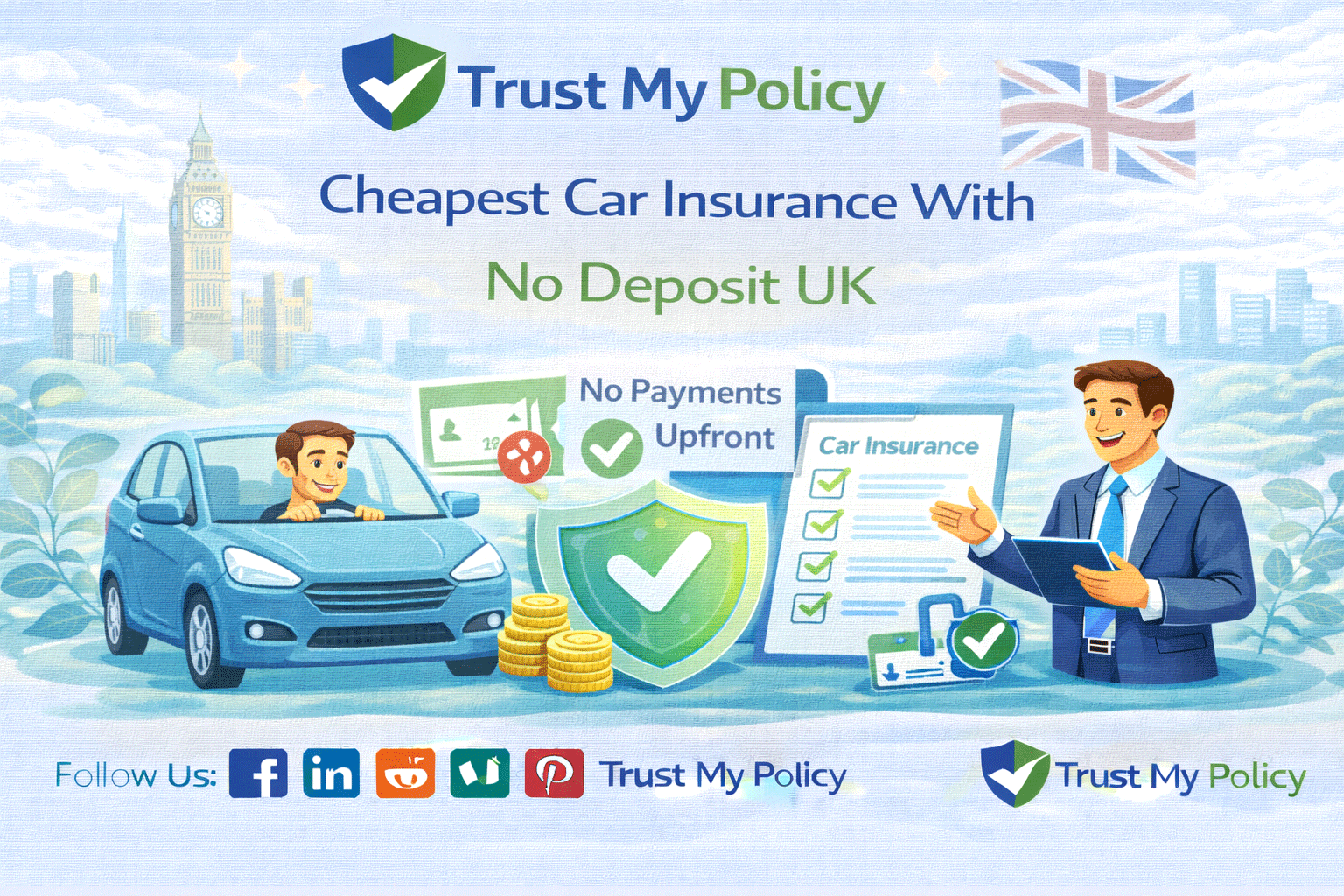
No deposit’ car insurance in the UK means paying for your annual policy in 12 equal monthly instalments, with no large upfront payment beyond your first monthly premium. You still pay the first month’s premium before cover starts — this is not optional. Monthly car insurance costs 10–25% more than paying annually upfront due to interest charges. The average UK car insurance premium is approximately £622/year. On a monthly plan with 11% interest, total annual cost would be around £690. Compare 100+ providers at GoCompare, Compare the Market, or MoneySupermarket to find the cheapest monthly rate.
Emma, 23, needed car insurance urgently. She had £60 to her name until payday. Her first quote on Compare the Market: £840/year. Paying annually upfront wasn’t an option. She clicked through to pay monthly — her monthly cost was £84, with the first payment the same as every other month. No lump-sum deposit. She set up the direct debit and was covered the same afternoon. She paid a total of £1,008 over the year — £168 more than the annual price. She knew this going in. It was a deliberate trade-off: higher annual cost for manageable monthly payments and immediate cover.
‘No deposit car insurance’ is one of the most searched terms in the UK car insurance market — and also one of the most misunderstood. There is no such thing as truly free upfront car insurance. What ‘no deposit’ actually means is that your total annual premium is split into 12 equal monthly payments, and your first payment is the same size as the others — not a larger lump sum.
This guide explains exactly what no deposit car insurance is, what it costs, which UK providers offer the best monthly payment terms, and how to minimise the extra cost of paying monthly rather than annually.
The term ‘no deposit car insurance’ is, as several UK consumer sites point out, a marketing phrase rather than an accurate description of the product. Here’s what’s really happening:
| Claim | Reality |
| ‘No deposit required’ | You pay the first month’s premium before cover starts — this IS your first payment, not a deposit, but cover only begins once this payment clears |
| ‘Pay nothing upfront’ | False — your first direct debit is taken within 1–2 days of setting up the policy. You must have the first monthly payment available immediately |
| ‘Spread the cost evenly’ | Accurate — true ‘no deposit’ means equal monthly payments, not a higher first instalment followed by lower ones |
| ‘No extra cost’ | False — monthly car insurance costs 10–25% more than paying annually due to interest charges on the credit agreement |
| ‘Same as annual cover’ | True — the coverage itself is identical; the difference is purely in payment structure and total cost |
| ⚠️ What ‘No Deposit’ Actually Means
A traditional car insurance monthly payment plan often requires a deposit of 20% of the annual premium upfront (e.g., £120 on a £600/year policy), followed by 10 equal monthly payments. ‘No deposit’ means splitting the whole year into 12 equal payments — so your first payment is only 1/12 of the total, not 20%. You still pay something immediately before cover begins. It is not zero upfront. |
| Annual Premium | Annual Cost (Pay Upfront) | Monthly Plan Cost (10% Interest) | Monthly Plan Cost (20% Interest) | Extra Cost of Monthly |
| £500 | £500 | £550/year (£45.83/month) | £600/year (£50/month) | £50–£100 more per year |
| £622 (UK average 2025) | £622 | £684/year (£57/month) | £746/year (£62/month) | £62–£124 more per year |
| £800 | £800 | £880/year (£73.33/month) | £960/year (£80/month) | £80–£160 more per year |
| £1,200 (young driver) | £1,200 | £1,320/year (£110/month) | £1,440/year (£120/month) | £120–£240 more per year |
| £2,000 (high risk) | £2,000 | £2,200/year (£183/month) | £2,400/year (£200/month) | £200–£400 more per year |
The APR (Annual Percentage Rate) charged on monthly car insurance plans varies significantly by provider. The FCA requires all providers to disclose the APR clearly. When comparing monthly car insurance deals, always check the APR — a provider offering a lower monthly payment but with 25% APR may cost more overall than one with 11% APR.
Why: Admiral is consistently cited as one of the most flexible monthly car insurance providers in the UK. They allow you to pay every month without additional deposit fees on their main policies, and they regularly offer discounts for safe drivers and multi-car policies. Multi-car households can save significantly by combining vehicles under one Admiral policy with monthly payment options. Admiral also offers MultiCar insurance — covering up to 5 cars on one policy, with monthly billing.
Cost: Competitive — typically within the cheapest quartile of UK insurers for most driver profiles.
Best for: Drivers who want a large, established UK insurer with genuine monthly payment flexibility and multi-car discounts.
Why: Hastings Direct is frequently recommended for younger drivers and those with limited credit history seeking monthly payments. They offer easy-to-use online tools and a mobile app to manage your policy. Their monthly payment terms are transparent and their premiums are competitive for the under-30 age group. They’re particularly accessible for drivers who have been quoted high rates elsewhere.
Cost: Often competitive for younger drivers and those with minor convictions who still want monthly payment flexibility.
Best for: Younger drivers (17–30) who need monthly payments and want digital policy management without large upfront costs.
Why: Direct Line is not available on comparison sites — you have to go direct. This can mean their true monthly rates are sometimes missed by drivers who only use comparison platforms. Direct Line is known for transparent monthly payment terms, clearly disclosed APR, and strong customer service. They consistently score well on claims satisfaction surveys.
Cost: Can be competitive, especially for drivers who bundle breakdown cover or other products.
Best for: Drivers who prefer dealing with a named insurer directly (not via a comparison site) and value claims service quality alongside monthly payment options.
Why: Tesco Bank car insurance rewards Clubcard holders with additional discounts, making it particularly good value for the many UK households who regularly shop at Tesco. Monthly payment options are available with transparent APR disclosure. Tesco Bank uses Defaqto-rated policies and compares well on price for standard driver profiles.
Best for: Tesco Clubcard holders who want to maximise rewards points alongside affordable monthly car insurance payments.
Why: The fastest way to find the cheapest no deposit monthly car insurance in the UK is to use the major comparison sites. GoCompare compares over 175 insurers. Compare the Market compares similar breadth. MoneySupermarket is also comprehensive. Each site lets you filter by monthly payment options and shows the first month’s payment clearly.
TIP: Always run the same quote on 2–3 comparison sites — some insurers appear only on one platform. Also check Direct Line directly (not on comparison sites) as they can occasionally offer better rates than comparison site quotes.
| APR | Annual Premium | Total Annual Cost Monthly | Extra Annual Cost | How to Check |
| 0% (interest-free credit card) | £622 | £622 | £0 | Use 0% purchase credit card to pay annual premium upfront |
| 11% (typical UK monthly plan) | £622 | £690 | £68 | Disclosed in policy documents; FCA requires clear APR statement |
| 15% (higher-cost plan) | £622 | £715 | £93 | Check APR in the policy schedule before accepting |
| 25% (highest-cost plans) | £622 | £778 | £156 | Avoid — nearly £160 extra for same cover |
| Comparison: paying annually | £622 | £622 | £0 | Best financial outcome if you have the funds |
| 💡 TIP: Use a 0% Credit Card to Pay Annually at Zero Extra Cost
If you have a 0% purchase credit card with enough available credit, use it to pay your annual car insurance premium in one lump sum. You get the annual price (cheapest), and the 0% period gives you months to pay it off in instalments. This effectively creates your own no-deposit monthly plan at 0% interest. Set a calendar reminder to pay it off before the 0% period ends. Many 0% cards offer 12–18 months of interest-free credit — perfectly matched to a 12-month car insurance policy. |
Different comparison sites have different insurer panels. GoCompare, Compare the Market, MoneySupermarket, and Confused.com each return somewhat different results for the same driver profile. Running your quote on 2–3 sites takes 10 additional minutes and can find significant savings. Also check Direct Line directly — they’re not on any comparison site.
Your excess is the amount you pay before your insurer covers a claim. A higher voluntary excess (e.g. £300 on top of your compulsory excess) reduces your premium — and therefore your monthly payment. Only increase your excess to an amount you can genuinely afford to pay if you need to make a claim.
Adding a parent or experienced partner as a named driver can reduce your premium, especially for younger drivers. This is legal and standard practice. Fronting — where an experienced driver is listed as the main driver when they’re not — is illegal and voids your policy. Named driver must be genuinely secondary, not the primary driver.
The lower your annual mileage, the lower your perceived risk. If you genuinely drive fewer miles than average (under 7,000–8,000 miles/year), declare this accurately. Lower declared mileage reduces your premium — and therefore your monthly payment.
Young drivers in particular can significantly reduce their premiums with a telematics (black box) policy. A sensor in your car monitors speed, braking, time of day, and mileage. Safe drivers earn lower premiums at renewal. The monthly payment structure is available on black box policies too. This is one of the most effective ways for young drivers to cut the cost of monthly car insurance.
Parking your car in a locked garage or driveway rather than on the street reduces your premium. Installing additional security features (steering wheel lock, GPS tracker, Thatcham-approved alarm) can also reduce the premium. Each of these reduces the declared risk, which reduces the annual premium and therefore the monthly payment.
The cheapest overall approach is always to pay annually upfront. If you can’t afford the lump sum, use a 0% purchase credit card instead of the insurer’s monthly payment plan. You pay the annual premium on the card, then pay the card off monthly at 0% interest. This eliminates the 10–25% APR charged by insurer monthly plans.
Situation: £60 available immediately. Annual premium quoted: £840. Monthly plan: £84/month (no large deposit, equal monthly payments). APR: 14%. Total annual cost: £1,008.
Better approach Emma didn’t know about: A 0% credit card with £840 limit would have let her pay the annual price (£840) and spread the cost over 12 months at 0% interest. Total cost: £840 — saving her £168 vs the monthly plan. She’d need the credit card limit and a plan to pay it off within the 0% period.
Verdict: Emma made a reasonable decision given her immediate cash position. The better financial move — if her credit score allows — is a 0% credit card for the annual payment. But without that option, no deposit monthly is the right choice over paying nothing and driving uninsured.
Situation: James’s renewal quote from his existing insurer: £650/year (£71.50/month on their plan, APR 11%). He shops around with 3 comparison sites.
What he finds: Hastings Direct via GoCompare: £498/year. Monthly plan: £51/month (APR 10%). Total annual cost: £612. Saving vs. renewal: £38/month, £456/year. He also checks Direct Line directly: £510/year, monthly plan at 9% APR = £46.33/month. He goes with Direct Line.
Verdict: Shopping around at renewal is where UK drivers save the most money on car insurance. The FCA’s insurance loyalty pricing reform means insurers cannot charge renewals more than new customer quotes — but switching remains the most effective way to get the cheapest monthly rate. James saved £456/year simply by comparing.
Situation: Zara got her license 4 months ago. Standard third-party quote: £2,200/year. Monthly: £220/month. With black box (telematics) policy: £1,450/year or £127/month on a no-deposit monthly plan.
How the black box helps: After 12 months of safe driving (monitored by the device), Zara’s next renewal quote dropped to £890/year — a 38% reduction. Over 2 years, the black box approach saved her approximately £1,320 vs. standard insurance.
Verdict: For young drivers, black box (telematics) car insurance is the single most powerful tool for reducing monthly premiums and building a lower-risk driving record for future renewals. The monitoring period is temporary — the savings are permanent.
Situation: David has 12 years’ no-claims bonus, clean record. Annual quote: £480. He wants to pay monthly but minimise extra cost.
What he does: Compares 3 sites. Finds £410/year with Tesco Bank via MoneySupermarket. Calls Tesco Bank to ask the APR on their monthly plan: 8.5%. Total annual cost monthly: £444.85. He has a 0% Barclaycard. He pays the £410 annual price in full on the card. Monthly repayment to the card: £34.17. Total cost: £410 — saving him £34.85 vs. the monthly plan.
Verdict: For David, the cheapest monthly car insurance approach is using a 0% credit card for the annual payment. This requires the card limit and discipline to pay it off within the 0% window — but eliminates the interest cost entirely.
You always pay the first month’s premium before your policy goes live. This is non-negotiable — the insurer cannot cover you for free. Budget for your first month’s payment to be taken immediately when you set up a direct debit.
Monthly car insurance is a credit agreement. FCA rules require the APR to be clearly disclosed. A plan advertising a low monthly rate might be hiding a 25% APR. Always ask for or look up the APR before accepting a monthly plan. The total annual cost is what matters, not the monthly payment headline.
If you cancel a monthly car insurance policy mid-term, you may owe more than you think. Most insurers calculate the refund on a ‘short-term’ basis — you receive a partial refund for unused months, but there are administration fees and in some cases the insurer charges a penalty for early cancellation. Read the cancellation terms before accepting any policy.
Different comparison sites have different insurer panels. GoCompare, Compare the Market, MoneySupermarket, and Confused.com each cover somewhat different provider sets. Running on 2–3 sites and checking Direct Line directly takes 15 extra minutes and regularly surfaces cheaper quotes.
Most UK insurers auto-renew at a higher price than you’d get as a new customer. The FCA’s 2022 rules prohibit loyalty pricing (new customers cannot be charged less than existing customers for identical risk), but this does not prevent price increases based on general market rate changes. Always shop around at renewal — even if you’re happy with your current insurer, a competitive quote often prompts a better renewal price when you call and ask.
| Level of Cover | What’s Covered | UK Legal Requirement? |
| Third Party Only (TPO) | Damage and injury to other people and their property that you cause | Yes — minimum legal requirement in UK |
| Third Party, Fire & Theft (TPFT) | Third party + fire damage to your car + theft of your car | No — above minimum |
| Comprehensive | All of the above + damage to your own car, even in at-fault accidents | No — but most widely chosen for protection |
Paying monthly does not restrict your choice of cover level. All three levels are available on monthly payment plans. Note that comprehensive car insurance is often only marginally more expensive than TPFT because the risk pool is different — always compare all three levels when getting quotes.
‘No deposit’ car insurance exists as a payment structure, but not as truly free upfront insurance. What it means in practice is that your annual premium is split into 12 equal monthly payments, and your first payment is the same size as every other month — not a larger upfront deposit (typically 20% of the annual premium). You still pay the first month’s premium before cover starts. You cannot get car insurance in the UK without making at least one payment before cover begins.
Yes — paying monthly for car insurance in the UK costs 10–25% more than paying the annual premium upfront, depending on the insurer’s APR. If your annual premium is £622, a monthly plan with 11% APR costs approximately £690/year. The cheapest approach is always paying annually upfront. If you can’t, the next cheapest is using a 0% credit card to pay annually and repaying the card monthly at 0% interest.
The cheapest overall approach: (1) Compare 3–4 comparison sites and Direct Line directly to find the lowest annual premium. (2) Pay that annual premium on a 0% purchase credit card. (3) Repay the card over 12 months within the 0% period. This gives you the annual price with effectively zero interest — significantly cheaper than any insurer’s monthly payment plan. If you don’t have a 0% card, compare monthly plan APRs across providers and choose the lowest.
Monthly car insurance is a credit agreement, so most providers run a hard credit check when you apply. A poor credit score may result in: a higher APR on your monthly plan, a requirement for a larger first payment (effectively a deposit), or in some cases a refusal of the monthly plan option. If you have bad credit, you may still get cover but at higher interest rates. Using a comparison site that filters for bad credit-friendly providers can help. Alternatively, paying in full (via family help or a savings plan) avoids the credit check entirely.
The first payment for ‘no deposit’ monthly car insurance is typically 1/12 of your annual premium. On a £600/year policy, that’s £50. Providers that genuinely offer equal monthly payments (not a larger first instalment) include Admiral and Hastings Direct. Some providers still require a larger first payment equivalent to 2–3 months’ premium — always check the payment breakdown when comparing monthly car insurance deals.
Yes, but expect cancellation fees. Most UK insurers charge a cancellation fee (typically £25–£75) and calculate your refund on a ‘short rate’ basis — meaning you get a partial refund for unused months but receive less than the proportional unused time. For example, if you cancel after 6 months, you may receive only a 40% refund rather than 50%. Always read the cancellation terms before setting up a monthly policy. If you expect to need to cancel, check the cancellation fee structure explicitly.
For US drivers looking at flexible car insurance options, see our pay per mile car insurance companies USA guide. For first-time drivers navigating their first policy, our best car insurance for first time drivers USA covers all the strategies that work.
| 📋 Disclaimer
This article is for informational purposes only. Always check with your insurer and state/country regulator for the most current rates and requirements. TrustMyPolicy.com does not sell insurance products or represent any insurer. |

Jagadeesh Gutha is the founder of TrustMyPolicy.com, an independent insurance information platform covering life, health, car, home, and business insurance for US and UK readers. He researches insurance products, policy structures, and consumer rights to help everyday people make informed coverage decisions without the jargon. All content on TrustMyPolicy is independently researched, fact-checked, and written to educate — not to sell.


Insurance Guides for UK, USA & Worldwide We are not an insurer or broker.
Reader Comments (0)