

• Most business owners need two separate layers: personal life insurance (income replacement for your family) and business life insurance (key person coverage and/or buy-sell funding).
• Term life insurance is the cheapest and most common choice for both layers, with 20-year term being the most popular length.
• Coverage amounts for business protection are typically tied to a business valuation, outstanding debt, or a multiple of the key person’s contribution to revenue — not a flat number.
• Companies known for handling business and key person policies well include Northwestern Mutual, MassMutual, Prudential, Pacific Life, and Banner Life.
Running a business means your family and your company both depend on you in ways a regular paycheck never captures. If something happened to you tomorrow, would your business survive the transition? Would your co-owners have the cash to buy out your share? Would your family still have an income while the business sorts itself out?
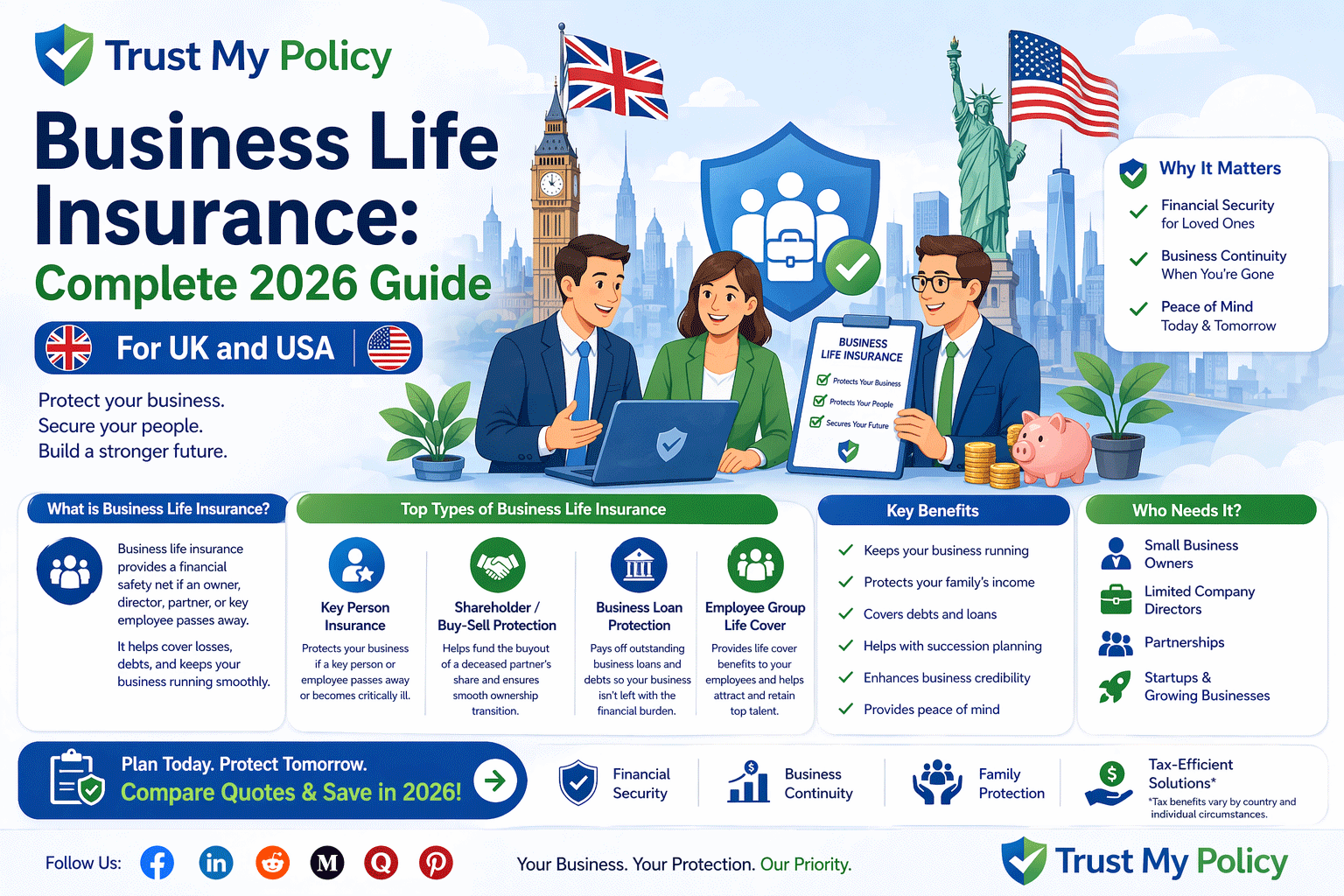
Life insurance for business owners isn’t one product — it’s a toolkit. The right combination protects your personal finances, keeps the business running, and gives your partners, employees, and family a plan instead of a scramble. This guide walks through the main types of coverage, how much you actually need, what it costs, and which insurers handle business-owner policies well.
Employees generally buy life insurance to replace a salary. Business owners have that same need, plus a second, separate set of risks tied directly to the business itself:
There isn’t a single “business owner policy.” Instead, owners typically layer a few standard life insurance products for different purposes — most built on a term life insurance foundation:
| Type | Best For | How It Works |
| Term Life Insurance | Personal income replacement, buy-sell funding, key person coverage | Fixed premium and death benefit for a set term (10–30 years); no cash value |
| Whole Life Insurance | Long-term buy-sell funding, estate planning, building cash value the business can borrow against | Permanent coverage with fixed premiums and a cash value component |
| Universal Life Insurance | Flexible premium buy-sell funding for growing businesses | Permanent coverage with adjustable premiums and death benefit |
| Key Person Insurance | Protecting the business against the loss of a critical owner or employee | Business owns the policy, pays premiums, and is the beneficiary |
| Buy-Sell (Cross-Purchase or Entity) Insurance | Funding a partner buyout after death | Co-owners or the business itself hold policies on each owner, structured to fund a predetermined buyout price |
Business-related life insurance — especially key person and buy-sell policies — tends to involve larger death benefits and more underwriting complexity than a typical personal policy. These insurers are commonly used for that reason:
| Company | Best For | Term Lengths | Notable Feature |
| Northwestern Mutual | Whole life buy-sell funding | 10–30 yr term; whole life | Strong dividend history on permanent policies |
| MassMutual | Key person and buy-sell policies | 10–30 yr term; whole & universal life | Works directly with business advisors on structuring |
| Prudential | High face-value key person coverage | 10–30 yr term; universal life | Handles large death benefits with streamlined underwriting |
| Pacific Life | Flexible buy-sell funding | 10–30 yr term; universal life | Indexed universal life options for cash value growth |
| Banner Life | Budget-friendly term coverage | 10–40 yr term | Competitive pricing on pure term policies |
Rates and product availability vary by state, age, health class, and coverage amount. Get quotes directly from carriers or a licensed broker before deciding.
Business coverage amounts are calculated differently from personal coverage. Three common approaches:
Personal coverage on top of this should still follow standard guidance: enough to replace 10+ years of income, plus outstanding personal debt and future obligations like a mortgage or college costs. See our full guide on how much life insurance you need for a more detailed breakdown.
Key person insurance is a policy the business itself owns, pays for, and benefits from. If a critical owner or employee dies, the payout goes to the business — not their family — to cover costs like recruiting and training a replacement, lost revenue during the transition, and reassuring lenders or investors that the company can absorb the loss.
Premiums are generally not tax-deductible as a business expense, and the death benefit is typically received income-tax-free by the business under current federal rules, though this depends on notice and consent requirements being met at the time the policy is issued — a detail worth confirming with a tax advisor before applying.
A buy-sell agreement is a contract between co-owners that spells out what happens to a deceased owner’s share — usually that the remaining owners or the business will buy it at a pre-agreed price or formula. Life insurance is the most common way to fund that obligation so the cash is actually there when it’s needed. Two structures are typical:
With more than two or three owners, cross-purchase arrangements get complicated fast (each owner needs a policy on every other owner), which is why larger partnerships often default to the entity-purchase structure instead.
Daniel and Priya co-own a mid-sized landscaping company, split 50/50. Their operating agreement includes a buy-sell clause, but for years it wasn’t funded — meaning if either partner died, the other would owe a lump sum to the deceased partner’s estate with no clear way to pay it. After a business valuation put the company at $1.4 million, they each took out a 20-year term policy for $700,000 on the other, held under a cross-purchase structure. Now if either dies, the surviving partner can buy out the estate’s share immediately, without taking on debt or forcing a fire sale of the business.
Marcus owns a specialty manufacturing business and has one employee, an operations manager named Élise, whose relationships with suppliers took years to build and would be difficult to replace quickly. Marcus took out a $500,000 key person policy on Élise, owned by the business, to cover the cost of recruiting and training a replacement and to reassure his bank — which had asked about succession risk — that a loss like this wouldn’t put loan repayments in jeopardy.
| Pros | Cons |
| Funds buy-sell agreements so a death doesn’t force a fire sale or a lawsuit between the estate and surviving owners | Requires an accurate, periodically updated business valuation to keep coverage amounts realistic |
| Protects the business from the financial shock of losing a key employee or owner | Key person premiums are typically not tax-deductible as a business expense |
| Term policies are relatively inexpensive relative to the risk they cover | Underwriting for large face amounts can require financial documentation, not just a medical exam |
| Whole and universal life options build cash value the business can potentially borrow against | Coverage needs change as the business grows, so policies need periodic review |
It can, but doing so can create tax complications and may cause the death benefit to be treated as taxable income to your beneficiaries in some structures. Keep business-owned policies (key person, entity-purchase buy-sell) and personally-owned policies clearly separated, and confirm the setup with a tax advisor.
Generally, no — premiums for key person insurance are typically not deductible as a business expense under current federal rules, though the death benefit is usually received tax-free by the business if notice and consent requirements were met when the policy was issued.
Cost depends on the coverage amount, the insured person’s age and health, and whether the policy is term or permanent. A healthy 40-year-old business owner might pay a few hundred dollars a year for a $500,000, 20-year term policy — but key person and buy-sell policies with larger face amounts will cost proportionally more.
For buy-sell funding, yes — the coverage amount should be based on a real or reasonably estimated valuation, not a round number picked without analysis. Many advisors recommend updating the valuation every 2–3 years.
Without funding in place, the surviving owner(s) may need to take on debt, negotiate a payment plan with the deceased owner’s estate, or sell business assets to buy out the share — any of which can strain the business and create conflict during an already difficult time.
Yes. Even without co-owners, a sole proprietor can use key person insurance on essential employees and personal life insurance sized to cover business debts and fund a transition or wind-down period for the company.
This article is for general informational purposes only and does not constitute financial, legal, insurance, or tax advice. Insurance products, pricing, and tax treatment vary by provider, state, and individual circumstances. Speak with a licensed insurance agent, financial advisor, or tax professional before making coverage decisions for yourself or your business. See our Advertiser Disclosure for information on how this site is monetized.

Jagadeesh Gutha is the founder of TrustMyPolicy.com, an independent insurance information platform covering life, health, car, home, and business insurance for US and UK readers. He researches insurance products, policy structures, and consumer rights to help everyday people make informed coverage decisions without the jargon. All content on TrustMyPolicy is independently researched, fact-checked, and written to educate — not to sell.


Insurance Guides for UK, USA & Worldwide We are not an insurer or broker.
Reader Comments (0)