
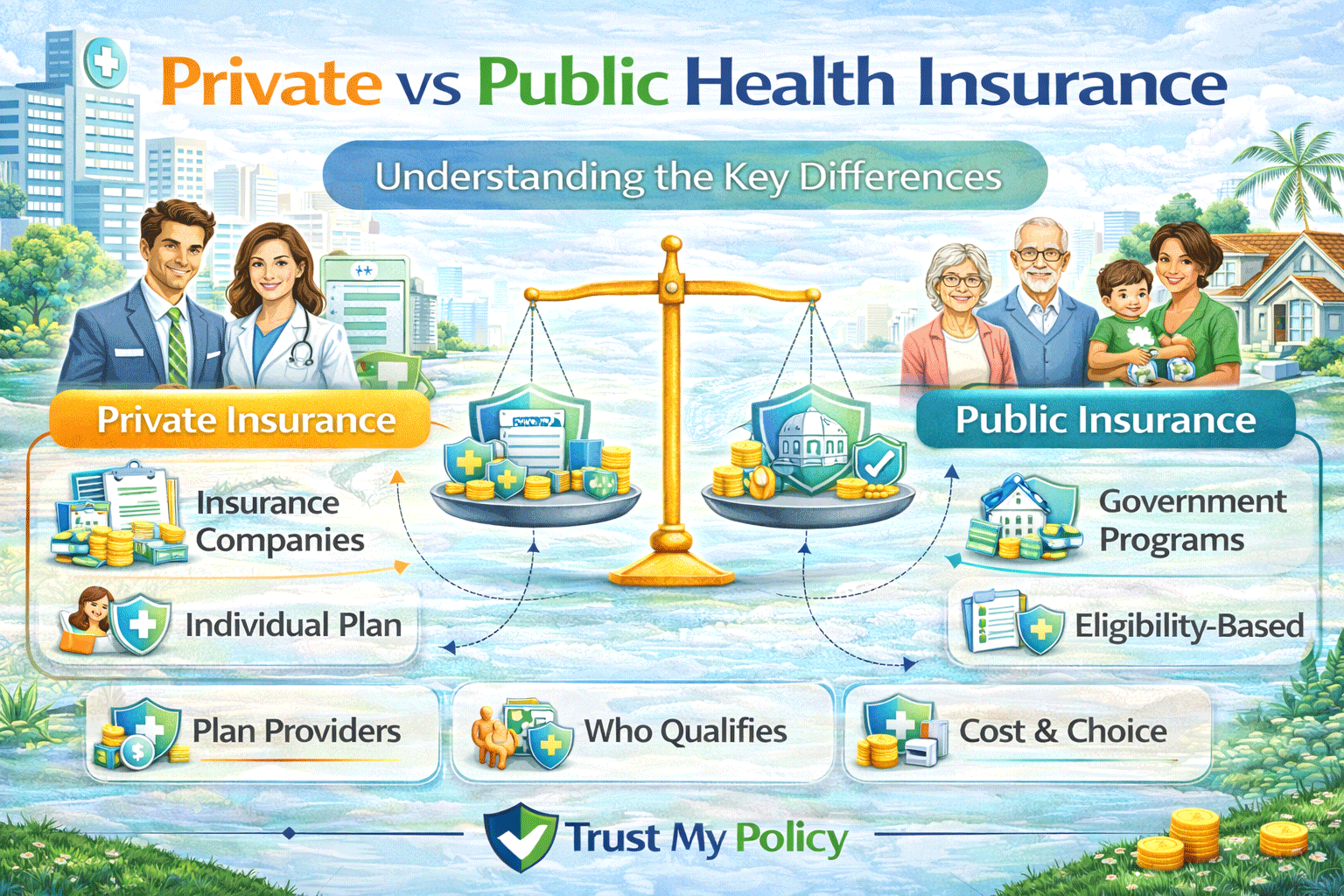
Public health insurance — the NHS in the UK, or Medicare and Medicaid in the US — provides government-funded or subsidized coverage available to eligible residents, often with longer wait times for non-emergency specialist care. Private health insurance costs more directly, typically $400–$700 a month in the US or £30–£100 a month in the UK, but usually offers faster access and broader provider networks.
Grace Adeyemi, 52, runs a small accounting firm in Birmingham and relied solely on the NHS for years, assuming private health insurance was only for the wealthy. After waiting nine months for a non-urgent gallbladder consultation, she finally compared private medical insurance quotes and found a plan for £52 a month that would have cut that wait to under two weeks.
Private vs Public Health Insurance in 2026 comes down to access, speed, and cost. Public health insurance — the NHS in the UK, or Medicare and Medicaid in the US — provides baseline or subsidized coverage funded by taxpayers, often with longer wait times for non-urgent care. Private health insurance costs more directly but typically offers faster specialist access and broader provider choice. This guide breaks down exactly how each system works and which makes sense for your situation.
This article covers how public and private health coverage actually differ, what each one costs, real scenarios showing the trade-offs, and a clear comparison to help you decide. By the end, you’ll know exactly where each system fits into your healthcare planning.
| Feature | Details |
| What it is | Public insurance is government-funded or subsidized; private insurance is purchased directly |
| Who relies on public coverage | UK residents via the NHS; US seniors via Medicare, low-income Americans via Medicaid |
| Who needs private coverage | Most working-age Americans without Medicare/Medicaid; UK residents wanting faster access |
| Typical cost | $0 direct cost for NHS; $400–$700/month US private; £30–£100/month UK private |
| Key benefit | Public systems guarantee baseline access; private systems offer speed and choice |
| Key limitation | Public systems can involve longer wait times for non-urgent specialist care |
| Regulator | CMS (US Medicare/Medicaid); NHS England and the Financial Conduct Authority (UK) |
Picture public healthcare like a well-run public library — open to everyone, fully functional, but sometimes you wait in a queue for the most popular book. Private healthcare is more like buying that same book outright — faster, but it costs you directly every time.
Public health insurance is funded through taxation or government subsidy and is available to eligible residents regardless of ability to pay upfront, with the NHS in the UK and Medicare or Medicaid in the US as the primary examples. Private health insurance is purchased directly by individuals or provided through employers, typically offering faster specialist access and broader provider choice in exchange for a higher direct cost. Anyone deciding how to structure their healthcare coverage needs to understand both systems clearly.
| Criteria | Public Health Insurance (NHS, Medicare, Medicaid) | Private Health Insurance |
| Cost | Funded by taxation; Medicare/Medicaid have specific eligibility and limited direct costs | $400–$700/month (US); £30–£100/month (UK) |
| Access speed | Can involve longer waits for non-urgent specialist care | Typically faster access to specialists and elective procedures |
| Eligibility | Universal in the UK; age/income/disability-based in the US | Available to anyone willing and able to pay the premium |
| Pros | Guaranteed baseline access regardless of income | Faster care, broader provider and hospital choice |
| Cons | Wait times for non-emergency specialist care | Higher direct cost, doesn’t replace the need for public system access in the UK |
We recommend most UK readers keep NHS registration as their baseline and consider private medical insurance specifically to reduce wait times, while most working-age US readers without Medicare or Medicaid should prioritize securing private coverage as their primary protection.
Scenario 1: Grace, 52, accountant in Birmingham. Grace waited nine months for a non-urgent gallbladder consultation through the NHS before learning private medical insurance could have cut that wait significantly. Verdict: public coverage guaranteed her care, but private coverage would have guaranteed speed. Action: Grace added a £52/month private medical plan specifically for faster non-emergency specialist access.
Scenario 2: Robert, 68, retiree in Florida. Robert relies on Medicare for his baseline coverage but added a Medicare Supplement plan to cover gaps like deductibles and coinsurance. Verdict: public coverage alone left meaningful out-of-pocket exposure for him. Action: Robert now budgets $180 a month for his supplement plan on top of Medicare.
Scenario 3: Aaliyah, 31, low-income single mother in Houston. Aaliyah qualifies for Medicaid, which covers her and her child’s care with minimal direct cost. Verdict: public coverage through Medicaid meets her needs without requiring private insurance. Action: Aaliyah reviews her Medicaid eligibility annually since income changes could affect her qualification.
Scenario 4: A self-employed 40-year-old in Seattle with no Medicare or Medicaid eligibility. He went without coverage for a year, assuming he’d rarely need care, until a $9,200 emergency surgery bill arrived. Verdict: working-age Americans without public eligibility have real exposure without private coverage. Action: he now maintains a marketplace private health insurance plan as his primary coverage.
| Pros | Cons |
| Public systems guarantee baseline access regardless of income. | Public systems can involve long wait times for non-urgent specialist care. |
| Private insurance typically offers faster access and broader choice. | Private insurance carries a significant direct monthly cost. |
| US Medicare and Medicaid remove major cost barriers for eligible groups. | Many working-age Americans don’t qualify for Medicare or Medicaid at all. |
| UK private medical insurance is relatively affordable as a supplement. | UK private insurance doesn’t replace the need for NHS registration for emergencies. |
| Both systems together can balance guaranteed access with speed and choice. | Managing both systems requires understanding what each one actually covers. |
⚠️ WARNING: Never assume UK private medical insurance covers emergency treatment. Most private medical plans exclude emergencies, which should still be accessed through the NHS regardless of any private coverage you hold.
| Your Situation | Our Recommendation |
| You’re a UK resident with no urgent need for faster specialist access | No — NHS coverage alone may be sufficient for your situation |
| You’re a UK resident facing long wait times for a non-urgent issue | Yes — consider private medical insurance as a supplement |
| You’re a US senior eligible for Medicare | Yes — enroll in Medicare and consider a supplement plan for coverage gaps |
| You’re a low-income US resident who may qualify for Medicaid | Yes — check your eligibility, since Medicaid can significantly reduce your costs |
| You’re a working-age American without Medicare or Medicaid eligibility | Yes — secure private health insurance as your primary coverage |
| You’re unsure whether your Medicaid eligibility has changed | Yes — review your eligibility annually or after any income change |
| You’re choosing UK private medical insurance and assuming it covers emergencies | No — keep NHS access as your emergency care pathway regardless |
💡 TIP: The single golden rule for choosing between public and private health coverage: use public coverage as your guaranteed baseline, and add private coverage specifically to address speed, choice, or gaps that the public system doesn’t fully close.
| Scenario | Cost | Notes |
| UK NHS access | £0 direct cost (funded via taxation) | Available to all UK residents |
| UK private medical insurance, individual | £30–£100/month | Supplements, does not replace, NHS access |
| US Medicare Part B premium, standard | $170–$185/month | Varies slightly by year and income level |
| US Medicare Supplement plan | $120–$250/month | Covers gaps like deductibles and coinsurance |
| US Medicaid, eligible individual | $0–minimal direct cost | Income and household-size dependent eligibility |
| US private marketplace health insurance, subsidized | $0–$240/month | Varies by income and household size |
| US private marketplace health insurance, unsubsidized | $400–$700/month | Standard Bronze to Silver tier pricing |
NHS England — The official source for registering with a GP practice and understanding what NHS care includes. Cost range: free. Best for: all UK residents establishing baseline coverage. Rating: national public health service.
Medicare.gov (US) — The official US government resource for Medicare enrollment, eligibility, and supplement plan comparisons. Cost range: free to use. Best for: US seniors and eligible individuals navigating Medicare. Rating: federal government resource.
Medicaid.gov (US) — The official source for checking Medicaid eligibility by state and income level. Cost range: free to use. Best for: low-income US residents checking eligibility. Rating: federal government resource.
Bupa (UK) — A leading UK private medical insurance provider offering faster specialist access alongside NHS care. Cost range: competitive UK private medical pricing. Best for: UK residents wanting reduced wait times. Rating: Defaqto 5 Star.
HealthCare.gov (US) — The federal marketplace for private health insurance for those without employer or government-provided coverage. Cost range: free to compare, premiums vary by plan. Best for: working-age Americans without Medicare or Medicaid eligibility. Rating: federal government marketplace.
We recommend starting with the relevant government resource — NHS England, Medicare.gov, or Medicaid.gov — as best overall, since confirming your public eligibility first determines exactly how much private coverage you actually need.
Public health insurance is government-funded or subsidized and available to eligible residents, while private health insurance is purchased directly and typically offers faster access and broader provider choice at a higher direct cost.
Not necessarily. The NHS provides baseline coverage to all residents; private medical insurance is an optional supplement mainly useful for reducing wait times for non-emergency care.
Medicare is primarily available to US residents aged 65 and older, as well as certain younger people with qualifying disabilities.
Medicaid eligibility depends on income and household size, varying by state, and is designed for low-income individuals and families.
Often yes, in the form of a Medicare Supplement plan, since Medicare alone doesn’t cover all costs like deductibles and coinsurance.
Public systems serve large populations with limited specialist capacity, which can create queues for non-urgent care, while private insurance can offer faster access by paying directly for quicker appointments.
Yes. In the UK, NHS access and private medical insurance work together, and in the US, Medicare recipients commonly add private supplement plans.
Yes, in most cases, since working-age Americans without public eligibility have full financial exposure to medical costs without private coverage.
Usually not. Most private medical plans exclude emergency treatment, which should still be accessed through the NHS regardless of private coverage.
Visit Medicaid.gov or Medicare.gov directly to check your specific eligibility based on your age, income, household size, and state of residence.
This guide reflects the latest 2026 insurance data.
This article is for informational purposes only. Always consult a licensed insurance professional before making coverage decisions. Trust My Policy does not sell insurance products or represent any insurer.

Jagadeesh Gutha is the founder of TrustMyPolicy.com, an independent insurance information platform covering life, health, car, home, and business insurance for US and UK readers. He researches insurance products, policy structures, and consumer rights to help everyday people make informed coverage decisions without the jargon. All content on TrustMyPolicy is independently researched, fact-checked, and written to educate — not to sell.


Insurance Guides for UK, USA & Worldwide We are not an insurer or broker.
Reader Comments (0)